In This Article
A HEPA air purifier is a domestic appliance that pulls room air through a High-Efficiency Particulate Air filter capable of trapping at least 99.95-99.97% of particles down to 0.3 microns, including pollen, dust mite debris, pet dander and fine soot. Add an air quality sensor and it stops guessing — it measures particulate levels in real time and adjusts fan speed automatically. That’s the short version. The longer version is a bit messier, because not every “HEPA” badge on Amazon means the same thing, and not every “covers 50m²” claim survives contact with a real British living room.
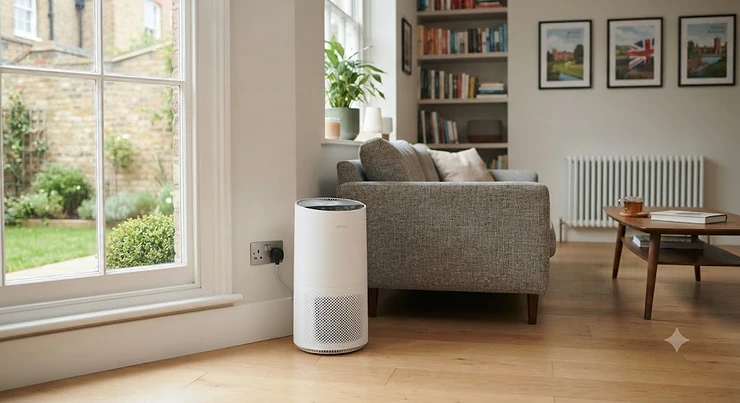
If you’ve spent any time browsing listings for a HEPA air purifier, you’ll have noticed the numbers pile up fast: CADR ratings in cubic metres per hour, room coverage in square metres, PM2.5 readouts, decibel figures, filter change intervals. It’s a lot to hold in your head at once, and manufacturers aren’t always generous with context. This guide pulls apart what those numbers genuinely mean for a semi-detached in Leeds or a flat in Zone 3, then walks through seven real machines — budget, mid-range and properly premium — with honest analysis of where each one earns its keep and where it falls short. Everything here is grounded in published specifications and aggregated reviewer sentiment; where the data is thin, that’s flagged rather than papered over.
Quick Comparison Table
| Product | CADR | Room Coverage | Air Quality Sensor | Price Range | Best For |
|---|---|---|---|---|---|
| Levoit Core 400S | ~360 m³/h | up to 46 m² (mfr) | IR particle sensor | £130-£170 | Budget bedrooms |
| Xiaomi Smart Air Purifier 4 Pro | ~500 m³/h | 35-60 m² | PM2.5/PM10 laser dual sensor | £150-£210 | Value-conscious tech fans |
| Winix Zero-S | ~410 m³/h | up to 100 m² (mfr) | Smart particle sensor | £180-£250 | Living rooms, pet owners |
| Philips Series 3200i | ~520 m³/h | up to 135 m² (mfr) | Optical PM2.5 sensor | £240-£330 | Allergy sufferers wanting data |
| Coway Airmega AP-1512HH | ~421 m³/h | up to 46 m² (5 ACH) | Colour-indicator sensor | £250-£320 | Best raw filtration per pound |
| Dyson Purifier Hot+Cool TP07 | High-CADR sealed HEPA | Whole-room, app-mapped | Formaldehyde + PM sensor array | £449-£599 | 2-in-1 heating and purifying |
| IQAir HealthPro 250 | Medical-grade, no ozone | Large open-plan rooms | HyperHEPA continuous monitoring | around £899 | Severe allergies, asthma, COPD |
Looking at the spread, there’s a clear pattern: cheaper units lean on manufacturer-quoted coverage figures that assume a lazy 2 air changes per hour, while the pricier machines either publish independently verified CADR or, in IQAir HealthPro 250‘s case, skip flashy marketing numbers entirely in favour of hospital-grade filtration credentials. None of these room coverage figures should be read as gospel — halve them if you actually want the 4-6 air changes per hour that matter for allergy relief, a point we’ll come back to later.
💬 Already got a favourite from the table? Check today’s price and availability before it changes.
Top 7 HEPA Air Purifiers: Expert Analysis
1. Levoit Core 400S — best budget pick for bedrooms
The Levoit Core 400S is the machine most UK first-time buyers land on, and there’s a reason it keeps topping budget round-ups: it does the fundamentals properly without charging a premium for branding. Its true HEPA filter is rated to capture 99.97% of particles at 0.3 microns, backed by a CADR of roughly 360 m³/h — enough, on paper, to turn over the air in a small-to-medium bedroom several times an hour rather than the single sluggish pass you get from bargain-bin units.
Where the Core 400S earns its keep is the VeSync app pairing: Auto Mode reads the built-in infrared particle sensor and ramps the fan up when it detects a spike, then eases off once things settle, which matters more for filter longevity and noise than the spec sheet lets on. Reviewers consistently note that the infrared sensor is a touch less precise than the laser sensors on pricier machines and benefits from an occasional wipe-down to stay accurate — a fair trade at this price point. It’s a sensible first purifier for a student flat, box room or anyone testing whether purification actually helps their allergies before committing serious money.
Pros:
- ✅ Genuine H13 HEPA filtration at an entry-level price
- ✅ Quiet running on lower speeds, good for overnight use
- ✅ VeSync app adds scheduling and Alexa/Google control
Cons:
- ❌ Infrared sensor needs periodic cleaning to stay accurate
- ❌ Real-world coverage is smaller than the marketing figure suggests
Expect to pay in the £130-£170 range depending on bundle and season, and given the H13 filtration on offer, it represents strong value for a single-room purifier rather than whole-house duty.
2. Xiaomi Smart Air Purifier 4 Pro — best dual-sensor value pick
The Xiaomi Smart Air Purifier 4 Pro undercuts most rivals on price while still packing a genuinely useful PM2.5/PM10 dual-effect laser sensor, which is the detail that separates it from cheaper single-sensor machines. That dual reading matters in practice: PM10 catches the bigger stuff — pollen, ash, pet epidermis — while PM2.5 tracks the fine particulate that actually penetrates deep into the lungs, so Auto Mode is reacting to a fuller picture of what’s actually in your air rather than one narrow slice of it.
With a particle CADR of up to 500 m³/h and a manufacturer coverage claim of 35-60 m², this sits comfortably as a living-room or open-plan kitchen-diner unit rather than a bedroom-only appliance. Night Mode drops noise to around 33.7 dB(A), which is genuinely low for a purifier moving this much air. Based on the spec comparison with same-price competitors, the trade-off is app polish — the Xiaomi Home app is functional but less refined than Levoit’s VeSync or Philips’s Air+, and the OLED display shows a colour-coded score rather than an exact PM2.5 number on some sibling models, so check the listing carefully.
Pros:
- ✅ Dual PM2.5/PM10 laser sensor for a fuller air-quality picture
- ✅ Strong 500 m³/h CADR for the price bracket
- ✅ Genuinely quiet 33.7 dB(A) night mode
Cons:
- ❌ App experience trails premium rivals in polish
- ❌ Filter running costs vary noticeably by region and retailer
Typically priced in the £150-£210 range, the Xiaomi Smart Air Purifier 4 Pro is arguably the strongest pound-for-pound CADR figure on this list.
3. Winix Zero-S — best for pet owners and living rooms
The Winix Zero-S pairs a true HEPA filter with a separate activated carbon layer, which is a deliberately practical design choice: when the carbon saturates with cooking or pet odours, you replace only that element rather than binning a perfectly good particle filter early. That alone can meaningfully cut running costs over a couple of years compared with combined-filter rivals.
Rated at a CADR of around 410 m³/h with a manufacturer coverage claim up to 100 m², the Zero-S is pitched at open living spaces rather than box rooms. Its built-in sensor triggers Auto Mode automatically as air quality drops, and — importantly for anyone wary of ionisers — the PlasmaWave ionisation feature can be switched off entirely, leaving pure HEPA filtration with no ozone by-product. Reviewers frequently flag the absence of a companion smartphone app as the one modern-comfort compromise on an otherwise well-specified machine; for buyers who just want a purifier that runs and reacts without a phone in the loop, that’s arguably a feature rather than a flaw.
Pros:
- ✅ Separate carbon filter keeps long-term running costs down
- ✅ Ioniser is fully switchable off — ozone-free by choice
- ✅ 100 m² manufacturer coverage suits open-plan living rooms
Cons:
- ❌ No dedicated smartphone app for remote control
- ❌ Larger footprint than compact bedroom units
Prices generally sit in the £180-£250 range, positioning it as a sensible mid-tier choice for households with pets or a mix of cooking smells and dust to manage.
4. Philips Series 3200i — best sensor and app experience
Philips has quietly built one of the more convincing smart-purifier ecosystems, and the Philips Series 3200i shows it. Its optical PM2.5 sensor feeds a genuine numeric readout on the touchscreen — not just a colour-coded mood ring — and syncs to the Philips Air+ app for scheduling, filter-change alerts and remote monitoring, which is useful if you want to check on air quality while you’re still at work.
The CADR sits around 520 m³/h with a manufacturer coverage claim up to 135 m², among the highest quoted figures in this line-up, achieved via a 3-in-1 filter combining pre-filter mesh, HEPA particle layer and activated carbon. What most buyers overlook about this model is the Allergy Sleep mode, which supercharges standard night mode specifically for pollen and dust mite season rather than treating every night the same. The LED ring doubling as a warm-white lamp is a nice touch but shouldn’t be the deciding factor — the sensor accuracy and app depth are what justify the step up from Xiaomi or Winix pricing.
Pros:
- ✅ Numeric PM2.5 display, not just a colour indicator
- ✅ Allergy Sleep mode tailored to pollen and dust mite season
- ✅ Strong 520 m³/h CADR with a high manufacturer coverage claim
Cons:
- ❌ Meaningfully pricier than Xiaomi or Winix for similar CADR
- ❌ Coverage claim, like most manufacturer figures, needs halving for allergy-grade air changes
Expect a price in the £240-£330 range, positioning the Philips Series 3200i as the pick for anyone who wants hard data, not vibes, from their sensor.
5. Coway Airmega AP-1512HH — best raw filtration per pound
The Coway Airmega AP-1512HH, often sold as the “Mighty,” has built a reputation among independent testers as one of the fastest small-room cleaners on the market, and the underlying engineering explains why: a genuinely dense HEPA filter combined with a well-designed 360° intake means it clears particulate from a small-to-medium room faster than several pricier rivals in side-by-side testing.
Its air quality indicator is simpler than Philips’s numeric display — a colour-coded light rather than a PM2.5 figure — which reviewers flag as the one area where it trails premium competitors, but Eco Mode compensates by automatically powering the unit down when the sensor detects consistently clean air, which is a genuinely useful energy-saving touch absent from cheaper machines. Here’s what to weigh: if you want raw filtration speed and don’t mind a less detailed readout, the Airmega punches above its price bracket; if granular PM2.5 numbers matter to you specifically, Philips or Xiaomi’s dual sensor will serve you better.
Pros:
- ✅ Among the fastest particle-clearance speeds tested at this size
- ✅ Eco Mode automatically cuts power once air is clean
- ✅ Filter replacement costs remain reasonable long-term
Cons:
- ❌ Colour-indicator sensor lacks a numeric PM2.5 readout
- ❌ Manufacturer coverage claims assume a lower air-change rate
Typically priced around £250-£320, the Coway Airmega AP-1512HH rewards buyers who prioritise filtration speed over dashboard detail.
6. Dyson Purifier Hot+Cool TP07 — best 2-in-1 for year-round use
The Dyson Purifier Hot+Cool TP07 solves a genuinely British problem: nobody wants two separate appliances cluttering a small flat, one for winter heat and one for allergy season. Independent lab testing found its sealed HEPA-13 filtration system captured 99.95% of particles at 0.1 microns — marginally behind Coway’s benchmark in the same tests but still comfortably ahead of the category average — while doubling as a bladeless fan heater and cooling fan.
The Dyson Link app is, by most accounts, the most detailed of any purifier tested here: proper air quality graphs over time, scheduling, and sensor readings that actually mean something rather than a vague traffic-light score. On paper this means you get real diagnostic insight into what’s polluting your air and when. The catch, and it’s a real one: heating mode meaningfully increases energy draw, averaging around 1.2 kWh during active use in independent testing, so running it purely as a winter heater will show up on your electricity bill in a way a dedicated purifier never would.
Pros:
- ✅ Combines HEPA-13 purification with genuine heating and cooling
- ✅ Dyson Link app offers detailed historical air quality data
- ✅ 99.95% filtration at 0.1 microns in independent lab testing
Cons:
- ❌ Heating mode increases running costs noticeably
- ❌ Premium price for what is, first and foremost, a fan with a filter
The Dyson Purifier Hot+Cool TP07 typically sits in the £449-£599 range, which only makes sense if you’ll genuinely use the climate-control side, not just the purification.
7. IQAir HealthPro 250 — best for severe allergies and asthma
At the very top of this list sits the IQAir HealthPro 250, a machine that’s less “smart home gadget” and more medical equipment that happens to work in a lounge. It’s the kind of unit found in hospitals, laboratories and clean rooms across the UK, built around IQAir’s HyperHEPA filtration rather than a standard HEPA-13 rating, engineered to capture particles smaller than the 0.3-micron benchmark most competitors are tested against.
Six-month independent testing reported zero mechanical degradation, describing it as engineered for decade-long service rather than the three-to-five-year lifespan typical of consumer purifiers — a meaningfully different ownership proposition once you factor in total cost over time. Noise ranges from 35 to 64 dB depending on speed, which is audible but not unreasonable given the airflow on offer, and daily energy consumption comes in around 0.35 kWh (roughly £2.52 a month at typical UK electricity rates). Reviewers consistently note it’s substantially larger and heavier than domestic rivals, at 15kg and 64cm tall, so it needs a semi-permanent spot rather than being shuffled room to room.
Pros:
- ✅ Medical-grade HyperHEPA filtration used in clinical settings
- ✅ Reported zero mechanical degradation over six months of testing
- ✅ Continuous air quality monitoring built in
Cons:
- ❌ Around three times the price of strong mid-range alternatives
- ❌ Large, heavy footprint needs a permanent spot, not portable use
At around £899, the IQAir HealthPro 250 is a considered purchase for households managing genuine respiratory conditions rather than general dust and pollen upkeep — for that use case, the price starts to look like reasonable value rather than excess.
Setting Up and Maintaining Your Purifier: The First 30 Days
Getting a HEPA air purifier home is the easy part; running it properly is where most of the benefit either shows up or quietly evaporates. Position matters more than people expect: place the unit at least 30-50cm from walls and furniture so air can actually circulate around the intake, and avoid tucking it into a corner behind curtains, which is a surprisingly common first-week mistake that throttles airflow before the filter even gets a chance to work.
For the first few days, run it on Auto Mode rather than a fixed low speed, so the sensor can calibrate to your home’s baseline and you can watch how it reacts to cooking, hoovering or opening a window. Most manufacturers recommend a light wipe of the pre-filter or intake grille every 2-4 weeks — this is the single most-skipped maintenance step, and letting dust cake up on the pre-filter forces the main HEPA element to work harder than it should, shortening its effective life. Set a calendar reminder for the actual filter swap based on the manufacturer’s stated interval (commonly 6-12 months for HEPA elements, shorter for carbon layers in the Winix Zero-S‘s modular system), rather than waiting for a “replace filter” light that may lag behind real saturation. A common early mistake is running the unit only when symptoms flare up; particulate matter builds up continuously, so consistent low-speed operation beats occasional full-blast bursts for actually keeping baseline air quality down.
Real-World Scenarios: Matching the Purifier to Your Life
Consider three genuinely different UK households. First, a postgraduate student in a rented one-bed flat near a busy A-road, budget under £200, mainly worried about traffic pollution seeping through a single-glazed window. The Levoit Core 400S or Xiaomi Smart Air Purifier 4 Pro both make sense here: compact, quiet enough for a studio, and priced to not sting if the tenancy ends in eight months.
Second, a family of four with a dog, an open-plan kitchen-diner, and a child with mild dust mite sensitivity flagged by their GP. This household needs coverage over raw sensor precision, and the extra activated carbon capacity in the Winix Zero-S genuinely earns its place against cooking smells and pet dander simultaneously — running continuously on Auto Mode rather than being switched on only during allergy flare-ups.
Third, a household managing a diagnosed respiratory condition — perhaps a parent recovering from a respiratory illness or a family member with poorly controlled asthma — where filtration performance isn’t a nice-to-have. Here the case for the IQAir HealthPro 250 or, at a lower budget, the Dyson Purifier Hot+Cool TP07 for its verified 99.95% filtration becomes about health management rather than comfort, and it’s worth discussing room sizing with whoever provides the household’s asthma care plan.
How to Choose a HEPA Air Purifier With Air Quality Sensor
Picking the right HEPA air purifier with air quality sensor comes down to matching a handful of specs to your actual room, not chasing the biggest number on the box. Work through these in order:
- Measure your room in square metres first. Multiply length by width, then check that figure against the CADR-based coverage rather than the manufacturer’s headline number.
- Halve the quoted coverage area if allergies or asthma are a factor. Manufacturers typically calculate coverage on 2 air changes per hour; allergy relief wants 4-6.
- Check the sensor type, not just its presence. A numeric PM2.5 laser sensor (Philips, Xiaomi) gives more actionable data than a basic colour-indicator light (Coway).
- Confirm HEPA grade explicitly. True HEPA/H13 captures at minimum 99.95-99.97% of 0.3-micron particles; vaguer “HEPA-style” claims deserve scepticism.
- Factor in filter replacement cost and interval, not just the upfront purchase price — this is genuinely the bigger long-term expense.
- Check the decibel rating on the lowest useful speed if the unit will run overnight in a bedroom.
- Decide whether you actually need app control and smart home integration, or whether a simpler sensor-driven Auto Mode covers your needs without the extra cost.
Understanding CADR Rating: What the Numbers Actually Mean
CADR rating — Clean Air Delivery Rate — measures how many cubic metres (or cubic feet, in US-style listings) of filtered air a purifier delivers per hour at its top fan speed. A higher CADR rating means faster air turnover for a given room size, which translates directly into how quickly a purifier can clear a smoke event, a fresh pollen influx after opening a window, or a burnt dinner.
Here’s what the spec sheet won’t tell you outright: CADR rating is typically measured separately for smoke, dust and pollen particles, and manufacturers often quote only the most flattering of the three on the box. When comparing the Xiaomi Smart Air Purifier 4 Pro‘s 500 m³/h against the Winix Zero-S‘s 410 m³/h, check whether both figures were measured under the same particle type and testing standard before assuming one is genuinely faster than the other. As a rule of thumb for allergy or asthma relief, aim for a CADR rating that would deliver five air changes per hour in your actual room size — for a 20m² bedroom, that generally means looking for a CADR comfortably above 300 m³/h rather than the bare minimum a listing suggests will “cover” the space.
Room Coverage (Sq M): Sizing Your Purifier Correctly
Room coverage in square metres is the figure most shoppers anchor on, and it’s also the most commonly misread spec on the entire listing. DEFRA’s UK-AIR monitoring data shows how much fine particulate exposure varies by location and season, which is worth bearing in mind when a manufacturer’s coverage figure was tested under lab conditions rather than your actual postcode. A purifier rated for “up to 50 m²” coverage isn’t promising five air changes an hour in a 50 m² room — it’s typically calculated at a much lower turnover rate, sometimes as few as two air changes per hour, which is fine for general freshening but inadequate for someone managing genuine allergy or asthma symptoms.
The practical fix is straightforward: for allergy-grade cleaning, treat the manufacturer’s stated room coverage figure as roughly double what you actually want to buy for. If your living room is 24 m², look for a unit rated to at least 40-50 m² rather than one rated almost exactly to size. In a larger open-plan space above roughly 35-40 m², it’s often more effective — and quieter, since each unit can run on a lower speed — to run two mid-sized purifiers like the Winix Zero-S in different corners than to rely on one undersized machine working flat out in a single spot.
HEPA Air Purifiers vs Traditional Alternatives
Compared with older approaches — ionisers, ozone generators, or simply opening windows and hoping — a properly specified HEPA air purifier offers something those alternatives structurally can’t: physical particle capture with a filter, rather than chemical neutralisation or dilution. Ionisers and ozone generators can leave measurable ozone as a by-product, which is itself a respiratory irritant, whereas true HEPA filtration, like the switchable-ioniser design on the Winix Zero-S, physically traps particles without producing anything to worry about breathing in.
Opening windows, meanwhile, helps with stuffiness but does nothing for outdoor-sourced particulate on high-pollution days, and can actively make indoor air quality worse near a busy road. The trade-off with HEPA purifiers is upfront cost and ongoing filter replacement, whereas ionisers are typically cheaper to buy and have no consumable filter — but the filtration performance and lack of ozone output on a genuine HEPA unit generally justifies the higher running cost for anyone with allergies, asthma, or small children in the household.
Common Mistakes When Buying a HEPA Air Purifier
The single biggest mistake is buying to the manufacturer’s maximum coverage figure rather than sizing down for genuine air changes per hour — a purifier rated “up to 80m²” is not a comfortable fit for an 80m² open-plan space if allergy relief is the goal. A close second is ignoring filter running costs entirely at the point of purchase; a cheap unit with proprietary, expensive replacement filters can cost more over three years than a pricier machine with commodity filter options.
Buyers also frequently overlook noise ratings, assuming all purifiers are “quiet,” then discover the top speed needed to actually clean a room properly pushes past 55-60 dBA — noticeable in a bedroom at night. Finally, treating an ioniser feature as a bonus rather than checking whether it can be switched off is a mistake worth avoiding if ozone exposure is a concern; models like the Winix Zero-S handle this well by making the ionisation function fully optional.
Features That Actually Matter (And Those That Don’t)
True HEPA/H13 filtration, an accurate sensor, and a genuinely quiet low speed matter enormously — these are the three things that determine whether a purifier is doing real work in your home. Activated carbon matters if cooking odours, smoke, or VOCs are a concern, but is largely wasted spend if particulate is your only issue.
On the “doesn’t matter much” side: UV-C sterilisation lamps sound impressive but have limited real-world impact on airborne particulate specifically, since HEPA filtration already physically captures the biological material UV claims to neutralise. Elaborate app dashboards and voice assistant integration are genuinely nice conveniences but shouldn’t outrank raw CADR and sensor accuracy in the decision — a beautifully designed app attached to a mediocre filter is still a mediocre purifier.
Long-Term Cost & Maintenance
The purchase price is only the opening bid. Filter replacements are the real recurring cost, typically running £30-£70 per HEPA filter and £15-£30 for a separate carbon element, needed every 6-12 months depending on usage and local pollution levels. Over a three-year ownership period, a budget unit with frequent, expensive proprietary filters can end up costing more in total than a pricier machine like the Coway Airmega AP-1512HH, which reviewers note keeps replacement costs reasonable relative to its filtration speed.
Energy consumption is comparatively modest across the board — even the IQAir HealthPro 250, at roughly 0.35 kWh daily, works out to about £2.52 a month at typical UK rates — but running costs jump noticeably on units like the Dyson Purifier Hot+Cool TP07 when the heating function is in regular use through winter. Budgeting realistically for total cost of ownership, not just shelf price, is the single most useful thing a buyer can do before checking out.
✨ Don’t Miss These Exclusive Deals!
🔍 Take your indoor air quality to the next level with these carefully selected purifiers. Click through to check current pricing and availability, and breathe easier knowing exactly what you’re bringing home.
Safety, Regulations & Compliance in the UK
UK domestic air purifiers sold legally must carry UKCA marking (or CE marking under current transitional arrangements) confirming they meet electrical safety and electromagnetic compatibility standards — always check the listing or box for this before buying from a lesser-known brand. Genuine HEPA filtration is typically benchmarked against the EN 1822 European standard, which grades filters from H13 upward for the efficiency levels most manufacturers advertise.
On the health side, indoor fine particulate matter is increasingly treated by public health bodies as a genuine exposure risk rather than a minor nuisance, underlining why indoor filtration is worth taking seriously rather than treating as a gadget purchase. If you’re buying specifically to manage dust mite or pollen-triggered asthma, it’s worth reviewing NHS-affiliated guidance on reducing house dust mite exposure at home, which covers practical steps beyond filtration alone, including bedding, humidity control and vacuuming technique.
Frequently Asked Questions
❓ What CADR rating do I need for a bedroom?
❓ Is a HEPA air purifier with air quality sensor worth the extra cost?
❓ How do I know my HEPA air purifier room coverage sq m figure is accurate?
❓ Do HEPA air purifiers remove cooking smells and VOCs?
❓ How often should I replace the filter in a HEPA air purifier?
Conclusion
There’s no single best HEPA air purifier UK-wide — there’s a best one for your room size, your budget, and what you’re actually trying to solve. For most first-time buyers, the Levoit Core 400S or Xiaomi Smart Air Purifier 4 Pro deliver genuine H13 filtration and a usable sensor without overspending on features you won’t touch. Families managing pets and cooking odours alongside dust get better long-term value from the Winix Zero-S‘s modular carbon filter, while anyone who wants hard sensor data should look hardest at the Philips Series 3200i.
At the top end, the Dyson Purifier Hot+Cool TP07 justifies its price only if you genuinely want the heating and cooling functions alongside purification, and the IQAir HealthPro 250 is a considered, deliberate purchase for households managing real respiratory conditions rather than general seasonal dust. Whichever you land on, the maths is the same: measure your room honestly, size up rather than down, and budget for filters as a genuine running cost — not a footnote you’ll deal with later.
Recommended for You
- Whole House Air Purifier: 7 Powerful Picks for Cleaner Air in 2026
- Best Air Purifier For 3 Bedroom House in 2026: 7 Top Picks
- Portable vs Whole House Air Purifier: 7 Picks Ranked (2026)
Disclaimer: This article contains affiliate links. As an Amazon Associate, I earn from qualifying purchases. If you purchase products through these links, we may earn a small commission at no additional cost to you.
✨ Found this helpful? Share it with your friends! 💬🤗
