In This Article
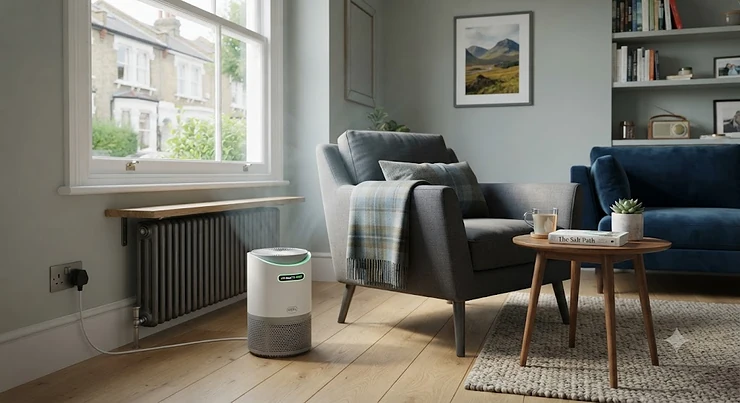
Somewhere between a scented candle and a full HVAC retrofit sits the question that brought you here: portable vs whole house air purifier — which one actually earns its keep? A portable air purifier is a standalone unit you place in a single room to filter the air passing through it, while a whole house system is a piece of equipment built into (or run alongside) your home’s heating and ventilation to treat air across multiple rooms at once. Both promise cleaner air. Only one of them, for most British homes, is realistic to install this weekend.
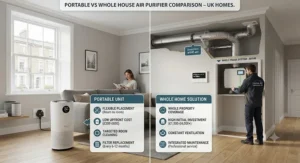
Here’s the honest bit up front: the UK’s housing stock makes this decision different from the American guides you might stumble across. Most homes here run on wet central heating with radiators, not the ducted forced-air systems that make true whole-house purifiers an easy bolt-on in places like Ohio or Texas. That single fact quietly decides a lot of this debate before you’ve even opened your wallet. According to government guidance on indoor airborne allergens, indoor bioaerosols can be a genuinely significant contributor to household air pollution — so getting this choice right isn’t just a gadget decision, it’s a health one.
Below, you’ll find seven real, currently available products spanning portable units and ducted whole-house filtration, plus the comparisons, running-cost maths and room-by-room strategy that actually determine which route suits your house, your budget and your lungs.
Quick Comparison: Portable vs Whole House Air Purifier
| Feature | Portable Air Purifier | Whole House System |
|---|---|---|
| Coverage | One room at a time (typically 20-135m²) | Every room connected to the ductwork |
| Upfront cost | Roughly £100-£450 per unit | Typically four figures once professionally installed |
| Installation | Plug in and go | Requires ducted HVAC and a qualified installer |
| Best for | Flats, bedrooms, single problem rooms | Large homes with existing ducted heating |
| UK suitability | Excellent — works in any home | Limited — most UK homes lack ducted air handlers |
Reading that table plainly: portables win on flexibility and upfront cost, and they’re the only genuinely plug-and-play option for the vast majority of UK properties. Whole-house systems win on invisibility and whole-property coverage, but only if the ductwork to support them already exists. If you’re renting, or living in a Victorian terrace with radiators, the “whole house” column is mostly aspirational — which is precisely why the room-by-room strategy later in this piece matters so much.
💬 Which camp do you fall into? Keep scrolling — the answer usually gets clearer once you see the real running costs.
Top 7 Portable & Whole House Air Purifiers: Expert Analysis
We’ve deliberately mixed portable units with ducted whole-house options so you can compare like against unlike, rather than just shopping within one category. Coverage figures and specifications below come from manufacturer documentation and independent testing; pricing is given in ranges only, since retail prices fluctuate constantly.
1. Levoit Core 600S — best all-rounder for large living rooms
The Levoit Core 600S is built around VortexAir 3.0 technology, and on paper that translates into a genuinely useful number: a CADR of around 410 CFM (697m³/h), enough to cycle a 59m² room once every hour or a smaller room several times over. What most buyers overlook about this model is that the three-in-one filter (pre-filter, H13 HEPA, activated carbon) means you’re not stacking separate cartridges — one swap covers dust, allergens and odours together. Based on the spec comparison with cheaper 300-series Levoit units, the 600S earns its higher price mainly through raw airflow for open-plan rooms, not gimmicks.
Reviewers consistently report that the app-based filter tracking (via VeSync) is more accurate than a simple countdown timer, and independent testing found it matched the room-clearing speed of pricier rivals while staying under 41dBA on most settings. This is the pick for a family living room, a large bedroom, or an open-plan kitchen-diner where a smaller unit would be working flat out.
Pros:
- ✅ Strong CADR for genuinely large or open-plan rooms
- ✅ Accurate app-based filter-life tracking, not guesswork
- ✅ Quiet enough for background running on most settings
Cons:
- ❌ Large and heavy — not one you’ll want to carry between rooms
- ❌ Genuine replacement filters run into the tens of pounds each swap
Expect to pay in the £250-£300 range at the time of research, with replacement filters adding a modest but real ongoing cost — check current price before buying, since retailers rotate offers frequently.
2. Blueair Blue Pure 311i+ Max — quietest choice for bedrooms and allergy sufferers
The Blueair Blue Pure 311i+ Max leans on HEPASilent dual filtration, a combination of mechanical and electrostatic filtering that Blueair uses to hit strong particle-capture rates without the fan noise a pure-mechanical HEPA unit needs to move the same volume of air. In practice, that means a CADR of roughly 250 CFM for a device that drops to around 23dB on its sleep setting — quieter than most bedroom air conditioning units.
Here’s what the spec sheet won’t tell you outright: the RealTrack algorithm actually adjusts filter-life estimates based on your real pollution exposure and fan speed, rather than a fixed calendar countdown, which is a meaningfully more honest way to budget for replacements. Reviewers note the “buzz” at maximum speed is noticeable in an otherwise silent room, though on sleep and medium settings it disappears into background noise. This is a strong pick for hay fever sufferers who want a purifier running overnight without it becoming the loudest thing in the room.
Pros:
- ✅ Whisper-quiet sleep mode around 23dB
- ✅ Zero-ozone verified and Quiet Mark certified
- ✅ Smart RealTrack filter-life tracking based on actual use
Cons:
- ❌ Slight mechanical buzz reported at top fan speed
- ❌ Covers a smaller footprint than the Levoit Core 600S
Price sits broadly in the £250-£350 range depending on retailer promotions — always check the current price rather than relying on a figure quoted here.
3. Dyson Purifier Cool TP07 — 2-in-1 purifier and cooling fan for design-led homes
The Dyson Purifier Cool TP07 is the one purchase in this list doing double duty: it’s a fully sealed HEPA H13 purifier and a bladeless cooling fan in one body, which matters if you’re trying to justify the spend to a partner who only cares about summer comfort. Dyson’s own testing claims 99.95% capture of ultrafine particles, and the whole-unit HEPA seal (not just the filter cartridge) is a genuine engineering difference from cheaper towers, where unsealed housings can let air bypass the filter media entirely.
Based on the spec comparison with the Levoit and Blueair units above, the TP07 trades some outright CADR efficiency for design, app polish and that cooling function — reviewers note it’s “barely audible” on moderate settings but climbs to a genuinely fan-like 61dB at full power. What most buyers overlook: the MyDyson app’s air quality tracking (PM2.5, PM10, VOC, NO2) is genuinely more detailed than most rivals, useful if you like data as much as clean air.
Pros:
- ✅ Fully sealed HEPA H13 filtration, not just a HEPA cartridge
- ✅ Doubles as a genuinely effective cooling fan
- ✅ Detailed real-time air quality sensing across four pollutant types
Cons:
- ❌ Noticeably noisier than dedicated purifiers at top speed
- ❌ Premium price for what is, underneath the design, a mid-range CADR
Typical UK pricing sits around £400, occasionally higher for newer colourways — treat this as a starting reference and check the current price at the point of purchase.
4. Xiaomi Smart Air Purifier 4 Compact — best budget entry point for a single room
The Xiaomi Smart Air Purifier 4 Compact is the answer to “I just want clean air in one small room without spending a fortune.” With a particle CADR of 230m³/h and TÜV Rheinland-certified filtration claiming 99.97% capture of 0.3-micron particles, it covers roughly 16-27m² — a bedroom, home office or nursery, not a shared living space.
Independent testing found it needed around 50 minutes to fully clear a test room at top speed, which trails pricier Levoit and Coway rivals, but at its price point that’s a reasonable trade. Reviewers note the top-speed noise (mid-50s dBA) is on the higher side for this size category, so running it at speed 3-4 rather than maximum tends to be the sweet spot for background use. What the spec sheet won’t tell you: the lower fibre-density filter is genuinely engineered to move air with less energy draw, not just marketing language — Xiaomi’s own testing puts rated power at just 27W.
Pros:
- ✅ Genuinely low upfront cost for certified HEPA filtration
- ✅ Low power draw at 27W rated consumption
- ✅ App control and reasonably quiet sleep mode around 20dB
Cons:
- ❌ Limited to small rooms — not a living room solution
- ❌ Slower clearance time than pricier rivals at full power
Expect to find it typically under £150, sometimes considerably less during sales — as ever, check the current price rather than assuming a fixed figure.
5. Philips Series 3200i (AC3220/10) — best value for large open-plan rooms
The Philips Series 3200i pairs a HEPA NanoProtect filter with an active carbon layer to hit a genuinely strong CADR of around 520m³/h, rated for rooms up to 135m² — on paper, one of the highest coverage figures at this price tier. Reviewers consistently note it performs closely with pricier Blueair and Xiaomi Pro units while staying ultra-quiet and energy efficient, which is exactly the combination allergy sufferers with open-plan living spaces are after.
Based on the spec comparison, the appeal here is straightforward: you’re getting near-premium coverage without the premium smart-home ecosystem some buyers don’t actually want. What most buyers overlook is that the “intelligent” auto mode responds to a built-in particle sensor rather than a basic timer, so the fan genuinely throttles up during a cooking session and back down once air clears — not just a marketing checkbox.
Pros:
- ✅ Excellent CADR-to-coverage ratio for open-plan rooms
- ✅ Genuinely quiet and energy efficient in daily use
- ✅ Real-time particle sensor driving auto mode, not a fixed timer
Cons:
- ❌ App ecosystem is less polished than Dyson’s or Levoit’s
- ❌ Replacement filters aren’t the cheapest in this category
Pricing typically falls in the £250-£330 range at the time of research — as with every model here, check current pricing before you commit.
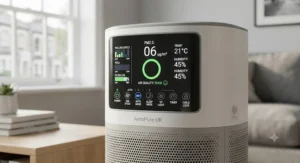
6. AprilAire Model 5000 Whole-House Electronic Air Purifier — true whole-house filtration for ducted heating systems
The AprilAire Model 5000 is a genuine whole-house purifier in the traditional American sense: it installs directly into a home’s ducted air handler and treats every room the air moves through. AprilAire’s own published figures claim capture rates of 89% for particles 0.3-1.0 microns, rising to 98% for larger 3.0-10.0 micron particles — a meaningfully different proposition from a portable unit, because it filters air as it’s already circulating rather than pulling it into one room.
Here’s the honest caveat this article won’t dodge: this system, and others like it, require an existing ducted forced-air heating or air-conditioning system to connect to — standard in much of North America, but genuinely uncommon in UK homes, which overwhelmingly run wet central heating through radiators. If you do have a ducted warm-air system (some UK new-builds and commercial-style conversions do), a professionally installed unit like this can meaningfully extend HVAC lifespan by keeping the coil and blower cleaner, according to AprilAire’s own maintenance documentation. For everyone else, treat this entry as the benchmark whole-house technology to understand, even if it isn’t something you can order and fit yourself.
Pros:
- ✅ Filters air across every connected room, not just one
- ✅ Can extend HVAC system life by reducing dust buildup
- ✅ No visible unit taking up floor or worktop space
Cons:
- ❌ Requires an existing ducted air handler — most UK homes lack one
- ❌ Professional installation is mandatory, adding meaningfully to total cost
Given the ducted infrastructure and professional fitting required, budget for this sitting in the four-figure range once installed rather than assuming a simple retail price — get a specific quote from an installer for your system.
7. AprilAire 2410/2416 Whole-House Media Air Cleaner — entry-level ducted upgrade over a standard furnace filter
If the Model 5000 above is the premium whole-house option, the AprilAire 2410/2416 is its more accessible sibling: a MERV 13-rated media filter cabinet that fits into an existing ducted air handler, replacing a standard 1-inch filter with a much deeper, higher-capacity one. The core advantage, based on the spec comparison, is filter life — AprilAire’s own testing shows a 6-12 month lifespan versus the 1-3 months typical of standard furnace filters, thanks to roughly 24.5 square feet of filtering media packed into the cabinet.
This is a genuinely sensible middle ground for anyone who already has ducted heating and wants better filtration without the electronic air cleaner’s higher purchase price. The self-seal technology is a small but real detail: it’s designed to stop air bypassing the filter media around the edges, which is a common failure point in cheaper cabinet filters. As with the Model 5000, the limiting factor for UK buyers is infrastructure, not the product itself — you need the ductwork first.
Pros:
- ✅ Far longer filter life than a standard 1-inch furnace filter
- ✅ Lower cost route into ducted whole-house filtration
- ✅ Self-seal design reduces air bypassing the filter media
Cons:
- ❌ Still requires ducted heating infrastructure to install
- ❌ MERV 13 filtration, while strong, sits below true HEPA-grade capture
As with the Model 5000, treat any headline price with caution — get an installer quote, since the filter cabinet and fitting labour are usually priced together.
Full Comparison: Top 7 at a Glance
| Product | Type | Approx. Coverage | Price Range | Best For |
|---|---|---|---|---|
| Levoit Core 600S | Portable | Up to 59m² | £250-£300 | Large living rooms |
| Blueair Blue Pure 311i+ Max | Portable | Up to 43m² | £250-£350 | Quiet bedrooms, allergies |
| Dyson Purifier Cool TP07 | Portable | Room-scale | Around £400 | Design-conscious multi-taskers |
| Xiaomi Smart Air Purifier 4 Compact | Portable | Up to 27m² | Under £150 | Budget single-room use |
| Philips Series 3200i | Portable | Up to 135m² | £250-£330 | Large open-plan rooms |
| AprilAire Model 5000 | Whole-house | Entire ducted home | Four figures installed | Homes with ducted HVAC |
| AprilAire 2410/2416 | Whole-house | Entire ducted home | Lower four figures installed | Entry-level ducted upgrade |
The pattern here is hard to miss: every portable model on this list can be bought and running within the hour, while both whole-house options depend entirely on infrastructure most UK homes don’t have. If you’ve got ducted heating, the AprilAire 2410/2416 is the sensible starting point before jumping to the pricier AprilAire Model 5000. If you don’t, your realistic decision is really between the five portable units above — which is exactly why the next few sections focus on getting that portable strategy right.
Practical Usage Guide: Setting Up and Maintaining Your Air Purifier
Getting an air purifier home is the easy part. First 30 days: place it at least 30-50cm from walls and furniture so intake and outflow aren’t restricted, and avoid tucking it behind curtains or under a desk, both common mistakes that quietly throttle performance. Run it on auto mode for the first week so the sensor calibrates to your home’s baseline air quality, rather than manually cranking it to maximum, which burns through filter life faster than necessary.
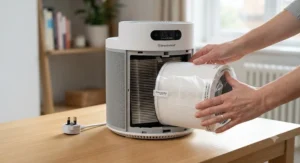
For maintenance, check the pre-filter monthly for visible dust and vacuum it gently rather than washing it unless the manual specifically says the filter is washable — soaking a HEPA filter that isn’t designed for it ruins the fibre structure. Most true HEPA cartridges last 6-12 months depending on usage and local pollution levels; app-connected models like the Levoit Core 600S and Blueair Blue Pure 311i+ Max will tell you this based on actual use rather than a fixed calendar date, which is worth trusting over a generic “replace every 6 months” sticker.
One optimisation trick Amazon listings rarely mention: running your purifier on a slightly lower continuous setting is usually more effective over 24 hours than high bursts followed by switching it off, since particle levels creep back up the moment filtration stops.
Real-World Scenarios: Who Should Buy What
Picture three households. First, a single professional in a one-bedroom flat with mild dust allergies and no ducted heating whatsoever — the Xiaomi Smart Air Purifier 4 Compact or Blueair Blue Pure 311i+ Max covers their needs completely, and a whole-house system would be both impossible to fit and wildly overkill.
Second, a family of four in a three-bedroom semi with a cat, a wood burner and a teenager with hay fever — here the sensible move is genuinely the “portable in every key room” approach rather than chasing a whole-house dream: a Levoit Core 600S or Philips Series 3200i in the main living space, plus a smaller unit in the bedroom most affected by allergies. Third, a household in a newer property with an existing ducted warm-air heating system and a family history of asthma — this is the rare UK scenario where the AprilAire 2410/2416, or eventually the AprilAire Model 5000, genuinely makes sense, because the ductwork already exists and the incremental cost of upgrading filtration is smaller than starting from scratch.
The through-line: budget, room count and existing heating infrastructure decide this far more reliably than brand loyalty or marketing claims ever will.
Buyer’s Decision Framework
If you live in a flat or a home with no ducted heating, choose a portable unit sized to your largest problem room, because that’s the only route physically available to you. If you have ducted HVAC and a whole-home allergy or asthma concern, choose a whole-house system like the AprilAire 2410/2416 as your entry point, upgrading to the AprilAire Model 5000 only if symptoms persist after the simpler filter upgrade.
If your budget is under £150, choose the Xiaomi Smart Air Purifier 4 Compact and accept single-room coverage. If your priority is silence for sleep, choose the Blueair Blue Pure 311i+ Max over anything louder, regardless of its slightly smaller CADR. If you want one device to also double as a cooling fan, the trade-off in the Dyson Purifier Cool TP07 is justified; if you just want clean air for the least money per square metre, the Philips Series 3200i wins that specific comparison outright.
✨ Ready to compare live prices before deciding? Check today’s listings and see what’s actually in stock near you.
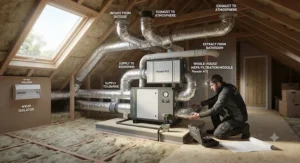
How to Choose a Portable vs Whole House Air Purifier
Five steps to work through before spending anything: first, check your heating system — if you don’t have ducted forced-air heating, a genuine whole-house system is off the table immediately, no matter how appealing it sounds. Second, measure your problem room in square metres and match it against a unit’s rated coverage, aiming slightly above rather than below your actual room size. Third, decide how much noise you can tolerate overnight, since sleep-mode decibel ratings vary more between models than most buyers expect. Fourth, factor in filter replacement costs over a full year, not just the sticker price, since a cheaper unit with pricier filters can cost more over 12 months. Fifth, check for genuine third-party certification — AHAM Verifide, Energy Star or Quiet Mark — rather than relying purely on manufacturer marketing claims.
Portable vs Whole House Air Purifier: The Real Difference
The core distinction isn’t really about power, it’s about scope and infrastructure. A portable unit treats the air in the room it’s standing in, full stop — walk into the next room and you’re breathing whatever that room’s air happens to be. A whole-house system treats air as it circulates through ducting, meaning every connected room benefits simultaneously, but only exists where that ducting is already in place.
In practice, this means a portable purifier reacts faster to localised pollution — cooking smoke in the kitchen, for instance — because it’s sitting right there sensing it. A whole-house system is slower to respond to a single-room spike but never needs moving, hiding or dusting around, since it lives out of sight in the plant room or loft space. Neither is objectively “better”; they solve genuinely different problems, and for the overwhelming majority of UK households without ducted heating, the whole-house column simply isn’t a live option regardless of preference.
Multiple Air Purifiers vs One Whole House System: Is One Ever Enough?
This is the comparison most buying guides skip, and it’s genuinely the crux of the portable vs whole house air purifier decision for UK homes. Is one air purifier enough for whole house coverage? In a genuinely open-plan flat, sometimes — a high-CADR unit like the Philips Series 3200i placed centrally can meaningfully improve air across a combined kitchen-living space. In a multi-room house with closed doors and separate bedrooms, no single portable unit reaches rooms it isn’t standing in, full stop; air doesn’t reliably travel through closed doorways in useful volumes.
| Approach | Coverage | Cost | Flexibility |
|---|---|---|---|
| One large portable (e.g. Levoit Core 600S) | Strong in open-plan spaces only | Lower upfront cost | Can be moved room to room |
| Multiple smaller portables | Every closed room covered | Higher combined cost | Each unit fixed to its room |
| Whole-house system (e.g. AprilAire 2410/2416) | Every connected room, always | Highest, plus installation | Fixed once installed |
The analysis here is straightforward: for a genuinely multi-room home, the realistic middle path is running two or three well-chosen portables — say a Levoit Core 600S downstairs and a Blueair Blue Pure 311i+ Max in the main bedroom — rather than assuming one unit will magically cover a whole house, or chasing a whole-house system your heating setup can’t support.
The Air Purifier for Every Room Strategy
Rather than buying one expensive unit and hoping, an air purifier for every room strategy means matching device size to each room’s actual use and pollution risk. Kitchens benefit from a unit with strong activated carbon for cooking odours and smoke — even a compact model earns its keep here. Bedrooms benefit most from the quietest option you can afford, since a purifier you switch off because it’s too loud is doing nothing at all. Living rooms, especially open-plan ones, justify the highest-CADR unit in the house, because they’re typically the largest space and often where pets spend most of their time.
This room-by-room approach costs more upfront than a single unit, but it solves the fundamental limitation portables have: they don’t purify air in rooms they aren’t in. For allergy-prone households, it’s consistently the more effective real-world strategy — genuinely more effective, per NICE’s guidance on indoor air quality at home, than relying on a single device to somehow protect an entire property.
Whole Home & Central Air Purification Systems: What’s Realistic for UK Homes
A whole home air purification system and a central air purifier are effectively the same idea: equipment integrated into a property’s heating or ventilation system rather than standing in a room. In the US, this typically means a filter cabinet or electronic air cleaner fitted into a ducted furnace or air handler — exactly what the AprilAire Model 5000 and AprilAire 2410/2416 represent. The honest limitation, again, is that this depends on ducted forced-air heating existing in the first place.
What UK homes more commonly have instead is mechanical ventilation with heat recovery (MVHR) or positive input ventilation (PIV), systems designed primarily for damp and condensation control rather than particle filtration, though many modern units do include a basic filter stage. If you’re building or extensively renovating, asking your installer about upgrading an MVHR system’s filter grade is a genuinely realistic route to whole-home-style air treatment — retrofitting a full ducted purifier into a typical semi with radiators generally isn’t, and no amount of enthusiasm changes the underlying plumbing. A whole house HEPA filter system, in the strict American sense, remains the exception rather than the rule on this side of the Atlantic.
Running Costs: Portable vs Whole House Air Purifiers Compared
Air purifier running costs whole house versus portable break down into two components: electricity and filter replacement. A typical portable unit draws somewhere between 25W and 60W depending on fan speed — the Xiaomi Smart Air Purifier 4 Compact sits at the low end around 27W, while the Dyson Purifier Cool TP07 can draw more on its highest cooling setting. Running one unit continuously adds a modest but real amount to an annual electricity bill; running three or four across a house for the “every room” strategy naturally multiplies that.
| Cost Factor | Single Portable Unit | Multiple Portables (3 units) | Whole-House System |
|---|---|---|---|
| Annual electricity (rough estimate) | Low, tens of pounds | Multiplied by unit count | Comparable per CFM treated |
| Annual filter cost | £20-£70 per unit | Multiplied by unit count | Longer filter life offsets some cost |
| Installation cost | None | None | Significant one-off cost |
Looking at the table above, whole-house systems front-load their cost into installation, while portables spread cost more evenly across electricity and filters year after year. Over a five-to-ten-year horizon in a home that already has ducted heating, a whole-house system can work out cheaper per square metre treated — but for the majority of UK homes without that infrastructure, the comparison is moot, and the real decision is simply how many portable units your household actually needs.
💬 Worth a look either way — compare current listings and see where the real value sits today.
Common Mistakes When Buying an Air Purifier
The single most common mistake is buying based on room name rather than room size — a “bedroom” purifier in a genuinely large master bedroom will underperform, while the same unit is perfect in a box room. Close behind is ignoring noise ratings and later switching the unit off because it’s too loud to sleep near, which defeats the entire purchase. Buyers also frequently skip checking real third-party certification, trusting marketing language like “HEPA-type” filtration, which doesn’t meet the same standard as true HEPA.
Another frequent error, particularly relevant here, is assuming a whole-house system is simply a bigger, better version of a portable unit you can order online and plug in — when in reality it’s a completely different category requiring ducted infrastructure and professional installation. Finally, many buyers underestimate ongoing filter costs, comparing only sticker prices rather than the total cost over a filter’s realistic lifespan.
Features That Actually Matter (And Those That Don’t)
True HEPA certification (capturing 99.97% of 0.3-micron particles, independently verified) genuinely matters; vague “HEPA-type” or “HEPA-style” wording on cheaper listings often doesn’t meet that bar and is worth treating with suspicion. CADR relative to your actual room size matters enormously; a headline CADR number without matching it to your square metreage is close to meaningless. Genuine app-based, sensor-driven auto mode — as seen on the Levoit Core 600S and Philips Series 3200i — matters because it responds to real pollution events rather than a fixed timer.
What matters far less, based on the spec comparison across every product in this guide, is ioniser or “plasma” technology, which can produce trace ozone and lacks the consistent independent verification that true HEPA filtration has. Smart home integration is a genuine convenience, not a performance factor — an Alexa-compatible unit doesn’t clean air any better than an identical model without it, so don’t pay a premium for voice control alone if budget is tight.
Safety, Regulations & Compliance Guide
Any air purifier sold in the UK should carry UKCA marking (or CE marking during the current transitional recognition period), confirming it meets electrical safety standards — always check for this on the product listing or packaging before buying. For whole-house systems tied into gas or ducted heating, any installation work should be carried out by a Gas Safe registered engineer where gas appliances are involved, and by a suitably qualified HVAC installer otherwise; this isn’t optional guidance, it’s a genuine safety requirement.
On the health side, government public health guidance on air pollution is worth reading if anyone in your household has asthma, COPD or a cardiovascular condition, since it outlines which groups face elevated risk from poor indoor air and what practical steps genuinely help. No air purifier, portable or whole-house, is a substitute for basic source control — fixing damp, ventilating when cooking, and avoiding indoor smoking will always do more for air quality than any filter alone.
Frequently Asked Questions
❓ Is a whole house air purifier worth it in the UK?
❓ Can one air purifier really cover a whole house?
❓ How many portable air purifiers does a typical UK home need?
❓ Do whole house air purifiers work with UK combi boiler heating?
❓ What's cheaper long-term, portable or whole house air purifiers?
Conclusion
Weighing portable vs whole house air purifier options ultimately comes down to a question most guides skip over: what does your heating system actually allow? For the overwhelming majority of UK homes without ducted forced-air heating, a whole-house system genuinely isn’t available at any price, which makes the choice among the five portable units here — the Levoit Core 600S, Blueair Blue Pure 311i+ Max, Dyson Purifier Cool TP07, Xiaomi Smart Air Purifier 4 Compact and Philips Series 3200i — the real decision in front of you.
If you’re one of the smaller number of households with existing ducted heating, the AprilAire 2410/2416 offers a sensible, lower-cost entry into genuine whole-house filtration, with the AprilAire Model 5000 as the upgrade path if you need more. Whichever direction fits your home, match the unit to your actual room size, prioritise genuine third-party certification over marketing language, and budget honestly for filter replacements — that’s what separates a purchase that quietly sits unused in a corner from one that genuinely changes the air you breathe every day.
Recommended for You
- Air Purifier for Open Plan Living: 7 Picks That Actually Cope (2026)
- Air Purifier for Kitchen Diner: 7 Best Picks Tested for 2026
- Best Air Purifier for Home Office in 2026: 7 Quiet Picks Tested
Disclaimer: This article contains affiliate links. As an Amazon Associate, I earn from qualifying purchases. If you purchase products through these links, we may earn a small commission at no additional cost to you.
✨ Found this helpful? Share it with your friends! 💬🤗
