In This Article
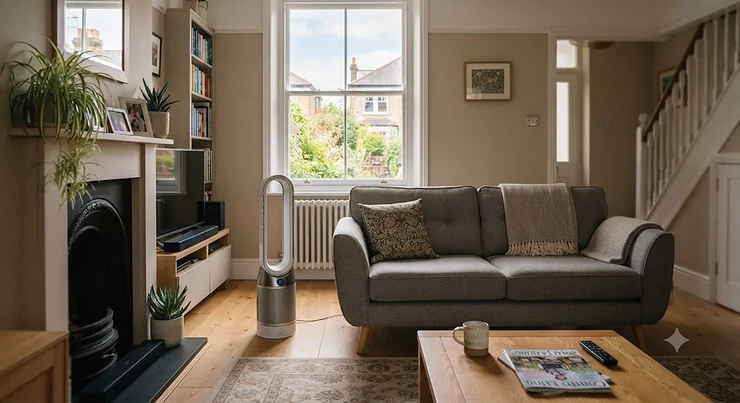
Here’s a fact nobody puts on the box: a single air purifier, however brilliant, cannot fix a three-storey semi from one plug socket in the hallway. An air purifier for 3 bedroom house use is not one product — it’s a plan, and most people buy the plan backwards, starting with the shiniest gadget and only later realising it was rated for a box room, not a landing. What is an air purifier for 3 bedroom house? At its simplest, it’s either one high-capacity unit sized generously enough to cycle air across open-plan ground floors, or — more often, and more effectively — two or three smaller units working in tandem across bedrooms and living space, each doing a job the others can’t reach. As Which?’s own testing has found, the gap between a genuinely effective purifier and a poorly-suited one is often bigger than the gap between a budget and premium model. Neither approach is inherently “better.” It depends on your floorplan, your budget, and whether your walls actually let air move between rooms in the first place. In this guide we’ve dug into real specs, real CADR numbers, and genuine aggregated review sentiment for seven purifiers that actually suit multi-room British homes — from a featherweight budget cylinder to a Dyson flagship that costs more than some people’s boilers. We’ll show you the maths behind “how many do I need,” the mistakes that waste money, and a practical framework for building a whole house air quality improvement plan that doesn’t involve remortgaging.
Quick Comparison: Air Purifier For 3 Bedroom House At A Glance
| Product | Best For | Rated Coverage | Price Range |
|---|---|---|---|
| Xiaomi Smart Air Purifier 4 Compact | Budget multi-unit strategy | Up to 30m² | £120-£160 range |
| Levoit Core 300S | Most-reviewed bedroom pick | Up to 108m² | £140-£170 range |
| MeacoClean CA-HEPA 76×5 | British-brand whole-room WiFi | Up to 76m² | £190-£230 range |
| Blueair Blue Pure 211i Max | Large open-plan living rooms | Up to 59m² (4.8 ACH) | £330-£400 range |
| Levoit Core 600S | Value large-room workhorse | Up to 52-59m² (realistic) | Around £300 |
| Philips Series 3000i (AC3033) | Sensor-led whole-floor performance | Up to 62m² | £400-£500 range |
| Dyson Purifier Big+Quiet Formaldehyde | Premium whole-house flagship | Around 100m² | £700-£880 range |
Look at that spread of coverage numbers and you’ll spot the pattern straight away: nothing on this table genuinely blankets an entire three-bedroom house from a single spot, no matter what the marketing copy implies. The Dyson Purifier Big+Quiet Formaldehyde projects the furthest and clears the most air, but even Dyson’s own testing caps it around 100m² — roughly a generous ground floor, not three bedrooms and a landing. For most terraced and semi-detached three-bed layouts, the sane strategy pairs one mid-size unit like the Levoit Core 600S or Blueair Blue Pure 211i Max downstairs with a smaller, quieter model such as the Xiaomi Smart Air Purifier 4 Compact in the bedroom that needs it most.
💬 Found a combo that matches your floorplan already? Scroll down — the full breakdown is waiting for you below.😊
Top 7 Air Purifiers For A 3 Bedroom House: Expert Analysis
1. Xiaomi Smart Air Purifier 4 Compact — lightest cylinder that’s genuinely True HEPA
The standout here isn’t power, it’s honesty: at this price, most rivals fudge their filter grade, but the Xiaomi Smart Air Purifier 4 Compact sticks to a real HEPA specification without inflating the numbers. Its CADR of 230 m³/h is rated for rooms up to 30m² at a full air change per hour, and the 2.2kg cylinder is light enough to carry upstairs one-handed while balancing a cup of tea. A crisp OLED display shows live PM2.5 readings, so you’re not guessing whether the box room actually needs it running. This is the purifier for someone assembling a multi-unit strategy on a tight budget — you buy two or three and station them where people actually sleep, rather than gambling everything on one machine in the hallway. Independent testers note the Mi Home app is functional but noticeably less polished than Levoit’s VeSync ecosystem, and the unit gets audible, around 55dB, once you push it to full speed for a quick blitz. Aggregated reviewer sentiment consistently flags it as the best-value True HEPA unit for a single small bedroom, not a substitute for whole-floor coverage.
Pros:
- ✅ Genuine True HEPA filtration at a genuinely low price
- ✅ Real-time PM2.5 readout on a crisp OLED display
- ✅ Lightest unit on this list, easy to move between rooms
Cons:
- ❌ 30m² coverage limit means one unit per room, not whole-house
- ❌ Audible near 55dB when running at full speed
At around £120-£160, the Xiaomi Smart Air Purifier 4 Compact earns its keep as a per-bedroom top-up rather than a house-wide solution — buy two for the kids’ rooms and put the budget you saved toward something bigger downstairs.
2. Levoit Core 300S — most-reviewed smart HEPA under £200
What most buyers overlook about the Levoit Core 300S is that its popularity isn’t hype — it’s backed by genuinely enormous review volume, which matters when you’re trying to separate marketing claims from lived experience. A real laser PM2.5 sensor drives the auto mode, ramping the fan only when it detects an actual spike rather than running full-tilt around the clock, and the sleep setting is Quiet Mark certified at roughly 24dB. Rated for 108m², it’s realistically suited to one large bedroom or an open-plan lounge-diner, not a whole floor. Aggregated Amazon review data — over 22,000 ratings averaging 4.6 stars — points to consistent satisfaction with build quality and the responsiveness of the auto mode, with the recurring gripe being filter replacement cost creeping up over a year of continuous use, a cost worth weighing against Defra’s national air quality data, which tracks the outdoor pollutant levels these filters are actually working to keep out. Based on the spec comparison with the rest of this list, the Levoit Core 300S is the one to buy if you want smart features and Alexa control without stepping up to 600S money.
Pros:
- ✅ Backed by tens of thousands of genuine Amazon reviews
- ✅ Real laser PM2.5 sensor drives a genuinely useful auto mode
- ✅ Alexa and app control included at a mid-budget price
Cons:
- ❌ 108m² rating covers one large room, not a whole floor
- ❌ Replacement filters add a recurring cost most buyers underestimate
At £140-£170, the Levoit Core 300S is the safe, well-reviewed default for the room where your family spends the most waking hours.
3. MeacoClean CA-HEPA 76×5 — British-brand pick with a genuinely useful WiFi app
Here’s what the spec sheet won’t tell you: Meaco has been building air treatment kit in the UK since 1991, and the MeacoClean CA-HEPA 76×5 is the only WiFi-enabled model in this round-up that’s designed and sold specifically for the British market rather than adapted from a global range. Rated for rooms up to 76m² of floor area, it draws around 50W and reviewers calculate its running cost at roughly 2p per hour — genuinely cheap to leave on overnight. A colour-coded LED ring shifts from blue through yellow to purple depending on measured PM2.5, giving you an at-a-glance read without opening the app. Reviewers at TechRadar praised how easy it was to set up and connect, while flagging that the design leans a little plain — some said it resembles a dehumidifier more than a lifestyle gadget — and that the app can lag slightly behind real room conditions. For anyone specifically hunting a British-brand option with proper UK-based customer support, this is the standout.
Pros:
- ✅ British-designed and built with UK customer support
- ✅ WiFi app plus colour-coded air quality display
- ✅ Genuinely low running cost, around 2p per hour
Cons:
- ❌ Reviewers note a fairly plain, dehumidifier-like design
- ❌ App response can lag behind the room’s real air quality
Typically priced in the £190-£230 range, the MeacoClean CA-HEPA 76×5 rewards buyers who care more about substance than styling.
4. Blueair Blue Pure 211i Max — best for large, open-plan living rooms
The Blueair Blue Pure 211i Max posts a CADR of 410 — among the strongest genuinely verified figures on this list — which in practice means it can turn over the air in a 59m² room (around 635 sq ft) roughly 4.8 times an hour, the threshold most experts consider necessary for allergy-grade cleaning rather than token freshening. HEPASilent technology combines mechanical filtration with an always-on ionisation stage, which boosts particle capture but is worth flagging honestly: the ioniser cannot be switched off, something to weigh if you’re wary of that technology. Energy Star certification means it does all this on relatively modest power for its output class. Consumer Reports and RTINGS both rate it well for dust, pollen, and smoke removal at both low and high fan speeds, though real-world noise measurements — 23dB at its quietest up to 53dB at full pelt — run a little louder than its “library-level” marketing suggests once you actually crank it up. This is the pick for an open-plan kitchen-diner-lounge knockthrough, the kind of space three-bed conversions increasingly have downstairs.
Pros:
- ✅ CADR of 410 handles genuinely large or open-plan rooms
- ✅ Energy Star rated despite its serious cleaning power
- ✅ Five fan speeds plus a proper auto mode
Cons:
- ❌ HEPASilent ionizer can’t be switched off, a dealbreaker for some
- ❌ Noticeably louder at top speed than its quiet reputation suggests
In the £330-£400 range, the Blueair Blue Pure 211i Max is the sensible anchor for the busiest shared space in a family home.
5. Levoit Core 600S — value workhorse for large or open-plan rooms
Here’s the honest version of the Levoit Core 600S story, because the marketing has shifted under everyone’s feet: Levoit dropped its “H13 HEPA” claim in 2023 after a Better Business Bureau challenge brought by Dyson, which is worth knowing before you buy on filter-grade alone. That said, independent lab testing still measures a genuinely strong estimated CADR around 375-391 CFM (roughly matching Levoit’s own pricier EverestAir), and reviewers who’ve lived with it for years in real family homes — dealing with cooking smells, pet odour, and dust — describe the auto mode as responsive rather than gimmicky. The realistic coverage for proper allergy-grade cleaning sits closer to 52-59m² once you account for needing several air changes per hour, considerably more modest than the “294m²” figure sometimes quoted for a single pass. Sleep mode measures around 25dB, genuinely bedroom-quiet, though it climbs to roughly 54dB — fridge-hum territory — at full speed, and the unit is bulky enough that it needs real floor space, not a shelf.
Pros:
- ✅ Real-world tested by multiple UK reviewers in family homes
- ✅ Whisper-quiet 25dB sleep mode for bedrooms
- ✅ Strong smoke and pet odour performance for the price
Cons:
- ❌ Levoit dropped its H13 HEPA marketing claim after a BBB challenge
- ❌ Bulky footprint needs genuine floor space to work
At around £300, the Levoit Core 600S remains a strong value pick for an open-plan ground floor, provided you buy it for its tested performance rather than its biggest headline number.
6. Philips Series 3000i (AC3033) — sensor-led performance for XL rooms
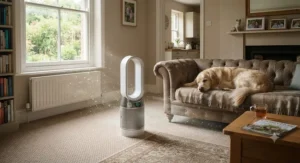
What stands out about the Philips Series 3000i AC3033, built specifically for XL rooms, is a CADR of 520 m³/h — the highest verified figure among the mid-tier options here — paired with 360-degree air intake rated to cover 62m². Three-layer NanoProtect HEPA filtration plus activated carbon captures particles down to 0.003 microns, and Philips has had the filtration independently tested to remove up to 99.9% of viruses and aerosols in controlled conditions. The Air+ app is genuinely useful in a way that goes beyond gimmick: it cross-references your indoor readings against local outdoor pollen and pollution data, which matters a lot if hay fever is why you’re shopping in the first place. Here’s where we have to be straight with you, though: verifiable customer review volume for this specific configuration is thinner than what exists for Levoit’s high-volume sellers, so treat the performance claims as manufacturer-tested rather than exhaustively crowd-verified, and weigh that against the premium price before you commit.
Pros:
- ✅ CADR of 520 m³/h among the strongest on this list
- ✅ Air+ app tracks indoor pollutants against outdoor pollen counts
- ✅ Alexa and Google Home voice control built in
Cons:
- ❌ Independently verified customer review volume is thinner than Levoit’s
- ❌ Premium pricing puts it above most mid-range rivals
Typically sitting in the £400-£500 range, the Philips Series 3000i AC3033 suits buyers who want manufacturer-grade sensor sophistication and are happy to pay for it.
7. Dyson Purifier Big+Quiet Formaldehyde — premium flagship for whole-house ambition
If one machine on this list comes closest to genuinely tackling a whole downstairs rather than a single room, it’s the Dyson Purifier Big+Quiet Formaldehyde. Dyson’s own testing, carried out in an 81m³ chamber, rates it for purification across roughly 100m² while projecting purified air a claimed 10 metres — a party trick that actually matters in an open-plan space, since it means air at the far end of the room gets cycled too, not just air near the machine. Three-stage filtration — H13-grade HEPA, activated carbon, and Selective Catalytic Oxidisation — is the only setup here that permanently destroys formaldehyde rather than just capturing it, relevant if you’ve recently had new flooring, paint, or flat-pack furniture releasing VOCs. The HEPA filter is rated to last up to five years and the carbon filter two, which meaningfully changes the long-term cost maths versus units needing new filters every six months. Reviewers at Expert Reviews found performance and build quality genuinely excellent, docking points only for Alexa voice commands feeling less intuitive than expected and filter changes being slightly fiddly.
Pros:
- ✅ Only model here that permanently destroys formaldehyde
- ✅ Projects purified air up to 10 metres across a room
- ✅ Five-year HEPA filter life cuts long-term filter costs
Cons:
- ❌ Considerably pricier than every other product on this list
- ❌ Reviewers found the Alexa voice commands less intuitive than expected
At £700-£880, the Dyson Purifier Big+Quiet Formaldehyde is a genuine investment piece — the right call if you want the fewest machines possible and have the budget to match the ambition.
How Many Air Purifiers Do I Need For A 3 Bedroom House?
The short answer: for genuine allergy-grade cleaning across a typical three-bedroom home, most households need two to three units, not one. Here’s the reasoning. Manufacturer coverage figures are almost always quoted at a single air change per hour — one full room-air turnover in sixty minutes — which is fine for freshening but falls well short of the 4-5 air changes per hour that specialists recommend for hay fever, asthma, or heavy pet dander. Halve any manufacturer’s headline coverage number and you’re closer to the truth. A three-bedroom house typically breaks down as: one larger unit for the main living space or open-plan kitchen-diner where the family spends daylight hours, one mid-size unit for the primary bedroom (the room you spend eight unbroken hours breathing in), and, budget allowing, a smaller unit for a second bedroom used by a child or anyone with allergies. Landings and box rooms rarely justify their own machine unless someone sleeps there — closed doors mean very little air actually crosses between rooms, whatever the specs imply. If your home has open-plan living downstairs and separate closed bedrooms upstairs, that structural reality, not the marketing copy, should decide how many machines you buy.
Multi-Room Air Purifier Strategy: The Practical Playbook
Getting a multi-room air purifier setup right starts before you plug anything in. First, walk the house and note which doors stay open most of the day — those rooms can realistically share airflow, while rooms behind a closed door need their own unit. Second, place each purifier at least 30-50cm from walls and furniture; intake grilles pressed against a sofa or wardrobe genuinely starve the machine of airflow, whatever the fan speed says. Third, run everything on auto mode for the first month rather than manually cranking to max — most sensors need that window to properly calibrate to your home’s baseline dust and pollen levels. Common first-30-days mistakes include placing a bedroom unit directly beside the bed (too loud, too close, and it recirculates the same cubic metre of air rather than cleaning the room), running kitchen-adjacent units on the same schedule as bedroom units (kitchens generate spikes at mealtimes that warrant a different auto-sensitivity setting), and forgetting to vacuum washable pre-filters monthly, which shortens the life of the expensive HEPA stage behind it. Stagger your purchases if budget is tight — get the living room sorted first, since that’s where the family spends the most collective hours, then add bedroom units as funds allow.
Building A Whole House Air Quality Improvement Plan
Think of a genuine whole house air quality improvement plan as three linked decisions rather than one purchase. Decision one is ventilation: no air purifier compensates for a house that never gets fresh air in, so open windows for ten minutes each morning even in winter, and check that trickle vents on your windows aren’t painted shut — a surprisingly common issue in older UK housing stock, and one covered in the government’s own ventilation guidance for dwellings. Decision two is source control: an air purifier fights pollutants after they’re airborne, but reducing them at source — extractor fans running during cooking, drying laundry outdoors rather than on radiators, switching to fragrance-free cleaning products — does more for less money than any machine. Decision three is the purifier layout itself, following the room-by-room logic above. Consider three household profiles: a young family with a toddler and a cat needs a living-room unit prioritising pet dander and allergen capture plus a nursery unit valued for near-silent night operation; a couple working from home in a terraced house with limited floor space benefits more from two compact units than one large one, since compacts fit awkward corners; and a household managing asthma should prioritise verified CADR and HEPA grade over smart features, since raw filtration performance is what actually protects breathing, not app polish.
Air Purifier For A Terraced House: What’s Different
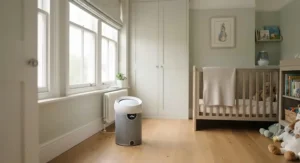
A terraced house changes the calculation in a specific way: shared party walls mean less natural cross-ventilation than a semi or detached home, and narrower floorplans often mean rooms are smaller but more numerous, stacked over three or four levels rather than spread wide. An air purifier for terraced house use, therefore, tends to favour compact, easily-relocated units over one dominant machine, simply because terraced layouts rarely have one central space large enough to justify a big unit’s full coverage radius. Noise also matters more in terraces than in detached homes — thin party walls mean a rattly fan on maximum speed at 11pm is a problem for you and, depending on wall thickness, potentially for next door too, so Quiet Mark certification or a genuinely low decibel sleep mode (the Levoit Core 300S and Levoit Core 600S both perform well here) is worth prioritising. Stair access is another practical wrinkle: narrow Victorian and Edwardian terrace staircases make moving a bulky unit like the Dyson Purifier Big+Quiet Formaldehyde between floors more of a chore, so a lighter unit such as the Xiaomi Smart Air Purifier 4 Compact, easily carried single-handed, often suits terraced living better than raw CADR numbers alone would suggest.
Single Large Unit Or Multiple Smaller Ones? The Whole-House Debate
This is the argument that decides most air purifier for entire house budgets, so it’s worth settling properly rather than defaulting to whichever product has the biggest number on the box.
| Factor | Single Large Unit (e.g. Dyson Purifier Big+Quiet Formaldehyde) | Multi-Unit Strategy (e.g. Xiaomi Smart Air Purifier 4 Compact ×2 + Blueair Blue Pure 211i Max) |
|---|---|---|
| Coverage evenness | Strong near the unit, weaker in closed-off rooms | Even coverage per room, no dead zones behind doors |
| Upfront cost | High, single purchase | Split across purchases, easier to stagger |
| Redundancy | If it breaks, whole plan fails | One unit down still leaves others running |
| Bedroom noise control | One machine, one noise profile everywhere | Smaller, quieter units possible per bedroom |
| Best for | Open-plan homes, high budget, minimal clutter | Closed-door layouts, staggered budgets, terraces |
Looking at the comparison above, a single large unit like the Dyson Purifier Big+Quiet Formaldehyde genuinely excels in open-plan homes where doors rarely close, but it can’t help a bedroom on another floor behind a shut door — physics doesn’t bend for a premium price tag. A multi-unit strategy costs roughly the same in total once you add two or three mid-range machines, but delivers far more even coverage across a typical three-bed layout with separate bedrooms. Most family homes with children’s bedrooms and a home office ultimately do better spreading their budget across the Levoit Core 300S, Levoit Core 600S, or Xiaomi Smart Air Purifier 4 Compact than gambling it all on one flagship.
✨ Compare Your Shortlist Side By Side!
🔍 Take your search for the right air purifier for large home use to the next level — click through on any highlighted model above to check current pricing and availability, and see which combination fits your actual floorplan, not just the spec sheet.
How To Choose An Air Purifier For A Large Home
- Start with CADR, not “coverage in m².” Manufacturer coverage figures assume just one air change per hour; a genuinely useful CADR figure lets you calculate real performance for your room size and desired air changes.
- Match HEPA grade to your actual concern. True HEPA (H13) matters most for asthma, severe allergies, or wildfire smoke; a good carbon-only stage may suffice for general household odour.
- Check the decibel rating at the speed you’ll actually use. A “quiet” spec sheet figure is almost always measured on the lowest setting — check the number at the speed you need for your room size.
- Price the filters before you price the machine. A cheap purifier with £80 annual filters can cost more over three years than a pricier unit with a five-year HEPA filter.
- Consider your walls and doors, not just square metres. A house with mostly open-plan space needs different logic to one with closed-off bedrooms and a narrow hallway.
- Decide if smart features earn their premium. App-based air quality tracking is genuinely useful for allergy sufferers monitoring trends, but it’s a poor reason to overspend if you’ll never open the app.
- Buy for your loudest room last. Kitchens and busy lounges can tolerate a slightly louder unit; bedrooms cannot, so prioritise your quietest models where people actually sleep.
Common Mistakes When Buying Air Purifiers For A 3 Bedroom House
The single most expensive mistake is buying one big-number purifier for the whole house and expecting it to reach upstairs bedrooms through closed doors — air simply doesn’t travel that way, no matter how strong the fan. A close second is fixating on marketing coverage figures instead of CADR and air-changes-per-hour maths, which routinely leads buyers to purchase units rated for double the room size they actually need for allergy-grade cleaning. Buyers also frequently ignore ongoing filter costs entirely at the point of purchase, only to discover a year later that replacement HEPA cartridges cost nearly as much as a budget unit’s original price tag. Placing a purifier in a corner, behind furniture, or hard against a wall is another quiet performance killer, since restricted airflow at the intake can cut real-world CADR significantly below the tested figure. Finally, plenty of households buy for the living room and never budget for the bedroom at all, despite bedrooms being where people spend the most consecutive, uninterrupted hours breathing the same air.
Features That Actually Matter (And Those That Don’t)
CADR and true HEPA grade matter enormously — they’re the two figures that separate genuine air-cleaning performance from marketing fluff, and everything else on the spec sheet is secondary to them. A real-time PM2.5 sensor driving genuine auto mode matters too, because it stops the unit running at full, noisy power when the air is already clean. What matters far less than the box suggests: UV-C sterilisation stages, which sound impressive but have limited real-world impact at typical purifier airflow speeds where particles pass the UV lamp too quickly for meaningful exposure; and headline “square footage” figures, which as covered above are usually calculated at a single, allergy-inadequate air change per hour. Smart app integration is a genuine nice-to-have for allergy sufferers who want to track trends over weeks, but it adds nothing to actual air-cleaning performance and shouldn’t be a tie-breaker between two otherwise similar units. Aesthetic design, similarly, is worth precisely nothing to your lungs, however much it matters to your living room.
Long-Term Cost & Maintenance For A Multi-Room Setup
| Product | Approx. Annual Filter Cost | Approx. Annual Electricity (12hrs/day) | Value Verdict |
|---|---|---|---|
| Xiaomi Smart Air Purifier 4 Compact | Around £55/year | Around £15/year | Cheapest to run per room |
| Levoit Core 300S | Around £45-£60/year | Around £20-£24/year | Strong value for one large room |
| MeacoClean CA-HEPA 76×5 | Around £35-£40/year | Around £10-£15/year | Lowest running cost on this list |
| Blueair Blue Pure 211i Max | Around £60-£80/year | Around £20-£25/year | Higher upkeep, matches its output |
| Levoit Core 600S | Around £70-£90/year | Around £20-£25/year | Pricier filters, justified by performance |
| Philips Series 3000i (AC3033) | Around £60-£80/year | Around £20-£25/year | Mid-pack running cost for its power |
| Dyson Purifier Big+Quiet Formaldehyde | Around £85/filter, replaced every 2-5 years | Around £20-£25/year | Lowest long-term filter frequency |
Interpreting the table above, the MeacoClean CA-HEPA 76×5 and Xiaomi Smart Air Purifier 4 Compact are the cheapest to keep running day to day, which matters if you’re deploying two or three units across a whole house rather than just one. The Dyson Purifier Big+Quiet Formaldehyde looks expensive up front but its five-year HEPA filter life means you’re not repeating a £85 purchase every six months like some rivals, so the total cost of ownership narrows considerably over a three-year horizon. Running costs stay fairly similar across the mid-range and premium units at typical UK electricity rates, meaning filters — not electricity — are where the real long-term budget difference lives.
Safety, Regulations & Compliance Guide For UK Homes
UK building regulations don’t currently mandate air purifiers in domestic homes, but they do set minimum ventilation standards under Approved Document Part F, which governs how fresh air should move through a dwelling via trickle vents, extractor fans, or mechanical ventilation — worth checking if your home feels persistently stuffy despite a purifier running, since a purifier recirculates existing air rather than replacing it with fresh air from outside. If anyone in the household has asthma or another respiratory condition, it’s worth reading up on genuine triggers and management via the NHS’s guidance on asthma rather than relying on purifier marketing claims alone. Look for products independently tested to recognised standards such as GB/T18801 or AHAM AC-1 for CADR, since these third-party benchmarks are far more reliable than a manufacturer’s own in-house figures. Households considering an ioniser-equipped model, such as the Blueair Blue Pure 211i Max, should know that some people are sensitive to ozone by-products from certain ionisation technologies, though reputable brands design their ionisers to stay within recognised safe limits — if in doubt, a purely mechanical HEPA unit avoids the question entirely.
Frequently Asked Questions
❓ Can one air purifier really cover a 3 bedroom house?
❓ What size air purifier do I need for a large home?
❓ Is it cheaper to run one big purifier or several small ones?
❓ Do air purifiers help with hay fever in a family home?
❓ How many air purifiers do I need for a terraced house?
Conclusion
There’s no single “best” air purifier for a three-bedroom house, and honestly, anyone claiming otherwise is skipping the bit where your floorplan, budget, and closed doors matter more than any spec sheet. What the research does make clear is that treating this as a room-by-room problem, not a one-machine purchase, gets better results for similar money. A living room or open-plan kitchen-diner benefits from real muscle — the Blueair Blue Pure 211i Max, Levoit Core 600S, or, budget allowing, the Dyson Purifier Big+Quiet Formaldehyde. Bedrooms reward quiet, right-sized units like the Levoit Core 300S or Xiaomi Smart Air Purifier 4 Compact. And if you want a genuinely British-built option with a proper WiFi app, the MeacoClean CA-HEPA 76×5 deserves a place on your shortlist. Whatever combination you land on, check current prices before you buy, since availability and offers shift constantly — and remember that ventilation and source control still do more heavy lifting than any single purchase ever will.
✨ Ready To Build Your Whole-House Plan?
🔍 Compare current prices on your shortlisted models today, and start with the room where your family spends the most time — clean air there does more good, more often, than anywhere else in the house.
Recommended for You
- Portable vs Whole House Air Purifier: 7 Picks Ranked (2026)
- Air Purifier for Open Plan Living: 7 Picks That Actually Cope (2026)
- Air Purifier for Kitchen Diner: 7 Best Picks Tested for 2026
Disclaimer: This article contains affiliate links. As an Amazon Associate, I earn from qualifying purchases. If you purchase products through these links, we may earn a small commission at no additional cost to you.
✨ Found this helpful? Share it with your friends! 💬🤗
