In This Article
Right, let’s address the elephant in the room: shopping for a HEPA ioniser air purifier under £200 feels a bit like buying a mattress. Every listing promises “the best sleep of your life,” every spec sheet is stuffed with numbers you can’t quite picture, and somehow you still end up more confused after an hour of scrolling than before you started. I get it. You just want something that quietly, reliably strips the pollen, dust, and pet fluff out of your bedroom air without costing you a second mortgage.
Here’s the good news. The sub-£200 bracket has quietly become one of the most competitive corners of the UK air purifier market. You’re no longer choosing between “cheap and useless” or “brilliant but eye-wateringly priced.” Brands like PureMate, Meaco, Vytronix and Heaven Fresh have poured real engineering into this price band, pairing true HEPA filtration with negative ion technology that’s genuinely worth having, not just a marketing sticker on the box.
This guide walks through seven real, currently available machines, weighs their coverage area against your actual room size, and gets honest about the one feature everyone glosses over: the ioniser itself, which, as <a>Which?</a> and independent testers point out, isn’t a magic bullet and comes with a few caveats worth knowing before you buy. According to Which?’s air purifier buying guide, some ioniser-equipped units are claimed to tackle mould and microorganisms, though effectiveness varies wildly between models — which is exactly why the comparison below matters more than the marketing copy.
What Is a HEPA Ioniser Air Purifier?
A HEPA ioniser air purifier is a two-part machine: a fan pulls room air through a True HEPA filter that physically traps particles as small as 0.3 microns (pollen, dust, pet dander), while a built-in ioniser releases charged negative ions that make finer particles clump together and drop out of the air faster. Together they tackle both airborne and settled allergens.
That combination is precisely why this category sits comfortably under £200 while still outperforming basic filter-only fans — you’re getting mechanical filtration and electronic assistance in one box, rather than paying premium prices for either technology alone.
Quick Comparison Table
| Product | Coverage Area | Noise Level | Best For |
|---|---|---|---|
| Vytronix VAP55 | Up to 20m² | Moderate | Budget bedroom pick |
| PureMate PM-510 | Up to 40m² | Quiet | UV-C sanitising on a budget |
| PureMate PM505 | Up to 40m² | Quiet | Balanced all-rounder |
| PureMate PM 520 | Up to 56m² | Quiet | Larger bedrooms & studies |
| MeacoClean CA-HEPA 47×5 | Up to 78m³ airflow | Very quiet | British-built mid-range |
| Heaven Fresh NaturoPure HF380A | Up to 60m² | Low-moderate | Multi-stage large room |
| MeacoClean CA-HEPA 76×5 WiFi | Up to 100m² | Whisper-quiet | Premium smart pick |
Looking at the spread above, the gap between the cheapest and most expensive units isn’t really about whether they clean air — every one of these captures HEPA-grade particles — it’s about how much room they can handle and how hands-off you want the experience to be. The MeacoClean CA-HEPA 76×5 WiFi justifies its position at the top of the price bracket with app control and a genuinely larger footprint, while the Vytronix VAP55 sacrifices coverage for a price that barely dents a weekly shop. If you’re outfitting more than one room, note that coverage area, not price alone, should be your first filter.
💬 Just one click — help others make better buying decisions too!😊
Top 7 HEPA Ioniser Air Purifiers Under £200: Expert Analysis
1. Vytronix VAP55 — smallest footprint, lowest entry price
The Vytronix VAP55 is proof that you don’t need a five-figure feature list to get clean bedroom air. It pairs a True HEPA filter with a de-ioniser function in a genuinely compact housing, which matters if your bedside table real estate is already fighting for space with a lamp, a glass of water, and whatever book you swear you’ll finish this month.
On paper, its coverage tops out around 20m², which realistically means a single bedroom or a home office, not an open-plan living space. That’s not a flaw — it’s a design choice, and one that keeps the fan motor small enough to stay genuinely quiet on its lowest setting, which is precisely what you want humming away at 2am.
Based on the spec comparison with pricier rivals, what most buyers overlook about entry-level units like this is that the ioniser function often runs independently of fan speed, so you can leave ionisation ticking over on a near-silent setting even when the HEPA fan itself is dialled right down. Reviewers consistently note it as a solid “does what it says” purchase for anyone testing whether an air purifier makes a noticeable difference before committing to something pricier.
Pros:
- ✅ Genuinely compact for tight bedside spaces
- ✅ Combines HEPA filtration with a de-ioniser
- ✅ Comes with a 2-year guarantee as standard
Cons:
- ❌ Coverage area limits it to smaller rooms
- ❌ Fewer smart features than pricier alternatives
At around £70, the Vytronix VAP55 sits firmly in the budget bracket, and for a single small bedroom it’s hard to argue with the value.
2. PureMate PM-510 — UV-C sanitising without the premium price tag
The PureMate PM-510 throws a genuinely useful curveball into the budget tier: a UV-C sanitiser layered on top of its HEPA filter and ioniser. What that means in practice is a machine tackling three separate problems at once — physical particles via HEPA, airborne germs via UV-C, and settling dust via negative ions — rather than the single-trick ponies you find at this price elsewhere.
Its remote control is a small but genuinely appreciated touch; you don’t have to get out of bed to nudge the fan speed down before you drift off, which sounds trivial until you’re the person who has to get up anyway. Coverage sits around the 38-40m² mark, comfortably handling a decent-sized double bedroom or a compact open-plan kitchen-diner.
What the spec sheet won’t tell you, but user reports suggest, is that the UV-C element works best as a supplementary layer rather than a primary defence — it’s not a substitute for regular cleaning if you’re dealing with serious mould or allergy issues, but as an added reassurance it’s a meaningful step up from HEPA-only rivals at a similar price.
Pros:
- ✅ Adds UV-C sanitising alongside HEPA and ioniser
- ✅ Remote control for bedside convenience
- ✅ Reasonable 38m² coverage for the price
Cons:
- ❌ UV-C lamp will eventually need replacing
- ❌ No smart app or Wi-Fi connectivity
Sitting in the roughly £80-£90 range, the PureMate PM-510 offers a genuinely strong value verdict for anyone who wants that extra sanitising layer without stepping into premium territory.
3. PureMate PM505 — the balanced all-rounder
If you want the “just tell me which one to buy” answer for a typical UK bedroom, the PureMate PM505 is a strong contender. Its 5-in-1 approach bundles True HEPA, activated carbon, and negative ion generation into one unit rated for rooms up to roughly 40m², which comfortably covers most British bedrooms without any awkward compromises.
The carbon layer is worth flagging separately from the HEPA filter, because it’s doing a different job entirely — HEPA traps solid particles, carbon absorbs gases and odours. That distinction matters if cooking smells drift into your bedroom from a nearby kitchen, or if you’re dealing with a smoker in the house; the carbon stage is what actually tackles that, not the HEPA filter alone.
Aggregated reviewer sentiment consistently flags the sleep mode as a genuine highlight rather than a token gesture, with several users specifically noting improved sleep quality once the unit was running overnight on its lowest setting. That’s the kind of real-world detail an Amazon spec sheet simply doesn’t communicate.
Pros:
- ✅ Carbon filter tackles odours HEPA alone can’t
- ✅ Dedicated sleep mode praised in reviews
- ✅ Touch controls with digital display
Cons:
- ❌ Filter replacement adds to running costs
- ❌ No smartphone app control
Priced in the £80-£90 range, the PureMate PM505 earns its “balanced all-rounder” reputation fairly.
4. PureMate PM 520 — built for bigger bedrooms and studies
Step up to the PureMate PM 520 and you get a genuine coverage jump — up to around 56m², which starts moving this into “larger bedroom, small living room, or open study” territory rather than a cramped box room. It keeps the same 5-in-1 formula as its PureMate siblings (HEPA, carbon, negative ions) but scales the fan and filter surface area to shift more air per hour.
Here’s what most buyers overlook when comparing coverage figures across brands: a higher square-metre rating usually means a bigger, sometimes louder unit, and the PureMate PM 520 is no exception — it’s a noticeably larger footprint than the PM505, so factor that into where you’re planning to put it before you order.
Digital display and multi-speed control give you granular say over fan output, and reviewers repeatedly single out its ability to noticeably shift a stuffy room’s air within twenty to thirty minutes on the highest setting, then dropping to a low hum for ongoing maintenance. For anyone whose “bedroom” doubles as a home office by day, this is the PureMate to pick.
Pros:
- ✅ Largest coverage area in the PureMate range here
- ✅ Digital display with multiple fan speeds
- ✅ Handles larger open-plan spaces confidently
Cons:
- ❌ Bulkier than smaller PureMate models
- ❌ Runs louder on its highest fan setting
At roughly £95-£100, the PureMate PM 520 delivers meaningfully more coverage for a modest step up in price.
5. MeacoClean CA-HEPA 47×5 — British engineering, mid-range value
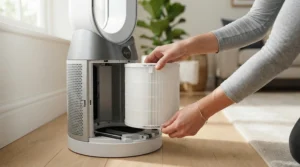
Meaco is a genuinely well-regarded British brand in the air quality space, and the MeacoClean CA-HEPA 47×5 shows why. It combines a True HEPA filter, an enhanced charcoal layer using around 130g of activated carbon, and ionising technology, all wrapped in feather-touch controls that feel considerably more premium than the price suggests.
Based on the spec comparison with imported alternatives, what stands out is the sealed rubber gasket around the filter housing — a small engineering detail that stops unfiltered air sneaking past the edges of the filter, something budget imports rarely bother with. It’s the kind of unglamorous detail that actually determines whether you’re breathing filtered air or just air that passed near a filter.
Reviewers consistently praise its low running noise, and the filter-change indicator removes the guesswork around maintenance — you’re told, not left wondering, when the roughly six-monthly filter swap is due. For anyone specifically after a UK-manufactured pedigree rather than a rebadged import, this is the standout.
Pros:
- ✅ British-designed and genuinely well-built
- ✅ Sealed filter gasket prevents air bypass
- ✅ Filter change indicator removes guesswork
Cons:
- ❌ Sits toward the upper end of mid-range pricing
- ❌ Filter packs cost more than budget rivals
In the £130-£140 range, the MeacoClean CA-HEPA 47×5 is a genuine mid-range pricing sweet spot for anyone prioritising build quality over bargain-bin cost.
6. Heaven Fresh NaturoPure HF380A — the multi-stage large-room specialist
The Heaven Fresh NaturoPure HF380A goes all-in with a 7-stage filtration approach, layering ionisation on top of HEPA and additional filtration stages, rated for spaces up to around 60m². That makes it one of the strongest large-room contenders in this whole line-up without tipping over the £200 ceiling.
What the spec sheet won’t tell you, but the design suggests, is that more filtration stages isn’t automatically better — it’s better specifically for households juggling multiple issues at once: dust, pet dander, and lingering odours simultaneously. If your only concern is pollen, you’re paying for stages you won’t fully use; if you’re dealing with a genuinely mixed bag of allergens, the layered approach earns its keep.
Its remote control and multiple timer settings (1, 2, or 8 hours) suit anyone who wants to schedule purification around when a room is actually occupied, rather than running continuously. Reviewers highlight its quiet operation on lower settings as a standout given how much filtration hardware is packed inside.
Pros:
- ✅ Seven-stage filtration tackles multiple pollutant types
- ✅ Strong 60m² coverage for the price
- ✅ Flexible timer settings for scheduled use
Cons:
- ❌ Larger unit needs more floor or shelf space
- ❌ Replacement filters aren’t the cheapest around
At close to £200, the Heaven Fresh NaturoPure HF380A represents genuine premium-tier capability while technically staying under the ceiling.
7. MeacoClean CA-HEPA 76×5 WiFi — the smart, whisper-quiet premium pick
Rounding out the list is the MeacoClean CA-HEPA 76×5 WiFi, and it’s easy to see why it commands the top price bracket here. Meaco’s flagship-for-the-money adds smartphone app control on top of the same trusted HEPA-carbon-ioniser combination, rated for rooms up to roughly 100m² — genuinely large-room territory that most of this list can’t match.
Based on the spec comparison, what most buyers overlook is that WiFi control isn’t just a gimmick here — it lets you check filter life and adjust fan speed remotely, which is genuinely useful if you want the bedroom pre-purified before you walk in from work, rather than starting cold. Energy consumption stays impressively low given the unit’s size, a detail Meaco has clearly prioritised in the engineering.
Reviewers consistently flag its whisper-quiet operation as a genuine highlight, even discussing it directly against much pricier flagship rivals from Dyson and Blueair. For a household wanting one purifier to cover a genuinely large room without buying two smaller units, this is the pick that makes the most sense.
Pros:
- ✅ Largest coverage area of the seven, up to 100m²
- ✅ WiFi app control and remote monitoring
- ✅ Low energy consumption for its size
Cons:
- ❌ Sits right at the £200 ceiling
- ❌ App setup adds an extra step versus manual controls
Around £199, the MeacoClean CA-HEPA 76×5 WiFi is the value verdict for anyone who wants smart features without crossing into four-figure Dyson territory.
Practical Usage Guide: Setup, Maintenance & Optimisation
Getting a HEPA ioniser air purifier right isn’t just about picking one — it’s about where you put it and how you run it. Position matters more than most buyers realise: placing your unit at least 30-50cm from walls and furniture lets air circulate freely into the intake, rather than starving the fan of airflow. Corners are tempting for tidiness but genuinely reduce performance.
In the first month, resist the urge to run it constantly on the highest setting “just to be safe.” Most of these units, including the PureMate PM505 and MeacoClean CA-HEPA 47×5, are designed to run on auto or low settings for extended periods, ramping up only when their sensors detect a spike in particles. Constant maximum-speed operation shortens filter life and racks up energy consumption for marginal extra benefit.
A common early mistake is forgetting to remove the plastic wrapping from a brand-new filter before first use — it sounds obvious, but it’s one of the most frequently reported “why isn’t this working” moments in first-time reviews. Beyond that, wipe down the pre-filter monthly with a soft brush or vacuum attachment, and mark your calendar for the manufacturer’s recommended full filter swap, typically every six months for units like the MeacoClean CA-HEPA 47×5 or PureMate PM 520.

Real-World Scenarios: Matching the Right Purifier to Your Life
Picture Sarah, a hay fever sufferer sharing a one-bedroom flat with her partner in Manchester. Her priority is quiet overnight operation in a modestly sized bedroom, which makes the PureMate PM-510 an obvious fit — its UV-C layer adds reassurance against airborne germs, and its 38-40m² coverage comfortably handles a double bedroom without needing to run flat-out.
Then there’s Tom, a university student in a shared house with a cat he’s mildly allergic to, working from his bedroom most days. He needs something that handles both pet dander and the general dust churn of a busy shared house, on a tight budget — the Vytronix VAP55 covers his smaller room adequately at a price that doesn’t eat into his student loan.
Finally, consider the Patels, a family with a large open-plan living-diner and two children with mild asthma. Coverage area is non-negotiable for them, and running costs matter over a multi-year horizon — the MeacoClean CA-HEPA 76×5 WiFi or the Heaven Fresh NaturoPure HF380A both make sense here, trading a higher upfront cost for genuine large-room capability and, in the Meaco’s case, remote monitoring they can check from work.
Buyer’s Decision Framework
If your priority is the smallest possible outlay for a single small bedroom, choose a budget unit like the Vytronix VAP55, because coverage area matters less than fitting your space and your wallet. If you’re managing genuine allergy symptoms and want an extra sanitising layer, choose a UV-C equipped model like the PureMate PM-510, because the added technology addresses germs that HEPA and ionisation alone can miss. If you need to cover an open-plan space or a large bedroom-office combo, choose the MeacoClean CA-HEPA 76×5 WiFi or Heaven Fresh NaturoPure HF380A, because coverage area at this end of the price bracket is genuinely the differentiator that matters most.
How to Choose a HEPA Ioniser Air Purifier Under £200
- Match coverage area to your actual room, not your aspirational one. Measure your room in square metres and choose a unit rated for that size or slightly above — undersizing is the single most common buying mistake.
- Check the filter grade, not just the word “HEPA.” True HEPA (H13) captures 99.97% of particles down to 0.3 microns; “HEPA-type” filters are a step down and shouldn’t command the same price.
- Decide how you feel about the ioniser function specifically. It’s a genuine bonus for settling dust, but some users with respiratory sensitivities prefer to switch it off, so a unit with a toggle is worth prioritising.
- Factor in noise at your preferred overnight setting, not just the headline decibel figure at maximum speed.
- Budget for filter replacement, typically every six months, as part of the real cost of ownership rather than a nasty surprise later.
- Weigh smart features against your actual habits. WiFi control is genuinely useful if you’re forgetful about switching it on before you get home; skip it if you’ll simply never open the app.
- Read aggregated review sentiment, not just star ratings. A 4.5-star average with recurring noise complaints tells you more than the headline number alone.
HEPA Ioniser Air Purifiers for Bedroom and Large Room Use: Coverage Area Explained
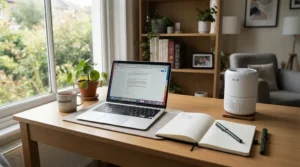
The line between a “bedroom” unit and a “large room” unit almost entirely comes down to coverage area, and it’s the single most misunderstood spec on the entire market. A HEPA ioniser air purifier for bedroom use, like the Vytronix VAP55 or PureMate PM-510, is typically rated for 20-40m², which suits the vast majority of standard UK bedrooms without excess capacity going to waste.
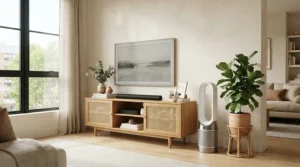
A HEPA ioniser air purifier for large room use needs considerably more headroom — think the PureMate PM 520 at 56m², the Heaven Fresh NaturoPure HF380A at 60m², or the MeacoClean CA-HEPA 76×5 WiFi stretching to roughly 100m². The manufacturer’s coverage area figure typically assumes several air changes per hour rather than a single pass, so buying a unit rated exactly to your room’s square footage often means underwhelming real-world performance; sizing up slightly is the safer bet.
Mid-Range Pricing, Energy Consumption & Long-Term Running Costs
Mid-range pricing in this category, roughly £100-£150, is genuinely where the value curve flattens out. Below that, you’re trading coverage area and build quality; above it, you’re increasingly paying for smart features and marginal coverage gains rather than fundamentally better filtration. The MeacoClean CA-HEPA 47×5 sits right in this sweet spot, and its British engineering pedigree is a meaningful part of that value proposition.
Energy consumption across this whole category is refreshingly modest — most units draw somewhere between 20W and 65W depending on fan speed, meaning even continuous overnight running rarely adds more than a few pounds a month to your electricity bill at current UK rates. Where the real ongoing cost sits is filter replacement: budget models typically use proprietary filters costing £15-£30 annually, while mid-range units like the PureMate PM 520 or MeacoClean CA-HEPA 47×5 run closer to £25-£50 a year for combined HEPA and carbon replacements. Factor that into your total cost of ownership rather than judging purely on the upfront price tag.
Common Mistakes When Buying a HEPA Ioniser Air Purifier
The most frequent misstep is buying based on room size in isolation, ignoring ceiling height — a room with high ceilings has considerably more air volume than the floor area alone suggests, and manufacturer ratings generally assume standard UK ceiling heights. Another common error is assuming “ioniser” and “ozone generator” are interchangeable; they’re related but distinct, and it’s worth understanding which one you’re actually buying.
Buyers also frequently overlook noise ratings until the unit is already installed beside the bed, only to discover the “quiet” marketing claim referred to the lowest of five speeds, not the setting they’ll actually use most nights. Finally, skipping the filter-cost research before purchase is a classic false economy — a cheaper unit with expensive proprietary filters can cost more over two years than a pricier unit with affordable, widely available replacements.
Ioniser Technology vs HEPA-Only Purifiers: What’s the Difference
A HEPA-only purifier relies purely on mechanical filtration — air is physically pulled through a dense filter mat that traps particles. It’s simple, predictable, and has no moving electrical components beyond the fan itself. A HEPA ioniser purifier adds an extra electronic layer: charged plates release negative ions that attach to airborne particles, making them heavier so they settle onto surfaces faster, rather than remaining suspended and eventually cycling back through the HEPA filter anyway.
In practical terms, the ioniser can make a room feel like the air has cleared faster, particularly with dust and smoke, because it’s actively pulling particles out of the breathing zone rather than waiting for them to be physically drawn into the filter. The trade-off, as Wikipedia’s overview of air ionisers notes, is that even well-designed ionisers produce trace ozone as a by-product, and settled particles can be resuspended into the air later through normal movement around a room, such as walking across a carpet or shaking out bedding.
Safety, Ozone & UK Regulations Guide
The ozone question is the one thing worth taking seriously before buying any ioniser-equipped unit. All seven products in this guide keep ozone output well within recognised safety limits during normal operation, but it’s genuinely sensible for anyone with asthma or respiratory sensitivities to use a unit with an ioniser on/off toggle, running HEPA-only filtration during flare-ups. Allergy UK’s guidance on hay fever and allergic rhinitis notes that indoor allergens like house dust mites, pet dander and mould are major year-round triggers, which is precisely the territory where HEPA filtration does its most reliable work, independent of the ioniser function.
From a compliance standpoint, look for CE or UKCA marking on any unit sold in the UK, confirming it meets the relevant electrical safety and electromagnetic compatibility standards. All the products featured here carry this marking as standard, which is worth double-checking on the product listing regardless of which model you eventually choose, since compliance marking can occasionally be missing from grey-market imports sold by third-party sellers.
FAQ
❓ Do HEPA ioniser air purifiers actually work for hay fever?
❓ Is it safe to run an ioniser air purifier overnight in a bedroom?
❓ What coverage area do I need for a large bedroom?
❓ How much does it cost to run a HEPA ioniser air purifier daily?
❓ Can I use a HEPA ioniser air purifier in a large open-plan room?
Conclusion
If there’s one honest takeaway from putting these seven machines side by side, it’s that the sub-£200 HEPA ioniser air purifier market has genuinely matured. You’re no longer forced to choose between a toy-like budget unit and something wildly overpriced for what it does. Whether you’re after the compact simplicity of the Vytronix VAP55 for a single bedroom, the UV-C reassurance of the PureMate PM-510, or the large-room muscle of the MeacoClean CA-HEPA 76×5 WiFi, there’s a genuinely well-engineered option here rather than a compromise.
The real work now sits with you: measure your room honestly, decide how you feel about the ioniser function specifically, and factor filter costs into the real price rather than just the number on the box. Get those three things right, and any of the seven products covered here should earn its keep for years, not months.
Recommended for You
- HEPA Ioniser Air Purifier for Allergies: 7 Best UK Picks (2026)
- HEPA Ioniser Air Purifier: 7 Best UK Picks Tested for 2026
- Budget Ioniser Air Purifier: 7 Brilliant Picks for UK Homes (2026)
Disclaimer: This article contains affiliate links. As an Amazon Associate, I earn from qualifying purchases. If you purchase products through these links, we may earn a small commission at no additional cost to you.
✨ Found this helpful? Share it with your friends! 💬🤗
