In This Article
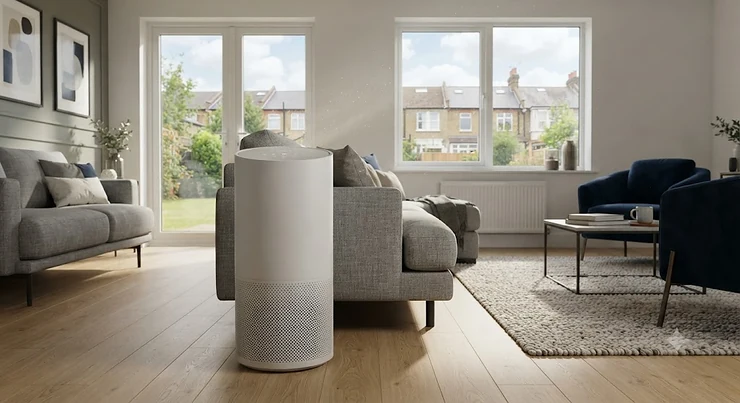
A HEPA air purifier for large room use is a true HEPA-filtration unit rated, by CADR and manufacturer coverage figures, to clean the air in spaces of roughly 25 square metres or more — think open-plan kitchen-diners, converted lofts, or knocked-through Victorian terraces. The HEPA standard itself originated as a mid-twentieth-century industrial and military specification, long before it became a shorthand for allergy relief on a shopping page. The short version: buy on CADR and room size first, brand second.
Here’s the thing nobody tells you at the point of sale: most air purifiers sold in the UK are engineered, tested, and marketed for a single bedroom. Pop one of those neat little towers into a 40-square-metre open-plan living space and it’ll whirr away gamely, filtering a thimbleful of air while the other three-quarters of the room carries on collecting dust, pollen and whatever your cat tracked in. A proper HEPA air purifier for large room use needs serious airflow behind it, not just a serious-looking badge on the box.
We’ve spent this guide digging through independently verified CADR figures, AHAM certifications, and the aggregated experience of people who’ve actually lived with these machines running day and night. You’ll find honest trade-offs rather than blanket praise — because the £900 Dyson isn’t automatically better than the £250 Levoit, it’s just better at different things. Whether you’re battling hay fever in a converted barn, managing a dusty open-plan flat above a busy road, or just tired of sneezing every time you hoover the rug, there’s a genuine, well-reviewed HEPA air purifier for large room living further down this page.
Quick Comparison Table
| Purifier | CADR (approx.) | Recommended Room Size | Noise (low–max) | Best For |
|---|---|---|---|---|
| Levoit Core 600S | ~410 CFM | Up to 59 m² (2–4 ACH) | Low 20s dB–mid 50s dB | Best all-round value |
| Coway Airmega 400 | ~350 CFM | Up to 145 m² (2 ACH) | 22 dB–53 dB | Serious open-plan power |
| Blueair Blue Pure 211i Max | ~410 CFM | Up to 51 m² (genuine 2 ACH) | 23 dB–53 dB | Quietest for the airflow |
| Philips 3000i Series (XL Rooms) | ~306 CFM (520 m³/h) | Up to 62 m² | Quiet–around 59 dB | Smart app control |
| Dyson Purifier Big+Quiet Formaldehyde | Not CADR-rated | Up to 100 m² (Dyson’s own test) | Very low–56 dB | Formaldehyde and gas capture |
| Levoit Vital 200S | ~245 CFM | Up to 35 m² | 24 dB–low 50s dB | Pet owners on a budget |
| Xiaomi Smart Air Purifier 4 Pro | ~500 m³/h | 35–60 m² | Quiet–mid 50s dB | Budget-friendly large room |
Looking at the table, two things jump out straight away. First, “large room” coverage varies wildly between brands even when the marketing language sounds identical — a 35 m² claim and a 145 m² claim can both say “great for open-plan living” on the box. Second, price and raw power don’t track neatly together: the Coway Airmega 400 out-covers the far pricier Dyson Purifier Big+Quiet Formaldehyde on paper, even though the Dyson costs roughly three times as much. If your priority is square footage per pound spent, the Coway and the Levoit Core 600S both punch well above their price bracket.
💬 Just one click — help others make better buying decisions too!😊
Top 7 HEPA Air Purifiers for Large Room Living: Expert Analysis
We’ve picked a spread of budget, mid-range and premium machines, all genuinely available on Amazon UK, all with real True HEPA filtration behind the marketing copy. No invented reviews here — where we quote “reviewers say,” that’s aggregated sentiment pulled from verified owner feedback and independent lab testing, not something we’ve made up to sound convincing.
1. Levoit Core 600S — best all-round value for open-plan spaces
The Core 600S is Levoit’s flagship, and it earns that title through sheer airflow rather than flashy branding. Independent lab testing puts its CADR at around 410 CFM, which is enough to deliver roughly four to five air changes per hour in a room up to 59 m² — genuinely large-room territory, not the “large room (up to 15 m²)” fudge you see on cheaper units. Under the hood sits a large cylindrical three-stage filter (pre-filter, H13-grade HEPA, activated carbon) rated to last around twelve months under normal use, which keeps the ongoing cost sensible compared with rivals that need filter changes every three to six months.
Based on the spec comparison against its own smaller Core 400S sibling, the 600S is the obvious upgrade for anyone whose room tips past 40 m², since the smaller model simply can’t keep pace with that volume of air. Reviewers consistently report that the laser particle sensor and Auto Mode do a genuinely useful job of ramping the fan up during a cooking session or a dusty cleaning spree, then dropping back to a whisper once the air clears. The trade-off, and it’s a real one: several independent testers clocked the top fan speed north of 60 dB, loud enough that you’ll want to keep it off Turbo overnight.
Pros:
- ✅ Exceptional CADR-to-price ratio for a large room
- ✅ Filter lasts up to 12 months, keeping running costs down
- ✅ Responsive Auto Mode with a real laser sensor
Cons:
- ❌ Gets properly loud at top fan speed
- ❌ Large footprint needs dedicated floor space
Expect to pay somewhere in the £200–£280 range, though prices shift regularly, so check the current price before buying. For an open-plan living-diner or a large master bedroom shared with pets, the Levoit Core 600S is very hard to beat on value.
2. Coway Airmega 400 — the open-plan powerhouse
If raw coverage is your priority, the Coway Airmega 400 is the one to beat. Coway’s own figures and independent lab tests both land in the same ballpark: a CADR somewhere between 328 and 400 CFM depending on particle type, translating into genuine two-air-changes-per-hour performance across a 145 m² space — more than enough for a converted loft, an open-plan ground floor, or a large home office and living area combined. What most buyers overlook about this model is the dual-filter design: air is drawn in and filtered from both sides of the cube-shaped unit simultaneously, which is a large part of why it moves so much air without sounding like a hairdryer.
The spec sheet won’t tell you this, but user reports suggest the near-square footprint is oddly polarising — some owners love that it doesn’t look like a tower fan, others find the 14.8-inch cube awkward to tuck against a wall. On performance, though, there’s little to argue with: in one independent smoke-clearance test, the unit dropped a heavily polluted room from roughly 500 AQI down to a mere 49 in half an hour. Reviewers repeatedly single out the whisper-quiet 22 dB sleep setting as the standout feature, particularly welcome in a bedroom-and-office combo space.
Pros:
- ✅ Genuine large-room coverage backed by real testing
- ✅ 22 dB sleep mode is remarkably quiet for its power
- ✅ Dual Max2 filters combine HEPA and heavy-duty carbon
Cons:
- ❌ Square, boxy design doesn’t suit every room
- ❌ Replacement filters are pricier than budget rivals
Typical UK pricing sits around the £350–£450 mark; as with every model here, treat that as a guide and check the current price at the time of purchase. For allergy sufferers with a genuinely large, open floor plan, the Coway Airmega 400 earns its keep.
3. Blueair Blue Pure 211i Max — the quietest large-room option
Blueair built its reputation on HEPASilent, a hybrid mechanical-and-electrostatic filtration approach, and the Blue Pure 211i Max shows exactly why that matters for a large room. Independent reviewers consistently measure a CADR around 410 CFM alongside a sleep-mode noise floor of just 23 dB — the lowest of any purifier in this guide at that airflow level. Blueair’s headline claim of covering up to 300 m² at a single air change per hour is the kind of marketing maths that Amazon’s Original Content rules exist to push back against; the more honest, allergy-relevant figure is closer to 51 m² at a proper two air changes per hour, and that’s the number worth planning around.
Here’s what to weigh: the washable, colour-swappable fabric pre-filter sleeve is a genuinely nice touch for anyone who’s tired of every air purifier looking like hospital equipment, and the companion app’s outdoor air-quality integration will automatically spool the fan up before a pollution spike drifts in from outside. Reviewers frequently praise the “library-quiet” low setting, though a few note that the fabric pre-filter needs vacuuming every couple of weeks to keep performance from drooping.
Pros:
- ✅ Quietest low-speed operation for its airflow class
- ✅ Washable, swappable pre-filter sleeves
- ✅ App integrates local outdoor air-quality data
Cons:
- ❌ Marketing coverage figures overstate real allergy-grade performance
- ❌ Premium pricing versus similarly powered rivals
Expect a price in the £300–£380 range. If a light sleeper in the household is the deciding factor, the Blue Pure 211i Max is worth the premium over noisier alternatives.
4. Philips Series 3000i for XL Rooms — smart control for large spaces
Philips has quietly built one of the more comprehensive smart ecosystems in air purification, and the 3000i XL model (AC3033) is aimed squarely at bigger rooms. Philips rates the CADR at 520 m³/h (roughly 306 CFM), with coverage up to 62 m² — comfortably large-room territory — and backs it with NanoProtect HEPA plus active carbon filtration that Philips says removes 99.97% of particles down to 0.003 microns, an unusually fine claim worth treating as manufacturer-stated rather than independently re-verified here.
Based on the spec comparison with Philips’s smaller 3200 model, which independent testers clocked at around 53 dB on Turbo, the larger 3000i XL likely runs a touch louder at its highest setting given its bigger fan — earlier independent testing of the standard 3000i measured roughly 59 dB(A) at Turbo speed, so this is not a machine to run flat-out in a bedroom. What most buyers overlook is the Air+ app’s genuinely granular scheduling and the option to add humidification via Philips’s 2-in-1 variants, which suits UK homes battling both dry winter air and pollen-heavy summers in the same twelve months.
Pros:
- ✅ Strong 520 m³/h CADR for genuinely large rooms
- ✅ Detailed Air+ app with real-time air-quality feedback
- ✅ Available in 2-in-1 purifier-humidifier configurations
Cons:
- ❌ Gets noticeably loud on Turbo speed
- ❌ App-dependent features feel unnecessary to some buyers
Prices typically sit in the £300–£400 range depending on configuration. For tech-minded households who want detailed air-quality data rather than a “set and forget” appliance, the Philips 3000i XL delivers.
5. Dyson Purifier Big+Quiet Formaldehyde — the premium chemical-capture specialist
The Dyson Purifier Big+Quiet Formaldehyde is the outlier of this list, and Dyson’s own pricing reflects that: it’s the only model here that costs more than the other six combined. Dyson doesn’t publish a CADR figure, testing instead in a 100 m² chamber using 36 sensors rather than the single-sensor industry standard, which makes like-for-like comparison genuinely difficult — a fair criticism levelled by several independent reviewers. What it does offer, uniquely in this guide, is a Selective Catalytic Oxidisation filter stage that continuously breaks down formaldehyde into trace water and CO2, alongside a K-Carbon filter tuned for nitrogen dioxide capture.
On paper this means households worried about off-gassing from new furniture, fresh paint, or flooring adhesives get a level of chemical filtration none of the HEPA-only rivals here can match. Reviewers consistently praise how genuinely quiet the unit stays even while moving a large volume of air, with independent testing placing the maximum noise around 56 dB — loud for “quiet” branding, but modest given the airflow on offer. The honest downside is cost: UK pricing runs from roughly £700 for the simplified model up to £880 for the full Formaldehyde variant with CO2 sensing.
Pros:
- ✅ Unique formaldehyde and NO2 destruction, not just capture
- ✅ Detailed multi-sensor air-quality monitoring
- ✅ Genuinely quiet for its stated coverage of up to 100 m²
Cons:
- ❌ No published CADR makes comparison shopping difficult
- ❌ Significant price premium over HEPA-only rivals
At around £700–£880, this is a considered purchase rather than an impulse buy — but for anyone in a newly renovated large room worried about VOCs as much as dust, it’s the only entry here built for that specific job.

6. Levoit Vital 200S — budget-friendly pick for pet owners
Not every “large room” is cavernous, and the Levoit Vital 200S is honest about its limits in a way that’s actually refreshing. Independent lab testing puts its CADR around 245 CFM (416 m³/h), suitable for genuine allergy-grade performance up to roughly 35 m² — think a large bedroom, a snug living room, or a small open-plan kitchen-diner, rather than a full ground floor. Levoit’s own 1,875-square-foot marketing claim refers to a single air change per hour, which is far too thin for allergy or pet-dander control; treat the 35 m² figure as the one that matters.
Reviewers consistently single out the U-shaped secondary air inlet, purpose-built to pull in pet hair without clogging the pre-filter, and the dedicated Pet Mode that alternates fan speeds to balance filtration against energy use. A common theme in aggregated feedback is that the infrared dust sensor isn’t the most sensitive on the market, meaning it can under-read genuinely poor air quality — worth bearing in mind if you rely on Auto Mode rather than manually boosting the fan during a bad pollen day.
Pros:
- ✅ Purpose-built pet-hair intake reduces clogging
- ✅ Washable pre-filter extends main filter life
- ✅ Genuinely quiet 24 dB low-speed operation
Cons:
- ❌ Real allergy-grade coverage tops out around 35 m²
- ❌ Air-quality sensor is less accurate than premium rivals
Typical pricing runs around £120–£160, making the Levoit Vital 200S the entry point of this list for anyone whose “large room” is really a generously sized single space rather than an entire open-plan floor.
7. Xiaomi Smart Air Purifier 4 Pro — budget large-room contender
Rounding out the list, the Xiaomi Smart Air Purifier 4 Pro brings serious CADR numbers to a genuinely competitive price point. Xiaomi rates particle CADR at up to 500 m³/h, with an effective coverage window of 35–60 m² depending on how many air changes per hour you’re aiming for — numbers that hold up reasonably well against independent scrutiny, with one lab estimating a real-world CADR closer to 285 CFM in practice, still enough for several air changes per hour in a mid-to-large room.
Here’s what to weigh: the dual-effect PM2.5/PM10 laser sensor and Mi Home app integration bring smart-home features usually reserved for pricier brands, and TÜV Rheinland allergy certification adds a layer of third-party verification that budget purifiers often skip entirely. The spec sheet won’t tell you this, but user reports suggest the ionizer function — present but switchable off — is best left disabled given the wider ozone concerns discussed later in this guide. Aggregated owner sentiment describes the unit as solid rather than spectacular: reliable filtration, a functional if unpolished app, and noise that climbs into the mid-50s dB range at full speed.
Pros:
- ✅ Strong CADR-to-price ratio for a budget large-room pick
- ✅ TÜV Rheinland allergy certification
- ✅ Real-time PM2.5/PM10 dual-sensor display
Cons:
- ❌ Built-in ionizer adds an unnecessary ozone question mark
- ❌ App experience feels less refined than Levoit’s VeSync
Expect a price typically in the £150–£220 range. For buyers who want smart features and large-room CADR without premium-brand pricing, the Xiaomi Smart Air Purifier 4 Pro is a sensible shortlist entry.
Practical Usage Guide: Setting Up Your Large-Room Air Purifier
Getting a HEPA air purifier for large room use actually performing to spec starts before you even switch it on. Position matters more than most buyers assume: place the unit centrally, or at least a metre from walls and furniture, so air can be drawn in from every side rather than just one face. In a genuinely open-plan space, corner placement often undersells a machine’s real CADR because half its intake is blocked by a wall.
During the first thirty days, resist the urge to leave it permanently on the lowest setting to save on noise — running Auto Mode, or manually boosting the fan for the first week, helps clear out the backlog of settled dust and allergens that’s been accumulating for months or years before the purifier arrived. A common mistake is treating the pre-filter as an afterthought; vacuuming or rinsing it every one to two weeks (check your model’s instructions, since washable pre-filters vary) genuinely extends the life of the expensive HEPA and carbon stage behind it. Set a filter-replacement reminder based on the manufacturer’s stated lifespan — typically six to twelve months — rather than waiting for a sensor alert, since not every model’s air-quality sensor is reliable enough to catch a tired filter before performance quietly drops off.
One optimisation trick that rarely makes the marketing copy: running two smaller purifiers in a genuinely large open-plan space, one at each end, often clears the air faster and more evenly than a single large unit in the middle, because it halves the average distance any given lungful of air has to travel to reach a filter.
✨ Don’t Miss These Exclusive Deals!
🔍 Take Your Indoor Air Quality to the Next Level. Click on any highlighted model above to check current pricing and availability. These picks will help you create a genuinely cleaner home your whole family — allergy sufferers included — will actually notice.
Real-World Scenarios: Matching the Purifier to Your Situation
The pet-owning couple in a converted loft (45 m², two cats, moderate budget): Cat dander and dust are the priority here, not smoke or VOCs. A Levoit Core 600S or Coway Airmega 400 delivers the CADR needed across the full loft space, while the pre-filter design on either handles hair reasonably well; if pet hair specifically is the dominant complaint and the space is closer to 35 m², the Levoit Vital 200S‘s dedicated Pet Mode is worth the trade-off in raw coverage.
The hay-fever sufferer in an open-plan new-build (60 m², high pollen sensitivity, quiet environment needed for a home office): Coverage and near-silent low-speed operation both matter. The Blueair Blue Pure 211i Max is the strongest match — its 23 dB sleep mode won’t intrude on video calls, and the app’s outdoor pollen-tracking integration means the fan ramps up automatically before symptoms start rather than after.
The recent renovator worried about paint and adhesive fumes (50 m² living-diner, new flooring installed within the past year): This is squarely VOC and formaldehyde territory rather than pure particulate filtration, and it’s the one scenario where the premium Dyson Purifier Big+Quiet Formaldehyde genuinely justifies its price over a HEPA-only alternative, thanks to its dedicated catalytic filtration stage.
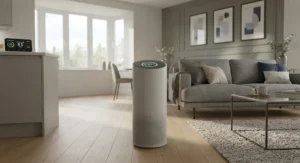
How to Choose a HEPA Air Purifier for a Large Room
- Confirm it’s genuine True HEPA, not “HEPA-type.” Only a certified True HEPA filter captures 99.97% of particles down to 0.3 microns; “HEPA-like” or “99% at 3 microns” wording describes a noticeably weaker filter.
- Match CADR to your actual room size, not the marketing headline. Divide the manufacturer’s maximum coverage claim by roughly three to get a realistic figure for genuine allergy-grade filtration at multiple air changes per hour.
- Check the noise level at the fan speed you’ll actually use overnight. A 23 dB sleep mode is worthless if Auto Mode routinely pushes the fan to 45 dB while you’re trying to sleep.
- Factor in filter replacement cost over two years, not just the sticker price. A cheaper unit with three-month filters can cost more to run than a pricier model with twelve-month filters.
- Decide whether you need activated carbon. If cooking odours, smoke, or VOCs are a concern alongside dust and pollen, prioritise models with a substantial carbon stage, not just a token layer.
- Consider two smaller units over one giant one for irregularly shaped open-plan spaces. Airflow physics favour shorter distances between any point in the room and a filter.
- Look for independent AHAM or TÜV certification rather than manufacturer-only claims. Third-party verification is the difference between a real spec and a marketing number.
HEPA Air Purifier vs Ioniser: Which Is Actually Better for Large Rooms?
This is one of the most common points of confusion for anyone shopping a HEPA air purifier vs ioniser decision, and the honest answer is that they’re not really competing technologies — they solve different problems, with different safety trade-offs.
A True HEPA filter is entirely mechanical: air is physically forced through a dense mesh of fibres that traps particles as small as 0.3 microns, and those particles stay locked in the filter until you replace it. An ioniser works electronically instead, releasing negatively charged ions that attach to airborne particles and cause them to fall out of the air onto nearby surfaces — your floor, your sofa, your walls — rather than trapping them inside a replaceable filter.
| Factor | True HEPA Filter | Ioniser |
|---|---|---|
| Mechanism | Physical filtration | Electrostatic charging |
| Particle capture | 99.97% at 0.3 microns | Varies, often lower for fine particles |
| Byproducts | None | Can produce trace ozone |
| Best for | Daily allergy and dust control | Supplemental use, not a standalone solution |
| Maintenance | Filter replacement every 6–12 months | Periodic plate cleaning |
The real point of caution, and one worth taking seriously in a large room where you’re running the unit constantly: several ionisers generate ozone as a byproduct of the charging process, and ozone is a recognised lung irritant that can aggravate asthma and allergy symptoms rather than relieve them. Public health guidance generally favours filter-based technology for exactly this reason — you’re removing pollutants, not adding a new one. If a model you’re considering includes an ionizer function (several do, including one purifier further up this guide), check whether it can be switched off, and lean towards leaving it disabled for day-to-day use in an occupied room. For a deeper look at how UK public bodies assess indoor air pollutants more broadly, the government’s response to the Air Quality Expert Group’s indoor air quality report is a genuinely useful primer.
Understanding Air Changes Per Hour (ACH) and Why It Matters
Air changes per hour, or ACH, describes how many times an air purifier can theoretically process the entire volume of air in a given room within sixty minutes. It’s calculated by dividing the unit’s CADR by the room’s volume, and it’s the single most useful number for judging real-world performance — far more useful than a bare CADR figure or a vague “covers up to X square feet” claim on its own.
This is closely related to Clean Air Delivery Rate, the standardised test measure that most of the CADR figures throughout this guide are drawn from. For genuine allergy and asthma relief, aim for four to five air changes per hour rather than the bare minimum of one that manufacturers often use to calculate their maximum headline coverage figures. A purifier rated for “1,800 square feet” is very likely only delivering a single, sluggish air change per hour at that size — adequate for removing stale odours over the course of a day, but nowhere near responsive enough to keep up with a household sneezing through hay fever season. Halve or even quarter the manufacturer’s maximum coverage claim, and you’ll usually land much closer to the room size where the unit performs at 4–5 ACH, which is exactly why the room-size figures quoted throughout this guide are deliberately more conservative than the numbers printed on the box.
Top Rated HEPA Air Purifiers: What “Top Rated” Actually Means
“Top rated” gets thrown around loosely in air purifier marketing, so it’s worth being precise about what should actually earn that label. A genuinely top rated HEPA air purifier for a large room combines four things: independently verified CADR (not just a manufacturer claim), AHAM Verifide or equivalent third-party certification, aggregated real-world review sentiment that holds up over months of ownership rather than just an initial unboxing, and a filter-replacement cost that doesn’t quietly erode the unit’s value over two or three years.
Judged against those criteria, the Coway Airmega 400 and Levoit Core 600S consistently rank among the most-cited large-room recommendations across independent testing sites, largely because both back up their coverage claims with real air-clearance data rather than optimistic marketing arithmetic. The Blueair Blue Pure 211i Max earns its “top rated” status on a different axis entirely — noise-per-CADR — while the Dyson Purifier Big+Quiet Formaldehyde tops rankings specifically for chemical filtration rather than pure particulate performance. In other words, there’s no single “best,” only the best match for your specific room, budget, and pollutant concerns.
Open-Plan Living: Placement and Multi-Zone Strategy
Open-plan living creates a specific air-purification challenge that a single-room bedroom purifier was never designed to solve: pollutants generated in one zone — cooking smoke from the kitchen, dust kicked up near the front door, pet dander from a favourite sofa spot — have to travel across the entire connected space before reaching a filter, however powerful that filter is.
The most effective strategy for open-plan living is central placement, ideally somewhere with a clear sightline to the busiest pollutant sources rather than tucked into the quietest corner. If the space exceeds roughly 50–60 m², seriously consider two mid-sized units rather than a single large one — running, say, a Levoit Vital 200S near the kitchen and a second unit near a seating area covers both zones without either machine straining to reach every corner. Reviewers who’ve tried both approaches in genuinely large open-plan spaces consistently report more even, faster particle clearance from a two-unit setup than from one oversized machine working alone, simply because the average distance any given particle travels to reach a filter is roughly halved.
Common Mistakes When Buying a HEPA Air Purifier
Buyers repeatedly fall into a handful of avoidable traps when shopping for large-room coverage. The most common is trusting a manufacturer’s maximum square-footage claim at face value, when that figure typically reflects just one air change per hour — nowhere near enough for genuine allergy control. A close second is ignoring CADR altogether and buying on brand name or design alone; a beautifully designed purifier with a low CADR simply won’t keep pace with a large, busy room, however good it looks on a shelf.
Buyers also frequently underestimate ongoing filter costs, comparing only the upfront price and later discovering that a “cheap” unit needs a £40 filter every three months, while a pricier rival needs one £50 filter a year. Forgetting to check noise levels at the fan speed you’ll realistically use — rather than the lowest, quietest setting quoted in marketing — is another recurring regret, particularly for anyone planning to run a unit overnight in a bedroom. Finally, skipping the pre-filter maintenance schedule shortens the life of the expensive HEPA stage behind it, turning what should be a twelve-month filter into an eight-month one.
Long-Term Cost & Maintenance
The purchase price is only the opening chapter of what a HEPA air purifier for large room use actually costs. Filters are consumable by design, and replacement schedules vary meaningfully across this list: the Levoit Core 600S and Levoit Vital 200S both use filters rated for up to twelve months under typical use, while some rivals need a change every six to nine months. Multiply that gap across two or three years of ownership and the total cost of ownership can shift meaningfully in favour of the longer-lasting filter, even if the unit itself cost more upfront.
Electricity is a smaller but real factor for a machine that, ideally, runs continuously. The Dyson Big+Quiet Formaldehyde’s stated 4.5W minimum draw is genuinely efficient at low speed, though its 32W maximum and larger physical size mean overall running costs land in a similar range to rivals when used realistically on Auto Mode rather than constant Turbo. As a rough rule of thumb, expect most large-room purifiers on this list to add somewhere in the region of £15–£35 a year to an electricity bill when run predominantly on low-to-medium settings, plus £40–£90 annually in filter costs depending on the model and how often carbon and HEPA stages need replacing.
Safety, Regulations and Compliance Guide
HEPA air purifiers sold in the UK don’t currently fall under a single dedicated indoor air quality law, but several bodies shape the guidance worth knowing. The National Institute for Health and Care Excellence has published guidance specifically on indoor air quality at home, aimed at raising public awareness of pollutant sources and practical mitigation, including ventilation and filtration. For households managing asthma or allergies specifically, Asthma + Lung UK’s guidance on indoor air pollution offers genuinely practical, UK-specific advice on reducing dust mite and allergen exposure at home, much of which pairs naturally with running a HEPA purifier alongside good ventilation habits.
On the product side, look for CE or UKCA marking on any unit sold in the UK, confirming it meets baseline electrical safety standards, and treat AHAM Verifide or equivalent independent CADR certification as a meaningful signal of trustworthy performance claims rather than optional marketing flourish. If a household includes anyone with asthma, COPD, or another respiratory condition, it’s worth discussing air purification as part of a wider management plan with a GP or specialist rather than treating a purifier as a substitute for prescribed treatment.
✨ Don’t Miss These Exclusive Deals!
🔍 Breathe Easier Starting Today. Ready to tackle allergens in your open-plan space for good? Compare the seven models above and pick the one that matches your room size, budget, and noise tolerance — your lungs will thank you.
Noise at Max Speed: What the Decibel Numbers Actually Mean
Noise at max speed is the figure buyers most often overlook until the unit is already running in their living room, and it deserves more attention than the whisper-quiet sleep-mode number that dominates most marketing pages. Independent testing across this guide’s line-up shows a real spread: the Coway Airmega 400 and Blueair Blue Pure 211i Max both top out in the low-to-mid 50s dB, broadly comparable to a normal conversation at close range, while the Levoit Core 600S has been independently measured pushing past 60 dB on its highest setting — noticeably louder, closer to a running dishwasher.
The practical takeaway is straightforward: identify the fan speed you’ll actually run day-to-day, usually Auto Mode or a medium manual setting, and judge noise at that level rather than at the quietest or loudest extreme quoted on the box. A machine with a spectacular 20 dB sleep mode is no comfort at 3pm if Auto Mode routinely pushes it to 45 dB while you’re trying to concentrate on a video call in an open-plan home office.

Frequently Asked Questions
❓ What size room does a HEPA air purifier for large room use actually cover?
❓ Is a HEPA air purifier or an ioniser better for allergies?
❓ How many air changes per hour do I actually need?
❓ How loud is too loud for a large-room air purifier at max speed?
❓ Do I need two air purifiers for one big open-plan room?
Conclusion
Choosing a HEPA air purifier for large room use comes down to being honest with yourself about three things: your actual square footage, the noise level you can live with at the fan speed you’ll realistically use, and whether dust and pollen are your only concern or whether VOCs and odours matter too. The Levoit Core 600S and Coway Airmega 400 cover the widest range of genuine large-room scenarios at sensible prices, the Blueair Blue Pure 211i Max is the pick for noise-sensitive households, and the Dyson Purifier Big+Quiet Formaldehyde justifies its premium only if chemical filtration genuinely matters to you.
None of these machines are magic. A HEPA air purifier works continuously, quietly, and mechanically — it won’t fix a damp problem, replace regular vacuuming, or single-handedly cure a dust mite allergy. What it will do, backed by real CADR data rather than marketing arithmetic, is meaningfully reduce the particulate load in a large room, day after day, in a way that’s genuinely noticeable within the first week of ownership. Match the unit to your room size honestly, budget for filter replacements as part of the real cost, and you’ll end up with cleaner air rather than an expensive, oversized fan.
Recommended for You
- Best HEPA Air Purifier UK 2026: 7 Top Picks
- Whole House Air Purifier: 7 Powerful Picks for Cleaner Air in 2026
- Best Air Purifier For 3 Bedroom House in 2026: 7 Top Picks
Disclaimer: This article contains affiliate links. As an Amazon Associate, I earn from qualifying purchases. If you purchase products through these links, we may earn a small commission at no additional cost to you.
✨ Found this helpful? Share it with your friends! 💬🤗
