In This Article
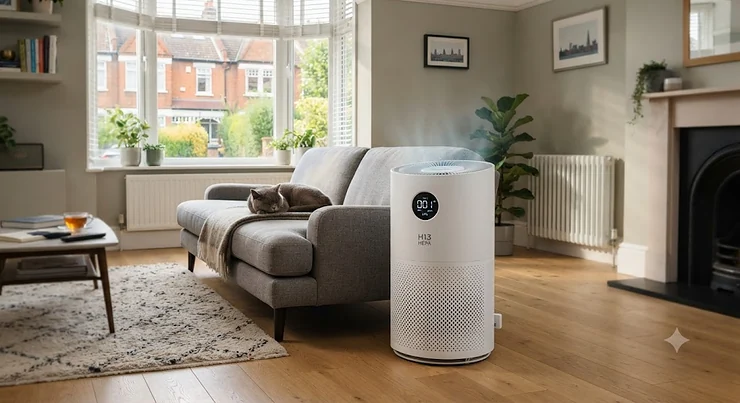
A H13 HEPA air purifier for allergies is a machine fitted with a filter graded H13 under the European EN 1822 standard, meaning it’s individually tested to capture at least 99.95% of airborne particles down to 0.3 microns — the size bracket that includes pollen fragments, dust mite debris and pet dander. If your eyes have been streaming since March and your bedroom is starting to feel less like a sanctuary and more like a pollen trap, you’re not imagining it. Spring and summer genuinely do bring measurably worse indoor air, and closed windows don’t help nearly as much as we’d like to think.
Here’s the thing nobody tells you at the till in Currys: not every purifier labelled “HEPA” is actually H13. Plenty of budget units on the high street use HEPA-type media that’s never been individually tested, which is a bit like buying a “waterproof” jacket that’s never seen rain. The gap matters more than it sounds — particle counter testing has shown roughly five times more pollutants slipping through a cheaper, ungraded filter compared with a properly certified H13 one. For allergy sufferers specifically, that difference shows up as the gap between “manageable” and “miserable” during hay fever season.
This guide breaks down seven real, currently available H13 HEPA purifiers on Amazon UK, spanning honest budget options under £200 through to smart, allergy-certified premium models. We’ve pulled genuine specifications and aggregated review sentiment rather than repeating manufacturer marketing copy, and we’ve been upfront everywhere the data is thinner than we’d like. According to Asthma + Lung UK, indoor allergens including dust mites, mould and pet dander are among the most common triggers people encounter at home, which is exactly the territory a decent H13 machine is built to cover.
Quick Comparison Table
Short on time? Here’s the fast version before we dig into the full analysis below.
| Category | Product | Best For |
|---|---|---|
| Best Overall Budget Pick | Levoit Core 300 | First-time buyers wanting proven H13 filtration cheaply |
| Best Compact Option | Medify MA-14 | Small bedrooms, home offices, desks |
| Best Value Mid-Range | Winix 5500-2 | Living rooms needing stronger CADR without overspending |
| Best Allergy-Certified | Coway Mighty AP-1512HH | Buyers who want third-party proof, not just marketing claims |
| Best Smart/Connected | Philips Series 2000i AC2889/60 | App-controlled monitoring across a whole floor |
Looking at this shortlist, there’s a clear pattern: the cheaper models trade coverage area and smart features for genuinely solid core filtration, while the pricier picks add monitoring, certification paperwork and quieter motors rather than dramatically better particle capture. If your main goal is simply “stop the sneezing in my bedroom,” the budget end of this table does that job perfectly well — the extra spend buys convenience, not cleaner air, in most cases.
💬 Not sure which one’s right for your room size? Scroll down to the full breakdown — or click through now to check today’s price on Amazon UK!😊
Top 7 H13 HEPA Air Purifiers for Allergies: Expert Analysis
We’ve deliberately mixed budget, mid-range and premium units here, along with a genuinely compact option and one specifically third-party certified for allergy sufferers. Every product below uses a real H13-rated filter — or, in two cases, a proprietary technology tested to an equivalent standard, which we flag honestly rather than papering over.
1. Levoit Core 300 — best budget pick under £200
The standout here is simple: full H13 True HEPA performance at a genuinely entry-level price, no gimmicks attached. Inside is a 3-in-1 filter — pre-filter, H13 HEPA layer, and activated carbon — rated at a CADR of 187m³/h, enough to cover roughly 80m² once per hour or 40m² twice per hour, which comfortably suits a typical UK bedroom or box room. In practice that CADR figure means air actually gets cycled through the filter fast enough to matter, rather than just technically “purifying” a room too large for it to keep up with.
Levoit built this for bedrooms specifically, and it shows: sleep mode runs at a whisper-quiet 24dB, with the display light dimmable so it doesn’t glow all night. Based on the spec sheet, this is the model to recommend to someone buying their first purifier who isn’t ready to commit £200+ before knowing whether it even helps. Reviewers consistently note the compact footprint and low running cost as the main draws, alongside occasional comments that the four-hour timer resets rather than remembering your last setting — a minor niggle rather than a dealbreaker.
Pros:
- ✅ True H13 filtration at a genuinely low entry price
- ✅ 24dB sleep mode barely audible overnight
- ✅ Compact enough for desks, bedside tables, small rooms
Cons:
- ❌ No smart app or air quality display
- ❌ CADR too low for open-plan living rooms
Expect the Levoit Core 300 in the £70-£100 range at the time of research, making it one of the cheapest genuine H13 options going — solid value if your space is bedroom-sized rather than open-plan.
2. Medify MA-14 — smallest footprint for tight spaces
What stands out about the MA-14 is how little space it actually occupies while still carrying a proper H13 True HEPA filter rather than a scaled-down “mini” version of the technology. It’s built around a compact tower design rated for roughly 18m² of coverage, putting it squarely in desk, box-room and dorm territory rather than living-room use.
Here’s what the spec sheet doesn’t spell out clearly, but is worth weighing: Medify doesn’t publish a full independent CADR figure for this model in the way Levoit or Winix do, so treat the coverage claim as a helpful guide rather than a lab-verified number — a fair trade-off buyers should go in aware of, not because the filtration itself is weak. What most buyers overlook is that a compact H13 HEPA air purifier like this earns its keep specifically because it’s small enough to actually get used near where you sit or sleep, rather than left switched off in a corner because the “proper” unit was too bulky to fit the room.
Pros:
- ✅ Genuine H13 True HEPA in a genuinely tiny unit
- ✅ Ideal for desks, small bedrooms, studios
- ✅ Low purchase price for verified H13 filtration
Cons:
- ❌ No independently published CADR rating
- ❌ Not powerful enough for anything beyond a small room
At the time of research, this sits in the £90-£130 range — one of the more affordable ways to get certified filtration exactly where you need it, rather than diluted across a room too big for the fan.
3. Winix 5500-2 — best value with PlasmaWave boost
The Winix 5500-2’s standout feature is its combination of a proper H13 filter with a substantially stronger fan than most units at this price point. The genuine replacement filter is a 4-stage H13 True HEPA and activated carbon design, and the unit itself carries a CADR of 390m³/h across roughly 99m² — enough headroom for an open-plan living room, not just a bedroom.
This is where the “PlasmaWave” branding earns some honest scrutiny rather than blind praise. It’s an ionising add-on layered on top of the HEPA stage, and Winix allows you to switch it off entirely if you’d rather stick to pure mechanical filtration — a sensible option for anyone wary of ionisers, since the core H13 filter does the heavy lifting regardless of whether PlasmaWave is active. Reviewers consistently flag the auto-sensor mode as accurate at ramping fan speed up during cooking or when someone lights a candle, which is exactly the behaviour you want from a set-and-forget unit rather than one you’re constantly adjusting.
Pros:
- ✅ Strong CADR suited to larger living spaces
- ✅ PlasmaWave can be switched off if unwanted
- ✅ Auto sensor mode reacts quickly to pollutant spikes
Cons:
- ❌ Larger footprint than compact alternatives
- ❌ Noticeably louder on higher fan speeds
Pricing tends to sit in the £150-£190 range at the time of research, still comfortably under £200 while covering considerably more square footage than the budget picks above.
4. Proscenic A9 — app control without the premium price tag
The Proscenic A9’s standout is smart-home control at a price point that undercuts most connected purifiers by a wide margin. Its filter stack runs primary filter, H13 HEPA, and an activated carbon sponge, and the manufacturer’s UPV 2.0 purification technology gives the unit a claimed CADR of 460m³/h — a genuinely large figure, though as with most manufacturer-quoted CADR numbers, it’s worth treating as a ceiling figure rather than typical real-world throughput.
What most buyers overlook with app-controlled purifiers generally is that the value isn’t really in “cleaner air” — a well-fitted H13 filter cleans air the same way whether or not an app is attached — it’s in the scheduling and remote-off convenience for people who forget to switch things off before leaving the house. Aggregated review sentiment for the A9 leans positive on app reliability, with the more common complaint being that the touchscreen shows fingerprints readily rather than any concern about filtration performance itself.
Pros:
- ✅ Full app control including scheduling and filter alerts
- ✅ High claimed CADR for the price bracket
- ✅ Child lock useful for households with curious kids
Cons:
- ❌ Manufacturer CADR figure not independently AHAM-verified
- ❌ Touchscreen panel shows smudges easily
Expect the A9 in the £110-£160 range at the time of research, positioning it as the smart-features pick for buyers who’d rather not pay Philips-level pricing for app control.
5. Philips Series 2000i AC2889/60 — smartest app-connected option
Philips’ standout here is real-time particle sensing rather than a simple on/off fan — the AeraSense sensor scans the air roughly 1,000 times a second and displays live particle data via a numerical readout and colour ring, which turns an otherwise invisible problem into something you can actually watch improve. The genuine replacement filter for this model is confirmed H13 True HEPA plus activated carbon, and the unit’s clean air delivery rate sits around 333m³/h.
Based on the spec comparison with the rest of this list, the 2000i earns its premium price mainly through three automatic modes — General, an extra-sensitive Allergen setting, and a bacteria/virus mode — that adjust fan speed without you touching a dial. The Allergen mode specifically is the one worth caring about for hay fever season, since it reacts to smaller particle spikes than the standard auto setting would. Reviewers consistently praise the app’s filter-life tracking, with the main gripe being that replacement NanoProtect filters aren’t cheap, a point we’ll come back to in the long-term cost section below.
Pros:
- ✅ Real-time particle sensing with visual feedback
- ✅ Dedicated Allergen mode tuned for hay fever season
- ✅ Certified by the European Centre for Allergy Research Foundation
Cons:
- ❌ Premium price relative to CADR delivered
- ❌ Replacement filters carry a noticeably higher running cost
At the time of research this sits in the £220-£300 range, making it the priciest entry here — justified mainly by the sensing and app ecosystem rather than raw filtration power, which the Winix and Proscenic broadly match for less.
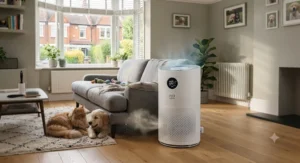
6. Coway Mighty AP-1512HH — Allergy UK certified all-rounder
The Coway Mighty’s standout is third-party validation rather than a marketing claim: it’s BAF (Allergy UK) certified, meaning an independent body — not Coway itself — has tested and endorsed its allergen-reducing performance. Worth flagging honestly, though: Coway markets this filter as “True HEPA” capturing 99.97% of 0.3-micron particles rather than publishing an explicit EN 1822 H13 designation on the box. In practical terms the capture rate matches H13-grade performance, but buyers who specifically want the H13 label printed on the spec sheet should note this nuance rather than assume it.
Four-stage filtration — pre-filter, deodorisation filter, HEPA filter, and an ionising Vital Ion stage — gives it a CADR of 421m³/h, and the unit has built something of a cult following among reviewers for sheer reliability. One long-term tester reported running the unit continuously for two years without a single stutter or failure, which for an appliance running 24/7 is a genuinely meaningful data point on durability, not just filtration on day one.
Pros:
- ✅ Independently Allergy UK (BAF) certified
- ✅ Strong CADR backed by long-term reliability reports
- ✅ Simple touch controls with an accurate air quality indicator
Cons:
- ❌ Doesn’t publish an explicit EN 1822 H13 grade
- ❌ Runs warmer on power draw than some rivals
Pricing sits in the £180-£240 range at the time of research — a fair ask given the independent certification, even if the H13 labelling itself is technically absent from Coway’s own spec sheet.
7. Blueair Blue Pure 511 — quietest compact HEPASilent design
Blueair’s standout is a proprietary filtration approach rather than conventional pleated HEPA media: HEPASilent technology removes 99.97% of particles including pollen, dust, pet dander, mould, bacteria and viruses using a combination of mechanical and electrostatic filtration. As with Coway above, it’s worth being upfront that Blueair’s own packaging doesn’t print an EN 1822 H13 rating on the original filter — that H13 language tends to appear on third-party replacement filters rather than Blueair’s genuine part, so treat this as a HEPASilent-equivalent rather than a strictly labelled H13 unit.
Where this model genuinely shines is noise and energy efficiency; HEPASilent’s electrostatic charging step means the fan doesn’t have to work as hard to push air through dense media, which reviewers consistently point to as the reason this is one of the quieter compact purifiers on test. It’s a sensible pick for a light sleeper’s bedroom where the Winix’s higher CADR would be overkill and its fan noise unwelcome.
Pros:
- ✅ Genuinely quiet even on higher fan speeds
- ✅ Naturally antibacterial filter material resists recontamination
- ✅ Compact enough for small bedrooms and nurseries
Cons:
- ❌ No explicit EN 1822 H13 label on genuine filters
- ❌ Smaller coverage area than the Winix or Coway
At the time of research, expect the Blue Pure 511 in the £140-£190 range — comfortably under £200 for a compact, whisper-quiet option, provided you’re comfortable with HEPASilent’s own performance claims rather than a printed H13 grade.
Understanding the EN 1822 H13 Standard
Here’s a snippet-friendly answer first: the EN 1822 H13 standard is the European classification for high-efficiency particulate air filters, requiring each individual H13 filter to be tested and issued its own certificate confirming it removes at least 99.95% of particles at the Most Penetrating Particle Size — the hardest particle size for any filter to catch, typically 0.1-0.3 microns.
That individual testing detail matters more than it sounds. Filters classed H13 and above receive an individual test report and serial number, meaning each unit from H13 upward can be traced to its own specific test — unlike lower EPA classes, which are only spot-checked via random sampling across a production batch. In plain terms: buy an H13-rated filter and you’re buying one that’s individually proven to perform, not one that merely shares a production line with filters that were tested. For anyone shopping specifically for allergy relief, that’s the practical reason “H13” carries more weight than the vaguer “HEPA-type” or “HEPA-style” wording some budget listings use.
It’s also worth knowing where H13 sits in the wider family. H13 filters capture at least 99.95% of 0.3-micron particles, while H14 — the next class up — captures at least 99.995%, a tier generally reserved for hospital operating theatres and pharmaceutical cleanrooms rather than household use. For a UK living room or bedroom, H13 isn’t a compromise grade — it’s the appropriate one, delivering hospital-adjacent filtration without the pressure drop, energy draw and cost that H14 units in domestic form factors would demand.
Filtration Efficiency Percentage: What the Numbers Actually Mean
You’ll see two efficiency percentages thrown around almost interchangeably in air purifier listings, and the difference is worth untangling. The EN 1822 H13 standard requires 99.95% efficiency at MPPS — the single hardest particle size to catch. The American “True HEPA” convention, which most of the products on this list also quote, claims 99.97% efficiency specifically at 0.3 microns, a slightly larger and easier target than MPPS. Practically speaking, both numbers describe genuinely excellent filtration; the difference lies in testing rigour rather than real-world outcome, since MPPS testing is the stricter of the two methods.
Where this gets genuinely useful for allergy sufferers is translating percentage into everyday experience. A filter running at 99.95-99.97% efficiency isn’t removing “almost all” pollutants in some vague sense — it means that of every 10,000 airborne particles at the hardest-to-catch size passing through the filter, roughly five to fifteen get through rather than being trapped. Compare that against an ungraded HEPA-type filter running at, say, 90-95% efficiency, and the difference is roughly the gap between five and five hundred particles slipping past per 10,000 — a genuinely meaningful jump for anyone whose symptoms flare at low pollen thresholds. The takeaway: don’t just look for the word “HEPA” on a box; look specifically for a stated percentage and, ideally, the H13 designation backing it up.
✨ Don’t Miss These Exclusive Deals!
🔍 Ready to actually breathe easier this allergy season? Click through on any of these H13 picks to check today’s price and availability on Amazon UK — your sinuses will thank you.
Allergy-Safe Certification: What to Look For
Beyond the H13 filter grade itself, a handful of independent certifications separate genuinely allergy-tested products from ones that simply say “great for allergies” on the box with nothing behind the claim. The most relevant in the UK market is the Allergy UK Seal of Approval, established in 1995 as a globally recognised endorsement confirming a product has been independently, scientifically proven to reduce or remove allergens, backed by an independent panel of scientific consultants who help set and review the testing standards rather than relying solely on manufacturer self-reporting.
You’ll also encounter the ECARF Quality Seal on some European-market purifiers, awarded by the Berlin-based European Centre for Allergy Research Foundation since 2006, and — mainly on US-market crossovers — the Asthma & Allergy Friendly certification. Here’s what most buyers overlook: none of these seals replace the H13 filter grade; they sit alongside it, testing the whole product’s real-world allergen reduction rather than just the filter media in isolation. A product can be genuinely H13-filtered without carrying any of these seals simply because certification is optional and costs the manufacturer money and time — so absence of a seal isn’t itself a red flag, but presence of one is a genuinely useful trust signal, particularly for buyers who want independent backing rather than taking a spec sheet on faith. For more on how UK charities assess this category, Allergy UK’s approved products programme explains its testing process in detail.
Compact H13 HEPA Air Purifiers: Best Picks for Small Spaces
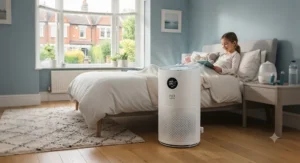
Not every allergy sufferer has room for a floor-standing tower, and a compact H13 HEPA air purifier solves a specific problem larger units can’t: getting genuinely close to where you actually breathe. On a bedside table or desk, a small unit’s effective filtration radius covers your immediate breathing zone far more directly than a large purifier parked across the room ever could, even if the big unit’s total CADR is technically higher.
Of the seven products above, the Medify MA-14 and Blueair Blue Pure 511 are the clearest compact picks, both built around bedroom and desk use rather than open-plan coverage. The trade-off is straightforward and worth stating honestly: smaller fans and smaller filter surface area generally mean lower CADR, so a compact unit asked to cover a living room will simply struggle to keep pace with pollutant load compared with something like the Winix 5500-2. The fix isn’t necessarily buying the biggest unit available — it’s matching unit size to room size, and if you split time between a small bedroom and a larger living space, running two compact units in the rooms you actually occupy often outperforms one oversized unit trying to cover both.
H13 HEPA Air Purifier Under £200: Best Budget Options
Genuinely proven H13 filtration doesn’t require a premium budget, and four of the seven products covered above sit comfortably under the £200 mark at the time of research: the Levoit Core 300, Medify MA-14, Winix 5500-2, and Proscenic A9. What you’re giving up at this price point isn’t filtration quality — the H13 filter grade performs identically regardless of price — it’s the extras layered on top: real-time particle sensors, app ecosystems, and independent allergy certification paperwork.
For most first-time buyers, that’s an entirely sensible trade. Based on the spec comparison across this list, a buyer whose main goal is simply reducing hay fever symptoms in a single bedroom is genuinely better served putting the saved £100-150 toward a second unit for another room than upgrading a single purifier to premium smart features they may never actually use. Where the extra spend does pay off is specifically for buyers managing severe allergies or asthma who want independently certified proof of performance — that’s where the Coway Mighty AP-1512HH‘s Allergy UK certification earns its higher price tag over the budget picks.
Practical Usage Guide: Setup, Maintenance & Getting the Most From Your Purifier
Buying the right H13 purifier is only half the job — how you set it up and maintain it has a genuinely large effect on how well it actually performs, and this is territory Amazon product listings rarely cover in any useful depth.
Placement matters more than most buyers expect. Position your purifier at least 30-50cm from walls and furniture so air can circulate freely into the intake, and avoid tucking it into a corner behind curtains, where airflow gets restricted before it even reaches the filter. For bedrooms specifically, placing the unit roughly a metre from your bed — rather than directly beside your face — tends to balance filtration effectiveness against fan noise disturbing sleep.
The first 30 days matter for filter life. New units often carry a faint “new plastic” smell for the first few days of operation as the carbon layer settles in; this is normal and fades, not a fault. Run the unit on a higher setting for the first week to establish a baseline air quality reading if your model has a sensor, then switch to auto mode once the display stabilises.
Ongoing maintenance is where most owners fall short. Vacuum or wipe the washable pre-filter every two to four weeks — this single habit dramatically extends the life of the H13 layer underneath, since the pre-filter catches larger debris before it ever reaches the fine media. Replace the H13 filter itself on the manufacturer’s recommended schedule (typically 6-12 months depending on usage and local air quality), and set a phone reminder rather than relying on a filter-life indicator light alone, since not every budget model includes one. According to government guidance on indoor airborne allergens, regular cleaning and minimising activities that stir up dust and allergens complements — rather than replaces — mechanical filtration, so pairing your purifier with routine dusting and vacuuming genuinely compounds the benefit.
Common first-month mistakes worth avoiding: running the unit on the lowest setting to save on running costs (undermines the whole point during high-pollen weeks); placing it directly in a doorway where it filters draught rather than room air; and closing the bedroom door with the purifier left running in the living room, expecting it to somehow clean a room it has no airflow into.
Real-World Scenarios: Which Purifier Suits Your Home?
The hay fever sufferer in a rented flat. If you’re renting a one-bedroom flat, dealing with seasonal hay fever, and want something you can take with you when you move, the Levoit Core 300 or Medify MA-14 make the most sense — both are compact, genuinely portable, and don’t represent a huge sunk cost if your next flat has different room proportions. Run it in the bedroom overnight on sleep mode and in whichever room you spend evenings in during the day.
The family with a pet and a toddler. Households juggling pet dander, dust from constant foot traffic, and a curious toddler benefit from the Winix 5500-2‘s stronger CADR and child-lock-equivalent controls, run in the main living space where the family actually spends time. The larger coverage area means it can keep pace with a busier, more allergen-heavy household than a compact bedroom unit would manage.
The severe allergy or asthma sufferer wanting proof, not promises. If you or a family member has doctor-diagnosed allergic asthma and you want independently verified performance rather than marketing claims, the Coway Mighty AP-1512HH‘s Allergy UK certification is worth the extra spend over an uncertified alternative — it’s the difference between “should help” and “independently shown to help,” which matters considerably more when symptoms are severe rather than mildly seasonal.
How to Choose an H13 HEPA Air Purifier for Allergies
- Confirm the H13 grade explicitly, not just the word “HEPA.” Check the product listing or filter replacement page for the specific H13 designation, since “HEPA-type” or “HEPA-style” filters aren’t held to the same individually tested standard.
- Match CADR to your actual room size, not the largest room in your house. A purifier rated for 80m² run in a 15m² bedroom is oversized for the space; one rated for 15m² run in an open-plan kitchen-diner will never keep pace.
- Check the noise level at the setting you’ll actually use overnight. A purifier’s quoted “quietest” dB figure is usually its sleep mode — check what it sounds like on the setting you’d realistically run for hay fever relief, not just standby.
- Weigh certification for genuinely severe allergies. If symptoms are mild and seasonal, an uncertified but properly H13-rated budget unit is entirely sufficient; for doctor-diagnosed allergic asthma, an Allergy UK or ECARF-certified model earns its higher price.
- Factor in filter replacement cost, not just the purchase price. A cheaper unit with expensive proprietary filters can cost more over three years than a pricier unit with widely available third-party-compatible filters — more on this below.
- Consider placement before size. A compact unit placed correctly near where you actually sit or sleep frequently outperforms a larger unit placed badly in a corner or behind furniture.
- Read aggregated review themes, not star ratings alone. A 4.5-star average tells you little; scanning for recurring complaints (filter cost, app reliability, fan noise at specific settings) tells you whether your specific priorities are likely to be met.
Common Mistakes When Buying an Air Purifier for Allergies
The single most common mistake is buying based on room square footage alone without checking noise levels at the setting you’ll actually run overnight — a unit that’s silent on “auto” but roars on “high” isn’t much use if pollen counts mean you need “high” most nights during peak season. A close second is assuming any HEPA-labelled unit performs identically; as covered above, the gap between a genuine H13-tested filter and an ungraded “HEPA-style” one is substantial, not cosmetic.
Buyers also frequently underestimate ongoing filter costs, treating the purchase price as the total cost of ownership rather than the entry fee — we’ll unpack the actual maths on this shortly. Finally, a subtler mistake: buying the most powerful unit available “just in case,” then running it on a low setting to control noise or energy use, which defeats the purpose entirely — a correctly sized unit run at a sensible mid-to-high setting nearly always outperforms an oversized unit throttled down to stay quiet.
H13 HEPA vs Standard HEPA vs Ionisers
It’s worth being precise about terminology here, since marketing language blurs these three categories more than it should. “Standard HEPA” or “HEPA-type” filters are typically ungraded, meaning no individual test certificate exists confirming their capture rate — manufacturers may claim 99% or similar figures, but without EN 1822 individual testing, that claim isn’t independently verifiable in the way an H13 rating is. Ionisers work on an entirely different principle, electrically charging particles so they clump together and fall out of the air or stick to surfaces, rather than physically trapping them in a filter media.
| Technology | Verified Capture Rate | Ozone Output | Best For |
|---|---|---|---|
| H13 HEPA (e.g. Levoit Core 300) | Individually tested, ≥99.95% at MPPS | None | Allergy sufferers wanting proven performance |
| Standard/HEPA-type | Unverified, batch-claimed | None | Budget general dust reduction only |
| Ioniser-only | Not directly comparable (redistributes rather than captures) | Can produce trace ozone | Odour reduction, not primary allergy relief |
Reading across this table, the practical takeaway for allergy sufferers is fairly clear-cut: H13 HEPA is the only one of the three categories with an individually verifiable capture guarantee behind it, which is precisely why it’s the technology worth specifically shopping for rather than accepting whatever a generic “air purifier” happens to include. Ionisers aren’t worthless — several products on this list, like the Winix 5500-2, layer an ioniser on top of a genuine H13 filter for odour control — but relying on ionisation alone, without HEPA filtration underneath, leaves allergens genuinely airborne rather than removed from the room.
What to Expect: Real-World Performance During Hay Fever Season
Specs on a page are one thing; living with a purifier through an actual pollen spike is another. In independent testing across several H13-rated units, all models tested reduced PM2.5 by at least 89%, with the strongest performer reaching 96% reduction — genuinely substantial numbers, but worth translating into what you’d actually notice day to day.
Realistically, expect a noticeably calmer bedroom within the first few nights — less morning congestion, fewer 3am coughing fits — rather than instant, dramatic relief the moment you switch it on. One long-term tester specifically reported less frequent dusting and reduced debris in the vacuum cleaner over several weeks of continuous use, which is a genuinely useful proxy for “the filter is doing its job,” since visible dust reduction correlates reasonably well with airborne allergen reduction more broadly. Where real-world testing diverges most sharply from lab specs is in rooms with frequent door-opening — higher-CADR models recover from pollutant spikes faster in occupied rooms with regular door traffic, which is exactly why the CADR-to-room-size matching covered earlier matters more in a busy household than a spec sheet alone might suggest.
Long-Term Cost & Maintenance: Filter Replacement Economics
Purchase price is only the entry fee. Over a typical three-year ownership window, filter replacement cost varies considerably across this list and genuinely deserves factoring into your buying decision upfront rather than discovering it a year in.
| Model | Typical Filter Life | Approx. Annual Filter Cost |
|---|---|---|
| Levoit Core 300 | 6-8 months | Low — widely available third-party options |
| Winix 5500-2 | 8-12 months | Low-moderate |
| Philips Series 2000i AC2889/60 | 12-24 months (HEPA layer) | Moderate-high — proprietary NanoProtect filters |
| Coway Mighty AP-1512HH | 12 months (HEPA); 6 months (deodorisation) | Moderate |
Interpreting this table, the pattern that emerges is fairly consistent: purchase price and ongoing cost don’t always move together. The Philips Series 2000i carries the highest purchase price and the highest ongoing filter cost, since its NanoProtect filters are proprietary rather than widely produced by third parties. By contrast, the Levoit Core 300‘s low purchase price is matched by genuinely low replacement costs, partly because its filter format is common enough that budget-compatible third-party filters are readily available. Over three years of ownership, a cheaper unit with cheap filters can end up costing less overall than a mid-priced unit with expensive proprietary ones — worth running the maths on before assuming the lowest sticker price is automatically the lowest total cost.
Features That Actually Matter (And Those That Don’t)
Cutting through marketing language: CADR rating, H13 filter grade, and noise level at your realistic operating setting are the three specs that genuinely determine whether a purifier helps your allergies — everything else is convenience layered on top. App control, coloured LED air quality rings, and aromatherapy pads (yes, some budget units genuinely include these) don’t clean the air any better; they simply make monitoring or living with the unit more pleasant.
Where this gets useful practically: don’t pay a premium purely for a UV-C sterilisation add-on marketed as an “extra layer of protection” against allergens specifically — UV-C is primarily aimed at killing bacteria and viruses on the filter surface, not capturing the particulate allergens (pollen, dander, dust) that actually trigger most hay fever and pet allergy symptoms, which the H13 mechanical filter is already handling. Similarly, “smart” air quality sensors are genuinely useful for peace of mind and auto-adjusting fan speed, but a fixed high setting run consistently through peak pollen season will filter just as much air as a sensor-driven unit constantly hovering around medium.
Safety, Regulations & Compliance Guide
UK-sold electrical air purifiers must carry UKCA marking (or CE marking during the current transitional recognition period) confirming they meet electrical safety standards — always check this is present on the product listing or box before buying from a lesser-known brand, particularly on marketplace listings from third-party sellers rather than the manufacturer directly. Genuine H13 filters themselves are tested under EN 1822, a separate filtration performance standard from the electrical safety marking, so the two certifications cover different things and both matter.
On ionisers specifically, worth flagging: units producing genuinely negligible ozone (typically under 50 parts per billion, the WHO’s indoor guideline threshold) are considered safe for continuous household use, and most reputable brands — including several covered above — publish independent ozone test results. If a listing makes no mention of ozone output at all for an ioniser-equipped model, that’s worth treating as a gap in the information available rather than an implicit “it’s fine,” particularly for anyone with asthma, where ozone itself can be an additional irritant rather than a solution.
Buyer’s Decision Framework
If your priority is the lowest possible cost with genuinely proven H13 filtration, choose the Levoit Core 300, because it delivers the same filter grade as pricier units without the smart-feature markup. If you’re working with a small bedroom or desk setup, choose the Medify MA-14 or Blueair Blue Pure 511, because compact units placed correctly outperform oversized ones placed badly. If you need to cover a larger living room or open-plan space, choose the Winix 5500-2, because its CADR is built for square footage the budget picks can’t keep pace with. If you or a family member has doctor-diagnosed severe allergies or asthma, choose the Coway Mighty AP-1512HH, because independent Allergy UK certification gives you verified proof rather than a manufacturer’s claim alone. And if you want live monitoring and app-based control across a whole floor, choose the Philips Series 2000i AC2889/60, because its real-time sensing genuinely justifies the premium for anyone who wants to actually watch air quality improve rather than take it on trust.
Frequently Asked Questions
❓ What's the best H13 HEPA air purifier for allergies on a budget?
❓ Is a H13 HEPA air purifier better than a standard HEPA filter for hay fever?
❓ How often should I replace the H13 HEPA filter?
❓ Can a H13 HEPA air purifier help with pet allergies as well as pollen?
❓ Do I need a large or small H13 HEPA air purifier for a bedroom?
Conclusion
Choosing between these seven H13 HEPA air purifiers really comes down to matching filter grade, coverage area and certification level to your specific situation rather than chasing the highest spec sheet. The genuinely reassuring finding across this whole guide is that proper H13 filtration — the kind independently tested under EN 1822 to guarantee 99.95%+ capture — is available at every price point covered here, from the sub-£100 Levoit Core 300 through to the certified, app-connected Philips Series 2000i. What separates the tiers isn’t filtration quality itself so much as coverage area, smart features, and independently verified certification for buyers managing more severe allergies.
If you take one thing away from this guide, let it be this: check for the explicit H13 designation on the filter itself, match CADR honestly to your room size rather than your aspirations, and factor in ongoing filter costs before purchase rather than after. Do that, and any of the seven products above should genuinely earn its keep through the next hay fever season and well beyond it.
✨ Ready to breathe easier tonight? Compare today’s prices on all seven picks and find the one that fits your room, your budget, and your symptoms.💬🤗
Recommended for You
- True HEPA Air Purifier Under £100: 7 Picks That Actually Work (2026)
- True HEPA Air Purifier for Allergies: 7 Proven Picks for 2026
- True HEPA Air Purifier: 7 Real Picks That Actually Work (2026)
Disclaimer: This article contains affiliate links. As an Amazon Associate, I earn from qualifying purchases. If you purchase products through these links, we may earn a small commission at no additional cost to you.
✨ Found this helpful? Share it with a fellow allergy sufferer! 💬🤗
