In This Article
Somewhere between the third sneeze and the fourth blast of antihistamine, most allergy sufferers start wondering if their own living room is working against them. It usually is. A true HEPA air purifier for allergies is a home air-cleaning device fitted with a certified High-Efficiency Particulate Air filter that traps at least 99.97% of airborne particles down to 0.3 microns — the size band that covers pollen, dust mite debris, mould spores and pet dander. That’s the textbook definition, but the lived experience is simpler: run one properly, and the itchy eyes and 3am coughing fits tend to calm right down.

Britain isn’t short on triggers. Grass pollen season alone stretches from May into August, and that’s before you factor in damp housing stock, centrally heated flats that trap dust, and the roughly half of UK households that share their sofa with a cat or dog. A true HEPA air purifier for allergies won’t cure a sensitised immune system, but it does something a nasal spray can’t: it reduces the total allergen load floating around the room you sleep, work and relax in.
This guide skips the marketing fluff. We’ve dug into real product specifications, independently tested CADR figures, and aggregated review sentiment from owners and testers across seven genuine models — spanning a sub-£90 bedroom unit right up to a hospital-grade machine costing several hundred pounds. Whether you’re chasing pollen relief, wrangling pet hair, or trying to keep fine particulate matter away from an asthmatic chest, there’s a sensible option ahead. Let’s get into it.
Quick Comparison Table
| Product | Filter Grade | Standout Strength | Best For | Price Range |
|---|---|---|---|---|
| Levoit Core 300 | True H13 HEPA | Best CADR-per-pound | Small bedrooms on a budget | Under £90 |
| MeacoClean CA-HEPA 76×5 | True H13 HEPA | UK-built, pollen tracking app | Hay fever sufferers | £190-£230 |
| Blueair Blue Pure 411+ | HEPASilent (electrostatic + HEPA) | Whisper-quiet 17dB | Light sleepers | £90-£130 |
| Shark NeverChange5 HP150UK | NanoSeal HEPA | 5-year, zero-replacement filter | Low-maintenance households | £150-£200 |
| Coway Airmega 150 | True HEPA | Legendary reliability | Long-term daily use | £160-£190 |
| Dyson Purifier Cool TP12 | Sealed HEPA H13 | Fan + purifier in one | Multi-season, multi-use rooms | £400-£480 |
| IQAir HealthPro Plus | HyperHEPA (0.003 micron) | Highest tested allergen removal | Severe allergy or asthma | £700-£900+ |
Looking at the spread above, there’s no single “best” true HEPA air purifier for allergies — there’s a best one for your room, your budget and your allergy severity. The Levoit Core 300 and Blueair Blue Pure 411+ both punch well above their price for a single bedroom, while the Coway Airmega 150 and Shark NeverChange5 HP150UK are built for people who want to set it running and forget about filter shopping for months at a time. At the top end, the Dyson Purifier Cool TP12 and IQAir HealthPro Plus justify their price tags with either everyday versatility or genuinely clinical-grade filtration.
💬 Just one click — help others make better buying decisions too!😊
Top 7 True HEPA Air Purifiers for Allergies: Expert Analysis
1. Levoit Core 300 — best budget option for small allergy-prone bedrooms
The Levoit Core 300 earns its keep by doing one thing extremely well: cleaning a small room without draining your wallet. Its 3-in-1 filter stacks a fine pre-filter, an activated carbon layer and a genuine H13 True HEPA layer, giving it an AHAM-verified CADR of around 140-145 CFM across smoke, dust and pollen. In practice, that means it can turn over the air in a roughly 20m² bedroom about four to five times an hour — plenty for pollen season, though it starts to struggle once you push it into open-plan living spaces.
Based on the spec comparison, this is a purifier built for people who want dedicated allergy relief in one specific room rather than whole-house coverage. Independent testers have found it can’t quite match pricier rivals like the Coway or Blueair units on raw CADR, but for a single bedroom it’s more than adequate. Reviewers consistently note the 24dB sleep mode as one of its best features — quiet enough to run overnight without becoming another source of insomnia.
Pros:
- ✅ True H13 HEPA at one of the lowest prices around
- ✅ 24dB sleep mode barely audible overnight
- ✅ Simple dial controls, no confusing app required
Cons:
- ❌ No auto mode or built-in air quality sensor
- ❌ Coverage tails off badly in rooms over 20m²
At under £90, the Levoit Core 300 is the sensible starter pick if your allergy battleground is one bedroom rather than the whole house.
2. MeacoClean CA-HEPA 76×5 — best British-designed pick for hay fever season
Meaco has been building air treatment kit since 1991, and the MeacoClean CA-HEPA 76×5 reflects decades of UK-specific know-how — it’s the only Meaco purifier with full Wi-Fi app control, letting you compare your indoor air quality against outdoor pollen forecasts in real time. Its H13 HEPA filter captures over 99.97% of particles, and near-360° intake pulls polluted air in from every side rather than just the front, which matters in oddly shaped British box rooms.
What most buyers overlook about this model is that it’s specifically rated for larger spaces — up to 32m², or a decent-sized living room — which is a genuine step up from bedroom-only units. Reviewers who tested it through a hot, high-pollen spell reported a noticeable drop in symptoms after leaving windows open, which is exactly the scenario it’s designed for. The trade-off is a slower reaction time on the automatic sensor and a design that prioritises function over flair.
Pros:
- ✅ Covers larger rooms (up to 32m²) than most rivals here
- ✅ Wi-Fi app tracks air quality against pollen forecasts
- ✅ UK-only brand with dedicated allergy-season testing
Cons:
- ❌ Automatic sensor can be slow to react to sudden changes
- ❌ Filter replacement (~every 6 months) costs around £35 each time
Priced in the £190-£230 range, this is the one to check current price on if hay fever is your primary trigger rather than pet dander or smoke.
3. Blueair Blue Pure 411+ — best for whisper-quiet bedrooms
Blueair’s HEPASilent technology combines mechanical HEPA filtration with electrostatic charging of particles, and the payoff is a purifier that can run on its lowest setting at just 17dB — quieter than a whispered conversation. The Blue Pure 411+ covers rooms from roughly 15m² up to 36m² depending on how hard you run it, using a two-stage particle and activated carbon filter that reduces particles down to 0.1 microns.
Here’s what the spec sheet won’t tell you, but reviewers note repeatedly: the washable pre-filter genuinely extends the life of the main filter, which keeps running costs down over a year of continuous use. Blueair has also picked up more UK independent performance awards than almost any other brand in this category, a detail that matters for allergy sufferers who want third-party validation rather than marketing claims. The compact metal-cage design won’t suit every décor, but function clearly took priority here.
Pros:
- ✅ Genuinely near-silent at 17dB on low speed
- ✅ Washable pre-filter reduces ongoing filter costs
- ✅ Most independently awarded air purifier brand in the UK
Cons:
- ❌ No auto mode on this particular model
- ❌ Larger rooms need the fan on a higher, louder setting
Sitting in the £90-£130 range, the Blue Pure 411+ is the pick for anyone whose allergies are worst at night and who can’t tolerate a droning fan by the bed.
4. Shark NeverChange5 HP150UK — best for minimal ongoing maintenance
Most air purifiers ask you to remember filter replacements every six to twelve months — the Shark NeverChange5 flips that entirely. Its four-layer system pairs a NanoSeal HEPA layer with activated carbon, a dedicated pet particle barrier, and a washable DebrisDefence pre-filter that protects the HEPA layer from clogging. The result, according to Shark, is up to five years of use before the core filter needs replacing at all, which the brand estimates could save around £150-£200 in ongoing filter costs compared with typical rivals.
Reviewers consistently note that this trades some raw filtration precision for practicality: independent testing puts particle capture at 99.97% down to the 0.1-0.2 micron range, and one UK reviewer testing it through a three-week trial in a household with both hay fever and a pet found it a genuinely low-fuss addition to daily life. Clean Sense IQ automatically adjusts fan speed based on real-time air quality readings, which suits people who don’t want to fiddle with settings.
Pros:
- ✅ Up to 5 years without buying a replacement filter
- ✅ Dedicated pet particle barrier layer for dander and hair
- ✅ Auto-adjusting Clean Sense IQ takes the guesswork out
Cons:
- ❌ Higher upfront price than budget rivals
- ❌ Minimum noise level (42.5dB) is louder than the Blueair or Levoit
At £150-£200, the value case for the Shark NeverChange5 HP150UK improves the longer you own it — this is a long-game purchase, not an impulse buy.
5. Coway Airmega 150 — best for long-term daily reliability
Coway has quietly built one of the most trusted names in air purification, and owners tend to be vocal about it — it’s not unusual to find Amazon reviewers reporting units that are still running strong after five or six years of daily use. The Airmega 150 carries Coway’s signature combination of a washable pre-filter and a True HEPA main filter, alongside real-time air quality monitoring and an auto mode that ramps the fan up or down based on what its sensor detects.
Based on the spec comparison with rival mid-range units, the Airmega 150 doesn’t chase flashy smart-home features the way some competitors do — there’s no elaborate app ecosystem here. What most buyers overlook is that this restraint is arguably a strength: fewer components to fail, a simpler filter-change routine, and a lower price point than Coway’s larger Airmega 300 and 400 models while retaining the same filtration philosophy.
Pros:
- ✅ Strong long-term reliability reputation among owners
- ✅ Washable pre-filter cuts down on replacement frequency
- ✅ Real-time air quality display removes the guesswork
Cons:
- ❌ No smartphone app or voice assistant integration
- ❌ Best suited to small-to-medium rooms rather than open-plan spaces
In the £160-£190 range, the Coway Airmega 150 is the “boring but brilliant” choice — exactly what you want from a device you’re relying on every single day.
6. Dyson Purifier Cool TP12 — best dual-purpose fan and purifier
If you want one machine doing double duty as both a cooling fan and a serious allergy tool, the Dyson Purifier Cool TP12 is the standout. Its fully sealed HEPA H13 filtration system means air can’t bypass the filter through gaps in the casing — a detail Dyson is fairly obsessive about, and one that genuinely matters, since a leaky seal undermines even the best filter media. Onboard sensors continuously track particulate matter, VOCs and NO2, feeding live readings to the Dyson Link app.
What the spec sheet won’t tell you, but user reports suggest, is that the bladeless oscillating tower design makes this far more likely to actually get used year-round compared with a purifier that only earns its keep during pollen season. On paper this means better value over its lifetime, since a device sitting unplugged in a cupboard from October to March isn’t protecting anyone from house dust mites or winter mould spores. The trade-off, unsurprisingly, is price.
Pros:
- ✅ Fully sealed HEPA H13 filtration with no bypass gaps
- ✅ Doubles as a genuinely useful cooling fan year-round
- ✅ Real-time particulate and VOC sensors feed a companion app
Cons:
- ❌ Considerably pricier than dedicated purifier-only rivals
- ❌ Replacement filters cost more than most competitors’ equivalents
At £400-£480, the Dyson Purifier Cool TP12 suits buyers who want one appliance instead of two and don’t mind paying a premium for the convenience.
7. IQAir HealthPro Plus — best for severe allergy and asthma sufferers
When allergy or asthma symptoms are genuinely disruptive rather than a mild seasonal nuisance, the IQAir HealthPro Plus sits in a different filtration league entirely. Its HyperHEPA system is engineered to capture particles down to 0.003 microns — roughly 100 times smaller than the 0.3 micron threshold that defines standard True HEPA. In independent controlled-room testing, it has been recorded removing around 99.5% of airborne allergens, the highest result among a wide field of tested purifiers.
Reviewers consistently frame this as a medical-grade rather than lifestyle purchase — it’s genuinely used in some clinical and hospital settings, which tells you something about the seriousness of its filtration claims. Based on the spec comparison, proper placement in the room matters almost as much as the unit itself: testers found correct positioning improved real-world performance more than upgrading from a mid-range machine to a premium one, so this isn’t a purifier you can simply plug in anywhere and forget about.
Pros:
- ✅ Highest independently tested allergen removal rate available
- ✅ HyperHEPA filters particles far smaller than standard HEPA
- ✅ Used in clinical settings, reflecting rigorous filtration standards
Cons:
- ❌ Substantial upfront cost compared with every other product here
- ❌ Larger, heavier unit that’s less discreet in smaller rooms
At £700-£900+, the IQAir HealthPro Plus is a considered investment for anyone whose allergies or asthma genuinely limit daily life rather than a device for casual hay fever.
Setting Up Your Air Purifier for Maximum Allergy Relief
Buying the right true HEPA air purifier for allergies is only half the job — placement and habits do a surprising amount of the remaining work. First, position the unit away from walls and furniture by at least 30-50cm so air can circulate freely into the intake; a purifier wedged into a corner is working at a fraction of its rated CADR. Second, close doors and windows while it runs during high pollen counts, since an open window essentially cancels out the filtration happening indoors.
A common mistake in the first 30 days is running the unit only when symptoms flare up. True HEPA filtration works cumulatively — continuous operation on a lower, quieter speed generally outperforms occasional bursts on maximum power, because it never lets allergen levels build back up. On a maintenance front, most True HEPA filters need replacing every six to twelve months depending on usage and local air quality, while washable pre-filters (found on the Blueair Blue Pure 411+ and Coway Airmega 150) should be rinsed monthly to stop them clogging and choking airflow to the main filter. One air purifier review by TechRadar found noticeable symptom relief within days of correct, continuous operation during a high-pollen spell — a useful benchmark for what “working properly” actually looks like.
Real-World Scenarios: Which Purifier Matches Your Allergy Type?
If you’re a university student sharing a small rented bedroom and battling seasonal hay fever on a tight budget, the Levoit Core 300 or MeacoClean CA-HEPA 76×5 make the most sense — compact, effective in a single room, and priced for a student budget or a first flat. If you’re a parent with a toddler, a shedding Labrador and a spare room that doubles as a home office, you’re better served by something with genuine pet-dander credentials and larger coverage, such as the Shark NeverChange5 HP150UK with its dedicated pet particle barrier, or the Coway Airmega 150 for its long-term reliability across a busier household.
For a professional working from home with diagnosed asthma who needs the air genuinely clean rather than just fresher-smelling, the calculation shifts toward the IQAir HealthPro Plus or, for a strong middle ground, the Dyson Purifier Cool TP12, which adds year-round cooling utility to justify its price. As a simple priority checklist: if budget is your main constraint, start with the Levoit Core 300; if room size is the constraint, look at the MeacoClean or Coway models; and if symptom severity is the constraint, the IQAir HealthPro Plus earns its premium.
How to Choose a True HEPA Air Purifier for Allergies
- Confirm it’s genuinely True HEPA (H13 or higher), not a “HEPA-type” or “HEPA-like” filter, since the latter can capture up to a third fewer allergens in independent testing.
- Match the CADR to your room size, aiming for a figure at least two-thirds of your room’s square footage for effective air changes.
- Check for an activated carbon layer if odours, cooking fumes or VOCs are part of your sensitivity picture alongside particulate allergens.
- Weigh noise output against where it’ll sit, since a 45dB unit is fine in a living room but disruptive parked beside a bed.
- Factor in filter replacement cost and frequency over a full year, not just the sticker price of the unit itself.
- Look for AHAM Verifide or equivalent independent certification, which confirms the manufacturer’s CADR claims rather than relying on marketing copy alone.
- Consider washable pre-filters as a way to extend main filter life and reduce long-term running costs.
True HEPA vs HEPA-Type Filters: What’s the Real Difference?
This is one of the most consequential distinctions in the entire category, and it’s routinely blurred by marketing language. True HEPA (specifically the H13 grade referenced throughout this guide) is independently certified to capture 99.97% of particles at 0.3 microns. “HEPA-type” or “HEPA-like” filters make similar-sounding claims without meeting that certified standard, and independent testing has found they can capture up to 37% fewer allergens than genuine True HEPA media — a gap serious enough to matter for anyone with diagnosed asthma or severe hay fever.
| Filter Type | Certified Standard | Typical Allergen Capture | Best Suited To |
|---|---|---|---|
| True HEPA (H13+) | 99.97% at 0.3 microns | Highest, independently verified | Allergy, asthma, pet dander |
| HEPA-Type / HEPA-Like | No fixed independent standard | Up to ~37% lower than True HEPA | Light dust, general freshening |
| Ionic / Ozone-based | No particulate capture certification | Variable, some produce ozone byproduct | Not recommended for allergy sufferers |
The takeaway from this table is straightforward: every product recommended in this guide uses genuine True HEPA or an equivalent (or superior) certified standard like Blueair’s HEPASilent or IQAir’s HyperHEPA, precisely because “HEPA-type” branding has become genuinely misleading in parts of the wider market. It’s also worth noting that industry scrutiny has previously been directed at manufacturers loosely using “True HEPA” language on filters that didn’t quite meet the grade — a reminder to check independent test data rather than box copy alone before buying.
Pollen Filtration Explained: How True HEPA Tackles Hay Fever Season
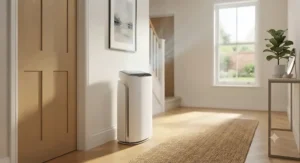
Pollen grains typically range from around 10 to 100 microns in diameter, which sounds like it should make them easy to catch — and largely, it is. The harder problem is the fragments: pollen breaks down into smaller particles once it’s been through a rainstorm or an air conditioning system, and those fragments can drop well under the 10 micron mark, closer to the size range where True HEPA filtration genuinely earns its keep. According to Allergy UK, tree pollen (particularly from birch) affects an estimated quarter of the UK population, while grass pollen dominates the main summer season.
A true HEPA air purifier for allergies helps most when it’s combined with sensible pollen-avoidance habits: running the unit continuously with windows shut during high pollen count days, and washing bedding regularly to remove settled pollen that a purifier can’t reach once it’s landed on fabric. Reviewers testing several of the units above through peak pollen weeks reported the clearest benefit overnight, when windows are naturally closed anyway and the purifier can work on a sealed room rather than fighting a constant fresh influx from outside.
Fine Particulate Matter (PM2.5): Why It Matters for Allergy Sufferers
Fine particulate matter, or PM2.5, refers to airborne particles 2.5 microns or smaller — small enough to penetrate deep into the lungs and, in some cases, the bloodstream. It’s a slightly different category to pollen and dust mite debris, since PM2.5 also includes traffic pollution, smoke and combustion byproducts that drift indoors through open windows and door gaps. Under the Environmental Targets (Fine Particulate Matter) (England) Regulations 2023, the UK government has set a legally binding target to bring the annual mean concentration of PM2.5 down to 10 micrograms per cubic metre by 2040 — a sign of how seriously this pollutant is now treated at a policy level.
For allergy and asthma sufferers specifically, PM2.5 exposure can act as an irritant that worsens existing symptoms even when it isn’t itself an allergen in the strict sense — inflamed airways become more reactive to genuine allergens like pollen and dander. Every True HEPA filter in this guide is certified down to the 0.3 micron threshold, which comfortably covers the PM2.5 particle range, and premium options like the IQAir HealthPro Plus extend that protection to particles roughly 100 times smaller still.
True HEPA Air Purifiers for Asthma Sufferers
Asthma and allergic rhinitis are closely linked conditions — research suggests up to 80% of people with asthma also experience allergic rhinitis, and a flare-up of one frequently aggravates the other. For asthma sufferers specifically, the priority shifts slightly from “does it capture pollen” toward “does it run continuously without irritating sensitive airways further” — which rules out ionic or ozone-generating purifiers entirely, since ozone itself is a respiratory irritant.
Among the seven products featured here, the IQAir HealthPro Plus is the clearest fit for moderate-to-severe asthma, given its independently tested allergen removal rate and hospital-grade design pedigree. For milder asthma alongside general allergy management, the Dyson Purifier Cool TP12 offers a sensible middle ground, combining sealed HEPA filtration with real-time particulate sensors that let an asthma sufferer actually see when air quality dips rather than guessing. Whichever unit you choose, continuous low-speed operation tends to suit asthmatic households better than intermittent high-speed bursts, since sudden airflow changes can occasionally feel uncomfortable to sensitive airways.
True HEPA Air Purifiers for Pet Hair and Pet Dander
Pet hair itself is usually too large to stay airborne for long, but the dander attached to it — microscopic flecks of skin — is a genuinely potent allergen that behaves much more like pollen or dust in the air. This is where filtration design matters more than raw CADR numbers: the Shark NeverChange5 HP150UK stands out here specifically because of its dedicated Pet Particle Barrier layer, engineered on top of the standard HEPA and carbon stages to intercept hair and larger debris before it can clog the finer filtration behind it.
The Coway Airmega 150‘s washable pre-filter serves a similar practical function in pet-owning households, catching visible hair so the main HEPA filter isn’t constantly working through a layer of fur. What most pet owners overlook is that odour control matters almost as much as particle capture in this scenario — an activated carbon layer, present in every product recommended in this guide, is what actually deals with the “wet dog” or litter-box smell that pure HEPA filtration alone won’t touch.
Common Mistakes When Buying an Air Purifier for Allergies
The single most common mistake is undersizing: buying a compact bedroom unit like the Levoit Core 300 and expecting it to handle an open-plan kitchen-diner, where its CADR simply can’t keep pace with the room volume. A close second is chasing “HEPA-type” branding without checking for genuine H13 certification, which — as covered above — can mean capturing meaningfully fewer allergens than the marketing implies.
Other frequent pitfalls include ignoring ongoing filter costs entirely at the point of purchase (a cheap unit with expensive, frequent filter changes can cost more over three years than a pricier model with a longer-lasting filter), placing the unit against a wall or behind furniture where airflow is restricted, and running it only during “allergy attacks” rather than continuously, which undermines the cumulative benefit HEPA filtration is designed to deliver.
Long-Term Cost & Maintenance: What You’ll Really Spend
The sticker price is only ever part of the picture with any true HEPA air purifier for allergies — filter replacement frequency and cost vary dramatically between models, and that gap compounds over several years of ownership.
| Product | Typical Filter Life | Approx. Replacement Cost | 3-Year Estimated Filter Spend |
|---|---|---|---|
| Levoit Core 300 | 6-8 months | Low | Low-to-moderate |
| MeacoClean CA-HEPA 76×5 | ~6 months | Moderate (~£35) | Moderate-to-high |
| Blueair Blue Pure 411+ | 6-9 months (washable pre-filter extends life) | Low-to-moderate | Moderate |
| Shark NeverChange5 HP150UK | Up to 5 years | Minimal ongoing cost | Lowest of the seven |
| Coway Airmega 150 | 12 months (washable pre-filter) | Moderate | Moderate |
| Dyson Purifier Cool TP12 | 12 months | Higher | High |
| IQAir HealthPro Plus | 12-18 months | Highest per filter | Highest overall |
Reading this table alongside the upfront prices tells a slightly different story than sticker shock alone suggests: the Shark NeverChange5‘s higher initial cost is largely offset within two to three years by its near-zero ongoing filter spend, while the Dyson and IQAir models carry premium running costs to match their premium filtration. For anyone weighing true HEPA air purifiers for asthma sufferers against a tight household budget, this total cost of ownership matters as much as the number on the box.
✨ Don’t Miss These Exclusive Deals!
🔍 Take your indoor air quality to the next level with these carefully selected true HEPA picks. Click on any highlighted product to check current pricing and availability — these purifiers will help you create a cleaner, calmer home your whole family (pets included) will love!
Features That Actually Matter (And Those That Don’t)
Genuinely worth paying for: certified True HEPA (H13+) filtration, an activated carbon layer for odours and VOCs, a CADR figure matched sensibly to your room size, and a washable pre-filter that extends main filter life. These four elements do the overwhelming majority of the practical work in any true HEPA air purifier for allergies.
Largely marketing noise for most allergy sufferers: built-in ionisers or “plasma” technology (which can generate trace ozone, itself a respiratory irritant), elaborate smartphone apps with little bearing on actual filtration performance, and inflated “coverage area” claims that assume a single air change per hour rather than the four-to-five changes genuinely needed for allergy relief. Reviewers consistently note that a simpler unit with a properly sized CADR outperforms a feature-loaded one that’s undersized for the room it’s placed in.
Safety, Regulations & Compliance in the UK
Any electrical air purifier legally sold in Great Britain must carry a UKCA mark (or, under current transitional arrangements, a recognised CE mark) confirming it meets the Electrical Equipment (Safety) Regulations. Under gov.uk guidance on placing UKCA or CE marked products on the market, manufacturers are responsible for a declaration of conformity confirming the product has been designed and built to recognised safety standards, including protection against electric shock and fire risk.
For allergy sufferers specifically, it’s worth checking that any purifier is explicitly marketed as “ozone-free,” since some older ionic and electrostatic precipitator designs produce ozone as a byproduct — a genuine irritant for asthmatic airways rather than a benefit. All seven products featured in this guide use HEPA-based mechanical filtration rather than ozone-generating technology, which is the safer approach for anyone managing allergies or asthma at home.
Frequently Asked Questions
❓ What is the best true HEPA air purifier for allergies in the UK?
❓ Do true HEPA air purifiers really help with hay fever?
❓ How often do I need to replace a true HEPA filter?
❓ Can a true HEPA air purifier help with pet allergies?
❓ Is a true HEPA air purifier worth it for asthma?
Conclusion
There’s no single crown-holder among these seven purifiers — only the right match for your particular allergy triggers, room size and budget. If you’re managing mild, seasonal symptoms in one bedroom, the Levoit Core 300 or Blueair Blue Pure 411+ will handle it comfortably without a big outlay. If pet dander or a larger living space is the main battleground, the Shark NeverChange5 and Coway Airmega 150 both offer genuine long-term value once ongoing filter costs are factored in. And if allergies or asthma are seriously disrupting daily life rather than mildly annoying you each spring, the Dyson Purifier Cool TP12 and especially the IQAir HealthPro Plus represent a considered step up in filtration precision.
Whichever true HEPA air purifier for allergies you land on, remember that the machine is only half the equation — correct placement, continuous rather than intermittent operation, and staying on top of filter replacement all meaningfully affect how much relief you actually feel. Do all three properly, and even a modest budget unit can make a genuinely noticeable difference to how your home — and your sinuses — feel day to day.
Recommended for You
- True HEPA Air Purifier: 7 Real Picks That Actually Work (2026)
- Quiet HEPA Air Purifier for Bedroom: 7 Whisper-Quiet Picks (2026)
- HEPA Air Purifier Under £150: 7 Brilliant UK Picks (2026)
Disclaimer: This article contains affiliate links. As an Amazon Associate, I earn from qualifying purchases. If you purchase products through these links, we may earn a small commission at no additional cost to you.
✨ Found this helpful? Share it with your friends! 💬🤗
