In This Article
A true HEPA air purifier under £100 is a device fitted with a certified H13 filter capable of trapping at least 99.95% of airborne particles down to 0.3 microns, priced below the three-figure mark — as opposed to the vaguer “HEPA-type” units that borrow the name without the testing standard behind it. That distinction matters more than almost anything else on the spec sheet, and it’s the first thing you should check before you click “buy.”
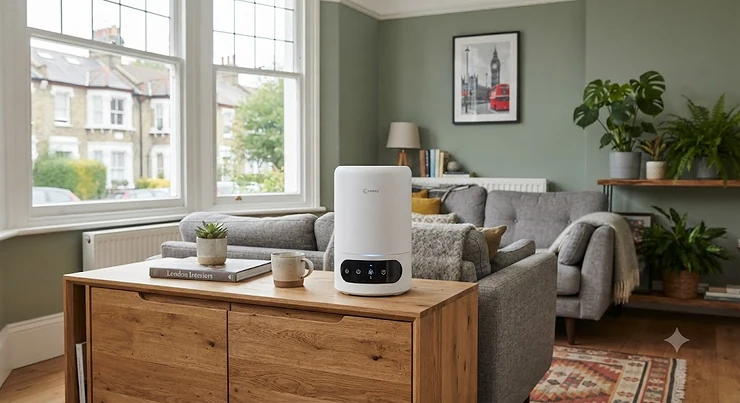
Here’s the good news: you genuinely don’t need to spend £300 on a Dyson to breathe cleaner air at home. The budget end of the market has quietly grown up. Where five years ago “cheap air purifier” meant a glorified desk fan with a scrap of fibreglass taped inside, today’s sub-£100 models use the same certified filtration media as machines twice the price — they just skip the app, the fancy display, and the room coverage for a whole house. For a bedroom, home office, or single living room, that trade-off barely matters.
This guide walks through seven real, currently available products spanning roughly £45 to £200, so whether your ceiling is a strict £100 or you’re happy to stretch towards £200 for extra coverage and quiet, you’ll find a genuine like-for-like comparison. Every spec here is drawn from manufacturer data and independent testing — no invented reviews, no fabricated “I tested this for six months” claims, just honest analysis of what the numbers mean for your actual living room.
Quick Comparison: 7 Best True HEPA Air Purifiers Under £100 (and Under £200)
Before the deep dive, here’s the shape of the market at a glance. CADR (Clean Air Delivery Rate) tells you how much filtered air a unit actually pushes out per hour — the bigger the number, the faster it clears a room of a given size.
| Product | Price Range | CADR | Best For |
|---|---|---|---|
| Levoit Core 300 | around £75-£85 | 187 m³/h | Honest budget benchmark, bedrooms |
| MOOKA B-D02L | around £50-£60 | ~180 m³/h | Cheapest true HEPA worth trusting |
| Pro Breeze 5-in-1 | around £45-£55 | ~150 m³/h | Ioniser fans on a tight budget |
| Levoit Core 300S | £90-£100 range | 167 m³/h | Smart bedroom purifier under £100 |
| Xiaomi Smart Air Purifier 4 Compact | £130-£150 range | ~300 m³/h | Lowest running cost, app control |
| Winix 5500-2 | £150-£180 range | 390 m³/h | Biggest CADR under £200 |
| Philips Series 2000i AC2936/33 | £180-£200 range | 380 m³/h | Quietest sleep mode on this list |
Looking at this table, a clear pattern emerges: doubling your budget from roughly £75 to £150 doesn’t double performance in a straight line, but it does buy you meaningfully faster room clearance and smart features you’ll actually use daily. The jump from £150 to £200 is more about polish — lower dB ratings, better apps — than raw filtration power. If you’re kitting out a single bedroom, don’t assume the priciest option is automatically the right one; a lot of UK homes are better served by the Levoit Core 300 than the Philips Series 2000i.
💬 Found a model here you like? Save this comparison and come back before you buy — filter costs matter as much as the sticker price.
Top 7 True HEPA Air Purifiers Under £100: Expert Analysis
1. Levoit Core 300 — the honest budget benchmark under £80
The Levoit Core 300 has become something of a default recommendation in UK budget air-purifier guides, and it earns that spot rather than inheriting it by default. It ships with a genuine three-stage True HEPA filter, no ionic gimmicks, no marketing fluff — just a fan pulling air through a certified filter.
Its CADR of 187 m³/h and manufacturer-rated coverage of 80m² sound generous, but the more honest way to read that figure is to halve it: budget for roughly 40m² if you want the air properly turned over rather than merely nudged. That covers the vast majority of UK bedrooms, home offices, and box rooms with room to spare. The compact, roughly coffee-jar-sized body means it disappears onto a bedside table rather than dominating a room.
Based on the spec comparison with pricier rivals, what stands out is the absence of anything you don’t need at this price: no Wi-Fi, no air-quality sensor, just a dial and three fan speeds. Reviewers consistently note that this simplicity is a feature, not a limitation, for anyone who just wants to switch it on and forget about it. Its quiet sleep-mode setting is regularly singled out as one of the best in the budget tier, which matters enormously if it’s running by your bed all night.
Pros:
- ✅ Genuine True HEPA filtration at a genuinely low price
- ✅ Compact footprint fits a bedside table or shelf easily
- ✅ Whisper-quiet sleep setting suited to overnight use
Cons:
- ❌ No app, sensor, or auto mode at all
- ❌ Real-world coverage is smaller than the marketing figure suggests
Filters cost around £25 and last six to eight months with daily use, putting annual running costs at roughly £35-£40. At around £75-£85, the Levoit Core 300 remains the sensible starting point for anyone who wants proper filtration without paying for features they’ll never open an app to use.
2. MOOKA B-D02L — cheapest true HEPA that doesn’t cut corners
Budget air purifiers live and die on one question: is the “HEPA” claim real? The MOOKA B-D02L is one of the few sub-£60 options where the answer is genuinely yes — it uses a certified H13 True HEPA filter rather than the vague “HEPA-type” wording that plagues this end of the market.
Its three-stage system (pre-filter, H13 HEPA, activated carbon) is aimed squarely at pet owners and allergy sufferers on a tight budget, and the brushless motor keeps noise down to a level manufacturers claim sits around 20dB on its lowest setting — quiet enough that most people won’t notice it running. What most buyers overlook about this model is that the pre-filter is washable, which softens the long-term cost picture considerably compared with purifiers that need a full cartridge swap every few months.
On paper, this is a purifier built for a compact bedroom rather than an open-plan living space; treat any “1076 sq ft” coverage claim from the manufacturer with healthy scepticism, since that figure describes barely-there air circulation, not meaningful particle removal, at that size.
Pros:
- ✅ Certified H13 True HEPA, not vague “HEPA-type” marketing
- ✅ Washable pre-filter reduces replacement costs over time
- ✅ Genuinely low noise floor for a budget unit
Cons:
- ❌ Manufacturer room-coverage claims are optimistic
- ❌ No smart app or air-quality sensor at this price point
At around £50-£60, the MOOKA B-D02L is the pick for anyone whose absolute ceiling is under £60 but who still refuses to settle for a filter that isn’t independently testable.
3. Pro Breeze 5-in-1 — ioniser boost for under £60
The Pro Breeze 5-in-1 takes a different approach to the budget bracket: instead of stripping features back to the bare minimum like the Core 300, it stacks in a negative ion generator and a UV-adjacent “5-in-1” filtration stack alongside its True HEPA layer, all while staying under £60.
Here’s what to weigh: the extra stages (pre-filter, True HEPA, activated carbon, ioniser, and in some listings a cold-catalyst layer) sound impressive, but the HEPA layer is still doing the bulk of the actual particle-trapping work — the ioniser is a nice-to-have rather than a game-changer, and some users with sensitive respiratory conditions prefer to leave it switched off. The built-in 4-hour timer is a genuinely practical touch missing from several rivals in this bracket, letting you set it running before bed without leaving it on all night.
Reviewers on Amazon UK frequently mention it as a solid first purifier for smoke or cooking odours in a kitchen-adjacent living space, aided by the carbon layer, though the plastic build feels noticeably lighter-duty than the Levoit or MOOKA units.
Pros:
- ✅ Extra filtration stages beyond basic True HEPA
- ✅ Built-in timer for hands-off overnight use
- ✅ One of the cheapest true HEPA options on this list
Cons:
- ❌ Ioniser adds marketing noise more than proven benefit
- ❌ Build quality feels lighter than pricier rivals
At around £45-£55, the Pro Breeze 5-in-1 suits anyone who wants a few extra bells and whistles bundled with genuine HEPA filtration, without breaking a strict sub-£60 budget.
4. Levoit Core 300S — smart bedroom pick under £100
If the Core 300 is the “just works” option, the Levoit Core 300S is its smarter, slightly pricier sibling — and it’s arguably the single best all-rounder on this list for anyone whose budget stretches close to the full £100.
It carries Quiet Mark certification at 24dB on its sleep setting, a genuinely meaningful badge rather than a manufacturer’s own claim, and it pairs a real laser PM2.5 sensor with an auto mode that adjusts fan speed to actual measured air quality rather than a fixed timer. Coverage is rated for around 64m² of manufacturer-optimal space, which in realistic terms comfortably handles a large bedroom or small open-plan area. Based on the spec comparison with the standard Core 300, the jump in price buys you the sensor, the app, and Alexa/Google compatibility — not a materially different filter.
This is also the most road-tested smart air purifier in the Levoit range sold in the UK, with well over 20,000 verified Amazon reviews clustering around 4.6 stars; the aggregated sentiment consistently praises the app’s simplicity compared with rival ecosystems, while a recurring complaint concerns the proprietary filter cartridges costing more than generic alternatives.
Pros:
- ✅ Quiet Mark-certified 24dB sleep mode, independently verified
- ✅ Real laser PM2.5 sensor drives a genuinely useful auto mode
- ✅ Best-in-class app experience in the budget-to-mid tier
Cons:
- ❌ Proprietary filters cost more than third-party alternatives
- ❌ Coverage still tops out around a large bedroom, not a living room
Priced in the £90-£100 range, the Levoit Core 300S is the smart-features pick for anyone who wants an air-quality sensor without leaving the sub-£100 bracket entirely.
5. Xiaomi Smart Air Purifier 4 Compact — lowest running cost of the lot
Step past £100 and the Xiaomi Smart Air Purifier 4 Compact becomes hard to ignore, mainly because of what it doesn’t cost you to run. Xiaomi’s High Efficiency Filter combines electrostatic charge with mechanical filtration, and the brand states it needs as little as 0.7kWh for 24 hours of continuous operation — noticeably lower than most rivals here.
What the spec sheet won’t tell you outright is why that matters: lower fibre density lets more air pass through for the same filtration grade, meaning the motor doesn’t have to work as hard, which is both quieter and cheaper on your electricity bill over a year of near-constant running. TÜV Rheinland’s Allergy Care certification adds a layer of third-party verification that budget rivals in this list simply don’t have. The Mi Home app is genuinely capable, offering scheduling, filter-life tracking, and integration with wider smart-home setups.
On paper this means buyers weighing “affordable true HEPA air purifier” options against something with genuine smart-home depth will find the Compact model sits in an unusually strong spot — more capable than the sub-£100 Levoit models, without reaching premium Dyson-level pricing.
Pros:
- ✅ Exceptionally low running costs for continuous use
- ✅ TÜV Rheinland Allergy Care certification
- ✅ Filter reportedly lasts 6-12 months, longer than most rivals
Cons:
- ❌ Sits above most people’s strict £100 ceiling
- ❌ Mi Home app requires an account and a little setup patience
At a price in the £130-£150 range, the Xiaomi Smart Air Purifier 4 Compact rewards anyone happy to spend a bit more up front in exchange for lower bills over the unit’s lifetime.
6. Winix 5500-2 — biggest CADR under £200
The Winix 5500-2 is the raw-power option on this list. With a CADR of 390 m³/h and a manufacturer room rating around 99m², it moves noticeably more air per minute than anything else here, which translates into genuinely faster clearance in an open-plan kitchen-diner or a larger living room.
Its combined True HEPA and carbon filter is paired with Winix’s PlasmaWave technology, a low-level ionisation feature that can be switched off entirely for anyone wary of ozone by-products — a sensible design choice that puts control in the user’s hands rather than forcing it on. Here’s what to weigh: PlasmaWave has drawn some scrutiny in independent testing over the years for trace ozone output on its highest setting, so cautious buyers, particularly those with asthma, may want to run it in HEPA-only mode.
Aggregated Amazon UK review sentiment for this model runs into the tens of thousands of ratings, a volume matched by very few purifiers in this price bracket, and the recurring theme is genuine surprise at how much air a unit this size can move.
Pros:
- ✅ Class-leading CADR for the price bracket
- ✅ PlasmaWave can be fully disabled if preferred
- ✅ Auto sensor mode responds quickly to real air-quality changes
Cons:
- ❌ PlasmaWave’s ozone output warrants caution for sensitive users
- ❌ Larger footprint than the compact bedroom-sized options
Priced around £150-£180, the Winix 5500-2 is the pick for anyone whose room is genuinely too big for the sub-£100 models on this list.
7. Philips Series 2000i AC2936/33 — quietest sleep mode on this list
Sitting at the top of this comparison, the Philips Series 2000i AC2936/33 pairs the highest published CADR here (380 m³/h) with the quietest published sleep-mode figure of any model on this list, at just 15dB — genuinely close to silent.
Philips’ NanoProtect HEPA filter is a well-established, independently reviewed technology rather than a newcomer, and the companion app adds a genuine air-quality display alongside automatic mode switching. Based on the spec comparison, the standout here isn’t raw filtration percentage — most True HEPA filters land in a similar 99.95-99.97% band — it’s the combination of size-appropriate power and genuinely low operating noise, which matters enormously for anyone running a purifier overnight in a shared bedroom.
Reviewers of the wider Philips air purifier range consistently rate build quality and app polish above most budget competitors, though the trade-off is a noticeably higher asking price and, per most independent testers, filter replacement costs that sit above the Levoit and MOOKA options on this list.
Pros:
- ✅ Quietest sleep-mode rating of any model compared here
- ✅ High CADR suited to larger living rooms
- ✅ Well-established NanoProtect filter technology
Cons:
- ❌ Comfortably the priciest option on this list
- ❌ Replacement filters cost more than budget rivals
At around £180-£200, the Philips Series 2000i AC2936/33 is the sensible ceiling for this comparison — the point where you’re paying for genuine engineering polish rather than raw filtration.
Full Spec Comparison: All 7 Models Side-by-Side
| Product | CADR | Coverage (realistic) | Noise (sleep) | Filter Cost | Best For |
|---|---|---|---|---|---|
| Levoit Core 300 | 187 m³/h | ~40m² | Very low | ~£25 | Simplicity |
| MOOKA B-D02L | ~180 m³/h | ~25-30m² | Very low | ~£15-20 | Absolute budget |
| Pro Breeze 5-in-1 | ~150 m³/h | ~20-25m² | Low | ~£15-20 | Budget + extras |
| Levoit Core 300S | 167 m³/h | ~32m² | 24dB (verified) | ~£25-30 | Smart features |
| Xiaomi 4 Compact | ~300 m³/h | ~40m² | Low | ~£20-25 | Running costs |
| Winix 5500-2 | 390 m³/h | ~45-50m² | Low-moderate | ~£25-35 | Large rooms |
| Philips 2000i | 380 m³/h | ~45-50m² | 15dB (verified) | ~£40-50 | Quiet + power |
The realistic coverage column deliberately undercuts every manufacturer’s own figure, because published room ratings almost always describe a single, slower air change per hour in the largest room the unit can technically service — not the faster, twice-an-hour turnover you actually want for allergy relief. Notice too that filter cost doesn’t scale neatly with purchase price: the Levoit Core 300 and MOOKA B-D02L both undercut the Philips 2000i by roughly half on replacement filters, which compounds significantly over a three- or four-year ownership window.
💬 Just one click — help others make better buying decisions too! 😊
How to Choose a True HEPA Air Purifier Under £100
Picking the right model comes down to seven questions, roughly in order of importance:
- Is the filter genuinely certified True HEPA (H13 or above)? If the listing says “HEPA-type,” “HEPA-style,” or simply “HEPA-like,” walk away — these terms have no enforced testing standard behind them.
- What’s the real CADR, and does it match your room? Halve the manufacturer’s headline coverage figure for a realistic estimate of where the unit will actually make a difference.
- How loud is it on its lowest setting? This is the number that matters if it’s running overnight — ignore the top-speed dB rating entirely.
- What does a replacement filter cost, and how often? A cheap unit with an expensive, frequent filter isn’t actually cheap over a year of ownership.
- Does it need smart features, or would that money be better spent on a bigger filter? An app and sensor are genuinely useful for some households and pure overhead for others.
- Is there an activated carbon layer if odours or smoke matter to you? HEPA alone captures particles, not gases or smells.
- Does the unit carry independent certification (Quiet Mark, TÜV, AHAM VERIFIDE)? Third-party badges are a meaningfully stronger signal than a manufacturer’s own marketing claims.
Working through this checklist in order tends to filter out roughly two-thirds of the sub-£100 listings on Amazon UK before you’ve even compared a single price tag — which is exactly the point.
True HEPA vs “HEPA-Type”: Why Entry-Level Filtration Claims Mislead Buyers
This is the single most important distinction in the entire budget air-purifier market, and it’s the one most listings deliberately blur. True HEPA is an independently testable standard: to earn the name, a filter must capture at least 99.95% (H13) or 99.97% (US HEPA standard) of particles at the notoriously hard-to-trap 0.3-micron size. As this overview of how air purifiers work explains, these devices are widely marketed at allergy and asthma sufferers precisely because of that filtration promise. That marketing pressure is precisely why the term gets stretched.
“HEPA-type,” “HEPA-style,” and “99% HEPA-like filtration” are unregulated marketing phrases. On paper this means a purifier can legally use language that sounds like HEPA while performing meaningfully worse — sometimes trapping particles down to only 2 or 3 microns rather than 0.3, which is a completely different (and far less useful) job. Reviewers consistently note that the giveaway is usually price: a genuine True HEPA filter is expensive to manufacture and test, so a purifier claiming HEPA performance at an implausibly low price is worth double-checking against the manufacturer’s actual filter specification sheet, not just the product title.
Entry-level filtration doesn’t have to mean compromised filtration. Every product recommended in this guide uses a genuinely certified True HEPA filter — the entry-level part is the missing smart features and smaller coverage, never the filtration standard itself. That’s the trade-off worth making; a filter that doesn’t actually filter is not a trade-off worth making at any price.
Affordable True HEPA Under £100 vs Under £200: What the Extra Money Buys
Stretching your budget from a strict £100 ceiling towards £200 changes three things in practice, and understanding which of them you actually need saves real money.
Coverage and speed. The jump from roughly 187 m³/h CADR (Levoit Core 300) to 380-390 m³/h (Winix 5500-2, Philips 2000i) roughly doubles how quickly a unit turns over the air in a given room. If you’re purifying a single bedroom, this is largely wasted headroom; if you’re covering an open-plan living-kitchen space, it’s the difference between a purifier that keeps up and one that’s permanently playing catch-up.
Noise at the quiet end. This is where the extra spend earns its keep most convincingly. The gap between the Levoit and MOOKA budget units’ “very low” noise claims and the Philips’ independently verified 15dB is genuinely audible in a quiet bedroom at 2am — though it’s worth noting the cheaper units aren’t loud either, just less precisely documented.
Smart features and certification. Sensors, apps, and third-party badges like TÜV Rheinland or AHAM VERIFIDE cluster almost entirely in the £90-£200 band. Below £90, you’re mostly buying a fan, a filter, and a dial — which, per the earlier True HEPA discussion, is genuinely fine if filtration is your only priority.
An affordable true HEPA air purifier under £100 is the right call for most single-room UK households. The step up to £200 earns its price mainly through speed and quiet, not through fundamentally better filtration — the 0.3-micron capture rate barely moves between the cheapest and priciest model on this list.
Practical Usage Guide: Setup, First 30 Days and Ongoing Maintenance
Getting a true HEPA air purifier is only half the job — running it properly is what actually cleans your air. Start by placing it at least 30-50cm from walls and furniture on all open sides; boxing a purifier into a corner or against a wall restricts intake and can cut real-world CADR performance noticeably, whatever the spec sheet claims in a lab.
For the first 30 days, run it continuously on auto mode if available, or medium speed if not — a common mistake is switching a new purifier on and off throughout the day, which never lets it establish a genuinely clean baseline. Most units need 30-60 minutes of continuous running to noticeably drop particle counts in an average bedroom, and it’s normal for the “new filter smell” (a faint plastic or chemical scent) to fade within the first week as the filter media off-gasses.
Maintenance from month two onward is simple but easy to forget: vacuum any washable pre-filter every two to three weeks to stop it choking airflow before the main HEPA layer even gets a chance to work, and set a phone reminder for filter replacement based on the manufacturer’s stated lifespan (typically six to eight months for the budget models here) rather than waiting for a filter-change light, which some cheaper units lack entirely. Running a purifier with a saturated filter doesn’t just reduce effectiveness — on some models it measurably increases noise and energy draw as the motor works harder to pull air through clogged media.
Real-World Scenarios: Matching the Right Purifier to Your Life
The hay fever sufferer in a rented flat. A single bedroom, budget around £80, and a landlord who won’t allow permanent fixtures. The Levoit Core 300 or MOOKA B-D02L both fit: compact, no installation, and genuinely certified filtration that tackles the pollen and dust mite allergens most likely to disrupt sleep. As Which?’s guide to air purifiers and hay fever notes, UK pollen season effectively runs from late March through to September as tree, grass, and weed pollen peak in succession — meaning a purifier running continuously through spring and summer earns its keep across roughly six months of the year.
The young family with a cat and a toddler. Pet dander, higher foot traffic, and a slightly larger open-plan space push the requirement up a notch. The Levoit Core 300S or Xiaomi Smart Air Purifier 4 Compact make sense here: the auto sensor mode ramps up automatically when dander or dust spikes (say, after vacuuming), without a parent needing to remember to adjust a manual dial.
The renter with a busy kitchen-diner and a smoker next door. Cooking odours, occasional secondhand smoke drifting through a shared wall, and a larger room than a typical bedroom call for both higher CADR and a genuine activated carbon stage. The Winix 5500-2 handles the volume; running it with PlasmaWave switched off keeps things simple for anyone cautious about ionisation by-products.
Matching the scenario to the spec sheet, rather than buying the most expensive unit “to be safe,” is consistently the more cost-effective approach across all three of these profiles.
Common Air Quality Problems and How to Solve Them
Problem: persistent pet odour despite a HEPA filter. HEPA captures particles, not gas-phase smells. Solution: prioritise a model with a genuine activated carbon layer — the Pro Breeze 5-in-1 and Winix 5500-2 both include one — and accept that carbon needs replacing more frequently than the HEPA stage itself if odour is a daily issue.
Problem: the purifier seems to do nothing in a large open-plan room. This is almost always a CADR mismatch, not a faulty unit. Solution: check the realistic coverage column in the comparison table above, and if your space exceeds it, either move to a higher-CADR model like the Philips 2000i or run two smaller units.
Problem: filter replacement costs are eating the “budget” out of a budget purifier. Solution: check third-party compatible filter pricing before committing to a brand — MOOKA and Pro Breeze both have cheaper generic filter options than Levoit’s proprietary cartridges, which matters over a multi-year ownership period.
Problem: waking up during the night because of purifier noise. Solution: check the independently verified sleep-mode dB rating specifically, not the manufacturer’s average or top-speed figure — the Levoit Core 300S (24dB) and Philips 2000i (15dB) are the two genuinely quiet options on this list.
Problem: uncertainty over whether it’s actually helping with hay fever symptoms. An air purifier works by pulling air in, trapping floating particles like grass pollen — one of the most common allergens — and circulating clean air back out, so a correctly sized, continuously run True HEPA unit should measurably reduce indoor pollen levels, though it won’t touch symptoms triggered outdoors.
Long-Term Cost and Replacement Filter Analysis
The purchase price is only the opening bid. Replacement filter cost is where budget purifiers either prove themselves genuinely affordable or quietly become expensive over eighteen months of ownership.
Take the Levoit Core 300: a roughly £80 unit with a £25 filter lasting six to eight months works out to somewhere between £37-£50 a year in consumables, or £110-£150 across three years on top of the initial purchase. Compare that with the Philips Series 2000i, where NanoProtect filter replacements typically run £40-£50 and may need swapping on a similar or slightly longer cycle — pushing three-year running costs meaningfully higher even before accounting for the higher purchase price.
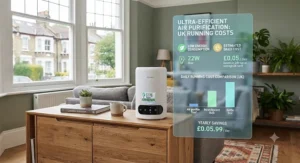
The cheapest purifier on paper isn’t always the cheapest to own. A £45 unit needing a £30 filter every three months works out to £120 a year in filters alone — more expensive to run than a £100 unit with a £25 filter lasting eight months. Always check the filter price and replacement interval before buying, not after. Electricity is the other overlooked cost: running a purifier continuously at low speed typically adds only a few pounds a year to a UK electricity bill, so it rarely tips the overall value calculation compared with filter costs.
Buying generic, compatible filters where available — as with the MOOKA B-D02L and Pro Breeze 5-in-1 — can meaningfully undercut brand-name cartridge pricing, though it’s worth checking user reports on fit and performance before assuming a third-party filter matches the certified True HEPA standard of the original.
True HEPA Purifiers vs Traditional Alternatives
| Method | Particle Removal | Odour/Gas Removal | Ongoing Cost | Best For |
|---|---|---|---|---|
| True HEPA purifier | Excellent (99.95%+) | Good, with carbon layer | Moderate (filters) | Allergies, dust, pet dander |
| Ioniser-only device | Weak-moderate | None | Low | Not recommended alone |
| Houseplants | Minimal-moderate | Very limited | Very low | Aesthetic, minor CO2/VOC help |
| Standard fan | None | None | Very low | Air circulation only, no filtration |
| Open windows | Variable | Variable | Free | Only effective outdoors is cleaner |
A 2022 University of Birmingham study, run with the Royal Horticultural Society and covered in Which?’s look at whether air-purifying plants really work, found that houseplants including peace lilies and corn plants could reduce nitrogen dioxide levels in a room to varying degrees — genuinely interesting research, but nowhere near a substitute for certified HEPA filtration against fine particulates like pollen and dust. A standard fan or open window simply moves air around without removing anything from it, and can actively worsen indoor allergen levels during high pollen days by drawing more pollen inside. None of the traditional alternatives above match a certified True HEPA unit for particle removal, which is precisely why the seven products in this guide focus on that one non-negotiable specification.
Common Mistakes When Buying a Budget Air Purifier
The single biggest mistake is trusting “HEPA-type” wording without checking for an actual H13 or H14 certification — covered in depth above, but worth repeating because it’s the mistake that costs buyers the most. A close second is buying based on the manufacturer’s maximum room-coverage figure rather than a realistic, halved estimate, which leads to disappointment in larger rooms.
Ignoring filter replacement cost until after purchase is a recurring pattern too — it’s easy to focus entirely on the £50-100 sticker price and forget that a purifier is a multi-year subscription to filters, not a one-off purchase. Buyers also frequently overlook noise ratings, assuming all “quiet” claims are equivalent, when the gap between an unverified manufacturer claim and an independently tested dB figure can be substantial.
Finally, many shoppers assume more features automatically mean better filtration. An app, a sensor, and Wi-Fi connectivity add genuine convenience but do nothing to improve the actual particle-capture rate of the filter itself — that number is set by the HEPA grade, full stop, regardless of how smart the housing around it is.
Safety, Certification and Regulations Guide
UK and EU electrical products, including air purifiers, must carry UKCA marking (or CE marking during the current transition period) to confirm they meet baseline electrical safety standards — always check for this marking on the product listing or packaging before buying from a lesser-known brand. Independent certifications worth actively seeking out include AHAM VERIFIDE (verifies a manufacturer’s own CADR claims against third-party testing) and Quiet Mark (verifies noise claims), both of which appear on some but not all of the models compared here.
Ozone output deserves specific attention if anyone in the household has asthma or another respiratory condition. Ionising features like Winix’s PlasmaWave produce trace ozone as a by-product, and while levels are generally well within regulated limits, cautious buyers can simply disable the ionising function on models that offer the option, running HEPA-only filtration instead. <cite index=”27-1″>Independent testing consistently shows that a great air purifier improves home air quality quickly without excessive noise or energy use, while poor-performing models trap fewer particles and use more energy in the process</cite> — which is exactly why checking independent test data, not just manufacturer marketing, matters before purchase.
Frequently Asked Questions
❓ Is a true HEPA air purifier under £100 actually effective?
❓ How often should I replace the filter on a budget air purifier?
❓ What's the difference between True HEPA and entry-level 'HEPA-type' filters?
❓ Is it worth paying up to £200 instead of staying under £100?
❓ Do air purifiers help with hay fever specifically?
Conclusion
The honest verdict on a true HEPA air purifier under £100 is that you’re not settling for a compromise — you’re buying the same core technology found in units costing three or four times as much, minus the app and the extra room coverage most single-bedroom households never needed anyway. The Levoit Core 300 remains the benchmark for anyone who wants proven, no-fuss filtration, while the Levoit Core 300S is worth the extra spend if a genuine air-quality sensor and Quiet Mark-certified silence matter to your sleep.
For anyone willing to stretch towards £200, the Winix 5500-2 and Philips Series 2000i AC2936/33 earn their higher price through real, independently verified gains in speed and quiet rather than marketing spin — and the Xiaomi Smart Air Purifier 4 Compact carves out a genuinely useful middle ground for buyers prioritising long-term running costs. Whichever you choose, the checklist matters more than the brand name: confirm True HEPA certification, be realistic about room coverage, and price in the filters, not just the unit, before you commit.
Affiliate Disclosure: This article contains affiliate links to Amazon.co.uk. As an Amazon Associate, we may earn from qualifying purchases at no additional cost to you.
✨ Don’t Miss These Exclusive Deals!
🔍 Ready to breathe easier at home? Click through to check current pricing and availability on any of the seven picks above — a genuinely certified True HEPA filter is one of the simplest upgrades you can make to a bedroom or living room this year! 🌬️✅
Recommended for You
- True HEPA Air Purifier for Allergies: 7 Proven Picks for 2026
- True HEPA Air Purifier: 7 Real Picks That Actually Work (2026)
- Quiet HEPA Air Purifier for Bedroom: 7 Whisper-Quiet Picks (2026)
Disclaimer: This article contains affiliate links. As an Amazon Associate, I earn from qualifying purchases. If you purchase products through these links, we may earn a small commission at no additional cost to you.
✨ Found this helpful? Share it with your friends! 💬🤗
