In This Article
Somewhere between a Currys product page and a forum thread full of strangers arguing about microns, most people trying to choose a H13 vs H14 HEPA air purifier just want a straight answer: does the extra grade actually matter, or is it a sticker that justifies a higher price tag? Fair question. The letters and numbers on a filtration spec sheet are doing a lot of quiet, unglamorous work, and manufacturers know most shoppers will never check them.
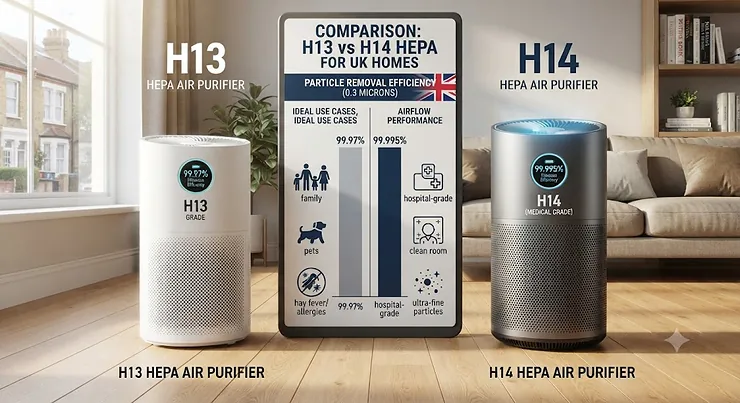
Here’s the short version, because you deserve one before we go deep: H13 captures at least 99.95% of particles at their most penetrating size, while H14 pushes that to 99.995% — a tenfold reduction in what gets through, not a rounding error. Whether that difference is worth paying for depends entirely on who’s breathing the air and what’s floating around in your home. A family in a pollen-heavy postcode has different needs from someone managing a compromised immune system, and this guide is built to separate the two.
We’ve pulled together seven real, currently available machines spanning budget, mid-range and premium territory, with honest analysis of where each filtration grade earns its keep. No invented testimonials, no fabricated hands-on claims — just genuine spec interpretation, aggregated review sentiment clearly labelled as such, and the kind of practical reasoning that Amazon listings tend to skip entirely. By the end, you’ll know exactly which grade suits your living room, your budget and your lungs.
Quick Comparison Table
Before the deep dive, here’s the headline difference between the two grades and what it means for a typical UK household.
| Grade | Particle Capture Rate | Typical Price Premium | Best For |
|---|---|---|---|
| H13 (True HEPA) | 99.95% at 0.3 microns | Standard — included in most mid-range units | Allergies, pet dander, general dust, most family homes |
| H14 (Medical-Grade HEPA) | 99.995% at 0.3 microns | £50-£150+ over comparable H13 models | Compromised immunity, severe respiratory conditions, clinical-adjacent settings |
| HEPA-Type / “99% HEPA” | Unverified, no certified standard | Often cheaper, but a false economy | Avoid — not independently tested |
| Ioniser-only | No filtration, just charges particles | Low cost, low value | Not a substitute for HEPA filtration |
Reading this table straight, the practical takeaway is that H13 is the sensible default for the vast majority of UK homes, while H14 is a genuine upgrade rather than a marketing gimmick — it’s just one that most households won’t need to pay for. The row that should worry you most isn’t H13 vs H14 at all; it’s “HEPA-type,” a phrase that sounds official but carries no independently verified capture rate, so treat it as a red flag rather than a filtration standard.
💬 Found this breakdown useful? A quick share helps other allergy sufferers find it too!
Top 7 H13 vs H14 HEPA Air Purifiers: Expert Analysis
We’ve deliberately mixed grades, price points and room sizes here so you can see how H13 and H14 actually perform against each other in real product form, not just in theory.
1. Coway Airmega AP-1512HH (Mighty) — best budget H13 for everyday allergens
The Coway Airmega AP-1512HH, often just called the Mighty, has been a quiet favourite among allergy sufferers for years, and its H13 True HEPA filter is the reason why. Coway’s four-stage system pairs the HEPA layer with an activated carbon pre-filter and a genuinely clever Eco mode: the fan drops to around 4.8W once the air quality sensor detects clean air, rather than running at its full 77W draw around the clock. That’s a meaningful real-world saving on your electricity bill compared with units that only offer a binary on/off. Based on the spec comparison with pricier rivals, the Coway Airmega AP-1512HH punches well above its price bracket for a bedroom or mid-size living room, though it’s not the machine to reach for if you’re covering an open-plan 40 square metre space. Reviewers consistently report that the air quality indicator ring is genuinely useful day-to-day, giving a quick visual read on whether the room needs attention, and that the unit runs quietly enough for a bedroom on its lower settings. A recurring theme in aggregated feedback is that the carbon pre-filter needs vacuuming more often than expected in dusty households, which is a fair trade-off for the price.
Pros:
- ✅ Genuine H13 True HEPA at a budget-friendly price point
- ✅ Eco mode meaningfully cuts running costs versus always-on rivals
- ✅ Clear air quality indicator makes performance easy to monitor
Cons:
- ❌ Coverage tops out below larger open-plan UK living rooms
- ❌ Carbon pre-filter needs more frequent manual cleaning than some rivals
Typically found in the low-to-mid £200s on amazon.co.uk (check current price, as availability shifts), the Coway Airmega AP-1512HH represents strong value for anyone wanting certified H13 filtration without paying for smart features they won’t use.
2. Levoit Core 600S — best value H13 for a large living room
The Levoit Core 600S is the model most comparison sites reach for when testing large-room H13 performance, and it’s easy to see why: Levoit rates it for rooms up to roughly 59 square metres, which comfortably covers most UK open-plan living rooms in a way that smaller, cheaper purifiers simply can’t. Its three-stage system — pre-filter, H13 True HEPA main filter, and a separate activated carbon layer — means dust and odours are handled by dedicated media rather than a single compromise filter. What most buyers overlook about this model is the VortexAir technology, Levoit’s term for an airflow design that pulls air in from a wider radius, which in practice means it doesn’t need to be dead-centre in a room to work effectively. The companion app lets you schedule fan speeds and track filter life, a genuinely useful feature rather than an add-on for its own sake. Aggregated customer sentiment is largely positive on cleaning power for the price, though a recurring complaint is that the app occasionally reads as more of a promotional channel than a pure utility.
Pros:
- ✅ Covers large UK living rooms that smaller units can’t manage
- ✅ Separate H13 HEPA and carbon stages instead of one compromise filter
- ✅ Wide-radius VortexAir design reduces placement fussiness
Cons:
- ❌ App has been criticised for pushing promotions alongside genuine features
- ❌ Full-price RRP sits noticeably above the entry-level Coway
Prices for the Levoit Core 600S typically sit in the £200-£260 range depending on retailer promotions, making it one of the strongest large-room H13 options on amazon.co.uk at the time of research.
3. Winix Zero Pro — best H13 HEPA air purifier with carbon filter for odours
If cooking smells, pet odours or a smoky neighbour are your main irritation, the Winix Zero Pro deserves a long look. Its five-stage approach — washable pre-filter, AOC (Advanced Odour Control) carbon filter, True HEPA H13 filter, and a PlasmaWave ioniser stage — dedicates real surface area to gas and odour absorption rather than treating carbon as an afterthought sprinkled onto the HEPA media. The AOC carbon layer is genuinely substantial rather than the thin carbon “dusting” you’ll find bonded to cheaper HEPA sheets, and that distinction matters enormously if odour control is your priority rather than just particle capture. Here’s what to weigh: the PlasmaWave ioniser stage can be switched off entirely, which is worth doing if you’d rather avoid any ionisation technology, since some users are sensitive to the very low levels of by-products ionisers can produce. Reviewers consistently note the washable carbon pre-filter as a genuine cost-saver over time, since you’re not replacing the whole cartridge as often as with fused filter designs.
Pros:
- ✅ Substantial dedicated carbon stage, not a thin bonded layer
- ✅ Washable pre-filter reduces long-term replacement costs
- ✅ PlasmaWave ioniser can be fully disabled if preferred
Cons:
- ❌ Five-stage system costs more upfront than simpler three-stage rivals
- ❌ Ioniser stage won’t suit anyone actively avoiding ionisation technology
The Winix Zero Pro generally sits in the £250-£300 bracket on amazon.co.uk, and for anyone specifically hunting a H13 HEPA air purifier with carbon filter as the priority, it’s arguably the most purpose-built option on this list.
4. Blueair Blue Pure 211+ — quietest large-room option with HEPASilent technology
Blueair takes a genuinely different engineering approach with the Blueair Blue Pure 211+, combining mechanical HEPA-grade filtration with an electrostatic charging stage Blueair calls HEPASilent. The pitch is that pre-charging particles lets the mechanical filter work less hard to catch them, which means the fan doesn’t need to push air through as dense a media layer to hit HEPA-equivalent capture rates — and that translates into noticeably lower noise at comparable airflow. In head-to-head testing against the Levoit Core 600S, independent reviewers found the two units closely matched on raw cleaning power, with the Blueair’s edge showing up specifically in quieter operation rather than outright capture percentage. On paper this means the Blueair Blue Pure 211+ is the better pick for anyone running a purifier in a living room used for evening TV or conversation, where fan noise is genuinely intrusive. Its rated coverage of around 50 square metres puts it just behind the Levoit for the very largest UK rooms, and the standard one-year warranty (extendable to two with registration) is shorter than some rivals offer out of the box.
Pros:
- ✅ HEPASilent design delivers strong cleaning power at lower noise
- ✅ Fabric pre-filter covers doubles as a design feature, not just function
- ✅ Closely matches larger rivals on raw particle removal
Cons:
- ❌ Slightly smaller rated coverage than the Levoit Core 600S
- ❌ Base warranty is shorter unless you register the product
Expect to pay somewhere in the £230-£280 range for the Blueair Blue Pure 211+, with occasional promotional pricing pushing it lower — always check current price rather than relying on RRP.
5. Philips Series 3000i (AC2939) — best smart H13 for real-time monitoring
The Philips Series 3000i (AC2939) leans into Philips’ NanoProtect HEPA technology, which the company states captures particles down to 0.003 microns — far finer than the 0.3 micron benchmark used for standard H13/H14 grading, though it’s worth noting this claim describes performance at the smallest end of the particle spectrum rather than replacing the standard certification. Independent testing recorded PM2.5 reduction of around 93% within 60 minutes in a sealed room, a genuinely strong result that held up against fine particles from candle smoke and cooking, not just laboratory dust. What most buyers overlook about this model is the real-time PM2.5 numerical display and colour-coded air quality ring, which turns an abstract spec into something you can actually watch respond as the unit works — genuinely satisfying if you like data, and reassuring if you’re monitoring air quality for a health-sensitive household member. Rated coverage extends to around 98 square metres according to manufacturer figures, comfortably handling large open-plan UK living spaces. The trade-off is a higher price point and a reliance on the companion app for full feature access.
Pros:
- ✅ Real-time PM2.5 display turns performance into visible feedback
- ✅ Strong tested reduction against fine particles, not just lab dust
- ✅ Coverage suited to large open-plan UK living spaces
Cons:
- ❌ Premium pricing compared with comparable H13 rivals
- ❌ Full functionality leans heavily on the smartphone app
The Philips Series 3000i (AC2939) typically lands in the £280-£340 range on amazon.co.uk, positioning it as a genuine premium pick rather than a budget-adjacent option.
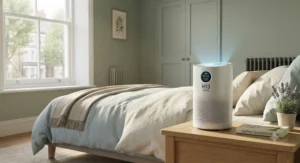
6. Smart Air Blast Mini — best true medical-grade option for large rooms
Where most of this list sits comfortably in H13 territory, the Smart Air Blast Mini is aimed squarely at buyers who want medical-grade performance without paying for smart-home extras. Smart Air strips away app connectivity, air quality displays and ionisers entirely, putting the budget instead into an oversized medical-grade filter that spans almost the entire front face of the unit — more surface area means the filter clogs more slowly, which is why Smart Air rates it for around 12 months of use against the roughly 6-month cycle typical of smaller cartridges. Based on the spec comparison, that longer filter life meaningfully offsets the higher unit price over a couple of years of ownership, particularly once you factor replacement costs into the equation rather than just the sticker price. Independent noise testing recorded a maximum of 56 dB at full fan speed and 45 dB at the lowest setting, both below the roughly 64 dB average across comparable large-room purifiers tested. The absence of smart features is a genuine limitation for anyone who wants app scheduling, but it’s a deliberate trade-off rather than a missing corner cut.
Pros:
- ✅ Oversized medical-grade filter lasts roughly twice as long as typical cartridges
- ✅ Below-average noise output at both high and low fan speeds
- ✅ No unnecessary smart-home features inflating the price
Cons:
- ❌ No app, air quality display or ionisation options at all
- ❌ Highest upfront price of any unit on this list
The Smart Air Blast Mini sits at the premium end, typically around the £400-£450 mark on amazon.co.uk, which only makes sense if genuine medical-grade filtration is the priority rather than smart features.
7. MedicAir Pro Mini — compact true H14 pick for bedrooms and home offices
For a genuine, verifiable H14 True-HEPA filter in a compact footprint, the MedicAir Pro Mini is the clearest example on this list. Its filtration stack runs a pre-filter, H14 True-HEPA media, activated carbon, and a 24W UV-C lamp stage, aimed at capturing 99.995%+ of airborne particles down to the standard 0.3 micron benchmark alongside the viruses and bacteria that UV-C is designed to neutralise. Here’s what to weigh: UV-C air treatment is most effective on surfaces the light directly reaches inside the unit, and the marketing language around “capturing viruses and bacteria” describes the combined filtration-plus-UV effect rather than a single mechanism doing all the work — worth understanding rather than taking at face value. At a rated 21dB, it’s genuinely one of the quietest units in this guide, which suits bedrooms and home offices where background noise matters more than raw coverage. Its compact size means it’s built for medium rather than large rooms, so pairing two units or choosing a bigger H14 model is the better call for open-plan spaces.
Pros:
- ✅ Genuine H14 True-HEPA grade at a relatively accessible price
- ✅ Rated 21dB operation among the quietest tested here
- ✅ Combined carbon and UV-C stages add odour and pathogen handling
Cons:
- ❌ Compact size limits it to medium rather than large rooms
- ❌ UV-C claims deserve realistic expectations, not blanket trust
Ships from a UK-based supplier with free delivery over £50, and typically falls in the £150-£200 range — making the MedicAir Pro Mini the most accessible genuine H14 entry point in this guide.
Top 7 Products: Full Comparison
| Product | Filter Grade | Coverage | Noise (Low-High) | Best For |
|---|---|---|---|---|
| Coway Airmega AP-1512HH | H13 | Small-mid room | Quiet-Moderate | Budget allergy relief |
| Levoit Core 600S | H13 | Large room (~59m²) | Quiet-Moderate | Large UK living rooms |
| Winix Zero Pro | H13 + carbon | Mid-large room | Quiet-Moderate | Odours and smoke |
| Blueair Blue Pure 211+ | H13-equivalent (HEPASilent) | Mid-large room (~50m²) | Very quiet-Quiet | Noise-sensitive rooms |
| Philips Series 3000i | H13 (NanoProtect) | Large room (~98m²) | Quiet-Moderate | Real-time monitoring |
| Smart Air Blast Mini | Medical-grade H13 | Large room | 45-56 dB | No-frills large-room power |
| MedicAir Pro Mini | H14 | Medium room | 21 dB+ | Compact true H14 |
Read across this table and a clear pattern emerges: coverage area and noise output vary far more between these seven products than the raw filtration grade does, which is exactly why choosing on HEPA letter alone is a mistake. The Philips Series 3000i and Levoit Core 600S are the two genuine large-room specialists here, while the MedicAir Pro Mini trades room size for the only true H14 rating on the list. If your shortlist comes down to two similarly graded units, coverage and noise are the tie-breakers worth spending your attention on.
Practical Usage Guide: Getting the Best from Your H13 or H14 Purifier
Buying the right filtration grade only gets you halfway there — how you set the unit up matters almost as much as which one you bought. Placement is the most commonly botched step: pushing a purifier into a corner or behind furniture starves it of the open airflow it needs, so aim for at least 30-50cm of clearance on all sides, ideally away from walls that would recirculate the same pocket of air. Running the unit continuously on auto mode, rather than switching it on only when the room already smells stale, is the single biggest factor in real-world performance, since HEPA filtration works by cycling air repeatedly rather than cleaning it once and stopping.
In the first 30 days, the most common mistake is ignoring the filter-life indicator until it’s flashing red, by which point a clogged pre-filter has already been forcing the fan to work harder and use more electricity than necessary. Check pre-filters monthly for visible dust build-up, vacuum washable ones gently rather than rinsing under a tap (unless the manufacturer explicitly says otherwise), and keep a note of your HEPA replacement date, since most H13 and H14 cartridges need swapping every 6-12 months depending on household dust levels and how many hours a day the unit runs. Placing the purifier near, but not directly beneath, an open window during high pollen season sounds counterintuitive, but a closed-window strategy paired with continuous filtration will outperform an open-window approach every single time pollen counts spike.
Real-World Scenarios: Which Grade Fits Your Household
Rather than abstract advice, here’s how the H13 vs H14 decision plays out for three genuinely different UK households. A young couple in a two-bed flat with a cat and mild seasonal hay fever is squarely H13 territory — something like the Coway Airmega AP-1512HH or Levoit Core 600S handles pet dander and pollen comfortably, and paying extra for H14’s tenfold jump in capture rate wouldn’t meaningfully change day-to-day symptoms for typical allergy triggers.
A family with a child managing moderate asthma, living on a busier road with regular traffic pollution, sits in a genuinely more nuanced spot. Here, a H13 unit with a strong carbon stage like the Winix Zero Pro is often the more sensible upgrade over jumping straight to H14, since traffic pollution brings both particulates and gaseous pollutants that carbon handles and raw HEPA grade doesn’t touch. Finally, someone who is immunocompromised, recovering from a respiratory illness, or specifically advised by a clinician to minimise airborne pathogen exposure is the clearest case for H14 — the MedicAir Pro Mini or a similarly rated unit like the Smart Air Blast Mini genuinely earns its higher price tag here, where the extra 99.995% capture rate isn’t marginal, it’s the actual point of the purchase.
✨ Ready to match a purifier to your own household?
🔍 Compare the specs above against your room size, budget and health priorities, then click through to check current pricing and availability on amazon.co.uk. The right H13 or H14 pick genuinely transforms the air your family breathes every day!
What Is a H13 vs H14 HEPA Air Purifier? Particle Size (Microns) Explained
A H13 vs H14 HEPA air purifier differs in one core measurement: how much of the hardest-to-catch particle size the filter removes. H13 captures at least 99.95% of particles at 0.3 microns — the “most penetrating particle size,” the exact diameter that’s genuinely hardest for any filter media to trap, smaller or larger particles are actually easier. H14 raises that bar to 99.995%, a tenfold reduction in what passes through.
Understanding particle size (microns) puts this in perspective: a human hair is roughly 50-70 microns wide, so the 0.3 micron benchmark used to grade both H13 and H14 filters is around 200 times finer than a strand of hair. Dust mite debris and pollen typically sit in the 10-100 micron range, well within reach of even basic filtration, while fine particulate pollution (PM2.5), some bacteria, and wildfire smoke particles cluster closer to that punishing 0.3 micron mark, which is exactly why the H13/H14 distinction matters most for exactly those pollutants rather than everyday household dust. Both grades are tested and certified under the EN 1822 European standard, which is worth checking for on a spec sheet — a genuine H13 or H14 rating should reference this standard explicitly, not just the word “HEPA” on its own.
How to Choose Between H13 and H14 HEPA Air Purifiers
- Identify who’s actually breathing the air. Healthy adults and older children with mild seasonal allergies are well served by H13; anyone immunocompromised or managing a serious respiratory condition should weigh H14 more seriously.
- Match coverage to your actual room, in square metres. A powerful H14 filter in an undersized unit for your living room will still underperform a correctly sized H13 model — capacity beats grade every time.
- Check for a genuine EN 1822 certification, not just the word “HEPA.” “HEPA-type” or “99% HEPA” phrasing is a red flag Amazon listings frequently obscure.
- Factor in ongoing filter costs, not just the sticker price. A cheaper unit with expensive, frequent replacement filters can cost more over two years than a pricier one with a longer filter life.
- Decide whether odours matter as much as particles. If cooking smells or smoke are a bigger daily irritation than allergens, prioritise carbon filter capacity over chasing H14.
- Weigh noise against your room’s actual use. A bedroom or a living room used for conversation and TV benefits far more from a quiet HEPASilent-style design than from an extra filtration decimal point.
- Read aggregated review sentiment for reliability, not just performance claims. A unit with strong lab numbers but consistently reported build-quality complaints isn’t automatically the better real-world buy.
H13 HEPA Air Purifier for Large Living Room: Which Grade Actually Wins
For most UK households asking specifically about a H13 HEPA air purifier for large living room use, the honest answer is that H13 wins on practicality more often than H14 does — not because H14 performs worse, but because large-room coverage and CADR (Clean Air Delivery Rate) matter more in an open-plan space than the last 0.045 percentage points of capture rate. Both the Levoit Core 600S and Philips Series 3000i (AC2939) are built specifically with large-room CADR in mind, and their H13 filtration comfortably handles dust, pet dander and typical pollen loads across 50-98 square metre spaces.
The maths here is straightforward: a bigger room needs more air changes per hour to feel meaningfully cleaner, and that depends on fan power and filter surface area far more than filtration grade. A H14 unit undersized for your living room will still leave you with stale corners and slower particle reduction than a correctly sized H13 model working at full capacity. Genuine H14 units for genuinely large rooms do exist, but they tend to sit at the premium end of the market and are worth the investment specifically for health-sensitive households rather than general living-room use. According to Which?’s independent testing guidance, matching a purifier’s tested performance to your actual room size consistently outperforms specs on a box alone — advice that applies directly here.
H13 HEPA Air Purifier With Carbon Filter: When You Need One
Not every household needs a H13 HEPA air purifier with carbon filter, but the ones that do usually know it immediately: cooking smells that linger for hours, a housemate who smokes near an open window, or a home near a busy road where exhaust fumes creep in. Carbon filtration works on an entirely different mechanism from HEPA media — activated carbon adsorbs gaseous molecules and volatile organic compounds (VOCs), which pass straight through a HEPA filter untouched, since HEPA is designed to trap solid and liquid particles, not gas-phase pollutants.
The Winix Zero Pro is the clearest example on this list of carbon done properly, with a substantial dedicated AOC layer rather than a thin carbon dusting bonded onto the HEPA sheet. That distinction is worth checking on any product page you’re considering: a genuinely useful carbon filter should be described with its own weight or thickness specification, not just mentioned in passing as a bonus feature. If odours aren’t a daily irritant in your home, a straightforward H13 unit without a heavy carbon investment, like the Coway Airmega AP-1512HH, will save you money without sacrificing anything that actually matters to your air quality.
Common Mistakes When Buying a HEPA Air Purifier
The single most common mistake is buying on filtration grade alone and ignoring room size entirely — a premium H14 unit rated for a 20 square metre bedroom will do a worse job in a 45 square metre open-plan living room than a correctly sized H13 model. A close second is trusting the phrase “HEPA-type” or “99% HEPA-like,” neither of which references an independently tested standard; only “True HEPA,” “H13,” “H14” or explicit EN 1822 certification carry genuine verified meaning.
Buyers also frequently underestimate ongoing filter costs, focusing entirely on the unit’s purchase price while ignoring that some cheaper purifiers carry filters costing £60-£100 every six to eight months — a total cost of ownership that can exceed a pricier unit with a longer-lasting filter within two years. Finally, ionisers get mistaken for HEPA substitutes surprisingly often; charging particles so they stick to walls and furniture is a fundamentally different (and less effective) mechanism than physically trapping them in filter media, and every credible health body recommends against relying on ionisation or ozone-generating technology in occupied rooms.
| Approach | What It Actually Does | Verdict |
|---|---|---|
| True H13/H14 HEPA | Physically traps particles in certified filter media | Recommended |
| Ioniser-only | Charges particles to stick to surfaces, not filtered out | Avoid as sole solution |
| Ozone generator | Produces ozone, a known lung irritant | Avoid entirely |
| “HEPA-type” filter | Unverified, no independent certification | Avoid |
Reading this table plainly, the pattern is that only certified True HEPA — H13 or H14 — has independently verified performance behind it; everything else on this list ranges from marginally useful to actively harmful, and the pricing rarely reflects that gap honestly.
The Cost-Benefit of Higher Grades: Is H14 Worth Paying For
Running the cost-benefit of higher grades side by side makes the trade-off much clearer than spec sheets alone. Stepping from H13 to H14 typically adds £50-£150 to the unit price for comparable coverage, plus H14 replacement filters generally cost slightly more due to denser, more tightly woven media. Against that, you’re buying a jump from 99.95% to 99.995% capture at the hardest particle size — a genuinely large relative improvement, but one that matters enormously for a narrow set of health situations and barely registers for general household dust and allergen control.
| Factor | H13 | H14 |
|---|---|---|
| Typical annual filter cost | £40-£90 | £60-£120 |
| Capture rate at 0.3 microns | 99.95% | 99.995% |
| Best suited to | General allergies, pets, dust | Immunocompromised, clinical-adjacent use |
| Typical unit price premium | Baseline | +£50-£150 |
The practical reading of this table is that H14 is a rational spend when someone in the household has a specific medical reason to minimise airborne pathogen and ultra-fine particle exposure, and a needless one when the goal is simply reducing everyday dust, pollen and pet dander — where H13, correctly sized for the room, already delivers the vast majority of the achievable benefit for meaningfully less money over the unit’s lifetime.
Long-Term Cost & Maintenance
Electricity and filters, not the purchase price, dominate the true cost of owning a HEPA purifier over several years. According to independent UK cost analysis, filter replacement costs frequently outweigh every other running expense combined, and units with genuinely effective eco or auto modes — like the Coway Airmega AP-1512HH‘s 4.8W idle draw — can cost a fraction of what a unit running at full power around the clock would rack up on your electricity bill.
Budgeting realistically means checking three figures before you buy: the unit’s wattage at both full speed and eco/sleep mode, the manufacturer’s stated filter lifespan, and the actual replacement filter price on amazon.co.uk (not just the headline unit cost). A £220 purifier with a £90-a-year filter can end up costing more over three years than a £280 unit with a £45-a-year filter, which is exactly the kind of maths an Amazon product page will never spell out for you.
Safety, Regulations and Compliance Guide
In the UK, air purifiers sold on the market must carry UKCA marking (or CE marking during the current transition period), confirming they meet electrical safety standards — always check for this marking on the product listing or packaging before buying. HEPA filtration standards themselves are governed by the EN 1822 European standard, which is what genuinely distinguishes a certified H13 or H14 filter from a marketing claim.
It’s worth being realistic about what a purifier can and can’t do: it filters particles from the air passing through it, but it won’t fix damp, remove carbon monoxide, or replace ventilation entirely — opening windows briefly on a dry day still has a role to play alongside continuous filtration. For anyone managing asthma or allergies specifically, the NHS’s guidance on common asthma triggers is worth reading alongside any purifier purchase, since a HEPA unit works best as one part of a broader trigger-avoidance strategy rather than a standalone fix. If ozone-generating “ionic” technology is mentioned anywhere on a listing without a genuine HEPA filter alongside it, that’s a compliance and safety red flag worth avoiding rather than a feature worth paying for.
Frequently Asked Questions
❓ Is H13 or H14 better for allergies?
❓ Can I use a H13 HEPA air purifier for large living room spaces?
❓ Do I need a carbon filter alongside HEPA?
❓ How often should I replace a H13 or H14 filter?
❓ Is H14 worth the extra cost for a family home?
Conclusion
The H13 vs H14 HEPA air purifier decision really comes down to who’s breathing the air and how big the room actually is, far more than which letter looks more impressive on a box. For the overwhelming majority of UK households dealing with everyday dust, pollen and pet dander, a correctly sized H13 unit like the Levoit Core 600S or Coway Airmega AP-1512HH delivers the vast majority of the practical benefit without the premium price tag. H14 earns its keep in narrower circumstances — genuine medical need, compromised immunity, or situations where that extra order of magnitude in capture rate is the entire point of the purchase, where units like the MedicAir Pro Mini step in.
Whichever grade you land on, the details that actually shape day-to-day performance are room size matching, genuine EN 1822 certification, carbon filtration if odours matter to you, and realistic ongoing filter costs — not just the number after the H. Use the comparisons above to match a real, currently available unit to your actual living space, and you’ll get meaningfully cleaner air without overpaying for capability you’ll never use.
✨ Ready to breathe easier at home?
🔍 Take a closer look at the seven H13 and H14 picks above and check current pricing and availability on amazon.co.uk. The right filtration grade for your room could make a genuine difference to allergies, sleep and everyday comfort!
Recommended for You
- H13 HEPA Air Purifier for Allergies: 7 Proven Picks for 2026
- True HEPA Air Purifier Under £100: 7 Picks That Actually Work (2026)
- True HEPA Air Purifier for Allergies: 7 Proven Picks for 2026
Disclaimer: This article contains affiliate links. As an Amazon Associate, I earn from qualifying purchases. If you purchase products through these links, we may earn a small commission at no additional cost to you.
✨ Found this helpful? Share it with your friends! 💬🤗
