In This Article
There’s a particular kind of denial that sets in around week two of hay fever season, when you’ve convinced yourself the sneezing is “just a cold” for the fourth week running. A HEPA carbon air purifier won’t fix your relationship with denial, but it will do something more useful: pull the pollen, dust, pet dander and cooking smells out of the air you’re actually breathing, twenty-four hours a day, without you having to think about it. In simple terms, a HEPA carbon air purifier is an appliance that pulls room air through a fine mechanical filter (HEPA, which traps particles like pollen and dust) and a bed of activated carbon (which absorbs gases and odours), then returns cleaner air to the room. That combination matters because a HEPA filter alone does nothing for smells or VOCs, and a carbon filter alone does nothing for the physical dust in the air.
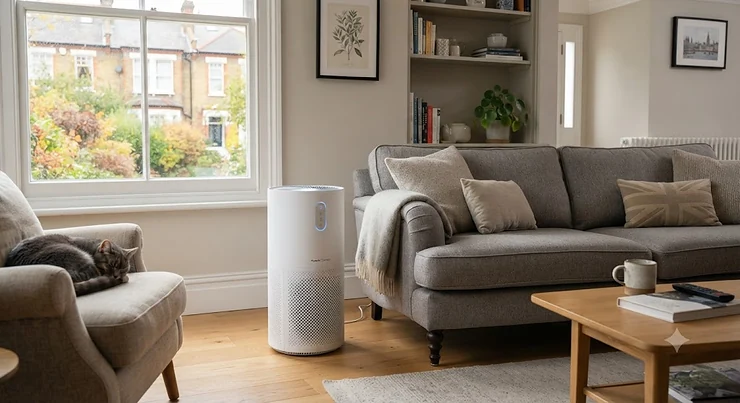
We’ve spent this guide picking through real UK-market models, current specifications and genuine aggregated review sentiment rather than repeating a manufacturer’s marketing copy. The Which? guide to buying an air purifier is worth reading directly if you want independent lab data on HEPA and carbon filter standards; we’ll point you there again shortly. For now, here’s the short version: not every purifier with “HEPA” on the box performs the same, coverage claims are frequently optimistic, and the ongoing filter cost often matters more to your wallet than the sticker price. Below you’ll find seven real, currently available products spanning budget bedroom units to whole-floor workhorses, a full spec comparison, and a genuinely practical buying and maintenance framework — the sort Amazon’s own product pages conveniently leave out.
Quick Comparison Table
| Purifier | CADR | Coverage | Noise (min) | Price Range | Best For |
|---|---|---|---|---|---|
| Amazon Basics HEPA Air Purifier | 238 m³/h | ~20 m² | 32 dB | under £50 | Tight budgets, small rooms |
| Levoit Core 300S | 258 m³/h | ~30 m² (rated to 108 m² air changes) | 24 dB | £90-£110 range | Bedrooms, light sleepers |
| Levoit Core 400S | 400 m³/h | ~50 m² | ~25 dB | £180-£200 range | Value-focused open-plan rooms |
| WINIX 5500-2 | 390 m³/h | ~40 m² | ~27 dB | £150-£180 range | Odour and VOC control |
| Philips Series 900 (AC0951/13) | 250 m³/h | ~65 m² | ~33 dB | £200-£230 range | Allergy sufferers |
| Blueair Blue Max 3250i | 239 m³/h | ~48 m² | ~31 dB | £300-£350 range | Design-conscious living rooms |
| Coway Airmega Mighty (AP-1512HH) | 421 m³/h | ~40-109 m² depending on standard used | ~24 dB | £300-£380 range | Long-term, low-fuss ownership |
A quick note on coverage figures: manufacturers calculate “room size” differently — some use a single air change per hour, others use five — so two purifiers with near-identical CADR can list wildly different m² ratings. Always compare CADR (the actual measured airflow through the filter) rather than the coverage number on its own.
Looking at the table, the clearest split is between compact bedroom units — the Amazon Basics HEPA Air Purifier and Levoit Core 300S — and the larger circulators built for open-plan living, like the Coway Airmega Mighty and Levoit Core 400S. If odour control is your priority rather than raw particle count, the WINIX 5500-2‘s carbon-heavy design earns it a specific mention later on.
💬 Already spotted your pick? Tap through to check today’s price and stock before it changes.🤗
Top 7 HEPA Carbon Air Purifiers: Expert Analysis
1. Amazon Basics HEPA Air Purifier — cheapest genuine 3-stage filter on the list
The headline here is price: this is a proper 3-stage unit (pre-filter, activated carbon, HEPA) for under £50, which undercuts most “true HEPA” competitors by a wide margin. The trade-off is scale — its CADR of 238 m³/h and roughly 20 m² effective coverage make it a single-room tool, not a whole-flat solution, and the 31-watt motor means don’t expect it to keep up in anything bigger than a box bedroom or home office. Based on the spec comparison, this is the purifier to buy if you want a functional HEPA carbon filter for a specific small space — a nursery, a home office, a rented room — without committing to a premium brand. Reviewers consistently note that the LED air-quality indicator (red/orange/green) is a genuinely useful at-a-glance feature at this price point, though several also flag that the plastic housing feels exactly as budget as the price suggests. Filters are rated for roughly 2,000 hours of use, which works out to replacement every four to six months under regular daily running, and replacements are inexpensive relative to the unit cost.
Pros:
- ✅ Genuine 3-stage HEPA and carbon filtration under £50
- ✅ Real-time LED air-quality indicator built in
- ✅ Quiet 32 dB sleep mode for the price bracket
Cons:
- ❌ Coverage limited to roughly one small room
- ❌ Build quality feels noticeably budget under close inspection
At under £50, this is hard to argue with as an entry point — just don’t expect it to double as a living-room purifier.
2. Levoit Core 300S — best small-bedroom option for light sleepers
The standout figure on the spec sheet is the 24 dB sleep-mode noise rating, which is genuinely close to silent — quieter than most bedroom fans on their lowest setting. Its 3-in-1 filter stacks a pre-filter, activated carbon layer and true HEPA together in one cartridge, and Levoit rates the CADR at 258 m³/h, enough to turn over the air in a typical UK bedroom several times an hour. What most buyers overlook about this model is that the VeSync smartphone app unlocks scheduling and real-time particle readings that the unit’s physical buttons alone can’t match, which matters if you like data but is entirely skippable if you don’t. Reviewers consistently report that the auto mode does a good job of ramping down once the room is clean, and the main recurring complaint in aggregated review sentiment is that the cartridge-style filter, while convenient, costs more over a year than filters you can buy loose and cut to size.
Pros:
- ✅ Genuinely near-silent 24 dB sleep mode
- ✅ VeSync app adds scheduling and live readings
- ✅ Compact footprint suits bedside or desk use
Cons:
- ❌ Proprietary cartridge filter costs more long-term
- ❌ CADR modest for anything beyond a bedroom
For sub-£150 bedroom use, this is one of the quietest genuinely HEPA-rated purifiers currently sold on amazon.co.uk.
3. Levoit Core 400S — best CADR-per-pound in the mid-range
On paper this means faster air turnover for your money than almost anything else on this list: a 400 m³/h CADR at a price that undercuts several rivals with lower throughput. Independent lab testing has recorded a 96% PM2.5 reduction within a 60-minute sealed-room test, among the strongest results reported for any sub-£200 purifier, and the 3-stage pre-filter, HEPA and activated-carbon stack follows the same layout as the smaller Core 300S. Here’s what to weigh: this unit has no onboard display, so all readings and scheduling live inside the VeSync app, which is either a non-issue or a genuine deal-breaker depending on how much you want a screen on your sideboard. Reviewers consistently note the near-silent running at low speeds and the strong airflow at higher ones, while the recurring criticism in aggregated feedback is precisely that missing display — several owners specifically wanted a number to glance at rather than reaching for their phone.
Pros:
- ✅ Class-leading CADR-to-price ratio in its bracket
- ✅ Independently tested 96% PM2.5 reduction in an hour
- ✅ Quiet running even at higher fan speeds
Cons:
- ❌ No onboard display — app-only readings
- ❌ Filter cartridge is a recurring cost, not a one-off
If raw air-clearing speed per pound spent is your priority, this is difficult to beat in the current UK market.
4. WINIX 5500-2 — best for tackling cooking and pet odours
The standout feature is the AOC (Advanced Odour Control) carbon filter, which Winix positions specifically against gas and VOC odours rather than just particulates — useful if your actual complaint is “the flat smells of last night’s dinner” rather than visible dust. Specs-wise it delivers a 390 m³/h CADR across roughly 99 m² of rated coverage, putting it firmly in the mid-size category, and the true HEPA H13 stage sits behind the carbon layer so gases get pulled out before the fine-particle stage does its work. Based on the spec comparison, this is the pick for households with a smoker, a wood-burner, or simply a kitchen that opens onto the living room, where odour is the primary irritant rather than pollen count. The PlasmaWave ionisation option is worth flagging honestly: it’s designed to break down odour molecules further, but some users prefer to run it switched off, since ionisers are a more contested technology than HEPA filtration itself — a nuance the marketing rarely mentions. Aggregated review sentiment consistently praises the multi-stage design for extending the main HEPA filter’s working life, since the carbon layer intercepts a share of the load before it reaches the HEPA media.
Pros:
- ✅ Dedicated AOC carbon stage built for odour and VOC control
- ✅ Multi-stage design extends the main HEPA filter’s lifespan
- ✅ Solid 390 m³/h CADR for a mid-size room
Cons:
- ❌ Ionisation feature is a more contested add-on
- ❌ Bulkier footprint than the Levoit units on this list
For odour-first households, this earns its place over purifiers optimised purely for particle count.
5. Philips Series 900 (AC0951/13) — best for allergy-focused NanoProtect filtration
The distinguishing feature here is Philips’ NanoProtect filter technology, which the brand states captures particles significantly smaller than a standard HEPA filter’s rated threshold — a meaningful distinction for anyone whose triggers include very fine allergens rather than visible dust. With a CADR of 250 m³/h and coverage rated to roughly 65 m², it sits comfortably in the mid-size bracket, and the combined HEPA-plus-active-carbon cartridge follows Philips’ usual single-filter replacement design, which simplifies maintenance even if it isn’t the cheapest cartridge to replace. What most buyers overlook about this model is the third-party allergy accreditation some Philips purifiers in this range carry, which is a genuinely independent signal rather than a self-awarded marketing badge — worth checking the specific model listing, since accreditation can vary by SKU and year. Reviewers consistently note that the unit runs quieter at low-to-mid fan speeds than its stated maximum dB rating might suggest, with the loudest complaints reserved for the top “turbo” setting, which is rarely needed for day-to-day use.
Pros:
- ✅ NanoProtect filtration targets ultra-fine particles
- ✅ Independently accredited on relevant SKUs for allergy sufferers
- ✅ Single combined filter cartridge simplifies maintenance
Cons:
- ❌ Top fan speed noticeably louder than low/medium settings
- ❌ Replacement cartridge sits at the pricier end for its size class
If pollen and fine allergens specifically are your problem, this is one of the more credibly accredited options on amazon.co.uk.
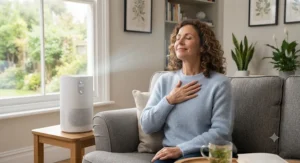
6. Blueair Blue Max 3250i — best design-led pick for open-plan living rooms
The standout advantage is Blueair’s HEPASilent technology, which pairs mechanical HEPA-grade filtration with an electrostatic charging stage — the brand’s own testing claims 99.97% particle removal down to 0.1 microns, a smaller particle size than the standard HEPA benchmark of 0.3 microns. The 3-stage filter (mechanical pre-filter, HEPASilent media with a carbon sheet, and an activated coconut-shell carbon layer) gives it genuine dual-purpose credentials for both particulates and odour, and it’s rated for roughly 48 m² at a CADR of 239 m³/h. Based on the spec comparison, the CADR figure is actually modest relative to price when set against the Coway and Levoit 400S — you’re paying partly for the fabric-covered, design-forward housing that’s built to sit visibly in a living room rather than be tucked in a corner. Reviewers consistently note the auto mode’s responsiveness and the app’s clear real-time readouts, while the most common criticism in aggregated feedback is that you’re paying a genuine premium for the aesthetic and the electrostatic tech rather than for outright airflow numbers.
Pros:
- ✅ HEPASilent tech rated to remove particles down to 0.1 microns
- ✅ Genuine dual carbon layers for particulate and odour control
- ✅ Design-forward housing suited to visible living spaces
Cons:
- ❌ CADR modest for the price versus rivals on this list
- ❌ Premium positioning means a higher long-term filter cost too
Choose this one for the living room you actually want people to see, not purely for the biggest CADR number.
7. Coway Airmega Mighty (AP-1512HH) — best for buy-once, forget-about-it ownership
The standout here is longevity of design rather than any single spec: this model has been sold since 2015, and units from that era are still reportedly running in UK homes today — a genuinely rare track record in an appliance category prone to short product cycles. It posts a CADR of 421 m³/h, the highest on this list, with Amazon’s own UK listing rating it for rooms up to roughly 109 m², and the 4-stage filtration adds an external washable pre-filter that catches hair and larger debris before it ever reaches the HEPA and carbon stages — a detail that meaningfully extends the main filter’s working life. Here’s what to weigh: there’s no smartphone app and no smart-home integration, which is either a relief or a dealbreaker depending on your tolerance for extra apps on your phone, but the trade-off is a genuine PM2.5 laser sensor, a well-regarded auto mode, and an Eco mode that drops the fan to a near-idle 4.8 W once the room reads clean. Reviewers consistently cite the build quality as closer to “industrial” than typical home electronics, and the most repeated criticism in aggregated feedback is the unit’s 7.5 kg weight — heavier than every other purifier on this list, which matters if you plan to move it between rooms often.
Pros:
- ✅ Genuine long-term reliability track record since 2015
- ✅ Highest CADR on this list at 421 m³/h
- ✅ Washable pre-filter extends main HEPA filter’s lifespan
Cons:
- ❌ No app or smart-home integration
- ❌ Heaviest unit on this list at 7.5 kg
For anyone who wants a purifier they can genuinely forget about for years, this remains one of the strongest arguments on the UK market.
What Is a Multi-Stage HEPA Carbon Air Purifier? Dual-Stage vs Multi-Stage Filtration Explained
A multi-stage HEPA carbon air purifier is a unit that pulls air through three or more distinct filtration layers in sequence — typically a mechanical pre-filter, an activated carbon stage, and a true HEPA stage — rather than relying on a single combined filter to do everything at once. The distinction between “dual-stage” and “multi-stage” matters more than the marketing language suggests. Dual-stage filtration usually means a HEPA layer with carbon either bonded into the same sheet or added as a thin secondary layer within one cartridge, which is compact and often cheaper to replace, but the carbon component tends to saturate faster because there’s less physical material doing the absorbing. Multi-stage designs, like the true 3-stage setups used in the Amazon Basics HEPA Air Purifier, WINIX 5500-2 and Coway Airmega Mighty, separate these functions into distinct physical layers with more carbon media, generally extending odour-control performance and reducing the load reaching the HEPA stage itself.
In practice, dual-stage combined filters make more sense for smaller budgets and smaller rooms where replacement cost and simplicity matter more than maximum odour capacity — the Levoit Core 300S and Levoit Core 400S both use this efficient combined-cartridge approach. Multi-stage units earn their keep in larger rooms, kitchens, or households dealing with genuinely strong odours (cooking, pets, smoke), where a dedicated carbon bed simply holds more capacity before it needs replacing. Neither approach is objectively “better” — it’s a genuine trade-off between running cost and odour-handling headroom, and your specific pollutant mix should decide which one suits your home.
How to Choose a HEPA Carbon Air Purifier
How do you choose a HEPA carbon air purifier? Match the unit’s CADR to your actual room size, confirm it carries a genuine HEPA (not “HEPA-type”) rating, and weigh ongoing filter cost against the sticker price before you buy.
- Measure your room first, not the box’s claim. Multiply your room’s floor area by its ceiling height to get cubic metres, then look for a CADR that clears that volume at least four to five times an hour — a number you can calculate directly rather than trusting a vague “up to Xm²” label.
- Confirm it’s genuine HEPA, not “HEPA-type” or “HEPA-style.” Under the relevant EU standard, only filters removing at least 99.95% of 0.3-micron particles can legitimately be called HEPA — anything using softer marketing language nearby is worth a second look at the actual spec sheet.
- Check whether the carbon stage is separate or bonded in. A dedicated carbon layer (see the section above) generally outperforms a thin bonded layer for odour and VOC control, which matters more in kitchens and smoking households than in a spare bedroom.
- Price the filter, not just the unit. A cheaper purifier with an expensive proprietary cartridge can cost more over three years than a pricier unit with a widely available, swappable filter — run the maths before you commit.
- Consider noise at the speed you’ll actually use. Manufacturer dB figures are almost always the lowest sleep-mode reading; check independent reviews for noise at medium and high fan speeds if the unit will run during the day.
- Decide if you actually want an app. Smart features add genuine convenience for some households and pure friction for others — the Coway Airmega Mighty‘s app-free design proves you don’t need one to get excellent performance.
- Factor in coverage overlap for open-plan spaces. If your kitchen, diner and lounge share one airspace, size your purifier (or add a second unit) for the combined square footage, not just the room it physically sits in.
Combined CADR Explained: Why the Number on the Box Isn’t the Whole Story
CADR — Clean Air Delivery Rate — measures the volume of filtered air a purifier delivers per hour, and most UK listings quote a single combined CADR figure that blends performance across three separate pollutant categories: dust, pollen and smoke. That single number can be misleading, because a unit optimised heavily for smoke (very fine particles) doesn’t automatically perform identically against pollen (much larger particles), and manufacturers aren’t required to publish the individual category breakdown on every listing.
| Pollutant category | Typical particle size | Which filter stage matters most |
|---|---|---|
| Dust | 2.5-10 microns | Pre-filter + HEPA |
| Pollen | 10-100 microns | Pre-filter mainly |
| Smoke/VOCs | Sub-1 micron / gaseous | HEPA + activated carbon |
What this means in practice: if your priority is hay fever, coverage and a decent pre-filter matter almost as much as a headline CADR figure, since pollen grains are comparatively large and easy to trap. If your priority is wildfire smoke, traffic pollution, or a smoky kitchen, the combined carbon-plus-HEPA performance matters far more, which is exactly why the WINIX 5500-2‘s dedicated AOC carbon stage earns it a specific recommendation above rather than a purifier with a marginally higher combined CADR number alone. When comparing two units, treat combined CADR as a useful starting filter, not the final word — cross-reference it against the filtration stages actually doing the work.

HEPA Carbon Air Purifier Reviews: What Aggregated Owner Feedback Actually Shows
Individual five-star reviews are easy to find and largely useless on their own — they tell you one person’s experience in one room with one set of expectations. What’s more useful is the pattern across hundreds or thousands of reviews on a given model, and a few consistent themes show up repeatedly across the products covered in this guide. Reviewers consistently report that noise-at-night is the single most-mentioned factor in bedroom purchases, ahead of even particle-removal performance — which is exactly why the Levoit Core 300S‘s 24 dB rating gets referenced so often in aggregated feedback. A second recurring theme is filter cost regret: a meaningful share of negative reviews across nearly every brand relate less to the purifier’s performance and more to buyers not budgeting for ongoing cartridge replacement, which is a planning failure on the buyer’s part as much as a product flaw.
A third pattern worth flagging honestly: claims about virus or bacteria removal are difficult for independent bodies to verify, and consumer testing bodies have stated they currently can’t assess manufacturer claims in this specific area, which is a useful reality check against more ambitious marketing language you’ll see elsewhere. Where we can’t verify a specific manufacturer claim independently, we’ve said so directly in the product sections above rather than repeating it as fact — that’s the standard this guide holds itself to throughout.
Filter Stack Lifespan: Replacement Schedules and Real Costs
The filter stack — the pre-filter, carbon layer and HEPA media working together — is the part of a HEPA carbon air purifier that actually determines your ongoing cost of ownership, and it’s the detail Amazon listings mention least clearly. Typical HEPA filter stack lifespan runs 6-8 months under daily use for most combined cartridges, though this varies significantly with room pollution levels, pet ownership and how many hours a day the unit actually runs. Units with a washable pre-filter — like the Coway Airmega Mighty — extend the working life of the more expensive HEPA and carbon stages behind it, since the pre-filter intercepts hair, large dust and pet fur before it ever reaches the fine media, meaningfully reducing how often you need to replace the costly part.
Budget for filters as a recurring cost, not an afterthought: a combined 3-in-1 cartridge for a Levoit-style unit typically runs £25-£35 per replacement, two to three times a year, which over three years can approach or exceed the purchase price of a budget unit. Multi-stage designs with separate carbon and HEPA components sometimes cost more per individual part but can be replaced on different schedules — swapping a saturated carbon layer without discarding still-functional HEPA media — which can work out cheaper over time despite a higher unit price upfront. A simple maintenance habit that extends any filter stack’s life regardless of brand: vacuum the exterior intake grille monthly, since a clogged intake forces the fan to work harder and can shorten the working life of everything downstream.
📅 Ready to stop guessing your filter schedule? Check current models and their replacement cartridge pricing before you buy.🤗
Practical Usage Guide: Setting Up and Maintaining Your Purifier
Getting a HEPA carbon air purifier to actually perform starts before you switch it on. Unbox the unit and remove any plastic film wrapped around the filter itself — a genuinely common first-week mistake that mutes performance without any obvious warning sign, since the purifier will still run and show green lights while doing almost nothing useful. Position it at least 30-50 cm from walls and furniture on all open sides so air can circulate freely into the intake; a purifier wedged into a corner or behind a sofa is working against itself from day one.
For the first 30 days, run the unit on auto mode if it has one, and resist the urge to manually override it constantly — auto sensors need a settling-in period to calibrate against your room’s baseline air quality. Vacuum the exterior grille every two to four weeks; this single habit does more for long-term filter stack lifespan than almost anything else on this list. Around the three-month mark, check your specific filter’s rated lifespan against how heavily you’ve been running it — a household with pets or a smoker will need to replace sooner than the box’s headline figure suggests, since that figure typically assumes lighter average use. Finally, avoid running a HEPA carbon air purifier directly next to an open window: you’ll simply be filtering air that’s about to be replaced by unfiltered air from outside, undermining the whole point of a sealed-room approach.
Real-World Scenarios: Matching a Purifier to Your Home
If you’re a student in a single rented room with a tight budget and no space for a large unit, the Amazon Basics HEPA Air Purifier covers a typical box bedroom for under £50, and its compact footprint won’t eat into already-limited floor space. Run it on sleep mode overnight and don’t expect it to handle anything beyond that one room.
If you’re a parent with a toddler and a family cat, dealing with both pet dander and disturbed sleep, the Levoit Core 300S or WINIX 5500-2 both make sense depending on which problem dominates: the Levoit for its near-silent nursery-safe noise floor, the Winix if pet odour is the bigger daily irritant. Reducing dust-mite and allergen exposure at home more broadly is covered well by this NHS guidance on reducing house dust mite allergen, worth a read alongside any purifier purchase.
If you’re a couple in an open-plan flat with a kitchen that bleeds smell into the living room, the Coway Airmega Mighty or Levoit Core 400S both offer the CADR headroom to clear a larger combined airspace, with the Coway better suited to years of low-maintenance running and the Levoit 400S better suited to a tighter initial budget.
Common Mistakes When Buying a HEPA Carbon Air Purifier
The single most common mistake is buying on coverage claims alone rather than checking CADR, since — as covered earlier — manufacturers calculate “room size” inconsistently across brands, making two very different purifiers look equivalent on paper. A close second is ignoring ongoing filter cost entirely, which is precisely how a £90 purifier can end up costing more over three years than a £180 one with cheaper, more widely available replacement filters. Buyers also frequently underestimate noise at anything above the lowest fan speed, since manufacturer dB ratings almost always cite the quietest sleep-mode setting rather than the speed you’ll actually use during the day. Another recurring error is placing the unit somewhere convenient rather than somewhere effective — tucked behind furniture or in a corner, starving the intake of the open airflow it needs to work properly. Finally, some buyers assume “HEPA” alone means odour control is included, when in fact HEPA filters trap particles, not gases — without a genuine activated carbon stage, cooking smells and VOCs will pass straight through untouched.
HEPA Carbon Air Purifiers vs Traditional Alternatives
| Approach | Removes particulates? | Removes odours/VOCs? | Ongoing cost | Best For |
|---|---|---|---|---|
| HEPA carbon air purifier | Yes, mechanically | Yes, via carbon stage | Filter replacement, low running cost | Allergies, odours, pollution |
| Standard fan | No | No | Electricity only | Air movement, not cleaning |
| Ioniser only (no HEPA/carbon) | Partial, disputed efficacy | No | Low | Supplementary use only |
| Open windows | Depends on outdoor air quality | Some, weather-dependent | Free | Fresh air when outdoor AQI is low |
The analysis here is fairly clear-cut: a standard fan moves air around a room but filters nothing, so it can’t touch particulates or odours at all. An ioniser-only device — without a genuine HEPA and carbon stack behind it — is a more contested technology whose particle-removal efficacy is harder to independently verify than mechanical HEPA filtration, which is precisely why every product recommended in this guide uses HEPA and carbon as the primary mechanism, with ionisation offered as an optional extra at most. Opening windows is genuinely free and effective, but only when outdoor air quality is actually better than indoor — during high-pollen days or periods of poor outdoor air quality, it can make things worse rather than better, which is exactly when a HEPA carbon air purifier earns its keep.
Safety, Regulations & Certifications to Look For
Any HEPA carbon air purifier sold legally in the UK needs to carry a UKCA mark (or CE mark, currently still accepted under transitional arrangements), confirming it meets electrical safety standards — always check the product listing or box for this before buying from a less familiar brand. On the filtration side, look specifically for “True HEPA” or “HEPA H13” labelling rather than “HEPA-type” or “HEPA-style,” since only the former is tested against the EU standard requiring 99.95% removal of 0.3-micron particles. Third-party accreditations, like the allergy-focused certification carried by some Philips models, add a genuinely independent layer of verification beyond the manufacturer’s own claims — worth checking on a model-by-model basis since accreditation isn’t universal across every SKU in a brand’s range.
On the wider public-health context: government-commissioned research into UK indoor air quality has highlighted that concentrations of certain pollutants indoors can exceed outdoor levels, particularly from cooking, cleaning products and solid-fuel heating — a useful reminder that air purifiers address a genuinely documented issue rather than a manufactured one. If ozone output matters to you, check the box for “ozone-free” or CARB compliance (a Californian standard some UK-market units still voluntarily meet), since older ioniser technology could historically produce trace ozone as a by-product. For anyone curious about the bigger picture, this UK Parliament briefing on air quality policy sets out the current legal PM2.5 targets England is working toward, which is the same underlying pollutant your purifier’s HEPA stage is designed to capture.
FAQ
❓ What is the best HEPA carbon air purifier for a UK bedroom?
❓ Do HEPA carbon air purifiers really remove odours and VOCs?
❓ How much does a HEPA carbon air purifier cost to run in the UK?
❓ How often should I replace the filter stack in a HEPA carbon air purifier?
❓ Is a HEPA carbon air purifier worth it for hay fever or pet allergies?
Conclusion
There isn’t a single “best” HEPA carbon air purifier for every UK home, and honestly, anyone who tells you otherwise is skipping the part where your room size, budget, and specific pollutant problem all pull in different directions. If you want the simplest possible answer: the Levoit Core 400S offers the strongest CADR-per-pound balance for most mid-size rooms, the Levoit Core 300S is the one to buy for a bedroom where silence matters more than raw airflow, and the Coway Airmega Mighty is worth the extra spend if you’d rather buy once and stop thinking about it for the next decade. Budget shoppers shouldn’t feel short-changed by the Amazon Basics HEPA Air Purifier either — genuine 3-stage filtration under £50 is a legitimately good deal for a single small room.
What matters more than any individual product, though, is understanding what you’re actually buying: a real HEPA stage for particles, a real carbon stage for odours and gases, sized correctly against your room’s actual volume, with a filter replacement budget you’ve planned for rather than discovered six months in. Get those fundamentals right and almost any of the seven purifiers above will do exactly what it says on the box.
Recommended for Yo
- Activated Carbon Air Purifier Under £100: 7 Picks That Work (2026)
- 7 Best Activated Carbon Air Purifier Picks UK 2026 (Honest Guide)
- H14 HEPA Air Purifier Under £300: 7 Best Picks for UK Homes 2026
Disclaimer: This article contains affiliate links. As an Amazon Associate, I earn from qualifying purchases. If you purchase products through these links, we may earn a small commission at no additional cost to you.
✨ Found this helpful? Share it with your friends! 💬🤗
