In This Article
Open a tin of paint, cook a curry with the windows shut, or bring home a new sofa, and you’ll notice it: that faint chemical tang that lingers long after the job’s done. That’s not your imagination. It’s volatile organic compounds — VOCs — off-gassing into your living room, and a standard HEPA filter won’t touch them. An activated carbon air purifier is a device that pairs a HEPA (or HEPA-type) particle filter with a bed of porous carbon, which chemically adsorbs gases, odours and VOCs that mechanical filtration alone simply lets pass straight through.
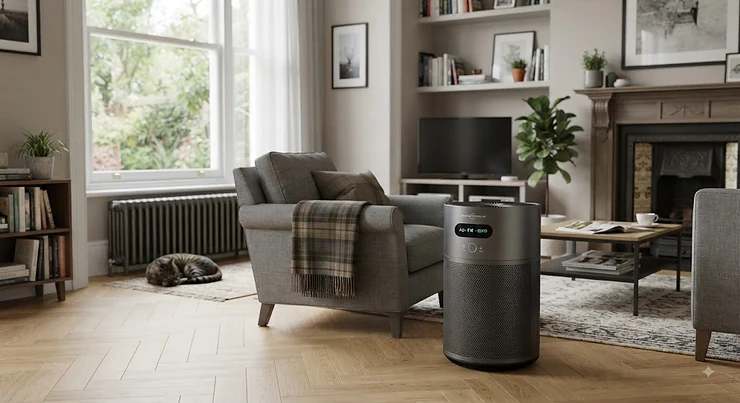
I’ve spent the past few weeks buried in spec sheets, lab test data and aggregated review threads to find seven genuinely good options for the UK market — not a rehashed listicle, but a proper look at what each one does well, where it falls short, and who should actually buy it. You’ll find budget picks, a genuinely pocket-sized option, and a couple of serious VOC specialists that most “top 10” roundups never mention.
Two things worth knowing upfront. First, carbon isn’t a permanent fix — it saturates over time and needs replacing or (rarely) regenerating, which we’ll cover in detail further down. Second, prices on Amazon shift constantly, so every figure here is a range based on research at the time of writing rather than a locked-in price — always check the current listing before you buy. Right, let’s get into it.
Quick Comparison Table
| Product | Best For | Room Coverage | Price Range |
|---|---|---|---|
| Levoit Core 300S | Budget smart pick | Up to 25m² | £90–£120 |
| Levoit Core Mini | Desks, travel, tiny rooms | Up to 17m² | £40–£60 |
| Winix Zero-S | Allergy sufferers, mid-size rooms | Up to 100m² | £180–£220 |
| Philips 800i (AC0850) | Sleek all-rounder with app | Up to 49m² | £130–£180 |
| Blueair Blue Max 3250i | Quiet premium, larger rooms | Up to 48m² | £300–£400 |
| Dyson Purifier Cool Formaldehyde TP09 | Formaldehyde-specific homes | Whole room | £500–£550 |
| Austin Air HealthMate | Heavy-duty VOC/chemical sensitivity | Up to 140m² | £600–£750 |
Looking at the spread above, there’s a clear split between everyday odour-and-allergen units (the Levoit Core 300S, Levoit Core Mini, Winix Zero-S and Philips 800i) and dedicated chemical-and-gas specialists (the Dyson Purifier Cool Formaldehyde TP09 and Austin Air HealthMate). If your main concern is pet smells, cooking odours or general freshness, you don’t need to spend premium money. If you’re dealing with new-build off-gassing, a recent renovation, or a diagnosed chemical sensitivity, the extra investment in the specialists genuinely buys you more carbon and a different class of gas removal.
💬 Just one click — help others make better buying decisions too!😊
Top 7 Activated Carbon Air Purifiers: Expert Analysis
1. Levoit Core 300S — smartest budget pick with app control
The Levoit Core 300S proves you don’t need to spend three figures on a premium brand to get a genuinely useful smart purifier. Its 3-in-1 filter combines a nylon pre-filter, an H13-grade HEPA layer, and an activated carbon layer rated to capture 99.97% of particles down to 0.3 microns, with the carbon stage handling smoke, cooking smells and light VOC odours. In practice, that means it’ll cope fine with a curry night or a candle-heavy evening, though it isn’t built for sustained chemical off-gassing.
Based on the spec comparison, this is squarely a bedroom-and-home-office unit rather than a whole-flat solution — its sweet spot sits around 20-25m², and pushing it much further stretches the CADR thin. Reviewers consistently note the sleep mode is genuinely quiet, and the VeSync app’s auto mode does a decent job of ramping up when cooking smells spike, without needing to be told.
Pros:
- ✅ Genuinely quiet sleep mode for bedrooms
- ✅ App and voice control via the VeSync ecosystem
- ✅ Filters are affordable and widely stocked
Cons:
- ❌ Coverage tops out around 25m²
- ❌ Carbon layer is thin compared with dedicated VOC units
In the £90-£120 range, the Levoit Core 300S is hard to beat as an everyday odour-and-allergen purifier for a single room.
2. Levoit Core Mini — smallest true compact for desks and travel
Where the Core 300S is Levoit’s all-rounder, the Levoit Core Mini is the brand’s answer to “I just want something on my desk that stops my flat smelling of last night’s dinner.” It’s a genuinely tiny unit — light enough to toss in a rucksack — running a 3-stage system with a personal HEPA-type filter (97% capture, not full True HEPA) and a slim activated carbon layer aimed at smoke, fumes and household odours.
What most buyers overlook about this model is that its low CADR (around 46 CFM) means it’s only realistically effective in spaces up to roughly 15-17m², such as a small bedroom, kitchen corner or campervan — not a full living room. On the plus side, its 6-7W power draw is negligible, and independent testing has clocked it clearing smoke pollutants faster than some pricier “compact” rivals, which says more about how mediocre some of those rivals are than how powerful the Mini is.
Pros:
- ✅ Genuinely pocket-and-backpack portable
- ✅ Extremely low running cost, under £10 a year in electricity
- ✅ Whisper-quiet even at higher fan settings
Cons:
- ❌ Not a True HEPA filter, only 97% capture
- ❌ Underpowered for anything beyond a small room
At around £40-£60, the Levoit Core Mini is the compact activated carbon air purifier to buy if your problem is a small space, not a big one.
3. Winix Zero-S — best mid-range pick for allergy sufferers
The Winix Zero-S sits in an unusually good spot: proper mid-size room coverage with genuine third-party allergy certification, not just marketing language. Its 4-stage system runs a washable pre-filter, an activated carbon pellet filter, a HEPA filter rated at 99.999% down to 0.1 microns, and Winix’s PlasmaWave stage, which the brand states is ozone-free. The carbon here is pelletised rather than a thin sheet, which on paper means more surface area for VOC and smoke adsorption than cheaper mesh-style carbon filters.
Here’s what to weigh: the Zero-S is independently tested and certified by both Allergy UK and AHAM, which matters if you’re buying specifically for hay fever or pet-related symptoms rather than general freshness. Reviewers consistently note the auto sensor mode responds quickly to cooking smoke, and that sleep mode dims lights and quietens the fan without fully switching off filtration.
Pros:
- ✅ Allergy UK and AHAM certified, not just self-tested
- ✅ Pelletised carbon handles smoke and cooking odours well
- ✅ Covers a genuine mid-size living room, not just a bedroom
Cons:
- ❌ Bulkier footprint than the Levoit models
- ❌ No smartphone app, control panel only
In the £180-£220 range, the Winix Zero-S earns its place as the mid-range all-rounder for anyone whose priority is certified allergen and odour reduction.
4. Philips 800i Series (AC0850) — sleekest all-rounder with app control
Philips has been in small appliances long enough to know how to make a purifier that doesn’t look like lab equipment, and the Philips 800i Series (model AC0850) is proof. It runs Philips’ NanoProtect HEPA filtration alongside an activated carbon layer, and the AC0850 variant specifically retains carbon — worth flagging, because Philips does sell carbon-free versions of this same body shape elsewhere in its range, so it pays to check the exact model code before buying.
The spec sheet won’t tell you this, but user reports suggest the touch-sensor air quality indicator on top is unusually responsive and genuinely useful day-to-day, rather than a gimmick — it visibly shifts colour within minutes of frying something. Based on the spec comparison, its ~49m² rated coverage makes it a strong open-plan-kitchen-diner candidate, provided you’re not also trying to cover a hallway or landing from the same spot.
Pros:
- ✅ Real-time air quality indicator that’s genuinely responsive
- ✅ App connectivity via Philips Air+ for remote monitoring
- ✅ Compact footprint for its stated coverage
Cons:
- ❌ Easy to accidentally buy the non-carbon variant by mistake
- ❌ Replacement filters sit at the pricier end for this size class
Around £130-£180, the Philips 800i Series (AC0850) rewards anyone who wants a smart, good-looking mid-range unit and remembers to check the model code.
5. Blueair Blue Max 3250i — quietest premium powerhouse
The Blueair Blue Max 3250i is where things start getting genuinely serious about performance-per-decibel. Blueair’s HEPASilent technology combines electrostatic charging with mechanical filtration, which on paper lets it move more air through a denser filter without the fan noise that usually comes with it — and the activated carbon layer is built into the same combination filter, targeting VOCs and household odours alongside particulate capture.
Based on the spec comparison, what stands out isn’t raw CADR (though it’s strong, rated for spaces up to roughly 48m²) but the noise-to-performance ratio: independent sources cite it running as low as 18dB on its quietest setting, which is close to library-silent. Reviewers consistently note the WiFi app is genuinely useful rather than an afterthought, and that HEPASilent’s lower power draw per unit of clean air translates into noticeably lower running costs than comparable HEPA-only rivals at this coverage level.
Pros:
- ✅ Exceptionally quiet even at higher fan speeds
- ✅ Strong CADR for genuinely large living rooms
- ✅ Lower running cost than most HEPA-only rivals its size
Cons:
- ❌ Premium price puts it out of reach for casual buyers
- ❌ Replacement combination filters aren’t cheap
In the £300-£400 range, the Blueair Blue Max 3250i is the pick for anyone who wants a big, quiet, genuinely capable purifier and has the budget to match.
6. Dyson Purifier Cool Formaldehyde TP09 — only 2-in-1 fan that destroys formaldehyde
The Dyson Purifier Cool Formaldehyde TP09 does something none of the others on this list attempt: it doesn’t just trap formaldehyde in carbon, it catalytically breaks it down into carbon dioxide and water using a dedicated solid-state sensor and catalytic filter, on top of a standard HEPA H13 and activated carbon combination for everything else. That distinction matters because most carbon filters only capture formaldehyde temporarily before re-releasing some of it as the filter saturates — the TP09’s catalytic layer is designed to keep working for the life of the unit rather than needing replacement for that specific job.
What most buyers overlook about this model is that it’s also a genuinely capable bladeless cooling fan, using Dyson’s Air Multiplier technology to project purified air around the whole room rather than just near the unit itself — useful if you’re buying one device to solve two problems. Reviewers consistently note the MyDyson app’s pollutant breakdown is more detailed than most rivals, showing exactly what’s been captured rather than a vague single score.
Pros:
- ✅ Ongoing formaldehyde destruction, not just temporary capture
- ✅ Doubles as a genuinely effective cooling fan
- ✅ Detailed app-based pollutant tracking
Cons:
- ❌ One of the pricier options here, before filters
- ❌ HEPA+carbon filter replacement isn’t cheap, roughly £70-£80 a year
At around £500-£550, the Dyson Purifier Cool Formaldehyde TP09 suits households specifically worried about formaldehyde from new furniture, flooring or a recent renovation.
7. Austin Air HealthMate — heaviest-duty VOC specialist on the market
If the other six purifiers on this list are sensible everyday appliances, the Austin Air HealthMate is a piece of industrial-grade equipment that happens to sit in a living room. Its four-stage filter houses roughly 15lbs (nearly 7kg) of activated carbon and zeolite blend — for comparison, most consumer purifiers ship with a few ounces. That sheer mass of carbon creates dramatically more surface area for adsorbing formaldehyde, benzene, ammonia and general VOCs, and the zeolite component specifically targets gases that plain carbon binds poorly, formaldehyde chief among them.
Here’s what to weigh: Austin Air rates the filter to last up to five years under normal use, versus the 6-12 month cycles typical elsewhere on this list, which changes the long-term cost maths considerably even against the steep upfront price. On paper this means slower particle-clearing speed than lighter, higher-CADR rivals — independent testing has shown it takes noticeably longer to clear fine particles than something like the IQAir HealthPro Plus — but for gas and chemical removal specifically, reviewers and independent testers consistently rate it among the strongest consumer options available.
Pros:
- ✅ Roughly 15lbs of carbon/zeolite, far beyond typical units
- ✅ Filter rated for up to five years, not months
- ✅ Genuinely effective for formaldehyde and chemical sensitivity
Cons:
- ❌ Slower particle-clearing speed than lighter HEPA-first rivals
- ❌ Large, heavy, and among the priciest units here
In the £600-£750 range, the Austin Air HealthMate is overkill for casual odour control but genuinely excels for chemical sensitivity, wildfire smoke exposure, or serious off-gassing concerns.
Practical Usage Guide: Setup, Maintenance and Getting the Most from Your Filter
Getting an activated carbon air purifier out of the box is the easy part — getting real value from it depends on a handful of habits most listings never mention. First, unwrap the filter fully before switching on; carbon filters often ship in plastic sleeves to protect the pellets, and running the unit with the sleeve still on is a surprisingly common first-week mistake that quietly kills performance from day one.
Positioning matters more than most buyers assume. Place your purifier at least 30-50cm from walls and furniture so air can circulate freely on all sides, and avoid tucking it into a corner behind curtains, where intake airflow gets restricted. For rooms with a specific odour source — a kitchen, a smoker’s room, a recently renovated nursery — position the unit closer to that source rather than dead-centre in the room.
In the first 30 days, resist the urge to run it only when you notice a smell. Activated carbon works continuously and cumulatively; running the unit on auto or low speed around the clock captures VOCs as they off-gas, rather than playing catch-up after concentrations build. Most units also benefit from a monthly vacuum of the pre-filter (a soft brush attachment works well) to stop dust from prematurely clogging the carbon layer underneath it — a five-minute job that meaningfully extends filter life.
Real-World Scenarios: Which Activated Carbon Air Purifier Suits You?
If you’re a student in a rented one-bed flat where the kitchen and living room share one open space, cooking smells are probably your biggest complaint, not chemical sensitivity. The Levoit Core 300S or Levoit Core Mini covers that use case affordably, and the low running cost matters when you’re already watching every bill.
If you’ve just moved into a new-build or recently had flooring, kitchen units or a wardrobe fitted, you’re dealing with genuine formaldehyde off-gassing, which can continue for months. This is where the Dyson Purifier Cool Formaldehyde TP09 earns its premium price — its catalytic destruction is built specifically for this scenario, rather than temporary capture that a standard carbon filter provides.
If you’re a parent with a child who has diagnosed asthma or a household member with multiple chemical sensitivity, the calculus changes again. The Austin Air HealthMate‘s sheer carbon mass and five-year filter life suit a household managing a long-term condition, where consistency and gas-removal depth matter more than app features or sleek design. Meanwhile, a family with pets and mild hay fever in a larger open-plan living room is generally best served by the Winix Zero-S or Blueair Blue Max 3250i, both of which balance certified allergen performance with genuine room coverage.
Problem → Solution: Common Activated Carbon Air Purifier Issues
Problem: The purifier is running but I can still smell cooking or pet odours. This is often a sizing issue rather than a faulty unit — check the manufacturer’s rated coverage against your actual room size, and if you’re close to the limit, run it on a higher fan speed rather than auto.
Problem: Smells were gone, but they’ve slowly crept back over a few months. This is the classic sign of carbon saturation, covered in full detail in the next section — the short version is that carbon has a finite number of binding sites and needs replacing once they’re full.
Problem: The unit smells slightly “off” or plasticky when first switched on. This is usually off-gassing from the plastic housing itself rather than the filter, and normally fades within a few days of continuous running in a ventilated room.
Problem: My allergies haven’t improved despite running the purifier daily. Activated carbon targets gases and odours, not allergens directly — allergen relief comes from the HEPA stage, so check you’re using a True HEPA-rated model and that it’s sized correctly for the room.
Problem: Filter replacements feel expensive over time. Compare cost-per-month rather than upfront filter price; a cheaper filter replaced every three months can cost more annually than a pricier one rated for a full year.
How to Choose an Activated Carbon Air Purifier
- Match CADR to your actual room size, not the marketing headline. Manufacturers often quote maximum coverage under ideal conditions; sizing down slightly gives more headroom for genuine performance.
- Check the carbon quantity, not just its presence. A few ounces of impregnated fabric behaves very differently from several pounds of granular or pelletised carbon.
- Confirm True HEPA (H13) if allergens are a concern. “HEPA-type” or “HEPA-like” filters aren’t independently certified and typically underperform.
- Factor in filter replacement cost and frequency. A cheap unit with expensive, frequently replaced filters often costs more over two years than a pricier unit with a long-life filter.
- Consider noise level for bedroom use. Anything above roughly 40dB on its effective setting becomes noticeable for light sleepers.
- Decide whether you need gas-specific certification. If formaldehyde or chemical sensitivity is a genuine concern, look specifically for catalytic destruction or zeolite-enhanced carbon rather than standard carbon alone.
- Check for independent certification, not just brand claims. Allergy UK, AHAM, and ECARF marks indicate third-party testing rather than in-house marketing figures.
How Activated Carbon Absorbs VOCs
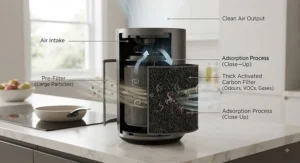
Activated carbon works through a process called adsorption — not to be confused with absorption, though the terms get used loosely in marketing copy. Rather than soaking gases up like a sponge, carbon’s surface is riddled with microscopic pores that create an enormous internal surface area; a single gram of quality activated carbon can have a surface area exceeding 1,000 square metres. VOC molecules passing through the filter physically bond to that porous surface, effectively getting trapped rather than absorbed into the material itself.
What most buyers overlook about VOC absorption specifically is that not all gases bind to carbon equally well. Larger, heavier VOC molecules — many cooking odours, smoke compounds and solvents — adsorb readily onto standard activated carbon. Formaldehyde, being a smaller and more chemically stubborn molecule, binds far less efficiently to plain carbon, which is exactly why specialist units like the Austin Air HealthMate blend in zeolite, and why the Dyson Purifier Cool Formaldehyde TP09 uses catalytic destruction instead of relying on adsorption alone. Understanding this distinction matters practically: a purifier that’s excellent at removing kitchen smells isn’t automatically equally good at formaldehyde, and checking which specific compounds a filter is rated for prevents a mismatched purchase.
Carbon Filter Saturation: Signs, Causes and What to Do
Carbon filter saturation happens when every available binding site on the carbon’s porous surface has captured a gas molecule, leaving no capacity left to adsorb anything new. At that point, the filter stops actively removing VOCs and odours — and in some cases, previously captured gases can even begin releasing back into the room as newer, more reactive molecules displace older ones, a phenomenon sometimes called off-gassing reversal.
The clearest sign is smells that were previously well-controlled gradually returning, even though the unit is running normally and the fan sounds fine. Saturation happens faster in homes with heavy cooking, smoking, frequent candle use, or ongoing renovation work, since these all push a higher gas load through the filter continuously. Reviewers consistently note that manufacturer-stated filter lifespans (typically 3-12 months for standard units) are based on average household use, so anyone with above-average odour or VOC sources should plan to check — and likely replace — filters sooner rather than waiting for the indicator light. The only real solution once saturation sets in is replacement; running a saturated filter longer doesn’t damage the unit, but it does mean you’re paying for electricity to move air through carbon that’s no longer doing its job.
Filter Regeneration: Can You Recharge Activated Carbon?
In industrial and laboratory settings, activated carbon can genuinely be regenerated — heated to extremely high temperatures in a controlled process that burns off adsorbed compounds and reopens the pore structure for reuse. This is real, well-documented chemistry, and it’s why carbon regeneration is common practice in large-scale water treatment and industrial air filtration.
Here’s what to weigh for home use: that process requires specialist equipment and precise temperature control that simply isn’t practical or safe to attempt with a domestic air purifier filter. Claims you’ll sometimes see online about “recharging” a home carbon filter by baking it in a domestic oven or leaving it in direct sunlight don’t replicate genuine industrial regeneration, and can in some cases damage the filter media or release previously captured compounds back into your kitchen. For household purifiers, the honest answer is that filter replacement — on the manufacturer’s recommended schedule, or sooner if you notice saturation symptoms — remains the only reliable way to maintain VOC and odour performance. It’s a less exciting answer than a DIY hack, but it’s the accurate one.
🔍 Ready to Upgrade Your Indoor Air?
✨ Whether you’re after a compact bedroom unit or a serious VOC specialist, the right activated carbon air purifier makes a genuine difference to how your home feels day to day. Check current prices and availability on the models above before they’re out of stock!
Best Compact Activated Carbon Air Purifiers for Small Spaces
Not everyone needs — or has room for — a floor-standing unit, and this is where a genuinely compact activated carbon air purifier earns its place. The Levoit Core Mini is the clearest example on this list: small enough for a desk, a bedside table, or a rucksack pocket, with a real (if thin) carbon layer rather than a token gesture at odour control. Its low CADR is the honest trade-off for that size, so it suits a single small room rather than an open-plan space.
The Philips 800i Series occupies a slightly different compact niche — not pocket-sized, but a notably small footprint for its 49m² rated coverage, making it a sensible pick for anyone who wants proper room coverage without a bulky tower unit dominating the space. Based on the spec comparison, the general rule for compact units holds across brands: smaller carbon volume means faster saturation under heavy odour load, so a compact purifier in a smoker’s room or an actively renovated space will need filter changes noticeably more often than the same model in a quiet spare bedroom.
Activated Carbon Air Purifier Reviews: What Real Owners Report
Rather than fabricate customer quotes, here’s an honest summary of the patterns that show up consistently across genuine review platforms and independent testing for the models on this list. A common thread across the Levoit Core 300S and Winix Zero-S reviews is praise for quiet sleep-mode operation, alongside recurring comments that carbon-specific odour performance (versus general dust and allergen capture) is noticeably weaker than the HEPA side of the filter — consistent with their comparatively modest carbon volume.
For the Blueair Blue Max 3250i, aggregated feedback consistently highlights noise level as the standout strength, with owners frequently comparing it favourably to louder rivals at a similar CADR. The Dyson Purifier Cool Formaldehyde TP09 draws a recurring theme of owners valuing the dual cooling-and-purifying function, tempered by comments about the ongoing cost of replacement filters. For the Austin Air HealthMate, if you cannot verify individual customer star ratings for your specific region and retailer, it’s worth checking current listings directly — but the pattern across independent long-term reviews is consistent: strong gas and chemical removal, slower particle-clearing speed, and a five-year filter life that owners frequently cite as offsetting the high upfront cost over time.
Activated Carbon vs HEPA-Only Purifiers
| Factor | Activated Carbon + HEPA | HEPA-Only |
|---|---|---|
| Removes VOCs, smoke, chemical odours | Yes | No |
| Removes dust, pollen, pet dander | Yes | Yes |
| Typical filter cost | Higher | Lower |
| Best for renovated or smoky homes | Yes | No |
| Best for pure allergen control | Good | Excellent |
The table above makes the trade-off fairly stark: a HEPA-only purifier will match or even slightly outperform a combination unit on pure particle capture, since it doesn’t dedicate any filter volume to carbon. But it does nothing whatsoever for gases — cooking smells, off-gassing furniture, and general chemical odours pass straight through untouched. For most UK households, the small premium for a genuine activated carbon layer is worth paying, unless your only concern is hay fever and pet dander with no odour issues at all, in which case a HEPA-only unit may be marginally more cost-effective.
Common Mistakes When Buying an Activated Carbon Air Purifier
The single most frequent mistake is buying based on room size claims without checking whether they assume continuous operation or a single air change — manufacturers sometimes quote the larger, more flattering figure. A close second is assuming any purifier with “carbon” mentioned somewhere in the listing has a meaningful amount of it; some budget units include a thin carbon-impregnated fabric layer that offers only token odour reduction.
Buyers also commonly underestimate ongoing filter costs, focusing entirely on the upfront unit price and getting caught out a year later by the cost of replacements. Finally, it’s easy to overlook noise ratings entirely until the unit is running in a bedroom at 2am — always check the dB rating at the fan speed you’ll realistically use overnight, not just the manufacturer’s quietest published figure.
Long-Term Cost & Maintenance
| Product | Filter Lifespan | Approx. Annual Filter Cost |
|---|---|---|
| Levoit Core 300S | 6-8 months | £40-£60 |
| Levoit Core Mini | 3-6 months | £30-£50 |
| Winix Zero-S | 6-12 months | £45-£65 |
| Philips 800i Series | 6-12 months | £50-£70 |
| Blueair Blue Max 3250i | 6 months | £70-£100 |
| Dyson Purifier Cool Formaldehyde TP09 | 12 months | £70-£80 |
| Austin Air HealthMate | Up to 5 years | £150-£200 (once every 5 years) |
Looking at total cost of ownership rather than sticker price flips the value picture somewhat. The Austin Air HealthMate‘s steep upfront cost looks far more reasonable once you divide its five-year filter life across that period, working out cheaper per year than several mid-range units on this list. Conversely, budget purifiers like the Levoit Core Mini carry a low entry price but need replacing often enough that a heavy user could spend close to the unit’s original price on filters within two years.
Safety, Regulations and UK Compliance
Activated carbon air purifiers themselves aren’t subject to specific UK product regulations beyond general electrical safety standards (CE/UKCA marking, which every legitimately sold unit in the UK must carry), but the pollutants they’re designed to address are taken seriously at a policy level. The UK currently has no statutory limit for total indoor VOCs in homes, though government-published indoor air quality guidance sets health-based reference values for individual compounds including formaldehyde and benzene, based on World Health Organization guidelines.
If anyone in your household has asthma or a diagnosed chemical sensitivity, it’s worth reading NHS-aligned guidance on indoor air quality and asthma triggers, which covers practical steps beyond just running a purifier, including ventilation and reducing pollutant sources at the root. An activated carbon unit is a genuinely useful tool, but it works best alongside good ventilation habits, not as a replacement for opening a window when you’re cooking or using strong cleaning products.
FAQ
❓ Do activated carbon air purifiers actually remove odours, or just mask them?
❓ How often should I replace an activated carbon filter?
❓ Can activated carbon filters remove formaldehyde completely?
❓ Is a bigger, more expensive activated carbon air purifier always better?
❓ Do activated carbon filters produce any harmful by-products?
Conclusion
Choosing the right activated carbon air purifier comes down to being honest with yourself about what you’re actually trying to solve. If it’s everyday cooking smells and pet odours in a single room, the Levoit Core 300S or Levoit Core Mini will do the job without overspending. If you want certified allergen performance across a proper living room, the Winix Zero-S and Blueair Blue Max 3250i both deliver, with the Blueair edging ahead on noise and the Winix on value.
For genuine chemical or formaldehyde concerns — new furniture, a recent renovation, or a diagnosed sensitivity — the Dyson Purifier Cool Formaldehyde TP09 and Austin Air HealthMate operate in a different league entirely, and the extra spend buys real, measurable gas-removal capability rather than marketing gloss. Whichever you choose, remember that carbon has a shelf life: budget for replacements from day one, keep an eye out for the saturation signs covered above, and pair your purifier with decent ventilation rather than treating it as a magic fix. Do that, and any of the seven models above should genuinely improve how your home smells and feels within days of setup.
✨ Don’t Miss These Exclusive Deals!
🔍 Take your indoor air quality to the next level with one of the carefully researched picks above. Click through to check current pricing and availability, and breathe easier knowing you’ve made an informed decision for your home!
Recommended for You
- H14 HEPA Air Purifier Under £300: 7 Best Picks for UK Homes 2026
- Medical Grade H14 HEPA Air Purifier: 7 Best Picks for 2026
- H14 HEPA Air Purifier for Asthma: 7 Trusted Picks 2026
Disclaimer: This article contains affiliate links. As an Amazon Associate, I earn from qualifying purchases. If you purchase products through these links, we may earn a small commission at no additional cost to you.
✨ Found this helpful? Share it with your friends! 💬🤗
