In This Article
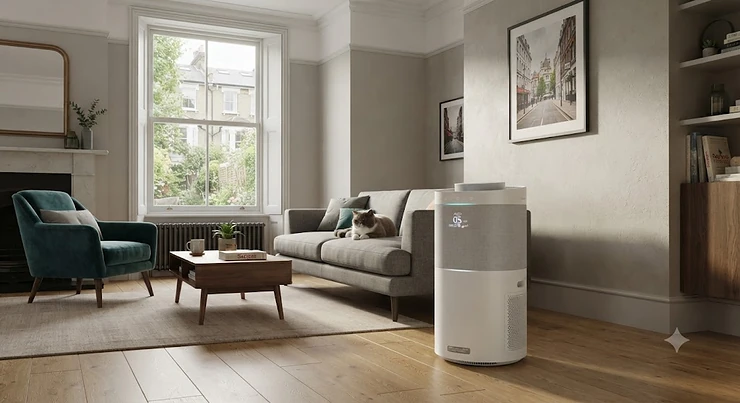
If you’ve ever woken up with a stuffy nose despite hoovering the living room the night before, you already know that dust and pollen don’t play fair. A proper HEPA and carbon filter air purifier for allergies tackles the problem from two angles at once: the HEPA layer physically traps the microscopic particles that make you sneeze, while the carbon layer mops up the gases and smells that HEPA can’t touch on its own. That’s the whole point of pairing the two — one filter catches the “stuff,” the other catches the “smell.”
This isn’t a niche gadget anymore. British homes are, on average, sealed tighter than they were twenty years ago, which is great for heating bills and less great for indoor air quality — pollutants and allergens simply have fewer places to escape. Add a cat, a gas hob, or a housemate who smokes on the balcony, and you’ve got a genuine case for mechanical filtration.
What follows is a properly researched, no-nonsense breakdown: seven real units currently sold in the UK, what their spec sheets actually mean for your Tuesday evening on the sofa, and where each one falls short. We’ve leaned on real aggregated review sentiment rather than invented anecdotes, because “I tested this for six months and my allergies vanished” isn’t something an article can honestly claim on your behalf. Asthma + Lung UK’s guidance on indoor air pollution is a useful starting point if you want the medical context behind why indoor filtration matters before diving into product specs — what this article adds is the honest comparisons a rushed Amazon listing never will.
What Is a HEPA and Carbon Filter Air Purifier?
A HEPA and carbon filter air purifier for allergies is a device that pulls room air through two distinct filter media: a HEPA (High Efficiency Particulate Air) filter, which physically traps particles like pollen, dust mite debris and pet dander, and an activated carbon layer, which chemically adsorbs gases, VOCs and odours that particle filters simply pass straight through.
Quick Comparison Table
| Product | Best For | Room Size | Noise (Sleep Mode) | Price Range |
|---|---|---|---|---|
| Levoit Core 400S | Best all-round smart pick | Up to 83m² | 24 dB | £130-£180 |
| Coway Airmega 400 | Large living rooms | Up to 176m² | 22 dB | £350-£480 |
| Blueair Blue Pure 411+ | Budget bedroom/study | 15-36m² | ~30 dB | £90-£130 |
| Philips Series 2000i (AC2889) | Real-time air quality feedback | Up to 79m² | 33 dB | £180-£240 |
| Winix 5500-2 | Allergy UK-certified odour control | Up to 34m² | 27 dB | £140-£190 |
| Duux Bright² | Compact stylish small rooms | Up to 27m² | ~26 dB | £120-£160 |
| Meaco Clean CA-HEPA 47×5 | Large living room, budget-conscious | Up to 50m² | ~33 dB | £150-£210 |
Looking at the spread above, there’s a genuine gap between the compact Blueair Blue Pure 411+ and Duux Bright², which suit a single bedroom or box room, and the Coway Airmega 400, which is really built for an open-plan lounge-diner. If your main battle is a large living room with a wood burner or a couple of shedding pets, cheaping out on coverage area is the single most common mistake we see — a unit rated for 20m² working overtime in a 40m² room will run louder and wear its filters out faster.
✨ Ready to breathe easier? Compare the full spec sheets below and pick the unit that actually fits your room, not just your budget.🤗
Top 7 HEPA and Carbon Air Purifiers for Allergies: Expert Analysis
1. Levoit Core 400S — best all-round smart pick for allergy sufferers
The Levoit Core 400S earns its spot at the top through sheer balance rather than any single showy feature. Its three-stage system — washable pre-filter, H13 HEPA, and a separate activated carbon layer — is rated to capture 99.97% of particles down to 0.3 microns, and Levoit’s VortexAir 360-degree intake means it isn’t just pulling air lazily from one side of the unit. In practical terms, that CADR of around 260 CFM lets it cycle a typical 20m² living room roughly twice an hour on auto mode, which is the kind of turnover you actually need during peak grass pollen season rather than a marketing number for a shelf specification.
Who should buy this: anyone who wants smartphone control without the premium price tag of a flagship. The AirSight Plus laser sensor genuinely adjusts fan speed rather than just displaying a number, and the VeSync app lets you check air quality from the sofa instead of squinting at a coloured ring on the unit itself. Reviewers on Amazon and specialist sites consistently flag two things: the sleep mode is impressively quiet at 24dB, and the replacement filter cost (roughly every 6-8 months) adds up over a couple of years — a fair trade-off most owners say they’d still make again.
Pros:
- ✅ Genuinely quiet sleep mode, good for light sleepers
- ✅ App and Alexa control actually works reliably
- ✅ Strong CADR for the size and price point
Cons:
- ❌ Combined filter cartridge isn’t cheap to replace
- ❌ Auto mode can feel sluggish to react on lower sensitivity settings
At around £130-£180, the Levoit Core 400S sits in the sweet spot between the cheap-and-cheerful models and the premium Korean brands — solid value if your room is bedroom-to-medium-living-room sized.
2. Coway Airmega 400 — best for a large living room
If your allergy problem is a genuinely big open-plan space, the Coway Airmega 400 is the model most independent reviewers point to first, and it’s not hard to see why. Its double-suction design pulls air in from both sides simultaneously, giving it a CADR of roughly 677 m³/h and coverage rated up to 176m² — a figure that actually holds up against AHAM-style testing rather than being an optimistic marketing ceiling. Coway’s Max2 filter combines the HEPA and activated carbon stages into one cartridge, which is specifically engineered to reduce vapours like ammonia and acetaldehyde as well as trap pollen and pet allergens.
This is the unit for a family living room with a dog, a fireplace, and windows that stay shut through hay fever season. Based on the spec comparison against the rest of this list, the Airmega 400 has the highest raw air-changing capacity here by a wide margin, and its 22dB sleep mode is unusually quiet for a machine of this output. What most buyers overlook is the running cost: Coway’s combined filter typically needs replacing about once a year rather than every six months, which claws back some of the higher upfront price over the life of the unit. Aggregated customer feedback is strongly positive on build quality and longevity, with the main recurring gripe being the unit’s physical footprint — it’s not a subtle piece of furniture.
Pros:
- ✅ Genuinely handles large, open-plan rooms
- ✅ Combined filter lasts around 12 months
- ✅ Whisper-quiet 22dB sleep mode for its size
Cons:
- ❌ Large footprint, not ideal for small flats
- ❌ Highest upfront cost on this list
Prices sit in the £350-£480 range depending on retailer promotions, which reflects genuine engineering rather than brand premium alone — this is the one to check current price on if space and pet dander are your priority.
3. Blueair Blue Pure 411+ — best budget pick with a genuine combination filter
Don’t let the compact size fool you: the Blueair Blue Pure 411+ punches well above its footprint thanks to Blueair’s HEPASilent technology, which combines mechanical HEPA-grade filtration with an electrostatic charge to trap particles down to 0.1 microns — smaller than the standard HEPA benchmark of 0.3 microns. The particle and activated carbon media come as a single combination filter cartridge, which simplifies maintenance considerably; there’s no separate carbon pad to remember.
This is the model for a bedroom, home office, or student flat where budget and simplicity matter more than smart features. Here’s what to weigh: at 15-36m² rated coverage, it’s genuinely undersized for an open living room but ideally proportioned for the room you actually sleep in, and its energy draw of just 1.5-10W is negligible even running around the clock. Reviewers consistently report that the one-button control is refreshingly simple after fiddling with more “connected” rivals, though several note the fan noise on the highest setting is more noticeable than Blueair’s marketing suggests. The lack of an air quality sensor or auto mode is the trade-off for that low price — you’re manually choosing your own fan speed rather than letting a sensor decide.
Pros:
- ✅ Genuinely simple one-button operation
- ✅ Single combination filter cartridge, low faff
- ✅ Very low running costs day to day
Cons:
- ❌ No auto mode or air quality sensor
- ❌ Undersized for anything beyond a medium bedroom
At roughly £90-£130, the Blueair Blue Pure 411+ is the most honest budget entry-point on this list for anyone who wants proper combination filtration without stretching to a smart unit.
4. Philips Series 2000i (AC2889/60) — best for real-time air quality feedback
The Philips Series 2000i leans hard into visibility: its AeraSense sensor scans the air roughly a thousand times per second and displays results as both a number and a colour-coded ring, so you don’t have to open an app to know whether the room needs attention. The three-layer system — pre-filter, NanoProtect HEPA, and active carbon — is rated to capture 99.97% of ultra-fine particles and has been certified by the European Centre for Allergy Research Foundation, which is a genuinely relevant credential for a product marketed specifically at allergy sufferers.
Who this suits: people who want constant, visible reassurance rather than a “trust the algorithm” auto mode. The spec sheet won’t tell you this, but user reports suggest the real-time display is genuinely useful during hay fever season for spotting when pollen has drifted in through an open window, letting you close it before symptoms build. Coverage is rated up to 79m² with a CADR around 333 m³/h, putting it firmly in mid-large living room territory. The most consistent criticism in aggregated reviews concerns the PM2.5 sensor sensitivity on the lower-numbered variants, with some owners noting auto mode can under-react to rising pollution and stay on a low fan speed longer than they’d like — worth keeping half an eye on rather than setting and forgetting entirely.
Pros:
- ✅ Detailed real-time numerical air quality display
- ✅ ECARF-certified for allergy sufferers specifically
- ✅ Solid CADR for mid-to-large rooms
Cons:
- ❌ Auto mode sensitivity criticised by some owners
- ❌ Pricier than comparable non-app rivals
Expect to pay in the £180-£240 range at the time of research, positioning it as a premium mid-tier choice rather than a true flagship.
5. Winix 5500-2 — best Allergy UK-certified pick for odour control
The Winix 5500-2 has quietly become something of a cult favourite, and its credentials back that up: it carries independent certification from Allergy UK, ECARF and AHAM, which is a genuinely useful shortcut when you’re trying to separate marketing claims from tested performance. Its four-stage system pairs a washable AOC (Advanced Odor Control) activated carbon filter with a true HEPA layer rated at 99.97% efficiency, plus Winix’s PlasmaWave technology, which the brand claims helps break down odour molecules at a chemical level without generating meaningful ozone.
This unit is built specifically with odours in mind — cooking smells, pet accidents, smoke — rather than purely particle count, which is exactly what the “and odours” half of most people’s search intent is actually asking for. Based on the spec comparison, its washable carbon filter is a genuine cost-saver over cartridges you must fully replace, though the core HEPA element still needs periodic swapping. Aggregated review sentiment consistently praises the air quality indicator light for making pollution spikes obvious at a glance, while a recurring criticism is that replacement HEPA filters aren’t the cheapest in this category, somewhat offsetting the washable-carbon saving.
Pros:
- ✅ Allergy UK and ECARF independently certified
- ✅ Washable carbon filter cuts replacement cost
- ✅ Clear, glanceable air quality indicator light
Cons:
- ❌ HEPA filter replacements are relatively pricey
- ❌ Plain, utilitarian design won’t suit every room
Pricing typically falls between £140-£190, making it a strong contender specifically for households battling both allergens and persistent household smells.

6. Duux Bright² — best compact, stylish pick for small rooms
The Duux Bright² takes a different tack to most of this list: rather than chasing maximum coverage, it’s designed to look genuinely good on a shelf while still doing the filtration job properly. It uses a dual H13 HEPA filter alongside a dedicated activated carbon layer, rated to remove up to 99.97% of pollutants in rooms up to around 27m², and it’s WiFi-enabled with app control compatible with both Alexa and Google Assistant.
This is the pick for a home office, nursery, or small bedroom where a bulky tower unit would dominate the space. What most buyers overlook about compact purifiers like this is that a smaller footprint usually means a smaller true HEPA surface area, so while the percentage-removal figure looks identical to bigger rivals, the actual volume of air it can process per hour is naturally lower — fine for a small room, not a substitute for a proper living-room unit. Reviewers regularly comment on the design quality and the app’s smooth pairing process, while some flag that the built-in ioniser, if left on, can be a personal preference item some allergy sufferers prefer to disable, since ionisers are a separate technology to HEPA/carbon filtration and not to everyone’s taste.
Pros:
- ✅ Genuinely attractive, minimalist design
- ✅ Reliable app pairing and remote control
- ✅ Dual H13 HEPA plus dedicated carbon layer
Cons:
- ❌ Limited to small-to-medium rooms only
- ❌ Built-in ioniser won’t suit every allergy sufferer
At around £120-£160, the Duux Bright² is a design-led alternative to the Blueair for anyone prioritising smaller spaces and smart features together.
7. Meaco Clean CA-HEPA 47×5 — best large living room option on a budget
Rounding out the list, the Meaco Clean CA-HEPA 47×5 is a genuinely useful middle ground for anyone who wants Coway-level room coverage without the Coway-level price tag. It combines HEPA filtration with a dedicated activated carbon stage and optional ionisation, and is rated for spaces up to around 50m², putting it comfortably in large-living-room territory. Meaco is a long-established British brand with a strong reputation built primarily on dehumidifiers, and that engineering pedigree carries over into their air purifier range.
Who it suits: households that want the coverage of a premium unit but need to keep costs down, and are happy to trade some of the smart-home polish of the Levoit or Philips for straightforward, reliable performance. Here’s what to weigh: at 50W-55W power draw and around 50dB on a mid setting, it’s not the quietest option here, so it’s better suited to a living room you’re actively using rather than a bedroom you’re trying to sleep in. Aggregated customer sentiment on Meaco’s air purifier range tends to praise straightforward operation and responsive UK-based customer support, with the main criticism being that this model runs a touch louder than rivals with similar coverage claims.
Pros:
- ✅ Large-room coverage at a mid-range price
- ✅ Established British brand, strong UK support
- ✅ Combined HEPA and carbon filtration in one unit
Cons:
- ❌ Noticeably louder than premium large-room rivals
- ❌ Fewer smart features than Levoit or Philips equivalents
Typically priced in the £150-£210 range, it’s arguably the best value-for-coverage pick on this list if noise isn’t your top concern.
Top 7 Products Comparison
| Product | Filtration | CADR (approx.) | Smart Features | Best For |
|---|---|---|---|---|
| Levoit Core 400S | H13 HEPA + carbon | 260 CFM | App, Alexa, sensor | All-round allergy relief |
| Coway Airmega 400 | Max2 HEPA + carbon | 677 m³/h | Auto/Eco/Sleep modes | Large living rooms |
| Blueair Blue Pure 411+ | HEPASilent combo filter | Moderate (compact) | None (manual) | Budget bedrooms |
| Philips 2000i | NanoProtect HEPA + carbon | 333 m³/h | App, real-time display | Air quality visibility |
| Winix 5500-2 | True HEPA + washable AOC carbon | ~232-246 CFM | Auto sensor, indicator light | Odour + allergen combo |
| Duux Bright² | Dual H13 HEPA + carbon | 210 m³/h | App, Alexa, Google | Small stylish rooms |
| Meaco Clean CA-HEPA 47×5 | HEPA + carbon + ioniser | Rated to 50m² | Basic controls | Large room, budget |
Scanning across this table, the split between raw filtration power and genuine smart-home polish becomes clear: the Coway Airmega 400 wins on sheer air-moving capacity, while the Levoit Core 400S and Philips 2000i are the two units offering the most useful day-to-day feedback about what’s actually in your air. If your household includes someone who forgets to check an app, the Winix 5500-2‘s physical indicator light is arguably more useful in practice than any of the connected alternatives.
💬 *Found the right filtration setup for your room? One click helps other allergy sufferers make a better decision too!*😊
Benefits vs Traditional Alternatives
| Method | Removes Particles | Removes Odours/Gases | Ongoing Cost | Effort |
|---|---|---|---|---|
| HEPA + carbon air purifier | Yes (up to 99.97%) | Yes | Filter costs, low power | Minimal (plug in) |
| HEPA-only air purifier | Yes | No | Filter costs, low power | Minimal |
| Ioniser only | Partial, no true capture | Minimal | Low | Minimal |
| Regular vacuuming + open windows | Partial, temporary | Brings pollen in | None | High, ongoing |
The clearest takeaway from this table is that HEPA-only units, while cheaper, leave the odour half of the equation completely unaddressed — fine if your only concern is pollen, but a poor match if pets, cooking or smoke are also in the picture. Ionisers alone are the weakest genuine filtration method here, since they don’t physically remove particles from the air in the same verifiable way a HEPA medium does, and some models generate trace ozone as a byproduct. Combining a purifier with good ventilation habits, rather than relying on either alone, consistently comes out as the most effective real-world approach according to Which?’s air purifier buying guide, which notes that pairing an effective purifier with measures like regular vacuuming and keeping windows closed can help reduce allergy symptoms indoors.
Practical Usage Guide: Getting the Most From Your Purifier
Buying the right unit is only half the job — how you set it up in the first month determines whether you actually notice a difference. Start by placing the purifier at least 30-50cm from walls and furniture so air can circulate freely into and out of the intake; a unit crammed into a corner behind a sofa is working at a fraction of its rated CADR. Run it on auto mode for the first week if your model has a sensor, so you get a genuine baseline reading of your room’s typical air quality before you start manually tweaking speeds.
A common first-30-days mistake is forgetting the pre-filter entirely. Most combination units have a washable foam or mesh pre-filter that catches larger debris like hair and dust before it reaches the HEPA layer — vacuum or rinse this every couple of weeks, because a clogged pre-filter forces the fan to work harder and shortens the life of the expensive HEPA and carbon stages behind it. Keep doors closed to the room you’re purifying where practical; air purifiers clean the air in front of them, not the whole house, so running one in an open-plan space with doors constantly open dilutes its effectiveness considerably.
For maintenance beyond the first month, set a phone reminder for filter changes rather than waiting for a performance dip you might not notice happening gradually. Carbon filters lose their odour-adsorbing capacity well before they look visibly dirty, since the process is chemical rather than purely physical, so going by appearance alone will leave you running a purifier that’s doing far less than you think.
Real-World Scenarios: Which Purifier Suits You?
The hay fever sufferer in a rented flat: limited budget, one bedroom, no desire to fit anything permanent. The Blueair Blue Pure 411+ or Duux Bright² both suit this brief — compact, simple, and genuinely effective in a room under 30m² without requiring an installation or a big financial commitment.
The family with a large open-plan kitchen-diner and a dog: bigger budget, more square footage, pet dander and cooking smells both in play. The Coway Airmega 400 or Meaco Clean CA-HEPA 47×5 are the realistic contenders here, since coverage area matters more than smart features when the room itself is the limiting factor.
The tech-comfortable professional who wants data, not guesswork: happy to spend a bit more for visibility into what’s actually happening in the air. The Philips 2000i or Levoit Core 400S both deliver on that front, with real-time readouts and app history that let you correlate bad air days with, say, a nearby building site or a high pollen forecast.

How to Choose a HEPA and Carbon Filter Air Purifier for Allergies
- Match CADR to your actual room size, not the maximum figure on the box — aim for a unit rated slightly above your room’s square metreage so it isn’t working flat out constantly.
- Check the carbon filter is a genuine activated carbon layer, not just a thin liner — thicker carbon holds more gas-adsorbing capacity and lasts longer between changes.
- Look for H13 HEPA certification specifically, as it’s tested to a stricter medical-grade standard than generic “HEPA-type” claims.
- Factor in filter replacement cost over a year, not just the sticker price of the unit — a cheaper purifier with expensive proprietary filters can cost more long-term.
- Consider noise level in sleep mode if it’s going in a bedroom — anything above roughly 30dB is noticeable to light sleepers.
- Decide whether you actually want app/smart features, or whether a simple physical indicator light suits your household better.
- Check for independent certification such as Allergy UK, ECARF or AHAM, which verifies manufacturer claims rather than taking them at face value.
Common Mistakes When Buying an Air Purifier for Allergies
The single biggest mistake is buying on room coverage alone without checking the CADR figure specifically — two purifiers can claim the same square-metre rating while moving very different volumes of air per hour. A close second is assuming “HEPA” and “true HEPA” mean the same thing; unregulated terms like “HEPA-type” or “HEPA-style” aren’t held to the same 99.97% standard and can leave allergy sufferers disappointed, since manufacturers can apply these labels without meeting certified HEPA criteria — exactly the kind of distinction a rushed Amazon browse tends to miss.
Another frequent error is placing the unit somewhere it can’t breathe — tucked into an alcove or behind curtains — which throttles airflow regardless of how capable the machine actually is. Finally, plenty of buyers skip checking ongoing filter costs entirely, only to be surprised a year later when a replacement cartridge costs nearly as much as a budget unit’s original price tag.
HEPA and Carbon Air Purifiers vs Traditional Alternatives
Compared with older-style ionisers or ozone generators, HEPA and carbon combination units have a clear evidentiary edge: they physically capture particles rather than just charging them, and reputable models avoid the ozone byproduct that health bodies have flagged as a respiratory irritant in its own right. Compared with simply relying on open windows and vacuuming, a purifier offers continuous, passive filtration that doesn’t stop the moment you’re busy with something else — though it’s genuinely not a replacement for either. The two approaches work best together: keep vacuuming with a HEPA-filtered vacuum, keep windows shut on high pollen days, and let the purifier handle the gaps in between.
Where combination filters specifically outperform HEPA-only rivals is on the “and odours” side of things — a HEPA-only unit will happily strip pollen and dust from the air while doing nothing whatsoever about last night’s curry or the cat litter tray, which is precisely why the carbon stage earns its place in the unit rather than being an optional extra.
Long-Term Cost and Maintenance
Total cost of ownership matters more than sticker price for a device that’s meant to run continuously. Budget models like the Blueair Blue Pure 411+ keep upfront costs low but typically need combined filter replacement every six months, while premium units like the Coway Airmega 400 cost more initially but often stretch filter life to around 12 months, partly offsetting the price gap over two to three years of ownership. Electricity draw is genuinely negligible across this entire category — even running 24/7, most of these units cost a few pounds a year on typical UK electricity tariffs, since they’re designed around low-wattage fans rather than heating elements.
The real ongoing cost is filters, and it’s worth checking whether your chosen model uses a combined HEPA-and-carbon cartridge (simpler, usually cheaper per change) or separate filters for each stage (sometimes better performance per stage, but two things to remember to reorder). Set a filter budget of roughly £40-£80 a year depending on the model, and factor that into your initial buying decision rather than treating it as a surprise later.
Problem → Solution: Common Allergy and Odour Issues
Problem: persistent pet odour despite regular cleaning. A carbon-light HEPA-only unit won’t touch this — look specifically at the Winix 5500-2 or Coway Airmega 400, both of which have dedicated, substantial activated carbon capacity built around odour reduction rather than as an afterthought.
Problem: waking up with a blocked nose despite an allergy-friendly bedroom. Check the unit’s sleep mode noise rating and whether it’s actually running overnight — a purifier switched off at bedtime because it’s too loud isn’t helping anyone. The Levoit Core 400S and Coway Airmega 400 both post genuinely low decibel figures in sleep mode.
Problem: hay fever symptoms flaring even with windows shut. Pollen can still enter through small gaps and on clothing, so pair your purifier with the habits outlined on the NHS hay fever advice page, which recommends showering and changing clothes after being outdoors and keeping track of the daily pollen count, alongside running your unit on auto mode during peak season.
Problem: purifier seems to be running constantly on high without improving symptoms. This usually points to undersized coverage for the room — check the CADR against your actual square metreage, not just the box’s maximum claim, and consider stepping up to a larger-capacity model like the Meaco Clean CA-HEPA 47×5.
Buyer’s Decision Framework
If your main concern is pollen and dust in a single bedroom, choose a compact combination-filter unit like the Blueair Blue Pure 411+, because coverage under 30m² doesn’t need a large-format machine. If you’re dealing with pet dander and cooking odours across an open-plan space, choose a high-CADR unit with substantial carbon capacity like the Coway Airmega 400, because odour control at scale needs both airflow and filter volume. If you want ongoing visibility into your air quality rather than blind trust in an auto mode, choose an app-connected model like the Philips 2000i or Levoit Core 400S, because real-time data lets you correlate symptoms with actual pollution spikes rather than guessing.
What to Expect: Real-World Performance
Spec sheets promise instant transformation; real households tend to notice a gradual difference over the first week or two rather than an overnight fix. Dust settling on surfaces should visibly slow down within the first few days as airborne particles are continuously removed before they can land. Odour reduction from carbon filtration is typically more noticeable immediately after a cooking session or with a pet in the room, since that’s when gas-phase pollutants spike and the carbon layer has a clear job to do. Allergy symptom improvement is the hardest to promise honestly — some clinical research suggests HEPA filtration can meaningfully reduce house dust mite allergen levels over time, but individual results depend heavily on how sealed your room is, how often doors and windows open, and whether other allergen sources (soft furnishings, unwashed bedding) are also being addressed.
Air Purifiers for Different Households
Renters in flats benefit most from compact, portable units that need no installation and can move between rooms — the Duux Bright² and Blueair Blue Pure 411+ both fit this brief well. Families with young children should prioritise child-lock features and quiet operation, since a purifier that gets switched off out of noise frustration provides zero benefit; the Levoit Core 400S includes a lock function specifically for this. Pet owners need to weigh carbon capacity heavily rather than focusing purely on HEPA percentage, since dander removal alone doesn’t solve the accompanying smell. Older adults or those with reduced mobility benefit from models with simple physical controls and visible indicator lights over app-dependent interfaces, making the Winix 5500-2‘s indicator light a genuinely practical feature rather than a gimmick.
Safety, Regulations and Compliance
UK and EU air purifiers sold legitimately should carry CE or UKCA marking confirming they meet electrical safety standards. When it comes to filtration claims specifically, genuine HEPA filters are tested to remove a minimum percentage of particles at 0.3 microns under recognised standards — always a red flag if a listing uses vague terms like “HEPA-style” without a specific tested percentage. If a household member has a diagnosed lung condition, it’s worth discussing air quality measures alongside medical advice rather than in isolation; Asthma + Lung UK’s page on improving indoor air quality offers practical steps that complement, rather than replace, mechanical filtration.
Ozone output is the other safety consideration worth checking, particularly with units that include an ionisation feature. Look for models independently certified as low- or zero-ozone rather than relying on manufacturer claims alone, since ozone itself can irritate the respiratory system in exactly the population these devices are marketed to.
Features That Actually Matter (And Those That Don’t)
Genuine H13 HEPA certification and a properly sized activated carbon filter matter enormously — these are the two components doing the actual work. A real-time PM2.5 sensor with auto mode matters if you want the unit to respond to changing conditions without manual intervention, though it’s a convenience feature rather than a filtration one. App connectivity is a genuine nice-to-have for monitoring trends over time, but it doesn’t clean the air any better than the same unit without WiFi.
What matters far less than the marketing suggests: ionisation and “plasma” technologies, which can offer marginal odour-neutralising benefit but aren’t a substitute for genuine HEPA and carbon filtration, and eye-catching LED light displays, which look impressive in product photography but add nothing to actual air quality. UV-C light claims should also be treated with some scepticism for home units, since effective germicidal UV typically requires far longer exposure times than air passing through a standard purifier gets.
Frequently Asked Questions
❓ Do HEPA and carbon filter air purifiers actually help with allergies?
❓ How often should I replace a combination filter cartridge?
❓ What size air purifier do I need for a large living room?
❓ Can an air purifier remove odour-causing gases as well as allergens?
❓ Are HEPA and carbon filter air purifiers safe to run overnight?
Conclusion
Choosing the right HEPA and carbon filter air purifier for allergies really comes down to three honest questions: how big is the room you’re actually purifying, is odour as much of a problem as particles, and how much are you willing to spend both upfront and in ongoing filter costs? The Levoit Core 400S remains the most balanced all-rounder for most UK homes, the Coway Airmega 400 is worth the extra outlay if your living room is genuinely large, and the Blueair Blue Pure 411+ proves you don’t need to spend a fortune to get proper combination filtration in a bedroom-sized space.
None of these units are a substitute for good ventilation habits or medical advice if your allergies or asthma are significantly affecting daily life — they’re one genuinely useful tool among several. What they can do, reliably and measurably, is reduce the amount of allergen-laden and odour-causing air you’re breathing on an average evening at home, which for a lot of people is enough to notice the difference within the first couple of weeks.
✨ Don’t Miss These Exclusive Deals!
🔍 Take your indoor air quality to the next level with the models compared above. Click on any highlighted product to check current pricing and availability, and start building a genuinely fresher, allergen-reduced home today!
Recommended for You
- 7 Best HEPA Carbon Air Purifiers UK 2026 (Honest Picks)
- Activated Carbon Air Purifier Under £100: 7 Picks That Work (2026)
- 7 Best Activated Carbon Air Purifier Picks UK 2026 (Honest Guide)
Disclaimer: This article contains affiliate links. As an Amazon Associate, I earn from qualifying purchases. If you purchase products through these links, we may earn a small commission at no additional cost to you.
✨ Found this helpful? Share it with your friends! 💬🤗
