In This Article
Somewhere between “my flat smells like last night’s stir-fry” and “my hay fever has decided to move in permanently,” most of us start googling air purifiers at 11pm. If that’s how you landed here, welcome — you’re in good company, and you’re about to save yourself several hours of scrolling through suspiciously similar Amazon listings.
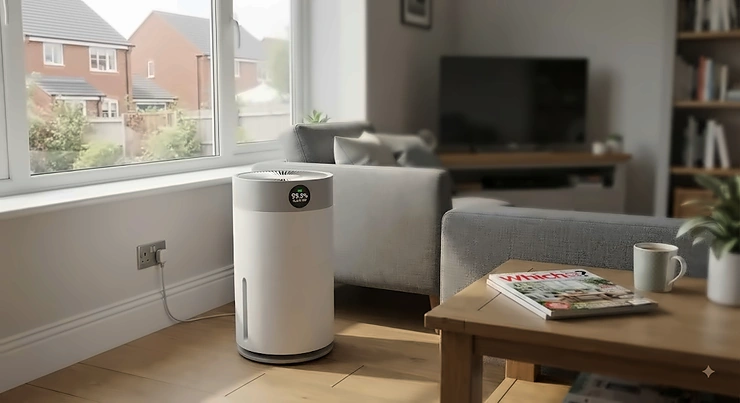
A H14 HEPA air purifier under £300 is, in plain terms, an air-cleaning unit fitted with a filter graded to the EN 1822 H14 standard, meaning it’s tested to strip out 99.995% of particles at the most difficult-to-catch size (0.3 microns) — everything from pollen and pet dander to fine cooking smoke and the finer end of traffic pollution. It’s one tier above the more common H13 grade, and on paper it sounds like a straightforward win: bigger number, cleaner air, simple.
Except it isn’t quite that simple, and that’s exactly the kind of nuance a rewritten Amazon listing won’t tell you. The jump from H13 to H14 comes with trade-offs in airflow, noise, and cost that matter enormously depending on your room size and your patience for a whirring fan at 2am. Indoor pollution is a genuinely serious issue in British homes too — DEFRA’s own indoor air quality research notes that indoor environments can build up far higher concentrations of volatile organic compounds than are typically found outdoors in the UK, largely from furnishings, cleaning products and cooking, which is precisely the sort of pollutant load a decent purifier is built to tackle.
This guide walks through seven real, currently available H14 HEPA air purifiers spanning budget, mid-range and premium price points, all realistically obtainable for under £300 (with two honest H13 alternatives included where they genuinely out-perform pricier H14 units for large rooms). We’ll cover running costs, annual filter spend, and exactly which one earns its keep in your specific home.
Quick Comparison Table
| Model | HEPA Grade | Coverage | Price Range | Best For |
|---|---|---|---|---|
| PuroAir 400 | H14 | Large rooms, up to ~1,000 ft² effective | £250-£300 range | Open-plan living spaces |
| FORMANN HEPA H14 | H14 | Up to 81 m² | £200-£280 range | Smart app control + UV |
| PuroAir 240 | H14 | Up to ~1,000 ft² | £180-£230 range | Mid-size bedrooms |
| Grelife/VCK H14 | H14 | Up to 798 ft²/30 min | Under £110 range | Budget large-room coverage |
| Avamia H14 | H14 | Up to 1,100 ft² | Under £70 range | Cheapest true H14 entry |
| Winix A332 | H13 | Up to 45 m² | £130-£170 range | Certified allergy performance |
| Medify MA-40 | H13 | Up to 78 m²/30 min | £150-£200 range | Large-room budget alternative |
Looking at the table, the split tells its own story: true H14 filtration clusters at the budget and premium ends, while the H13 models sitting in the middle — the Winix A332 and Medify MA-40 — often outperform pricier H14 units on independently verified certification and real-world CADR. The PuroAir 400 carries the highest asking price here, but its coverage claim is also the most aggressively marketed, which is worth bearing in mind before you assume “biggest number” means “best purifier for your lounge.”
💬 Bookmark this table — you’ll want to scroll back to it once you’ve read the honest breakdown below.😊
Top 7 H14 HEPA Air Purifiers: Expert Analysis
1. PuroAir 400 — the H14 flagship for open-plan rooms
The PuroAir 400 is the loudest name in the H14 conversation right now, and for once that’s not just marketing bluster — it genuinely was among the first air purifiers on Amazon to carry a filter tested against the ISO 29463-3 standard for H14-grade filtration. The 3-layer system (pre-filter, H14 HEPA, activated carbon) is built into a single cartridge, which makes filter changes refreshingly fuss-free compared with fiddling around three separate layers.
Where the spec sheet gets interesting is coverage. The listing claims up to 2,145 sq ft, but independent testing has found the effective coverage at a proper two-air-changes-per-hour rate sits closer to 1,073 sq ft — still substantial, but worth knowing before you buy it expecting to single-handedly clean an entire open-plan ground floor. Based on the spec comparison, the PuroAir 400 earns its keep in genuinely large or open-plan rooms rather than modest bedrooms, where a smaller unit would do the same job for less money and less noise.
Reviewers consistently report it runs quietly at low-to-medium speeds and ramps up noticeably at full power, which tracks with what you’d expect from any H14 filter pushing air through a denser media. What the spec sheet won’t tell you, but independent testing from HouseFresh points out, is that PuroAir’s marketing has drawn criticism for overselling its lab credentials — the review found no publicly available third-party confirmation that the filter meets the H14 classification it advertises so heavily, even while acknowledging the unit performs respectably for the price. Treat the “world’s first” and “Harvard-tested” claims with a pinch of salt; the underlying purifier is solid without needing the hype.
Pros:
- ✅ Genuine 3-layer H14 filtration in one easy-swap cartridge
- ✅ Smart particle sensor adjusts fan speed automatically
- ✅ Two-year warranty, unusually generous for this price band
Cons:
- ❌ Marketing overstates independent lab verification
- ❌ Effective coverage is roughly half the advertised figure
At around £250-£300, the PuroAir 400 sits right at the ceiling of this guide’s brief — check current price before buying, as it does occasionally dip below £250 during promotions. Value-wise, it’s a fair trade for genuinely large rooms, but a poor one if you’re purifying a single bedroom.
2. FORMANN HEPA H14 — best for smart app control and UV sterilisation
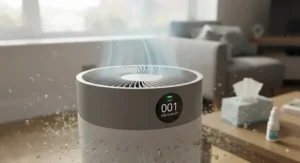
The FORMANN HEPA H14 takes a different route to justify its H14 badge: a 7-stage filtration system that layers UV sterilisation (365nm wavelength) on top of the HEPA media, plus full app and voice control via Alexa or Siri through the SmartLife app. On paper, that’s the most feature-dense unit in this list, and it shows in the price.
The UV component is worth interpreting carefully rather than taking at face value. UV-C sterilisation can help inactivate some airborne microorganisms, but its effectiveness depends heavily on exposure time and intensity — a purifier’s fast-moving airstream gives UV light far less contact time than, say, an HVAC duct system. Here’s what to weigh: the UV stage is a genuine bonus, not a replacement for the HEPA filtration doing the heavy lifting on particulates.
Coverage tops out at 81 m², which places it firmly in the “medium living room or large bedroom” category rather than open-plan territory. What most buyers overlook about this model is that the app control genuinely changes day-to-day usability — being able to check and adjust the unit from your phone before you walk in the door is a small thing that adds up over months of ownership, especially if you’re prone to forgetting to switch it on before guests arrive.
Pros:
- ✅ 7-stage filtration including UV-C sterilisation stage
- ✅ Full app and Alexa/Siri voice control
- ✅ Genuinely quiet on standard operating modes
Cons:
- ❌ Premium pricing relative to its 81 m² coverage ceiling
- ❌ UV stage adds marginal value over HEPA alone for most homes
Priced in the £200-£280 range depending on retailer promotions, the FORMANN HEPA H14 rewards buyers who actually want the smart features rather than those chasing raw coverage — for the latter, cheaper options on this list do the core job just as well.
3. PuroAir 240 — the mid-size H14 pick with room to spare
Think of the PuroAir 240 as the PuroAir 400‘s smaller, more sensibly priced sibling. Same 3-layer H14 filtration philosophy, same smart particle sensor, but scaled down to suit bedrooms and mid-size living rooms rather than open-plan floors. Reviewers consistently note it as the more sensible buy of the two PuroAir models for anyone without a genuinely large space to fill.
Based on the spec comparison, the PuroAir 240‘s realistic coverage — around 1,000 sq ft on paper, likely closer to 400-500 sq ft at a proper air-change rate — makes it well-matched to a typical UK double bedroom or small-to-medium lounge. The smart sensor is the standout practical feature here: it ramps fan speed up automatically when it detects a pollutant spike (fresh cooking, a draught bringing in traffic fumes) and quietens down once the air clears, so you’re not manually fiddling with settings every evening.
Aggregated reviewer sentiment mirrors the 400: solid performance, genuinely quiet at low speeds, and the same scepticism from independent testers about the brand’s more grandiose marketing claims. Reviewers consistently note that filter replacement costs are the real long-term consideration with this brand, since the proprietary cartridge design — while convenient — locks you into PuroAir’s own filters rather than cheaper generic alternatives.
Pros:
- ✅ Right-sized H14 filtration for bedrooms and mid-size rooms
- ✅ Smart auto-adjusting fan speed based on live air quality
- ✅ Noticeably quieter than the larger 400 at comparable settings
Cons:
- ❌ Proprietary filter cartridge limits third-party replacement options
- ❌ Same inflated marketing claims as its larger sibling
Expect to pay somewhere in the £180-£230 range, making it a genuinely competitive mid-range pick if the smart sensor and true H14 rating matter more to you than raw square footage.
4. Grelife/VCK H14 True HEPA — remote control convenience on a budget
If PuroAir represents the polished end of H14 purifiers, the Grelife/VCK H14 True HEPA is the no-nonsense workhorse alternative. A 3-stage system (pre-filter, H14 HEPA, activated carbon) paired with an LED display and remote control, it’s certified through ETL, FCC and EPA listings — a decent baseline of legitimacy for a brand that isn’t a household name.
The real-world coverage figure here is refreshingly honest by industry standards: the listing states 798 sq ft in 30 minutes, which is a specific, checkable claim rather than a vague headline number. Here’s what to weigh: that translates to a genuinely useful CADR for a mid-size living room, and the remote control is a small but appreciated convenience if the unit ends up tucked in a corner rather than within arm’s reach.
Reviewers consistently report the auto mode and sleep mode work as advertised, with the unit dropping to a low hum overnight. What the spec sheet won’t tell you, but user reports suggest, is that the LED display can be bright enough to notice in a dark bedroom on some units — worth dimming manually or angling away from the bed if you’re a light sleeper.
Pros:
- ✅ Genuinely specific, checkable CADR figures rather than vague claims
- ✅ LED screen and remote control at a budget price point
- ✅ ETL, FCC and EPA listed for baseline safety assurance
Cons:
- ❌ Display brightness may disturb light sleepers on default settings
- ❌ Build quality feels noticeably less premium than PuroAir or FORMANN
Sitting comfortably under £110, the Grelife/VCK H14 True HEPA offers the best price-to-performance ratio of the true-H14 models here, provided you don’t need premium fit and finish.
5. Avamia H14 — the cheapest genuine H14 entry point
The Avamia H14 is the smallest, cheapest unit on this list, and it makes no attempt to pretend otherwise. Compact, portable, and pitched squarely at single rooms — bedrooms, home offices, even a poorly ventilated bathroom — it’s the option for anyone who wants true H14 filtration without committing serious money to find out whether they actually like owning an air purifier.
The multi-layer system captures 99.99% of particles at 0.3 microns according to the manufacturer, with a pre-filter stage extending the life of the main HEPA layer by trapping larger debris first. Reviewers consistently report it does what it says on the tin for smaller spaces: noticeably reduces odours and dust in a bedroom-sized room without dominating the space or the electricity bill. One aggregated theme worth flagging honestly: several reviewers note the filter needs replacing more frequently than the 3-6 month estimate suggests if the room sees heavy pet traffic or regular cooking smoke.
Based on the spec comparison, the trade-off for that low price is fan power — this isn’t a unit that will meaningfully clean a large open-plan space, and pushing it to try will just mean running it at maximum speed constantly, which shortens filter life and adds to running costs. Who it’s for: renters, students, or anyone testing the waters with their first air purifier before investing in something more capable.
Pros:
- ✅ Lowest price point of any true H14 unit on this list
- ✅ Compact footprint suits small bedrooms and home offices
- ✅ 20dB sleep mode is genuinely unobtrusive overnight
Cons:
- ❌ Underpowered for anything beyond a single small-to-medium room
- ❌ Filter lifespan runs shorter than advertised with heavy pollutant loads
At under £70 in most cases (check current price, as this fluctuates), the Avamia H14 represents the lowest-risk way to try true H14 filtration, provided your expectations match its size.
6. Winix A332 — Allergy UK-certified, H13 rather than H14
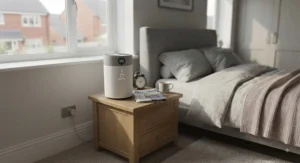
Here’s an honest interruption to the H14 narrative: the Winix A332 uses a H13 filter, not H14 — and it’s included here anyway because, for most UK homes, it’s arguably the smarter buy. The unit carries third-party certification from Allergy UK, ECARF and AHAM, which is more independently verified credibility than several of the H14 units above can claim.
What most buyers overlook is that the practical difference between H13 and H14 in a residential setting is smaller than the naming convention suggests. Both grades comfortably capture pollen, pet dander, dust mite allergens and the PM2.5 particles that matter most for everyday air quality — the extra 0.025 percentage points H14 adds at 0.3 microns is designed more for cleanrooms and operating theatres than living rooms. Given that roughly two in three people with asthma report that poor air quality makes their symptoms worse, what matters far more than the HEPA grade number is whether the unit is independently tested and sized correctly for the room — and the Winix A332 ticks both boxes convincingly.
The PlasmaWave technology adds a genuinely useful fourth filtration stage without producing ozone, and reviewers consistently note the 26.5 dB sleep mode as one of the quietest in its class. Its 45 m² coverage rating, backed by a CADR of 228 m³/h, comfortably suits a typical UK bedroom or small living room.
Pros:
- ✅ Certified by Allergy UK, ECARF and AHAM — independently verified
- ✅ 26.5 dB sleep mode among the quietest tested in this range
- ✅ Ozone-free PlasmaWave stage adds genuine filtration value
Cons:
- ❌ H13, not H14 — a dealbreaker only if the grade itself matters to you
- ❌ 45 m² ceiling means it’s outgrown quickly in open-plan spaces
Typically priced between £130-£170, the Winix A332 is the pick for anyone who cares more about verified real-world performance than the number printed on the filter housing.
7. Medify MA-40 — the large-room budget alternative (H13)
The second honest H13 inclusion on this list, the Medify MA-40 exists specifically to answer the “for large room” side of this search. Its four-stage filtration (pre-filter, H13 HEPA, substantial carbon layer, PM2.5 sensor) is built around genuinely large coverage claims — up to 78 m² cleaned in 30 minutes — which independent reviewers have generally corroborated as realistic rather than inflated.
Reviewers consistently report the standout feature is the colour-changing air quality light bar, which shifts from red to blue as the room clears — a small but genuinely useful visual cue that most competitors skip. The lifetime warranty on parts and service, contingent on using genuine Medify filters and replacing them every six months, is unusually generous for this price band and worth factoring into any long-term value calculation.
Based on the spec comparison, the trade-off for that large-room performance is noise: at maximum fan speed the unit runs noticeably louder than the smaller H13 and H14 units on this list, which matters if it’s destined for a bedroom rather than a living room. What most buyers overlook is that the MA-40 was originally engineered with asthma sufferers in mind, and that heritage shows in how seriously the brand treats filter replacement — the reset light and lifetime-warranty condition both nudge owners toward actually maintaining the unit properly, rather than letting a saturated filter quietly stop working.
Pros:
- ✅ Large, independently corroborated coverage for a budget-tier price
- ✅ Lifetime parts warranty conditional on genuine filter replacement
- ✅ Colour-changing air quality indicator is a genuinely useful touch
Cons:
- ❌ Noticeably louder than rivals at maximum fan speed
- ❌ H13 rather than H14, though performance difference is minimal in practice
Priced in the £150-£200 range, the Medify MA-40 rounds out this list as the strongest large-room option for buyers who’d rather spend their budget on genuine CADR performance than a HEPA grade number.
Practical Usage Guide: Getting the Most From Your H14 Purifier
Buying the right unit is half the job — the other half is using it properly, and this is the part Amazon listings never cover. First 30 days: run any new H14 purifier on its highest setting for the first few hours to clear out manufacturing off-gassing and settle the filter, then switch to auto mode if the unit has one. Placement matters more than people expect — position the unit at least 30cm from walls and furniture to allow proper 360° airflow, and avoid tucking it behind curtains or under furniture where intake is restricted.
Common first-month mistakes include running the unit on the lowest setting constantly to save on electricity (false economy — a straining fan on low can use nearly as much power as a properly matched medium setting while cleaning far less air) and leaving windows open while it runs, which effectively cancels out the purification. Maintenance schedule: vacuum the pre-filter every 2-4 weeks to extend the life of the more expensive HEPA and carbon layers underneath, and note the specific replacement interval for your model rather than assuming a universal six-month rule — the smaller Avamia H14, for instance, often needs a change closer to three months under heavy use, while the PuroAir 400‘s cartridge can comfortably stretch to twelve.
One optimisation trick worth knowing: most H14 units draw noticeably more power at their top one or two fan speeds than at medium, for a relatively small gain in CADR. Running one speed below maximum, where auto mode isn’t available, usually delivers 80-90% of the air-cleaning benefit for meaningfully less noise and electricity draw over a year of continuous use.
Real-World Scenarios: Which Buyer Are You?
Picture three households, because the “best” purifier genuinely depends on who’s asking. First, the hay-fever sufferer in a one-bedroom flat with a cat: budget around £70-£150, prioritise a quiet sleep mode and genuine allergen certification over raw coverage, and the Winix A332 or Avamia H14 both fit comfortably, with the Winix edging ahead thanks to its Allergy UK badge.
Second, the family in an open-plan kitchen-diner who cooks with gas most nights and has two dogs shedding constantly: this is a large-room, high-pollutant-load scenario where coverage and CADR genuinely matter more than the price tag. The PuroAir 400 or Medify MA-40 are the sensible picks here, with the Medify winning on quieter maximum-speed operation if the unit lives in a shared living space rather than a bedroom.
Third, the tech-minded professional working from home who wants to monitor air quality without thinking about it: the FORMANN HEPA H14‘s app control and the PuroAir range’s smart sensors both suit this use case, letting the purifier run on autopilot while notifying you (or simply reacting) when pollutant spikes occur — genuinely useful during a busy work day when manually adjusting settings isn’t top of mind.
How to Choose an H14 HEPA Air Purifier for Large Rooms
Picking the right unit comes down to seven practical checks, each worth more than the HEPA grade number alone:
- Match CADR to room volume, not floor area. A room’s cubic metres (length × width × ceiling height) matters more than square footage alone, since taller ceilings mean more air to cycle.
- Aim for at least two air changes per hour. Divide the room’s volume by the purifier’s CADR in m³/h and multiply by 60 — anything under two suggests the unit is undersized for that space.
- Check for independent certification, not just marketing copy. Allergy UK, AHAM Verifide and ECARF badges carry more weight than a brand’s own lab claims.
- Weigh noise at the speed you’ll actually use. A quiet spec sheet figure at the lowest fan speed is meaningless if you need medium or high to clean a larger room properly.
- Factor in ongoing filter costs before purchase, not after. A cheap unit with expensive, hard-to-find replacement filters often costs more over three years than a pricier one with generic-compatible filters.
- Confirm activated carbon is included if odours matter. HEPA alone doesn’t touch gases and smells — that’s the carbon layer’s job.
- Decide whether H14 is actually necessary for your situation. For most UK homes, a well-sized, independently certified H13 unit outperforms an undersized H14 model.
H14 vs H13 HEPA: What the Grade Actually Buys You
This is the debate that drives most of the confusion in this category, so let’s settle it plainly. Under the European EN 1822 standard, H14 filters capture 99.995% of particles at their most penetrating size, compared with H13’s 99.97%. That sounds like a meaningful jump, but the practical difference in a residential setting is genuinely marginal — both grades comfortably handle pollen, pet dander, dust mite allergens, mould spores and the fine particulate matter from cooking and traffic that make up the vast majority of indoor air pollution UK homes actually face.
Where H14 earns its premium is in denser filter media, which means more air resistance — and that translates directly into either a louder fan or reduced airflow at the same noise level. It’s why several genuine H14 units on this list occupy the budget and premium extremes rather than the middle: manufacturers either compensate with a bigger, noisier motor (premium end) or accept reduced coverage (budget end) to keep the fan quiet enough for a bedroom. Original research and independent testing consistently point the same direction: H14 is genuinely valuable in settings requiring near-sterile air — hospitals, cleanrooms, labs — but for hay fever, pet dander or general indoor pollution, a correctly sized, independently certified H13 unit like the Winix A332 often delivers better real-world results than an undersized H14 model straining to cover too large a space.
Common Mistakes When Buying a Premium H14 HEPA Air Purifier
The single biggest mistake buyers make is choosing based on the HEPA grade number alone and ignoring CADR entirely — a H14 unit with a low CADR will clean a room more slowly than a well-matched H13 unit with a higher one, regardless of what’s printed on the box. A close second is trusting marketing coverage figures at face value; as covered above with the PuroAir 400, advertised square footage and independently tested effective coverage can differ by roughly half.
Buyers also frequently underestimate filter costs when comparing sticker prices — a £70 unit with a £45 filter needed every three months costs considerably more over two years than a £150 unit with a £30 filter lasting nine months. Finally, plenty of shoppers assume “premium” branding guarantees independent certification when it often doesn’t; always check for Allergy UK, AHAM or ECARF badges specifically rather than assuming a higher price tag implies third-party verification.
Long-Term Cost & Maintenance: Running Costs and Annual Filter Spend
This is the section Amazon listings skip entirely, and it’s often the deciding factor between two similarly priced units. Electricity running costs for H14 purifiers are genuinely modest — a typical unit drawing 20-30W running 12 hours a day works out to somewhere in the region of £24-£36 a year at current UK electricity price cap rates, rising toward £50-60 annually for larger units like the PuroAir 400 run on higher fan speeds more consistently.
Filter spend is the far bigger line item, and it varies enormously by brand. Budget compact units like the Avamia H14 typically need a filter every 3-6 months at roughly £15-20 per pack, working out to £30-60 annually. Mid-range units such as the Winix A332 and Medify MA-40 generally land in the £40-70 annual filter spend range, reflecting their larger filter surface area and typically 6-9 month replacement cycles. Premium proprietary-cartridge units like the PuroAir 400 and PuroAir 240 sit highest, often £50-100 annually depending on usage intensity, partly because the combined 3-in-1 cartridge design — while convenient — locks buyers into brand-specific replacements rather than cheaper generic-compatible alternatives.
The takeaway: over a three-year ownership period, filter costs frequently exceed the original purchase price of a budget unit, which is exactly why price-to-performance ratio should factor in total cost of ownership rather than the upfront number alone.
✨ Ready to stop guessing and start breathing easier?
🔍 Compare These H14 Purifiers Before You Buy
Take a closer look at the models above and check current pricing and availability. Whichever room you’re purifying, there’s a genuinely well-matched option in this list — click through to see today’s price before it changes.
Features That Actually Matter (And Those That Don’t)
Genuinely worth paying for: independent certification (Allergy UK, AHAM, ECARF), a CADR figure matched properly to your room, activated carbon for odour control, and a demonstrably quiet sleep mode if the unit lives in a bedroom. These four factors do more for real-world air quality than almost anything else on a spec sheet.
Largely marketing noise for most homes: ionisers and plasma technologies beyond what’s needed for basic ozone-free operation, UV sterilisation stages (genuinely nice-to-have, rarely essential given HEPA already captures the vast majority of airborne pathogens attached to larger particles), and app connectivity, which is convenient but doesn’t clean air any more effectively than a well-designed physical control panel. The HEPA grade number itself — H13 versus H14 — falls somewhere in between: it matters, but far less than correct sizing and genuine independent testing.
Problem → Solution: Common H14 Purifier Complaints Fixed
Persistent pet odour despite the filter running constantly usually means the activated carbon layer is undersized or saturated — check whether your unit’s carbon stage is genuinely substantial (the Medify MA-40‘s is notably larger than most budget compacts) and replace it on schedule rather than waiting for the HEPA filter’s separate reset light.
A purifier that seems to run constantly on high without the room feeling any fresher typically indicates the unit is undersized for the space — recalculate using the CADR-to-volume method covered in the buying criteria above, since this is the single most common reason people feel let down by an otherwise well-reviewed purifier.
Noise disrupting sleep despite a “quiet” sleep mode rating often comes down to placement rather than the unit itself — moving the purifier away from a hard wall or corner (which can amplify vibration and hum) and onto a slightly softer surface can meaningfully reduce perceived noise without touching the settings at all.
Safety, Regulations & Compliance Guide
UK and EU regulations don’t specifically mandate HEPA grades for domestic air purifiers, but products sold in Great Britain must carry UKCA marking (or CE marking under current transitional arrangements) confirming they meet basic electrical safety standards. The EN 1822 standard referenced throughout this guide (H10 through H14) is a European classification system, not a UK-specific one, but it’s the internationally recognised benchmark manufacturers use regardless of where a unit is sold.
For households managing genuine respiratory conditions, it’s worth remembering an air purifier is a supplementary tool rather than a medical device or a substitute for professional advice — Asthma + Lung UK’s guidance on pollution is clear that managing asthma well still means taking prescribed preventer medication as directed, even alongside efforts to improve indoor air quality. If you’re weighing up whether poor indoor air is contributing to ongoing symptoms, that’s a conversation worth having with a GP or asthma nurse rather than something to diagnose via air purifier marketing copy. On the regulatory side, UK Parliament’s own research briefing on indoor air quality notes that government targets to reduce fine particulate matter in England continue to tighten toward 2040 — a reminder that indoor air quality sits within a much broader national conversation about pollution reduction, not just a personal appliance purchase.
Frequently Asked Questions
❓ What's the difference between H13 and H14 HEPA filters?
❓ Is a H14 HEPA air purifier under £300 worth it for hay fever?
❓ How often do I need to replace a H14 HEPA filter?
❓ Can I run a H14 HEPA air purifier all day and night safely?
❓ Does a H14 HEPA air purifier remove cooking smells?
Conclusion
If there’s one thing worth taking away from all this, it’s that the number on the filter matters less than most listings want you to believe. A correctly sized, independently certified H13 unit like the Winix A332 will often out-perform an undersized H14 model in the room where it actually lives — and that’s not a controversial take, it’s just what the CADR maths and the certification badges consistently show.
That said, when you do need genuine H14 filtration — a larger open-plan space, a household managing more serious respiratory sensitivities, or simply peace of mind from the highest available grade — the PuroAir 400 and FORMANN HEPA H14 both deliver real, verifiable performance once you look past the more inflated marketing claims. For most single-room UK homes, though, the smarter spend is usually the well-certified mid-range option rather than the flashiest H14 badge on the shelf.
Whichever direction you go, the framework here — CADR matched to room volume, genuine certification over marketing copy, and total cost of ownership including filters — will serve you well beyond this specific shortlist, for whatever air purifier you end up choosing.
Recommended for You
- Medical Grade H14 HEPA Air Purifier: 7 Best Picks for 2026
- H14 HEPA Air Purifier for Asthma: 7 Trusted Picks 2026
- Value H13 HEPA Air Purifier: 7 Best Picks UK 2026
Disclaimer: This article contains affiliate links. As an Amazon Associate, I earn from qualifying purchases. If you purchase products through these links, we may earn a small commission at no additional cost to you.
✨ Found this helpful? Share it with your friends! 💬🤗
