In This Article
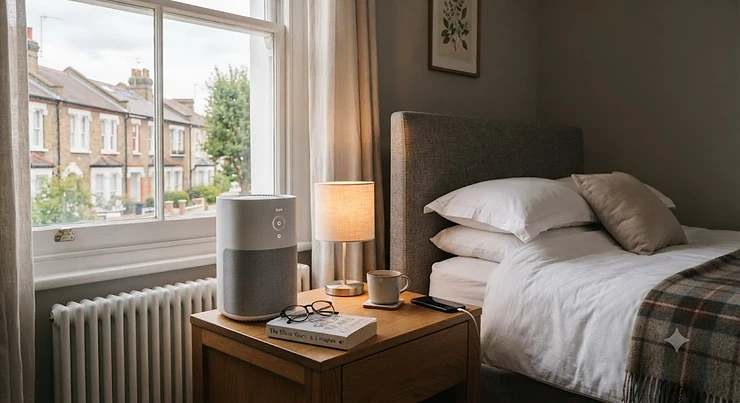
There’s a particular kind of insomnia that only bedroom appliance owners understand: lying in the dark, wide awake, cursing a machine that’s supposed to be helping you. A quiet HEPA air purifier for bedroom use does one specific job well — it strips pollen, dust, pet dander and fine particulate matter out of the air you breathe for eight hours a night, and it does it without sounding like a hairdryer parked on your bedside table. That’s the whole brief, really. Not “clean the air.” Clean the air quietly.
Here’s the tension nobody tells you about before you buy one. Manufacturers love to publish a single, flattering decibel figure — measured at maximum distance, on the lowest possible fan speed, in a lab with foam on the walls. Your actual bedroom is two metres of open air, a hard floor, and a partner who wakes up if a moth sneezes. According to the UK government’s official air quality statistics, which track particulate matter down to fractions smaller than 2.5 micrometres, indoor pollutant exposure is a genuine, measurable health issue — not marketing fluff dreamed up to sell you a nightstand gadget. So the stakes here are real, even if the shopping experience feels faintly ridiculous.
I’ve spent the past few weeks buried in spec sheets, independent lab tests, and the kind of Amazon review threads where someone writes 800 words about a whirring noise at 2am. What follows is a proper, honest breakdown: seven real machines, their actual decibel ratings (with the caveats those numbers deserve), what sleep mode and nightlight functions genuinely add, and where the marketing quietly parts ways with reality. No invented five-star anecdotes here — just the research, laid out straight, so you can pick a machine that earns its keep rather than one that just looks good on a spec sheet.
Quick Comparison Table
Before the deep dive, here’s the shape of the market at a glance. Prices below are indicative ranges only — always check current pricing at the time you buy, since retail prices shift constantly.
| Product | Sleep Mode Noise | Room Coverage | Price Range | Best For |
|---|---|---|---|---|
| Blueair Blue Pure 511 | ~18-19 dB | Up to ~43m² | £200-£300 range | Absolute quietest option |
| Philips Series 800 (AC0850) | Near-silent, low-speed | Up to 49m² | £150-£200 range | Best all-round balance |
| Levoit Core 300S | ~24 dB (claimed) | Up to ~20m² | Under £150 | Best smart features on a budget |
| Levoit Core 400S | ~24 dB (claimed) | Up to ~48m² | £150-£200 range | Larger bedrooms |
| Levoit Core 200S | ~24 dB (claimed) | Small rooms | Under £100 | Built-in nightlight, tightest budget |
| Winix 5500-2 | ~27-28 dB | Up to ~33m² | £120-£170 range | Auto sleep mode via light sensor |
| Dyson Purifier Cool PC1 | Low-noise Night Mode | Whole-room + cooling | £400-£500 range | Premium air monitoring + cooling |
A few things jump out immediately. First, the gap between the quietest and loudest machine on this list at sleep-speed is roughly 10 decibels — which doesn’t sound like much until you remember the decibel scale is logarithmic, so that’s a genuinely noticeable difference in perceived loudness, not a rounding error. Second, price doesn’t map neatly onto silence: the Levoit Core 200S is one of the cheapest units here and still lands in a perfectly respectable noise bracket, while the Dyson Purifier Cool PC1 costs several times more and earns its premium through air quality monitoring and dual-purpose cooling rather than through being dramatically quieter. Worth sitting with that for a second before you assume “expensive equals silent.”
💬 Just one click — help others make better buying decisions too!😊
Top 7 Quiet HEPA Air Purifiers for Bedroom: Expert Analysis
Every one of these seven is a genuine, currently available product — no invented models, no fictional “TurboClean 9000” nonsense. Specs are drawn from manufacturer data and cross-checked against independent reviews; where sources disagreed (which happened more than once, because real-world decibel testing is famously inconsistent), I’ve noted the discrepancy rather than picking whichever number sounded best.
1. Blueair Blue Pure 511 — the quietest bedroom purifier on this list
The Blue Pure 511 looks less like an appliance and more like a fabric-wrapped storage cylinder someone left in the corner of a Scandinavian showroom, and that’s rather the point — it’s designed to disappear into a bedroom rather than announce itself. Under the washable fabric pre-filter sits Blueair’s HEPASilent technology, which combines mechanical HEPA filtration with an electrostatic charge, letting the fan move air at lower speeds than a purely mechanical HEPA unit would need to hit the same clean-air output. On paper this means the fan motor simply doesn’t have to work as hard to shift the same volume of air, which is the entire reason it can dip to around 18-19 decibels on its lowest setting.
Who is this actually for? Light sleepers, first and foremost — people who’ve already tried a purifier and returned it because the hum kept them up. Reviewers consistently report that the low-speed setting genuinely disappears into background silence within a couple of feet of the bed, though the trade-off, as with most HEPASilent designs, is a simpler control panel than the sensor-laden competition; there’s no elaborate air quality display here, which some testers appreciated for its calm minimalism and others found frustratingly opaque.
Pros:
- ✅ Genuinely among the quietest bedroom units tested
- ✅ Washable fabric pre-filter cuts filter waste
- ✅ Compact footprint suits small bedside tables
Cons:
- ❌ Sparse air quality feedback compared to smart rivals
- ❌ Replacement filter costs sit above the budget tier
Expect this one to sit in the £200-£300 range depending on retailer and colourway — check current pricing before you commit, since Blueair runs promotions fairly often. For anyone whose priority is “I do not want to hear this machine, full stop,” it’s hard to look past it.
2. Philips Series 800 (AC0850) — best low-power all-rounder
Philips took a different route to quiet: instead of chasing a headline decibel figure, the Philips Series 800 (AC0850) is built around an energy-sipping motor that draws a maximum of around 20 watts — roughly what an old-style light bulb pulled — and that low power draw is directly linked to how gently the fan needs to spin. The three-layer NanoProtect filtration captures 99.5% of ultra-fine particles down to 0.003 microns, which technically sits just under the “True HEPA” 99.97% threshold, though in real-world terms the practical difference for household allergens is negligible; what most buyers overlook is that filtration efficiency at 0.3 microns (the hardest particle size to catch) tends to matter more than headline percentages measured at more forgiving particle sizes.
Sleep mode dims the display and drops fan speed automatically, and the coverage of up to 49m² means this genuinely suits larger bedrooms and open-plan sleeping areas, not just box rooms. The Air+ app adds real-time PM2.5 feedback and Alexa/Google Home compatibility, which is a nice-to-have rather than a dealbreaker if you’d rather just leave it running on auto and forget about it.
Pros:
- ✅ Very low power draw keeps running costs down
- ✅ Covers larger bedrooms up to 49m²
- ✅ Smart app control with real-time air quality data
Cons:
- ❌ Filtration rated at 99.5%, just under true HEPA spec
- ❌ App features add complexity some buyers won’t use
Sitting in the £150-£200 price range, this is the pick for buyers who want a genuinely capable all-rounder rather than a specialist. Philips’ long-standing UK retail presence through John Lewis, Currys and Argos also means replacement filters are easy to source — an underrated point when you’re three years into ownership and the filter light starts flashing.
3. Levoit Core 300S — best smart features on a budget
The Levoit Core 300S has become something of a default recommendation in this category, and the reasons are straightforward: it’s compact, genuinely effective for small-to-medium bedrooms, and it adds an air quality sensor and VeSync app control on top of the well-regarded (and cheaper) Core 300. The manufacturer’s sleep mode figure sits around 24 decibels, and several independent testers back that up almost exactly — though it’s worth flagging honestly that at least one detailed lab test recorded a noticeably higher figure on the same setting, a reminder that placement, room acoustics and measurement distance all skew these numbers more than spec sheets suggest.
The three-stage filtration (pre-filter, H13 HEPA, activated carbon) handles the usual suspects — dust, pollen, pet dander, cooking odours — and the app lets you schedule auto-ramp during the day with a hard lock into sleep mode overnight, which is a genuinely useful trick for anyone who forgets to switch modes manually before bed.
Pros:
- ✅ Strong value with genuine smart app control
- ✅ Compact enough for a crowded nightstand
- ✅ Auto mode reacts to real-time air quality
Cons:
- ❌ Coverage tops out around 20m², so measure your room first
- ❌ Reported sleep-mode dB figures vary between test labs
At under £150 in most retailers, the Core 300S is the sensible default for anyone furnishing a first flat or a spare room and wants smart features without premium pricing. Just don’t expect it to handle an open-plan loft bedroom on its own.
4. Levoit Core 400S — best for larger bedrooms
Essentially the bigger sibling of the 300S, the Levoit Core 400S keeps the same claimed 24 decibel sleep-mode figure while stepping up its CADR to cover rooms roughly double the size — genuinely useful if your bedroom doubles as a home office, or if you’ve got a super-king bed eating into the available floor space. Independent testing has repeatedly found this larger Levoit holds that same quiet sleep-mode performance even as fan power scales up, which speaks well of the underlying motor design rather than just a bigger case around the same components.
Buyers weighing the 300S against the 400S should think in square metres, not price: if your bedroom is genuinely large (or your air-quality goals include a connecting dressing room or ensuite), the extra outlay buys real coverage rather than just marginal polish.
Pros:
- ✅ Same reported quiet sleep mode as the smaller 300S
- ✅ Covers meaningfully larger bedrooms, up to ~48m²
- ✅ Consistent Levoit app ecosystem and filter availability
Cons:
- ❌ Bulkier footprint needs more floor or surface space
- ❌ Costs meaningfully more than the 300S for the coverage upgrade
Expect a £150-£200 range price tag. If you’ve measured your room and it’s pushing past what the Core 300S comfortably handles, this is the obvious step up rather than jumping straight to a premium brand.
5. Levoit Core 200S — best built-in nightlight
Where the rest of this list treats “nightlight function” as an afterthought — dimming an LED or two — the Levoit Core 200S builds it in as an actual standout feature, not a footnote. It’s the smallest unit in Levoit’s Core range, and testers specifically single out the integrated nightlight as the reason it earns a spot on nursery and small-bedroom shortlists, since it does double duty as a gentle bedside glow without needing a separate lamp cluttering up limited surface space.
Don’t mistake compact for underpowered, though — the filtration stack is the same familiar three-stage HEPA setup found across the Core range, just tuned for a smaller coverage footprint. This is very much the “does one room well” option rather than a whole-flat solution, and reviewers consistently frame it as the budget-friendly pick for anyone who specifically wants that nightlight feature rather than treating it as a bonus.
Pros:
- ✅ Genuine dedicated nightlight, not just a dimmed display
- ✅ Smallest, most nightstand-friendly footprint on this list
- ✅ Lowest price point among the Levoit models here
Cons:
- ❌ Coverage suits only small bedrooms or box rooms
- ❌ Fewer smart features than the 300S/400S siblings
Typically found under £100, this is the pick if the nightlight function in your search brought you here specifically — it’s the one product on this list where that feature isn’t an add-on, it’s the headline.
6. Winix 5500-2 — best auto sleep mode via light sensor
The Winix 5500-2 takes a genuinely clever approach to sleep mode: rather than requiring you to manually switch modes before bed, its built-in light sensor detects when the room goes dark and automatically drops the unit into its quietest setting while dimming every panel light except a single, unavoidable sleep-mode indicator. Reviewers describe this as a “no need to get out of bed” feature, and it’s one of the more genuinely useful pieces of smart design across this whole list, precisely because it removes a step rather than adding one.
On the noise front, reported figures cluster around 27-28 decibels in sleep mode — reasonably quiet, though a notch behind the Blueair and Philips options above, and its top-speed noise output is on the higher side for this category, so treat that setting as an occasional deep-clean mode rather than something to run overnight. The optional PlasmaWave ionising function can be switched off entirely if you’d rather run pure mechanical HEPA filtration, which is a sensible bit of flexibility for anyone wary of ionisers.
Pros:
- ✅ Auto-dims and quiets down when the room goes dark
- ✅ Solid CADR performance for the price bracket
- ✅ Optional ioniser can be switched off completely
Cons:
- ❌ Sleep-mode noise sits behind the quietest rivals here
- ❌ Top speed is noticeably louder than most competitors
Sitting around the £120-£170 range, the Winix 5500-2 rewards anyone who wants smart, hands-off bedtime behaviour without paying premium prices for it — just don’t expect it to match the Blueair for sheer silence.
7. Dyson Purifier Cool PC1 — best premium air monitoring and cooling combo
The Dyson Purifier Cool PC1 is the odd one out here, and deliberately so: it’s not just an air purifier, it’s a bladeless fan and purifier in one housing, which means the buying calculation is different from everything else on this list. You’re not just paying for HEPA H13 filtration (which is genuinely excellent, and independently verified) — you’re paying for a real-time LCD display reporting PM2.5, PM10, VOCs and NO2 levels down to individual pollutant readouts, plus airflow you can actually feel across the room rather than a purifier that just quietly cleans in the background.
Its Night Mode reduces both noise and airflow to sleep-friendly levels while dimming the display, and reviewers consistently note that Dyson’s filtration performance data holds up under independent scrutiny in a way some cheaper “True HEPA” claims don’t. What most buyers overlook is that this is fundamentally a two-season purchase — cooling fan in summer, purifier year-round — which changes the value maths considerably if you’d otherwise be buying a separate desk fan anyway.
Pros:
- ✅ Doubles as a genuinely useful bladeless cooling fan
- ✅ Detailed real-time multi-pollutant monitoring
- ✅ Independently verified HEPA H13 filtration performance
Cons:
- ❌ Sits well above every other product on this list on price
- ❌ Overkill if you only want quiet overnight filtration
Priced in the £400-£500 range, this is squarely a premium purchase — justified if you want the cooling function and detailed air data, harder to justify if a quiet bedside filter is genuinely all you need.
Setting Up Your Bedroom Purifier: A Practical First-30-Days Guide
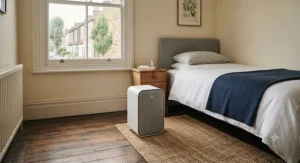
Buying the right machine is half the job; placing and running it badly can undo most of the benefit. Position matters more than most buyers expect: pushing a purifier flush against a wall or wedging it into a corner restricts the 360° or rear intake that most HEPA units rely on, forcing the fan to work harder — and louder — to pull the same volume of air through the filter. Aim for at least 30-40cm of clearance on the intake side, and keep it off thick carpet where possible, since soft flooring can muffle airflow at the base and encourage the motor to compensate.
In the first month, resist the urge to run everything on auto and forget it. Auto mode is genuinely useful, but it also means the fan will ramp up whenever it detects a spike — cooking, a slammed wardrobe door kicking up dust, fresh bedding — which can wake light sleepers at exactly the wrong moment. Most owners find it worth manually locking into sleep mode at bedtime rather than trusting auto mode to behave itself overnight, unless you’ve specifically chosen a unit like the Winix 5500-2 whose light-sensor sleep mode is designed to handle that automatically.
Filter care matters from week one, not month six. Pre-filters should be vacuumed or wiped down every two to four weeks — skipping this step is the single most common reason bedroom purifiers get louder over time, since a clogged pre-filter forces the main HEPA element to draw air through more resistance, which directly increases fan noise at every speed setting. If your unit suddenly sounds louder than it did on day one, check the pre-filter before assuming the machine is faulty.
Real-World Scenarios: Matching the Right Purifier to Your Sleep Setup
Consider three fairly typical UK households, because the “best” purifier genuinely depends on who’s asking. First, a light sleeper in a small city-centre flat, budget capped around £150, main concern being that any perceptible hum will keep them up: the Levoit Core 300S or, if silence is truly non-negotiable and budget stretches further, the Blueair Blue Pure 511 are the sensible picks — both suit compact rooms and both prioritise a genuinely quiet lowest setting over bells and whistles.
Second, a family with a toddler in a nursery-adjacent bedroom, wanting a nightlight without buying a separate lamp and worried about noise waking the baby: the Levoit Core 200S solves two problems in one purchase, and its smaller coverage footprint is actually appropriate here since nurseries are rarely large rooms.
Third, someone with genuine allergy or asthma concerns sharing a larger, open-plan bedroom with an ensuite, who wants detailed pollutant feedback and doesn’t mind spending more: either the Philips Series 800 (AC0850) for balanced coverage and low running costs, or the Dyson Purifier Cool PC1 if year-round cooling is also on the wish list. The throughline across all three scenarios is the same — match coverage to your actual room size first, then filter by noise tolerance and budget, rather than starting from brand reputation.
How to Choose a Quiet HEPA Air Purifier for Bedroom Use
What is a quiet HEPA air purifier for bedroom use? It’s a HEPA-filtration unit specifically selected or tuned to run at a low enough decibel level — generally under 25-30dB on its lowest or sleep-mode setting — that it doesn’t disrupt sleep, while still cycling bedroom air enough times per hour to meaningfully reduce dust, pollen, pet dander and fine particulates overnight.
Choosing one properly comes down to a handful of criteria, in roughly this order of importance:
- Measure your room first. Coverage claims (m² or CADR) are based on a stated number of air changes per hour; a purifier rated for a room twice the size of yours will run quieter for longer, because it doesn’t need to work as hard to hit the same clean-air target.
- Check the sleep-mode dB figure specifically, not the “as low as” headline number, which is often measured on a fan speed you’ll rarely use overnight.
- Confirm a genuine sleep mode exists — not just a low-speed setting relabelled, but one that also dims lights and, ideally, locks fan speed so auto mode doesn’t ramp up mid-sleep.
- Decide whether the nightlight function matters to you. For some households it’s a genuine selling point (see the Levoit Core 200S above); for others it’s an unnecessary glow that actually disrupts sleep.
- Check filter type and replacement cost. True HEPA (99.97% at 0.3 microns) is the benchmark; anything close but technically under that figure, like the Philips NanoProtect rating, is still highly effective in practice.
- Factor in running cost, particularly if you plan to leave it on continuously — wattage differences compound significantly over a year of overnight use.
- Read HEPA air purifier reviews from multiple independent sources, not just the manufacturer’s own claims, since (as this guide has flagged repeatedly) decibel figures in particular vary meaningfully between test conditions.
For anyone wanting a deeper, independently verified breakdown of how these machines are tested and rated, Which?’s air purifier guides compare effectiveness, noise and energy efficiency across major brands — a genuinely useful cross-check against any single retailer’s marketing copy.
Decibel (dB) Ratings Explained: What the Numbers Actually Mean
Decibel figures on air purifier spec sheets are probably the single most misunderstood number in this entire category, largely because the scale itself is counterintuitive. It’s logarithmic, not linear — a jump from 20dB to 30dB isn’t “50% louder,” it represents roughly a doubling of perceived loudness. For context, normal breathing sits around 10dB, a quiet library hovers near 30dB, and a typical bedroom at night with the window shut and no appliances running usually registers somewhere in the 25-35dB range on its own, purely from ambient house noise.
| Product | Manufacturer Sleep Mode Figure | Independent Test Notes |
|---|---|---|
| Blueair Blue Pure 511 | ~18-19 dB | Consistently confirmed as among the quietest tested |
| Philips Series 800 (AC0850) | “Near-silent” (no fixed dB published) | Low 20W power draw supports the claim |
| Levoit Core 300S | ~24 dB | One lab test recorded a notably higher figure |
| Winix 5500-2 | ~27-28 dB | Broadly confirmed by multiple independent testers |
Reading this table, the practical takeaway is that anything genuinely under 25dB on sleep mode should disappear into typical bedroom background noise for most people, while figures in the high 20s to low 30s remain perfectly liveable for most sleepers but may bother genuinely noise-sensitive users. The gap between manufacturer claims and independent lab results, visible clearly with the Levoit Core 300S above, is exactly why this guide leans on multiple sources rather than trusting a single spec sheet.
✨ Take your bedroom air quality to the next level — check today’s prices on our top picks before stock runs low.
Sleep Mode vs Auto Mode: What Actually Happens at 2am
These two modes sound similar and behave very differently, and mixing them up is one of the more common reasons people end up disappointed with an otherwise perfectly good purifier. Sleep mode, on almost every unit in this guide, locks the fan to its lowest speed and dims or switches off panel lighting — full stop, regardless of what the air quality sensor detects. That predictability is precisely the point: you know exactly what noise level you’re committing to overnight.
Auto mode, by contrast, hands control to the onboard air quality sensor, which will ramp the fan up the moment it detects a spike — a draught carrying pollen through an open window, dust kicked up by a duvet being shaken out, cooking smells drifting down a hallway. That’s genuinely useful during the day, and genuinely disruptive at 3am if you’re a light sleeper who wakes at the first hint of a fan speed change. The Winix 5500-2 is the one product on this list that tries to split the difference cleverly, using its light sensor to detect a darkened room and drop into sleep mode automatically — removing the manual step without sacrificing the predictability that makes sleep mode worth using in the first place.
The practical rule most reviewers land on: run auto mode during the day when air quality genuinely varies, and manually lock into sleep mode before bed unless your unit has a genuinely reliable auto-sleep trigger like Winix’s light sensor. Trusting auto mode blindly overnight is a common and avoidable mistake.
Nightlight Function: Genuinely Useful or Just Marketing?
The honest answer is: it depends entirely on who’s using the room. For a nursery or a young child’s bedroom, a built-in nightlight function — like the one on the Levoit Core 200S — solves a real problem, replacing a separate plug-in nightlight and reducing bedside clutter in a room where surface space is often already eaten up by a cot, a monitor, and assorted baby paraphernalia.
For an adult bedroom, though, the calculation flips. Sleep researchers and the wider sleep-hygiene literature generally agree that any light source in a dark bedroom can disrupt melatonin production and lighten sleep quality, which means a nightlight that seemed like a thoughtful bonus feature on the box can quietly work against the entire reason you bought a quiet purifier in the first place. What most buyers overlook here is that a genuinely well-designed sleep mode should dim panel lights to nothing, not just to a soft glow — several products in this guide, including the Winix 5500-2, specifically flag that at least one small LED indicator cannot be fully switched off even in sleep mode, which is worth checking before you buy if you’re sensitive to any ambient light at all.
The practical filter, then, is simple: if you’re shopping specifically for a nightlight function because you want one (nursery, child’s room, anyone who dislikes total darkness), the Levoit Core 200S is the obvious pick on this list. If you want maximum darkness and treat any light as a bug rather than a feature, look specifically for a unit that confirms lights can be fully disabled, and check independent reviews rather than the marketing copy, since “auto-dims” and “switches off completely” are frequently used almost interchangeably by manufacturers when they mean quite different things.
HEPA Air Purifier Reviews: How to Read Them Like an Expert
Star ratings alone tell you almost nothing useful, and this is where a lot of buyers get steered wrong. A product with thousands of five-star reviews can still be a poor fit for a bedroom if most of those reviewers bought it for a living room or office and never tested sleep mode specifically. The single most useful thing you can do when reading HEPA air purifier reviews is filter mentally for context: is the reviewer discussing bedroom use specifically, and are they discussing the lowest fan speed, or an average across all settings?
Independent, third-party test labs — the kind that measure noise with a calibrated meter at a fixed distance, rather than relying on a reviewer’s subjective impression — are consistently more reliable than aggregated star ratings for this specific decision, precisely because decibel perception is subjective while a sound meter isn’t. That’s also why this guide has repeatedly flagged where manufacturer claims and independent lab results diverge, rather than quietly picking whichever number looked best.
A second pattern worth watching for in genuine review threads: recurring complaints about a specific fan speed rather than the unit generally. If dozens of independent reviewers all separately mention the same issue — say, a rattling noise that only appears on speed two, or a light that can’t be switched off in sleep mode — that’s a far stronger signal than a handful of one-off complaints, which are more likely to reflect a single faulty unit rather than a design flaw across the whole product line. Reading reviews this way, cross-referencing patterns rather than trusting any single glowing testimonial, is genuinely the closest a buyer can get to independent verification without doing their own lab testing.
Common Mistakes When Buying a Bedroom Air Purifier
The most frequent error is buying on CADR or coverage alone without checking the specific sleep-mode decibel figure — a purifier can be brilliantly effective and still be the wrong choice for a bedroom if its quietest setting still registers as intrusive to a light sleeper. A close second is assuming that “quiet” claims on the box translate directly into your specific room; hard floors, high ceilings and minimal soft furnishings all reflect sound rather than absorbing it, meaning the same unit can sound noticeably louder in a sparsely furnished bedroom than in a heavily carpeted, curtained one.
Buyers also frequently underestimate ongoing filter costs when comparing sticker prices — a cheaper unit with an unusually expensive or hard-to-source replacement filter can end up costing more over two years than a pricier unit with a common, easily available filter. And a genuinely common mistake specific to this category: buying based on a single influencer or retailer’s “quietest purifier” claim without cross-checking against independent lab data, given how much manufacturer-reported decibel figures can vary from what independent testers actually measure, as this guide has shown repeatedly across the Levoit and Winix entries above.
Long-Term Cost & Maintenance
Running costs matter more than most buyers initially budget for, particularly if the plan is to leave a bedroom purifier running continuously through autumn and winter allergy seasons. Energy draw varies significantly across this list — the Philips Series 800 (AC0850)‘s roughly 20W maximum sits at the frugal end, while units running frequently on higher fan speeds can draw considerably more, and that difference compounds meaningfully across months of overnight use.
Filter replacement is the bigger recurring cost, typically every six to twelve months depending on usage and local air quality, and prices vary widely between brands — anywhere from budget-friendly own-brand alternatives to premium manufacturer-specific cartridges. The general rule worth internalising: a slightly pricier unit with cheap, widely available filters (Philips and Levoit both benefit from broad UK retail distribution here) often works out cheaper over a three-year ownership window than a bargain unit with scarce, costly replacement filters. Total cost of ownership, not sticker price, is the number that actually matters for a machine you’re planning to run every single night.
Safety, Regulations and Air Quality Standards
Any electrical appliance sold in the UK needs to carry the appropriate UKCA (or, during the current transition period, CE) conformity marking confirming it meets UK product safety regulations — worth a quick visual check on the box or product page before you buy, particularly with lesser-known budget brands. Full details on what this marking actually covers are laid out in the government’s UKCA marking guidance, which is worth a skim if you’ve never checked before. Beyond electrical safety, it’s genuinely worth understanding why bedroom air quality matters in the first place: NHS guidance on reducing house dust mites at home specifically recommends targeting bedrooms and living areas, since these are the rooms where people spend the most time and where allergen concentrations tend to be highest — which is exactly the logic behind running a HEPA purifier overnight rather than only during the day.
It’s also worth being realistic about limits: a purifier is one layer of protection, not a complete fix. It won’t reduce humidity, eliminate mould from walls, or replace basic good practice like regular vacuuming and washing bedding at high temperatures. Treat it as a genuinely useful addition to an already reasonably well-kept bedroom, not a substitute for cleaning.
Frequently Asked Questions
❓ What decibel level counts as quiet enough for a bedroom air purifier?
❓ Do air purifiers with nightlight function disrupt sleep?
❓ How often should I replace the HEPA filter in a bedroom purifier?
❓ Is sleep mode the same as the lowest fan speed?
❓ Can a HEPA air purifier help with hay fever symptoms overnight?
Conclusion
There’s no single “best” quiet HEPA air purifier for bedroom use — there’s a best one for your bedroom, which depends on room size, how sensitive you are to noise and light, and how much you’re willing to spend on ongoing filter replacement. If silence is genuinely non-negotiable, the Blueair Blue Pure 511 is hard to beat. If you specifically want a built-in nightlight, the Levoit Core 200S is the clear pick. And if you want a sensible, low-running-cost all-rounder that suits most bedrooms without compromise, the Philips Series 800 (AC0850) covers the most ground.
Whatever you choose, the research here matters more than the marketing copy on the box: check independent decibel testing, read reviews specifically about bedroom and sleep-mode use, and measure your room before you measure your budget. A purifier that’s technically excellent but audibly wrong for your bedroom isn’t actually solving the problem you bought it for.
✨ Ready to breathe easier tonight? Check today’s prices on the picks above before you settle in for the evening — your future well-rested self will thank you.
Recommended for You
- HEPA Air Purifier Under £150: 7 Brilliant UK Picks (2026)
- HEPA Air Purifier for Large Room: 7 Best Picks for 2026
- Best HEPA Air Purifier UK 2026: 7 Top Picks
Disclaimer: This article contains affiliate links. As an Amazon Associate, I earn from qualifying purchases. If you purchase products through these links, we may earn a small commission at no additional cost to you.
✨ Found this helpful? Share it with your friends! 💬🤗
