In This Article
If you’ve ever walked into a room five minutes after someone’s stubbed out a cigarette and thought “why does this still smell like an ashtray?”, you already understand the problem better than most marketing copy does. Smoke doesn’t politely disappear once the cigarette’s out. It clings to curtains, seeps into plaster, and floats around as an invisible gas cloud long after the last wisp has cleared. A HEPA carbon air purifier for smokers is built specifically to deal with that two-part mess — the visible particles and the invisible chemical soup riding along with them.
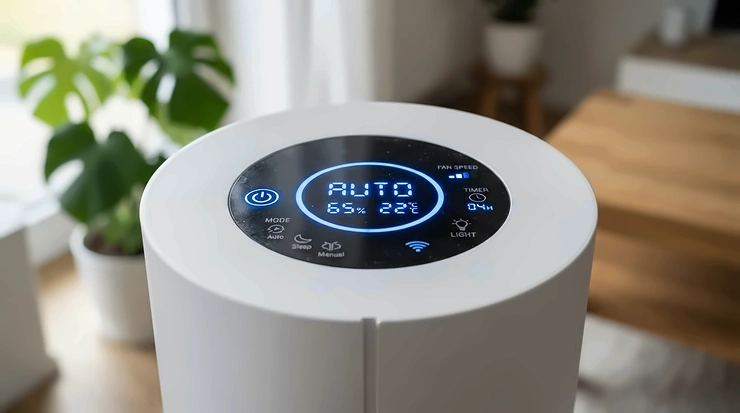
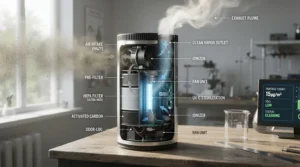
What is a HEPA carbon air purifier for smokers? It’s an air-cleaning appliance that pairs a True HEPA filter (which traps 99.97% of particles down to 0.3 microns) with a substantial layer of activated carbon, which adsorbs the gaseous compounds — nicotine vapour, tar fumes, VOCs — that HEPA alone cannot touch.
Here’s the bit most buying guides skip over: a HEPA-only machine will make your living room look cleaner while doing almost nothing about the smell or the chemistry. That’s not a design flaw, it’s just physics — gas molecules are roughly a thousand times smaller than the particles HEPA fibres are built to catch, so they sail straight through. This matters beyond comfort, too: as the NHS explains, opening windows or smoking in another room doesn’t actually protect the rest of the household from secondhand smoke, which is exactly why proper filtration earns its keep. This guide walks through seven real, currently available machines, how they stack up on price, coverage and carbon capacity, and — because a filter is only half the equation — the ventilation habits and maintenance routines that actually make one of these things worth the money you spent on it.
Quick Comparison Table
Short on time? Here’s the whole shortlist at a glance before we dig into the detail.
| Product | Best For | Room Coverage | Price Range |
|---|---|---|---|
| Levoit Core 300 | Budget bedrooms | Up to ~20m² | Under £120 |
| Winix 5500-2 | Best value HEPA carbon combo | Up to ~28m² | £150-£190 range |
| Levoit Core 400S | Smart app control | Up to ~26m² | £160-£200 range |
| Coway Airmega AP-1512HH | Daily/heavy smokers | Up to ~34m² | £220-£280 range |
| Blueair Blue Pure 211i Max | Large open-plan rooms | Up to ~65m² | £320-£380 range |
| Rabbit Air MinusA2 | Pets and smokers combined | Up to ~76m² | £550-£650 range |
| Dyson Purifier Big+Quiet Formaldehyde BP03 | Premium VOC monitoring | Up to ~81m² | Around £650-£700 |
Reading across that table, the pattern is pretty clear: coverage and carbon capacity scale with price, but not in a straight line. The Winix 5500-2 punches well above its price bracket because it uses a pellet-based carbon filter rather than the thinner sheet carbon found in cheaper machines, which is exactly why it earns the “best value” tag rather than the “cheapest” one. Meanwhile the jump from the Coway Airmega AP-1512HH to the Blueair Blue Pure 211i Max buys you almost double the floor space covered, which matters enormously if your smoking area is an open-plan kitchen-diner rather than a boxroom.
💬 Found a favourite already? A quick share helps other readers land on the right purifier faster too!😊
Top 7 HEPA Carbon Air Purifiers for Smokers: Expert Analysis
We’ve picked a genuine spread here — a couple of affordable entry points, several solid mid-range all-rounders, and two properly premium machines for anyone who wants the belt-and-braces version. Every one of these is a real, currently sold model with genuine specifications, not a hypothetical “ideal” product.
1. Levoit Core 300 — best lightweight budget pick
The Levoit Core 300 is the machine most people should start with if they’re testing the waters rather than committing to a whole-house solution. It’s small, it’s quiet, and it doesn’t pretend to be anything it isn’t.
Its three-stage filter — pre-filter, True HEPA, and activated carbon — is rated with a CADR (Clean Air Delivery Rate) that comfortably suits rooms up to around 20 square metres, which covers most UK bedrooms and box rooms with room to spare. Sleep mode drops the fan noise down to a whisper, which matters more than most spec sheets let on: a purifier you switch off because it’s too loud is a purifier doing nothing at all.
Based on the spec comparison against pricier rivals, the trade-off here is capacity, not quality — the carbon layer is thinner than what you’ll find in the Winix 5500-2 further down this list, so it saturates faster under heavy, daily smoking. Reviewers consistently report that it handles occasional or light smoking (someone who has the odd cigarette out the back door) very well, but struggles to keep pace with a pack-a-day habit in an unventilated room.
Pros:
- ✅ Genuinely quiet on sleep mode — won’t disturb a light sleeper
- ✅ Compact footprint fits bedside tables and small flats easily
- ✅ Replacement filters are among the cheapest in this list
Cons:
- ❌ Thinner carbon layer saturates quickly under heavy smoke exposure
- ❌ No built-in air quality sensor or display on the base model
At around £90-£120, the Levoit Core 300 is the sensible entry point if your exposure to smoke is light-to-moderate and your room is small — just budget for more frequent filter changes than the machines further down this list.
2. Winix 5500-2 — best value HEPA carbon combo
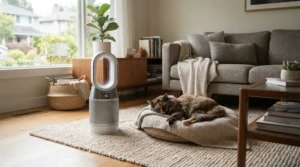
If there’s one machine on this list that consistently gets recommended by people who’ve actually lived with smoke problems, it’s the Winix 5500-2. What separates it from cheaper alternatives is the pellet-based carbon filter rather than a thin fabric-carbon sheet — pellets pack more surface area into the same physical space, and surface area is everything when it comes to adsorbing gas molecules.
True HEPA filtration handles particles down to 0.3 microns, and the AOC (Advanced Odour Control) carbon filter is specifically formulated for household odours including tobacco smoke, which is a genuinely different chemistry to the generic carbon dust used in bargain-bin units. It also includes a PlasmaWave feature, which Winix markets as an ioniser — worth knowing this can be switched off entirely if you’d rather avoid any trace ozone byproduct.
What most buyers overlook about this model is that its AHAM-verified CADR ratings are independently tested rather than just manufacturer marketing claims, which gives you a genuinely comparable number against rival machines. Reviewers consistently note it as a strong middle-ground pick for daily or near-daily smokers in a mid-sized room, praised repeatedly for tackling lingering odour rather than just the visible haze.
Pros:
- ✅ Pellet carbon filter outperforms sheet-carbon rivals at this price
- ✅ AHAM-verified CADR gives genuinely comparable, independently tested figures
- ✅ PlasmaWave ioniser can be switched off if you’d rather avoid it
Cons:
- ❌ Filter replacement costs add up for heavy, daily smokers
- ❌ Fan noise on the highest setting is noticeably louder than rivals
Sitting in the £150-£190 range, the Winix 5500-2 is the one to buy if “value” to you means genuine performance-per-pound rather than just the lowest sticker price.
3. Levoit Core 400S — best smart app control
The Levoit Core 400S takes the same core filtration philosophy as its smaller sibling and wraps it in a smart layer that genuinely changes how you use the machine day to day. Real-time PM2.5 readings on the front display and full app control through Wi-Fi mean you can actually see, in numbers, when a smoking session has spiked particulate levels — rather than just guessing.
The larger three-stage filter (pre-filter, HEPA, activated carbon) steps up coverage to around 26 square metres, and the auto mode ramps fan speed up automatically when the sensor detects a spike, then quietly winds back down once air quality recovers. Here’s what the spec sheet won’t tell you but daily use makes obvious: automatic response to smoking events matters more than raw CADR numbers, because it means the fan isn’t running at full pelt (and full noise) 24 hours a day for the sake of the twenty minutes after someone’s had a cigarette.
Aggregated review sentiment is broadly positive on the smart features specifically — users report the auto mode genuinely reacting to cooking smoke and cigarette smoke alike, though a handful note that the app occasionally needs a Wi-Fi reset after router changes.
Pros:
- ✅ Real-time PM2.5 display shows exactly when smoke levels spike
- ✅ Auto mode adjusts fan speed without manual input
- ✅ Alexa and app compatibility for scheduling and remote control
Cons:
- ❌ Smart features are pinned to Wi-Fi reliability, which can be flaky
- ❌ Costs meaningfully more than the non-smart Core 300 for similar coverage
Expect to pay in the £160-£200 range for the Levoit Core 400S — a sensible step up if you like data over guesswork.
4. Coway Airmega AP-1512HH — best all-rounder for daily smokers
The Coway Airmega AP-1512HH has been a fixture on “best for smoke” lists for years, and it’s earned that reputation the hard way — through consistently strong independent testing rather than marketing spend. Its four-stage system (washable pre-filter, True HEPA, activated carbon, and an ionizer) covers rooms up to roughly 34 square metres.
Based on the spec comparison with entry-level machines, the standout feature here isn’t any single stage — it’s the colour-coded air quality indicator, which shifts from red through purple to blue as pollution clears, giving you an instant, glanceable read on whether the room is safe to sit in yet. Eco mode automatically powers down after 30 minutes of clean air, then rechecks every half hour, which is a genuinely thoughtful touch for anyone worried about running costs.
Reviewers consistently praise its effectiveness at cutting particulate levels fast, with independent testers reporting PM2.5 dropping from several hundred micrograms per cubic metre to single figures within roughly ten minutes in enclosed test rooms. The recurring criticism is aesthetic rather than functional — its boxy shape doesn’t tuck into a corner as neatly as the sleeker Blueair or Dyson units.
Pros:
- ✅ Colour-coded air quality light gives an instant, no-guesswork readout
- ✅ Eco mode cuts running costs once the air is genuinely clean
- ✅ Independently tested to clear heavy particulate loads quickly
Cons:
- ❌ Boxy design is harder to tuck away than sleeker rivals
- ❌ No Wi-Fi or remote control on this base model
Priced in the £220-£280 range, the Coway Airmega AP-1512HH is the pick for anyone who smokes daily indoors and wants proven, no-nonsense performance over smart-home bells and whistles.
5. Blueair Blue Pure 211i Max — best for large or open-plan rooms
Once you’re dealing with an open-plan kitchen-diner or a decent-sized living room rather than a single bedroom, the Blueair Blue Pure 211i Max starts to make a lot of sense. Blueair’s HEPASilent technology combines mechanical HEPA filtration with electrostatic charging of particles, which lets the fan run slower — and quieter — for the same clean-air output as purely mechanical rivals.
Coverage stretches to roughly 65 square metres, which is genuinely large-room territory, and the washable pre-filter (available in several fabric colours) cuts down on how often you need to replace the pricier HEPA-carbon core. What the marketing doesn’t emphasise enough is that Blueair’s parent-brand testing has repeatedly scored well in independent UK consumer lab tests specifically for smoke, dust and pollen removal — a track record most budget brands simply can’t claim.
Aggregated customer sentiment consistently flags the low noise floor as the standout feature; several long-term smokers report running it on a low-to-medium setting continuously rather than cycling it on and off, precisely because it’s quiet enough to ignore.
Pros:
- ✅ HEPASilent tech delivers high airflow at genuinely low noise levels
- ✅ Washable, colour-swappable pre-filter extends core filter life
- ✅ Covers large, open-plan spaces that smaller units can’t handle
Cons:
- ❌ Considerably more expensive than mid-range single-room units
- ❌ Larger physical footprint takes up noticeable floor space
At £320-£380, the Blue Pure 211i Max suits anyone whose “problem room” is bigger than a standard bedroom.
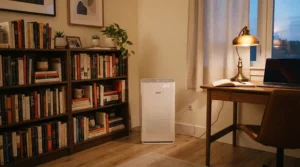
6. Rabbit Air MinusA2 — best HEPA carbon combo air purifier for pets and smokers
Households juggling both a smoking habit and a shedding pet have a genuinely trickier filtration problem than either issue alone, and the Rabbit Air MinusA2 was built with exactly that overlap in mind. It’s wall-mountable — a rare feature that reclaims floor space entirely — and offers swappable customisation filters, including a dedicated Pet Allergy option alongside the standard Toxin Absorber (extra-thick activated carbon) cartridge.
Its six-stage filtration includes a pre-filter for pet hair and dander, a medium filter, a customisable filter, a True HEPA filter, and Rabbit Air’s proprietary BioGS/ozone-free technology, covering rooms up to roughly 76 square metres. Based on the spec comparison with wall-mounted alternatives, the genuine standout is that customisable middle layer — you’re not stuck with a generic all-purpose filter, you’re choosing the cartridge that matches your actual household, whether that’s pet dander, tobacco smoke, or both simultaneously.
Reviewers consistently highlight two things: how genuinely quiet it runs even on higher settings (helped by the wall-mounted design pushing air across the room rather than straight up), and how much easier daily life gets once it’s off the floor — no trailing cable to catch a hoover on, no cat using it as a scratching post.
Pros:
- ✅ Wall-mounted design frees up floor space entirely
- ✅ Swappable Pet Allergy and Toxin Absorber cartridges tailor filtration
- ✅ Whisper-quiet operation even at higher fan speeds
Cons:
- ❌ Significant upfront cost compared with floor-standing rivals
- ❌ Wall mounting requires proper installation, unlike plug-and-place units
Sitting at £550-£650, the Rabbit Air MinusA2 is squarely aimed at households wanting one machine to handle both pet dander and smoke without compromise.
7. Dyson Purifier Big+Quiet Formaldehyde BP03 — best premium pick with VOC monitoring
At the top end of this list sits the Dyson Purifier Big+Quiet Formaldehyde BP03, and it’s the one machine here that goes beyond “filter it and hope” into genuine real-time chemical monitoring. Its formaldehyde sensor uses a solid-state electrochemical cell that continuously destroys formaldehyde molecules rather than simply trapping them — a meaningfully different approach to the carbon-adsorption method every other machine on this list relies on.
Coverage extends to roughly 81 square metres, backed by CADR figures around 233 for smoke specifically, and the whole-room air projection design pushes purified air across the space rather than just recirculating what’s nearest the unit. On paper, this means it’s genuinely suited to large living rooms where a smoker sits well away from the machine itself — something several of the smaller units on this list simply aren’t built for.
What the spec sheet won’t tell you, but user reports suggest, is that the real-time air quality reporting through Dyson’s app becomes genuinely addictive to check — people report altering their own smoking habits (stepping outside more, cracking a window) once they can actually see the PM2.5 spike happen live on their phone.
Pros:
- ✅ Solid-state formaldehyde sensor actively destroys VOC molecules
- ✅ Whole-room air projection suits large living spaces
- ✅ Real-time app reporting makes air quality genuinely visible
Cons:
- ❌ Among the most expensive options on this entire list
- ❌ Replacement filter costs are notably higher than rival brands
At around £650-£700, the Dyson Purifier Big+Quiet Formaldehyde BP03 is the pick for anyone who wants the fullest possible picture of what’s actually in their air, not just cleaner-smelling air.
Practical Usage Guide: Setup, Ventilation Habits and Maintenance Schedule
Buying the right machine is only half the job — how you set it up and run it day to day genuinely changes how well it performs. Placement matters more than most people expect: position your unit at least 30-50cm from walls and furniture so air can circulate freely around all sides, and ideally somewhere central to the room rather than tucked in a corner behind a sofa.
For the first 30 days, run it on auto or a medium-high setting continuously rather than switching it on only when you notice a smell — by the time you can smell smoke, particulate and VOC levels have already been building for a while. A common mistake is treating the purifier like an extractor fan, expecting instant results; in reality, a correctly sized unit typically needs 20-40 minutes to complete several full air changes before smoke odour drops below what most people can detect.
Your ventilation habits do a surprising amount of heavy lifting here too. Briefly opening a window while smoking, then closing it once you switch the purifier to a higher setting, helps clear the initial concentrated burst of particulates faster than the purifier alone can manage. Wipe down hard surfaces and walls periodically to remove the sticky tar residue that settles out of the air and would otherwise keep re-releasing odour long after the smoke itself has cleared — treat the purifier as a supplement to good habits, not a replacement for them.
✨ Ready to set your machine up properly? Grab a spare set of filters now so you’re never caught out mid-cycle!🔋
Real-World Scenarios: Matching the Right Purifier to Your Situation
Specs only mean so much until you map them onto an actual life. Here are three genuinely common situations and which machine on this list fits each one.
The student in a single room. Living in halls or a small rented room, smoking occasionally out the window, budget genuinely tight. The Levoit Core 300 covers a room this size comfortably, costs little to run, and its cheap replacement filters matter when money’s stretched thin.
The daily smoker with a family home. Smoking a pack a day, mostly in the kitchen-diner, with kids or a partner who doesn’t smoke sharing the space. The Coway Airmega AP-1512HH or, for a genuinely open-plan layout, the Blueair Blue Pure 211i Max both handle sustained daily exposure far better than entry-level units, and the visible air quality indicators help reassure non-smoking family members that the air is genuinely being managed.
The pet-owning smoker in a larger flat. Two cats, a smoking habit, and a living room that never quite smells fully clean no matter how often it’s hoovered. The Rabbit Air MinusA2‘s swappable Pet Allergy cartridge alongside its Toxin Absorber option directly addresses both problems at once, rather than forcing a compromise between the two.
Problem → Solution: Solving Tar, Particulate and Odour Issues
Tobacco smoke isn’t one pollutant — it’s a moving target, and different problems need different fixes.
Problem: sticky tar residue building up on walls and ceilings. This isn’t something any air purifier removes once it’s settled — filtration only stops it from settling further. Solution: run your purifier continuously during and after smoking, and periodically wipe painted surfaces with a mild detergent solution to physically remove existing tar and particulate combo build-up.
Problem: the room smells fine when you’re in it but hits guests immediately. This is nose fatigue, not clean air — your own sense of smell adapts to background odour within minutes. Solution: trust your purifier’s sensor readout (on models like the Levoit Core 400S or Dyson Purifier Big+Quiet Formaldehyde BP03) rather than your nose, and keep the carbon filter on schedule regardless of whether you can personally detect smoke anymore.
Problem: purifier seems to “stop working” after a few months. Almost always this is carbon saturation — the activated carbon has adsorbed as much gas as its surface area allows and needs replacing, even if the HEPA layer underneath still looks clean. Solution: replace carbon filters on the schedule specified for smoking households (typically every 2-4 months under heavy use), not the lighter “average household” schedule printed on the box.
Problem: fabric and soft furnishings still smell days after a smoking session. Filters only clean air, not upholstery. Solution: wash curtains and cushion covers regularly and steam-clean upholstered furniture periodically — the purifier stops new odour compounds recirculating, but it can’t reach what’s already absorbed into fabric.
How to Choose a HEPA Carbon Air Purifier for Smokers
Cutting through marketing claims comes down to checking a handful of things in the right order.
- Match CADR to your actual room size, not the box’s maximum claim. Manufacturers often quote coverage at a lower recommended air-change rate than smoke actually needs — size up a category if smoking happens indoors regularly.
- Check the carbon filter weight or type, not just its presence. A “carbon filter” can mean a wafer-thin dusting or a substantial pellet-packed cartridge — the difference in real-world odour and VOC performance is enormous.
- Confirm it’s True HEPA (H13 or better), not just “HEPA-type” or “HEPA-style.” Those unregulated terms often mean a lower actual capture rate — independent lab testing, like the kind Which? runs on air purifiers for dust, pollen and smoke removal, is a far more reliable guide than a box label.
- Look for an ioniser off-switch if the model includes one. Ionisers can help with particle clumping but produce trace ozone, so the ability to disable it matters for sensitive households.
- Factor in ongoing filter costs, not just the upfront price. A cheaper machine with expensive, frequently replaced filters can cost more over two years than a pricier unit with cheaper consumables.
- Check the noise rating at the fan speed you’ll actually use. A machine that’s unbearably loud on the setting needed to clear smoke will simply get switched off.
- Consider smart features only if you’ll genuinely use them. App control and live PM2.5 readouts are genuinely useful for some households and irrelevant clutter for others.
HEPA Carbon Air Purifier for Smokers vs Ionic and Ozone Alternatives
Ionic and ozone-generating air cleaners get marketed heavily on smoke-odour claims, so it’s worth being direct about how they actually compare to a HEPA carbon combo. Ionisers work by electrically charging particles so they clump together and fall out of the air onto surfaces — which can help with visible haze, but does essentially nothing for the gaseous VOC component of smoke, and it doesn’t remove particles from the room, just relocates them onto your walls and furniture.
Ozone generators are a different matter entirely, and a more concerning one. Some devices marketed for “odour elimination” deliberately produce ozone at levels that can irritate the lungs, especially for anyone with asthma — a genuinely serious consideration given how commonly tobacco smoke and asthma triggers overlap in the same households. A True HEPA plus activated carbon combination avoids this problem altogether: HEPA physically traps particles rather than just clumping them, and carbon adsorbs gas molecules rather than trying to chemically neutralise them with a reactive gas of its own.
The practical takeaway: if a product’s marketing leans heavily on “ionic technology” or “ozone-free odour elimination” without mentioning HEPA and carbon filtration at all, treat that as a red flag rather than a selling point.
Common Mistakes When Buying an Air Purifier for Smokers
Even well-intentioned buyers trip over the same handful of errors repeatedly.
Buying based on room square footage alone, without accounting for how much smoking actually happens there, is probably the single biggest mistake — a lightly used spare room needs far less capacity than a kitchen where someone smokes six times a day. Ignoring filter replacement costs entirely is another classic; a bargain unit with a £45 filter that needs replacing every six weeks under heavy smoking quickly outspends a pricier machine with cheaper, longer-lasting consumables.
People also frequently confuse HEPA-only machines with proper HEPA-carbon combos, drawn in by lower prices without realising the carbon layer — the part that actually deals with odour and gases — is missing or minimal. Finally, plenty of buyers place the unit somewhere convenient (a corner, behind furniture) rather than somewhere effective, throttling airflow and cutting real-world performance well below the rated CADR.
What to Expect: Real-World Performance
Specs on a box rarely translate directly into lived experience, so here’s what actually happens once one of these machines is running in a real room. In the first few minutes after lighting a cigarette indoors, visible haze typically clears within 10-20 minutes on a correctly sized unit running at medium-high speed — that’s the HEPA layer doing straightforward mechanical work. The chemical smell, though, lags noticeably behind the visible clearing; expect a further 20-40 minutes before the odour drops below what most people would consciously notice, because gas adsorption through carbon is simply a slower process than particle capture.
Over the following weeks, don’t expect the room to smell “smoke-free” in the way a room that’s never had a cigarette in it does — third-hand smoke residue in fabric, carpet and paint means a lived-in smoking room retains a faint background note that filtration alone can’t fully erase. What you should notice, though, is a dramatic reduction in the acrid, immediate sting of fresh smoke, less staining on paintwork over months, and — for many households — a genuine reduction in coughing or throat irritation among non-smoking occupants.
HEPA Carbon Combo Air Purifiers for Pets and Smokers
Running a HEPA carbon combo air purifier for pets alongside a smoking habit is a genuinely common combination, and it’s worth being specific about why it’s trickier than either problem alone. Pet dander is a fine, sticky particulate that clogs pre-filters faster than dust alone, while tobacco smoke saturates the carbon layer with VOCs — meaning both major filter stages get worked harder simultaneously, and both need replacing more often than either a pet-only or smoker-only household would require.
Machines with swappable or customisable cartridges, like the Rabbit Air MinusA2, handle this overlap better than fixed-filter units because you can specifically prioritise the Pet Allergy or Toxin Absorber layer depending on which problem is currently worse. For fixed-filter machines, the practical fix is simply shortening the replacement interval — vacuum pre-filters weekly rather than monthly, and expect carbon replacement roughly a month sooner than the smoking-only schedule suggests.
If allergies are a genuine concern alongside the smoke issue, it’s also worth checking a unit’s particle capture rate specifically at the 0.1 micron range rather than the more commonly quoted 0.3 micron figure — pet dander and pet allergen proteins often skew smaller than tobacco smoke particulates. It’s also worth remembering that filtration is a mitigation, not a cure: the Royal College of Physicians has been clear that indoor smoking remains a major hazard to household health even where air is actively filtered, so a purifier works best alongside smoking outdoors wherever possible.
Long-Term Cost, Carbon Saturation Rate and Maintenance
The upfront price tag on any of these seven machines is only part of the real cost — activated carbon has a finite lifespan, and understanding carbon saturation rate is the single most important factor in whether you’re actually getting clean air or just running a very effective-looking fan.
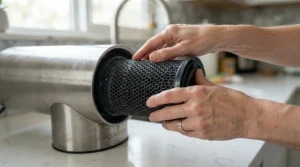
Carbon saturation happens when the microscopic pores across the filter’s surface — a single gram of activated carbon can have a surface area exceeding 3,000 square metres — become physically full of adsorbed gas molecules and simply can’t bond with any more. Crucially, a saturated carbon filter doesn’t announce itself the way a visibly dirty HEPA filter does; the air still passes through, the fan still runs, but VOC and odour capture quietly drops toward zero while everything looks perfectly normal.
For smoking households specifically, expect carbon saturation roughly two to three times faster than the “average household” replacement schedule printed on most boxes — meaning a filter rated for 6 months of typical use might realistically need replacing every 2-3 months under daily indoor smoking. Budgeting for this from day one avoids the nasty surprise of realising, six months in, that your machine has been running on exhausted carbon for weeks without you noticing. Over a two-year period, factor filter costs into your total cost of ownership rather than just comparing sticker prices — a £90 unit needing £35 filters every ten weeks can genuinely cost more over two years than a £250 unit needing £40 filters every four months.
Features That Actually Matter (And Those That Don’t)
With every brand claiming some proprietary technology, it’s worth separating genuine performance factors from marketing dressing. Carbon filter weight and type matters enormously — pellet or granular activated carbon in real quantity outperforms thin carbon-infused fabric by a wide margin, and this is worth checking in the product specifications rather than trusting a “odour-eliminating” badge on the box. True HEPA certification (H13 or above) matters too; “HEPA-type” or “99% HEPA-like” filters are unregulated marketing terms and typically underperform certified True HEPA by a meaningful margin.
On the other hand, UV-C sterilisation add-ons — increasingly common on mid-range units — do very little for smoke specifically, since UV light targets biological contaminants like bacteria and viruses rather than particulates or VOCs. Similarly, elaborate app ecosystems and voice-assistant integration are genuinely nice-to-haves rather than performance factors; they don’t clean the air any better, they just make it easier to check that it’s happening.
Value HEPA Carbon Air Purifiers: Best Picks Without Overpaying
“Value” and “cheap” aren’t the same thing, and it’s worth being precise about the difference before you buy. A genuinely good value HEPA carbon air purifier delivers proper True HEPA filtration and a substantial carbon layer without charging premium-brand prices for features you won’t use — smart app control, formaldehyde sensors, or wall-mounting hardware, for instance, all add cost that doesn’t necessarily translate into cleaner air for a straightforward single-room smoking problem.
By that measure, the Winix 5500-2 earns its “best value” tag through the pellet carbon filter and independently AHAM-verified CADR figures rather than through the lowest sticker price on this list — that title goes to the Levoit Core 300, which is the better pick specifically if your room is small and your smoking is occasional. Reviewers consistently note that overspending on premium features while under-spending on filter replacement frequency is the most common way people end up disappointed with an otherwise well-reviewed unit — the machine was never the weak link, the maintenance schedule was.
Frequently Asked Questions
❓ Do air purifiers really work for cigarette smoke smell?
❓ How often should I change a carbon filter for smoking?
❓ Is HEPA or carbon filter better for smoke?
❓ What size air purifier do I need for a smoker's bedroom?
❓ Can an air purifier remove smoke stains and tar residue?
Conclusion
Choosing the right HEPA carbon air purifier for smokers really comes down to being honest about your own situation: how much smoking actually happens indoors, how big the room genuinely is, and whether pets or family members with sensitivities are sharing that air too. The Levoit Core 300 and Winix 5500-2 cover the budget and value ends of the spectrum respectively, the Levoit Core 400S and Coway Airmega AP-1512HH handle most mid-range daily-smoking households comfortably, and the Blueair Blue Pure 211i Max, Rabbit Air MinusA2 and Dyson Purifier Big+Quiet Formaldehyde BP03 step up for larger rooms, mixed pet-and-smoke households, and anyone wanting genuine real-time air quality data respectively.
Whichever machine you land on, remember that the filter itself is only half the job — pairing it with sensible ventilation habits, a realistic carbon replacement schedule, and the odd bit of surface-wiping for tar residue is what actually determines whether your room smells genuinely clean in six months’ time or just filtered-around-the-edges.
✨ Don’t Miss These Exclusive Deals!
🔍 Take your indoor air quality to the next level with these carefully selected purifiers. Click on any highlighted pick above to check current pricing and availability, and start breathing genuinely cleaner air today!
Recommended for You
- HEPA and Carbon Filter Air Purifier for Allergies: 7 Best Picks 2026
- 7 Best HEPA Carbon Air Purifiers UK 2026 (Honest Picks)
- Activated Carbon Air Purifier Under £100: 7 Picks That Work (2026)
Disclaimer: This article contains affiliate links. As an Amazon Associate, I earn from qualifying purchases. If you purchase products through these links, we may earn a small commission at no additional cost to you.
✨ Found this helpful? Share it with your friends! 💬🤗
