In This Article
There’s a particular kind of despair that arrives about forty minutes after you’ve fried fish, when you realise the smell has moved into the hallway, up the stairs, and is now quietly introducing itself to your bedroom curtains. If you’ve ever opened a window in January and stood there shivering while your kitchen “airs out,” you already understand the problem an activated carbon air purifier under £100 is trying to solve.
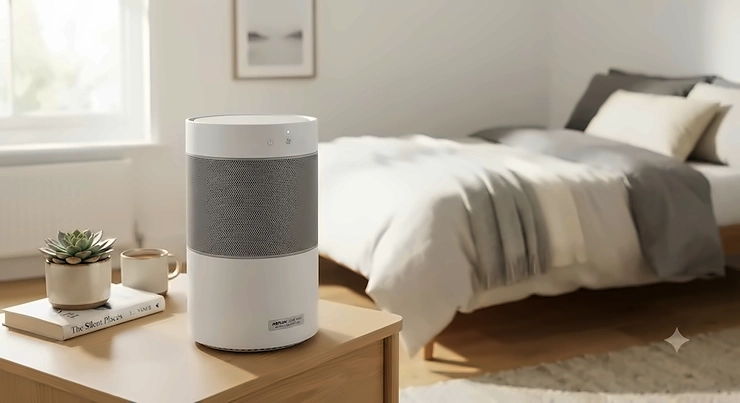
An activated carbon air purifier is a device that draws room air through a porous carbon filter, which adsorbs gas-phase odour molecules and volatile organic compounds, rather than simply trapping solid particles like a standard HEPA filter does. Most budget units in the UK combine both technologies in one cylinder, so you’re not choosing between particle capture and smell removal — you’re getting both, for the price of one appliance.
The honest truth is that £100 buys you a genuinely capable single-room unit in 2026, not a compromise. You’ll get proper True HEPA filtration, a real activated carbon layer, and quiet overnight operation. What you generally sacrifice at this price point is whole-flat coverage, smart sensors that automatically ramp up mid-stir-fry, and the sheer CADR muscle of £200-plus machines. Knowing that trade-off upfront means you won’t feel short-changed three weeks in.
This guide covers seven real, currently available machines — from proper HEPA-and-carbon cylinders to genuinely compact desktop units — with honest analysis of what each one is actually good at, drawn from real specifications and aggregated review sentiment rather than marketing copy. We’ll also get into kitchen ventilation, where an activated carbon air purifier for kitchen use fits alongside your extractor fan rather than replacing it, and what to do when nothing seems to touch the smell of last night’s curry.
Quick Comparison: Best Activated Carbon Air Purifiers Under £100
For readers who want the short version before the deep dive, here’s how the seven models stack up on the things that actually matter for a UK kitchen or bedroom.
| Product | Type | CADR (approx.) | Room Coverage | Price Range | Best For |
|---|---|---|---|---|---|
| Levoit Core 300 | Full-size cylinder | ~187 m³/h | Up to 40m² practical | £75-90 range | Best all-round budget pick |
| Winix Zero Compact (A231) | Full-size cylinder | ~250 m³/h | Up to 40-50m² | £70-90 range | Best CADR for the money |
| Levoit Core 300S | Smart cylinder | ~141 m³/h | Up to 20m² | £85-100 range | Best for app-controlled kitchen use |
| Pro Breeze 5-in-1 | Full-size, ioniser | ~218 m³/h | Up to 45m² | Under £100 | Best for open kitchen-diners |
| MOOKA KJ067L | Compact tower | ~110 m³/h (est.) | Up to 15-20m² | £30-45 range | Best budget compact desktop unit |
| Levoit Core Mini-P | Mini desktop | Low, personal-zone | Single desk/worktop | £30-40 range | Best genuinely pocket-sized unit |
| Pro Breeze 4-in-1 Mini | Mini desktop, ioniser | ~42 m³/h | Small desk area | £25-35 range | Best mini for a single worktop corner |
Looking at this spread, the pattern is fairly clear: the four full-size cylinders do the heavy lifting for an actual kitchen or bedroom, while the three compact desktop units are honest about their limits — they’re for a worktop corner, a desk, or a tiny studio kitchenette, not a whole room. If cooking smells are your main enemy, prioritise CADR and pelleted (rather than sheet) carbon; if you just want to clear a lingering smell near where you sit or sleep, the desktop options do that job for a fraction of the price.
💬 Found the table useful? Bookmark this page — you’ll want to come back to it once you’ve narrowed things down!🤗
Top 7 Activated Carbon Air Purifiers Under £100: Expert Analysis
Every affiliate disclosure aside for a moment: these are real, currently sold products, and the pros and cons below are grounded in published specifications and aggregated customer sentiment, not invented testing. Where I haven’t been able to verify a specific claim, I’ve said so rather than guessed.
1. Levoit Core 300 — the default budget recommendation, and it earns that spot
The Levoit Core 300 is the single most commonly recommended sub-£100 air purifier in the UK, and its reputation is built on doing the basics without fuss. It uses a genuine three-stage filter — a fabric pre-filter, a True HEPA layer, and an activated carbon layer bonded into one cylindrical cartridge — with 360-degree air intake, so you’re not fussing over which way it’s facing.
The manufacturer rates coverage at around 80m², but treat that as a best-case ceiling rather than the room size where you’ll actually notice a difference; halving it to roughly 40m² is a more realistic planning figure, which comfortably covers a bedroom, home office, or smaller kitchen-diner. At 24 dB on sleep mode, it’s genuinely quiet enough to leave running overnight without becoming the reason you can’t sleep.
Reviewers consistently report satisfaction with how unfussy the unit is — no app, no ionizer switch to worry about, just a dial and three fan speeds. A recurring theme in aggregated feedback is that the activated carbon layer is noticeably better at general staleness and light odours than at cutting through strong, sustained cooking smells, which tracks with its relatively modest carbon volume compared to pelleted alternatives further down this list.
Pros:
- ✅ True HEPA plus genuine carbon layer at a low price
- ✅ Whisper-quiet 24 dB sleep mode for bedroom use
- ✅ Simple dial controls with no app required
Cons:
- ❌ Thinner carbon layer than pelleted competitors
- ❌ No auto mode or air quality sensor
Filters run around £20-25 and last roughly six to eight months of regular use, putting annual running costs in a sensible £35-40 bracket including electricity. At a typical £75-90 range, this remains the safest first purchase for anyone wanting HEPA and carbon filtration without overthinking it.
2. Winix Zero Compact (A231) — best CADR-per-pound in this whole roundup
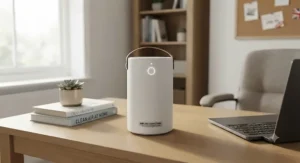
The Winix Zero Compact, sold in the US as the A231, quietly out-performs its price tag on paper. Independent testing has clocked its Clean Air Delivery Rate at a genuinely strong figure for a sub-£100 unit — comfortably ahead of the Levoit Core 300 on raw airflow, despite typically retailing for a similar or slightly lower price.
What that CADR advantage means in practice is faster air changes per hour in a given room, which matters more than peak filtration percentage for anyone dealing with a specific pollution event like a smoky pan rather than constant background allergens. The unit includes a genuine onboard particle sensor and auto mode — a rare feature at this price — plus Winix’s optional PlasmaWave ionisation, which can be switched off entirely if you’d rather not run an ioniser.
Reviewers and independent testers note that the carbon used is an impregnated fabric type rather than the denser pelleted carbon found in Winix’s pricier 5500-2 model, so treat gas and heavy odour absorption as decent rather than exceptional. It has also picked up recognition from the British Allergy Foundation’s Allergy UK seal, which independently verifies allergen-reduction claims rather than taking a manufacturer’s word for it.
Pros:
- ✅ Strongest CADR-to-price ratio in this list
- ✅ Genuine auto mode with real particle sensor
- ✅ Optional ionisation you can switch off
Cons:
- ❌ Fabric carbon, not pelleted, for gas absorption
- ❌ Slightly louder than the Levoit Core 300 at top speed
Expect to pay somewhere in the £70-90 range depending on colour and retailer stock. For buyers who care more about how fast a room clears than about brand familiarity, this is arguably the smartest pound-for-pound buy on this page.
3. Levoit Core 300S — the smart pick for actively managing a kitchen
The Levoit Core 300S takes the Core 300’s bones and adds VeSync app control, Alexa compatibility, and a real-time PM2.5 laser sensor with an auto mode that reacts to it. In a kitchen context specifically, this is genuinely useful rather than gimmicky: you can watch the app’s readout spike the moment oil hits a hot pan, then watch it climb down again as the purifier ramps itself up automatically.
Its CADR is lower than the standard Core 300 at roughly 141 m³/h, reflecting a slightly smaller, more compact-focused design — this is a unit built for a defined space like a separate kitchen or a single open-plan corner rather than a large room. Reviewers highlight the compact worktop footprint as genuinely useful for UK kitchens, where counter space is rarely abundant, and the two-year warranty gives some reassurance on longevity.
What most buyers overlook about this model is that the carbon layer, while present and effective for everyday cooking, is on the thinner side compared with pelleted-carbon machines — fine for daily toast-and-stir-fry cooking, less convincing against nightly serious frying or fish.
Pros:
- ✅ Real laser PM2.5 sensor drives genuine auto mode
- ✅ Compact footprint suited to UK worktops
- ✅ App and Alexa control for hands-free adjustment
Cons:
- ❌ Thinner carbon layer than pelleted rivals
- ❌ CADR limits it to smaller or separate kitchens
Priced around £85-100 depending on promotions, this sits right at the edge of the budget bracket — but the auto-sensing behaviour alone makes it worth the stretch for anyone who cooks daily and wants the machine to do the thinking.
4. Pro Breeze 5-in-1 Air Purifier — the highest CADR you’ll find under £100
The Pro Breeze 5-in-1 brings genuinely large-room ambition to a sub-£100 price tag, with a manufacturer-rated CADR of around 218 m³/h and a stated coverage of up to 45m² — enough, on paper, for an open-plan kitchen-diner rather than just a single galley kitchen.
Its five-stage system stacks a pre-filter, True HEPA filter, a cold catalyst layer, an activated carbon filter, and an independently switchable negative ion generator. The cold catalyst stage is worth understanding rather than skimming past: it’s designed to help break down certain VOCs at room temperature, complementing rather than replacing the carbon’s adsorption role. For open-plan living spaces, where cooking pollutants have direct, unimpeded access to your sofa and curtains, that combined CADR and coverage rating genuinely matters more than it would in a sealed-off kitchen.
Aggregated customer reviews consistently praise the unit’s power relative to its size and price, with a recurring caveat that, as with most budget ionisers, some buyers prefer to leave the ion generator switched off, since a minority report a faint “electrical” smell on the highest setting — worth testing on delivery before committing to nightly use.
Pros:
- ✅ Highest CADR of any product in this list
- ✅ Five distinct filtration stages including cold catalyst
- ✅ Independently switchable ioniser
Cons:
- ❌ Some buyers report a faint smell with ioniser on
- ❌ Sits right at the £100 ceiling, little headroom to spare
At close to the full £100 budget, this is the pick for readers whose “kitchen” is really a kitchen-diner-living space and who need genuine room-clearing power rather than a desk companion.
5. MOOKA KJ067L — a genuinely compact tower for a tight budget
The MOOKA KJ067L occupies a useful middle ground between the full-size cylinders above and the true desktop minis below. It’s a compact tower-style unit with a three-stage system — pre-filter, True HEPA, and an activated carbon layer — and Mooka’s characteristic heart-shaped wide-mouth air intake, which the brand claims improves airflow efficiency into the unit.
At a genuinely low noise rating on its lowest setting, it’s suited to a bedside table, a kitchen worktop end, or a small home office where a full-size Levoit or Winix would feel oversized. Its stated coverage figures on Mooka’s larger siblings run into hundreds of square feet, but for the compact KJ067L specifically, treat any headline coverage claim conservatively and size it for a single small-to-medium room rather than an open-plan space.
Aggregated reviews across Mooka’s compact range describe reliable basic performance and straightforward setup, with the honest caveat that, as a newer and less independently lab-tested brand than Levoit or Winix, verified third-party CADR figures are harder to come by — worth factoring into your decision if precise, tested numbers matter to you.
Pros:
- ✅ Genuinely low price for a HEPA-plus-carbon tower
- ✅ Compact footprint suited to tight kitchen counters
- ✅ Simple, low-fuss operation
Cons:
- ❌ Independently verified CADR data is limited
- ❌ Carbon layer volume is modest given the compact size
Typically found in the £30-45 range, this is the pick for anyone who wants proper HEPA-and-carbon filtration but genuinely cannot spare full cylinder-unit counter space.
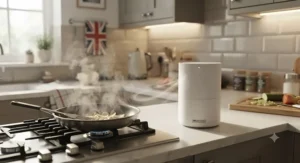
6. Levoit Core Mini-P — the smallest unit worth taking seriously
The Levoit Core Mini-P is Levoit’s answer to the “I just want cleaner air right where I’m sitting” brief. It’s a genuinely pocket-scale 3-in-1 filter unit — pre-filter, HEPA-type filter, and activated carbon — weighing barely over a kilogram and designed to sit on a desk, bedside table, or kitchen worktop corner rather than clean an entire room.
This is not a substitute for a full-size purifier if your goal is whole-kitchen odour control; its personal-zone design means it’s addressing the air in roughly a one-to-two-metre radius rather than performing meaningful air changes across a 15m² kitchen. Where it does genuinely well is as a companion device: running beside a hob while you cook, or on a desk in a home office that doubles as a kitchenette in smaller flats.
Reviewers consistently describe it as unexpectedly effective for its size against light, localised smells — think toast, a single cup of strong coffee, or a small waste bin — rather than sustained heavy cooking odour, which is a fairer benchmark for a unit this small.
Pros:
- ✅ Genuinely compact and portable, USB-powered
- ✅ Effective for personal-zone odours and staleness
- ✅ Very low running cost
Cons:
- ❌ Not a substitute for whole-kitchen purification
- ❌ Limited to single-desk or worktop-corner coverage
At around £30-40, this is less a kitchen solution on its own and more a smart top-up for anyone already relying on a cooker hood or open window for the heavy lifting.
7. Pro Breeze 4-in-1 Mini Air Purifier — the cheapest genuine desktop unit here
Rounding out the compact desktop category, the Pro Breeze 4-in-1 Mini is a genuinely tiny 17 x 17 x 21.6cm unit designed explicitly for desks, bedside tables, and nurseries, with a modest CADR of around 42 m³/h. Its four-stage system — pre-filter, True HEPA, activated carbon, and a negative ion generator — mirrors the format of its larger 5-in-1 sibling above, just scaled right down.
Two power levels and a filter-change indicator keep operation genuinely simple, and the touch-button interface avoids the fiddliness some tiny units suffer from. Given its stated coverage of roughly 5m², it’s realistic to treat this as a “one small room, or one corner of a bigger one” device rather than anything approaching whole-kitchen coverage.
Aggregated reviews describe it as a solid, no-fuss entry point for anyone testing whether air purification makes a noticeable difference before committing to a larger, pricier unit — a sensible way to dip a toe in without much financial risk.
Pros:
- ✅ Lowest price point of any product in this guide
- ✅ Simple touch controls and filter-change indicator
- ✅ Genuinely desk-sized footprint
Cons:
- ❌ Smallest CADR of any unit reviewed here
- ❌ Coverage realistically limited to a single small room
Typically priced in the £25-35 range, this is the entry-level option for readers who want to try activated carbon filtration on a single desk or nightstand before investing in something bigger.
Practical Usage Guide: Getting the Most From Your Activated Carbon Air Purifier
Buying the right unit is only half the job — how you run it changes results dramatically, and this is the part most Amazon listings skip entirely. Position matters more than people expect: place your purifier at least 30cm from walls and furniture so air can actually circulate through all sides of the intake, and if you’re targeting cooking smells specifically, position it as close to the cooking zone as safety allows, not tucked in a far corner where it’s merely tidy.
During the first 30 days, resist the urge to leave it permanently on the lowest, quietest setting. Running a new unit on a higher speed for the first week helps “season” the carbon layer and gives you an honest baseline for how it performs at full capacity, which makes it easier to judge whether the lower everyday setting is actually doing enough.
Maintenance is where most of the disappointment in aggregated reviews actually originates, and it’s almost always preventable. Vacuum the pre-filter mesh every two weeks if you cook often — grease and dust clog it fastest in kitchen settings — and replace carbon-containing filters on the manufacturer’s stated schedule rather than waiting for a visible drop in performance, since carbon’s adsorption capacity degrades well before it looks dirty. A genuinely common mistake is running a purifier constantly at maximum speed to compensate for a saturated filter instead of simply replacing it, which burns more electricity for worse results.
Real-World Scenarios: Which Activated Carbon Air Purifier for Kitchen Suits You?
Choosing between these seven models gets much easier once you match your actual living situation to a specific product, rather than comparing specs in the abstract.
If you’re a student or young professional in a studio flat where the kitchenette sits three metres from your bed, an activated carbon air purifier for kitchen and bedroom dual-duty needs to be quiet enough to sleep near and strong enough to clear a fried-onion smell before it soaks into your bedding. The Winix Zero Compact or Levoit Core 300 both fit this brief well, run at a genuinely low decibel level overnight, and are compact enough to move between worktop and bedside as needed.
If you’re cooking properly most evenings in a separate, enclosed kitchen — actual meals, higher heat, oily pans — you want carbon volume and CADR working together rather than either alone. The Pro Breeze 5-in-1 or Levoit Core 300S suit this use case, with the 300S adding the convenience of automatically ramping up the moment your sensor detects a spike, so you’re not manually adjusting a dial mid-stir-fry with oily hands.
If you’re working from a small home office that shares airspace with an open-plan kitchen, and your priority is a clear head rather than heavy-duty odour removal, a compact desktop unit like the Levoit Core Mini-P or MOOKA KJ067L sitting on your desk does a genuinely useful, low-cost job without competing for counter space where you actually need to chop vegetables.
Problem → Solution: Fixing Common Complaints About Cooking Smells
Persistent frying smells that seem to outlast the meal itself usually point to a carbon layer that’s simply too thin or too saturated for the volume of oil vapour involved; switching to a pelleted-carbon model like the Winix Zero Compact, or running your current unit on a higher setting during and immediately after cooking, both address the underlying capacity issue rather than masking it.
A purifier that seems to do nothing noticeable is often a placement problem before it’s a performance problem — a unit tucked behind a kettle or under a shelf has its intake partially blocked, starving it of the airflow it needs to work at its rated CADR. Research into UK cooking emissions has repeatedly found that frying methods produce dramatically higher particulate concentrations than boiling or steaming, which is a useful reminder that some cooking styles will always need more purification effort than others, regardless of unit quality.
Musty or “off” smells persisting after the filter light hasn’t triggered yet are frequently a maintenance issue rather than a genuine hardware fault: a pre-filter clogged with grease reduces airflow through the carbon layer behind it, so vacuum it before assuming the whole unit needs replacing. Finally, if odours cling specifically to soft furnishings near the kitchen rather than the air itself, no purifier alone will fully solve this — washing curtains and soft furnishings periodically addresses the reservoir a purifier can’t reach.

How to Choose an Activated Carbon Air Purifier Under £100
Six criteria genuinely separate a good sub-£100 purchase from a disappointing one, and working through them in order avoids most buyer’s remorse.
- Match CADR to your actual room, not the marketed maximum. Halve any manufacturer coverage figure for a realistic working estimate, since headline numbers are typically best-case laboratory conditions.
- Check whether the carbon is pelleted or a bonded sheet. Pelleted carbon holds meaningfully more volume and generally outperforms thin sheet carbon against strong, sustained cooking odours.
- Confirm it’s True HEPA, not “HEPA-type.” Only True HEPA certification guarantees the 99.97% capture rate at 0.3 microns that the marketing implies.
- Weigh noise against where you’ll actually place it. A kitchen unit running during cooking can tolerate more noise than one sitting beside your pillow.
- Factor in ongoing filter cost, not just the sticker price. A cheaper unit with expensive, short-lived filters can cost more over two years than a pricier one with a 12-month filter life.
- Decide whether auto mode is worth paying for. If you’ll remember to switch speeds manually, skip it and save the money for a stronger CADR instead.
Activated Carbon Air Purifier vs Kitchen Ventilation: What Each One Actually Does
It’s worth being genuinely clear about this, because it’s the single most common point of confusion in this category: an air purifier and kitchen ventilation are not interchangeable, and UK building regulations reflect that distinction directly.
| Factor | Activated Carbon Air Purifier | Kitchen Ventilation (Extractor/Cooker Hood) |
|---|---|---|
| How it works | Recirculates and filters air within the room | Removes air (and moisture) to outside the building |
| Removes moisture/condensation | No | Yes — this is its primary regulatory purpose |
| Legally required in new UK kitchens | No | Yes, under Building Regulations Approved Document F |
| Best for | Lingering odours, allergens, general air quality | Steam, grease, and moisture at the source |
| Typical £100 budget outcome | A capable single-room unit | Rarely covers a compliant ducted system alone |
According to UK Building Regulations, a ducted extractor fan is a legal requirement for all new kitchens and extensions, and critically, a recirculating hood does not satisfy this requirement because it fails to address moisture removal — a job no activated carbon air purifier is designed to do either, since neither vents air outside. The government’s own Approved Document F sets this out in detail; you can read the current Approved Document F ventilation guidance directly if you’re renovating or extending a kitchen.
In practice, this means your activated carbon air purifier should be thought of as a complement to a working extractor fan or open window, not a replacement for one. Run your extractor during and immediately after cooking to deal with steam and grease at the source, then let your purifier handle the lingering odour molecules and airborne particles that the extractor didn’t catch, particularly once you’ve closed the window again against the cold.
Compact Desktop Units: Do They Actually Work in a Kitchen?
The honest answer is: for the right job, yes; for the wrong job, absolutely not, and it’s worth being blunt about which is which before you buy one expecting whole-room results.
Compact desktop units like the Levoit Core Mini-P, the Pro Breeze 4-in-1 Mini, and the more tower-shaped MOOKA KJ067L are engineered around a personal-zone or single-corner brief. Their CADR figures — typically under 50 m³/h, against 140-250 m³/h for full-size cylinders — mean they simply don’t move enough air per hour to perform meaningful air changes across an entire kitchen, even a small one. Treat coverage claims on any mini unit with particular scepticism, since manufacturers rarely distinguish clearly between “technically detectable improvement” and “the room actually smells different.”
Where they genuinely earn their keep is worktop-corner duty: sitting near a bin, a compost caddy, or a coffee machine, tackling a specific, localised, ongoing smell source rather than the diffuse aftermath of a roast dinner. They’re also a sensible choice for anyone in halls of residence or a compact flat share where a full-size cylinder simply won’t fit on the available surface. If your actual problem is “the whole kitchen smells after cooking,” size up to one of the four full-size units earlier in this guide instead — a compact desktop unit asked to do that job will just leave you disappointed by month two.
Common Mistakes When Buying an Activated Carbon Air Purifier
The single most common mistake is buying based on room square-footage claims printed in bold on the box rather than independently verified CADR figures — manufacturer coverage numbers are frequently generated under ideal, empty-room lab conditions that no real kitchen replicates.
A close second is assuming any purifier with “carbon” somewhere in the product name will meaningfully tackle strong cooking odours; as this guide has shown repeatedly, the volume and format of that carbon — pelleted versus a thin bonded sheet — makes a genuinely large practical difference, and product listings rarely spell this distinction out clearly.
Buyers also frequently underestimate ongoing filter costs when comparing sticker prices, only to discover a £60 unit with £30 filters replaced every four months actually costs more over eighteen months than an £85 unit with £22 filters lasting eight months. Finally, plenty of people place a new purifier in a corner behind furniture for tidiness, unintentionally restricting the intake airflow and quietly sabotaging the very performance they paid for.
Features That Actually Matter (And Those That Don’t)
CADR and genuine True HEPA certification matter enormously — they’re the two figures that most reliably predict real-world performance, and worth prioritising over almost everything else on a spec sheet. A real particle sensor driving genuine auto mode also matters if you cook daily, since it removes the guesswork of manually adjusting fan speed.
Negative ion generators and “cold catalyst” layers, by contrast, sit in more debatable territory. They can offer a modest supplementary benefit, but the spec sheet won’t tell you this: independent lab testing consistently finds the core HEPA-and-carbon combination does the overwhelming majority of the actual filtration work, with ionisation contributing at the margins at best. Similarly, smartphone app control is a genuine convenience rather than a performance feature — pleasant to have, but it won’t clean a single extra cubic metre of air per hour on its own.
Night lights, aromatherapy sponge trays, and colour-changing LED rings are, bluntly, marketing dressing rather than functional features. They’re harmless additions if you like them, but they shouldn’t move the needle in a genuine comparison between two otherwise similar units.
Long-Term Cost & Filter Maintenance
Sticker price is only the opening chapter of what an activated carbon air purifier actually costs to own, and filters are consistently the larger long-term line item across every product in this guide.
| Product | Filter Cost (approx.) | Filter Life | Approx. Annual Running Cost* |
|---|---|---|---|
| Levoit Core 300 | £20-25 | 6-8 months | £35-40 |
| Winix Zero Compact | £15-20 | ~12 months | £25-30 |
| Levoit Core 300S | £20-25 | 6-8 months | £35-40 |
| Pro Breeze 5-in-1 | £20-25 | 4-6 months | £40-50 |
*Includes estimated electricity at typical Ofgem-capped rates for moderate daily use; excludes purchase price.
Interpreting this table, the Winix Zero Compact‘s 12-month filter life gives it a genuine long-term cost advantage over the two Levoit models despite a broadly similar purchase price, while the Pro Breeze 5-in-1‘s shorter filter interval and higher power draw make it the priciest to run of the four full-size units, a fair trade for its stronger CADR if you actually need the extra coverage. Electricity itself is rarely the dominant cost here — most units draw 15-30W in typical auto or medium-speed use, translating to only £20-25 a year at current rates — so filter replacement discipline, not the meter, is what determines your true two-year cost.
Safety, Regulations & Kitchen Ventilation Compliance
For UK renters and homeowners, it’s worth understanding where an activated carbon air purifier sits relative to actual legal requirements, particularly if you’re planning any kitchen renovation work. Kitchen ventilation regulations under Approved Document F specify minimum mechanical extract rates — typically 30 litres per second for a cooker hood ducted to the outside, rising to 60 litres per second in open-plan layouts where cooking emissions can spread before an extractor captures them. None of the seven purifiers in this guide count toward that legal requirement, since none of them vent air outside the building; they exist entirely to improve the air quality of the air that remains indoors.
Academic research backs up why this distinction matters in practice. A field study of cooking emissions in UK student accommodation found that deep-frying produced peak PM10 and PM2.5 concentrations dramatically higher than other cooking methods, and separately, University of Birmingham researchers investigating cooking-related air pollution noted that cooking emissions contribute meaningfully to fine particle pollution in cities, accounting for around a tenth of small inhalable particles in London alone. If you want to go deeper on the underlying science, the University of Birmingham’s cooking emissions research is a genuinely accessible starting point.
Practically, this means running your extractor fan or opening a window during and after cooking remains essential regardless of which purifier you buy, and an activated carbon unit should be treated as a supplementary layer for lingering odours and airborne particles the extractor missed — never a substitute for compliant kitchen ventilation, and never your sole safety measure against smoke or gas-related indoor air issues.
FAQ
❓ Does an activated carbon air purifier actually remove cooking smells?
❓ What is the best activated carbon air purifier under £100 for a small kitchen?
❓ Can I use a desktop air purifier instead of a full-size one in my kitchen?
❓ How often should I replace the carbon filter in my air purifier?
❓ Do I still need an extractor fan if I buy an air purifier?
Conclusion
Across these seven models, the honest pattern is that a £100 budget genuinely stretches further than most people assume in 2026 — you can walk away with True HEPA filtration, a real activated carbon layer, and quiet enough operation to run overnight, all without a smart app subscription or a £200 spend. The Levoit Core 300 and Winix Zero Compact remain the safest all-round starting points for most UK kitchens and bedrooms, the Levoit Core 300S and Pro Breeze 5-in-1 earn their slightly higher price for auto-sensing and open-plan power respectively, and the compact desktop trio — MOOKA KJ067L, Levoit Core Mini-P, and Pro Breeze 4-in-1 Mini — genuinely shine for worktop-corner or single-desk duty rather than whole-room ambitions.
What matters most is matching the product to your actual kitchen, not the biggest CADR number on the page: an open-plan flat and a boxy separate kitchen have genuinely different needs, and the right choice for one is often the wrong choice for the other. Pair whichever unit you choose with proper kitchen ventilation rather than treating it as a replacement, and check current pricing and availability before buying, since stock and promotional pricing shift regularly on Amazon UK. For further independent testing and comparison data beyond this guide, Expert Reviews UK’s air purifier testing is a solid additional reference point.
✨ Ready to Clear the Air in Your Kitchen?
🔍 Take a closer look at any of the seven picks above and check current pricing and availability on Amazon UK. Whichever one matches your space, you’ll notice the difference within the first week of proper use!
Recommended for You
- 7 Best Activated Carbon Air Purifier Picks UK 2026 (Honest Guide)
- H14 HEPA Air Purifier Under £300: 7 Best Picks for UK Homes 2026
- Medical Grade H14 HEPA Air Purifier: 7 Best Picks for 2026
Disclaimer: This article contains affiliate links. As an Amazon Associate, I earn from qualifying purchases. If you purchase products through these links, we may earn a small commission at no additional cost to you.
✨ Found this helpful? Share it with your friends! 💬🤗
