
In This Article
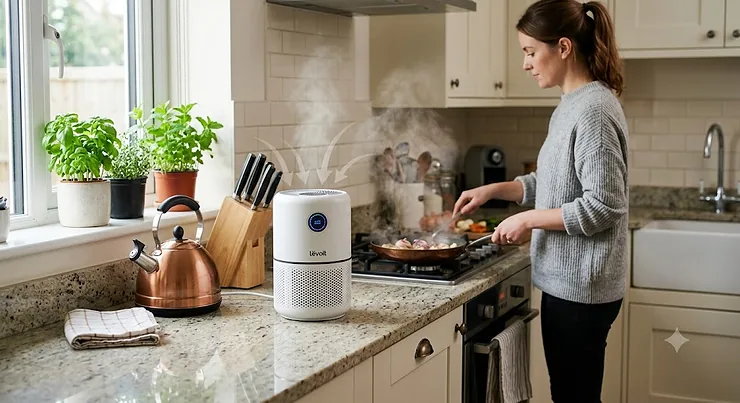
You’ve just made a lovely Friday night curry. The kitchen smells glorious — for about forty minutes. Then it doesn’t. The vindaloo has colonised your sofa, your curtains, and quite possibly your sense of wellbeing. And if you’re cooking on a gas hob, grilling bacon, or deep-frying anything at all, you’re not just dealing with lingering odours. You’re producing a cocktail of volatile organic compounds (VOCs), nitrogen dioxide, and fine particulate matter that most extractor fans barely touch.

Here’s the uncomfortable truth: the average British kitchen — particularly in terraced houses, flats, and those gorgeous open-plan kitchen-diners we’ve all convinced ourselves we need — is often worse for air quality than standing on a busy London pavement. According to research from the UK’s Indoor Air Quality programme, cooking is one of the leading sources of indoor pollution, with gas hobs producing nitrogen dioxide levels that would trigger health warnings if measured outdoors.
An air purifier for kitchen use won’t replace a good extractor hood — nothing will — but the right one, running quietly in the background, can make a meaningful difference to what you’re actually breathing after the wok goes back in the cupboard. The key word there is right. Kitchen air is chemically complex: you need an activated carbon filter capable of trapping VOCs and odours, plus a HEPA layer to catch smoke particles and grease aerosols. A cheap little ioniser from the pound shop? Not going to cut it.
I’ve spent considerable time researching what’s actually available on Amazon.co.uk in 2026, cross-referencing real UK buyer reviews, independent test data, and the specific realities of British home cooking and living spaces. What follows is an honest, no-faff guide to seven machines worth your money — and the knowledge to pick the right one for your kitchen.
Quick Comparison: 7 Best Air Purifiers for Kitchen at a Glance
| Product | CADR | Coverage | Carbon Filter Type | Smart Features | Best For | Price Range |
|---|---|---|---|---|---|---|
| Levoit Core 300S | 258 m³/h | up to 108 m² | Activated carbon layer | App, Alexa | Small-medium kitchens | Under £100 |
| Levoit Core 400S | 266 m³/h | up to 166 m² | Activated carbon layer | App, Alexa & Google | Open-plan kitchen-diners | £100–£150 |
| Winix 5500-2 | 390 m³/h | up to 99 m² | Pelleted carbon (washable) | Auto sensor, remote | Heavy cookers, budget buyers | £100–£180 |
| Winix Zero-S | 410 m³/h | up to 100 m² | Pelleted carbon + HEPA | App, Alexa, auto sensor | Large open-plan spaces | £150–£220 |
| Blueair Blue Max 3250i | 239 m³/h | up to 48 m² | Activated coconut carbon | WiFi, app, voice control | Compact kitchens, design-lovers | £120–£180 |
| Philips AC2220/10 | 420 m³/h | up to 109 m² | NanoProtect + active carbon | Auto, smart sensor | Serious air quality, large kitchens | £200–£300 |
| Coway Airmega Mighty AP-1512HH | 421 m³/h | up to 99 m² | Deodorisation carbon mesh | Auto, air quality indicator | All-rounder on a sensible budget | £150–£220 |
The table tells part of the story, but not all of it. CADR alone won’t save you from last night’s haddock. What matters in a kitchen context is the quality and depth of the carbon filter — pelleted carbon, as found in the Winix models, outperforms carbon-coated fabric for sustained odour absorption. Budget buyers should note that the Levoit Core 300S covers a surprisingly large area for its price, but if your kitchen connects directly to your living room, you’ll want the 400S or one of the Winix units instead.
✨ Don’t Miss These Exclusive Deals!
🔍 Ready to breathe easier? Click on any highlighted product below to check current pricing and availability on Amazon.co.uk. These are all Prime-eligible — meaning next-day delivery for most UK postcodes.
Top 7 Air Purifiers for Kitchen: Expert Analysis
1. Levoit Core 300S — The Smart Budget Pick
The Levoit Core 300S is the air purifier that somehow does everything reasonably well without doing anything embarrassingly badly, which puts it ahead of roughly 80% of its competition before you’ve even switched it on.
With a CADR of 258 m³/h and coverage up to 108 m² (or a more realistic 54 m² cycled twice per hour), it handles most British kitchens comfortably — the majority of UK kitchen-diners fall in the 20–35 m² range, meaning this machine can cycle the air multiple times per hour. The 3-stage HEPA filtration captures particles down to 0.3 microns, including cooking smoke and grease aerosols, while the activated carbon layer handles lighter odours from everyday cooking. Four interchangeable filter variants are available, including a Toxin Absorber option for those with particularly gassy hobs or a fondness for high-heat stir-fries.
What most UK buyers overlook: the laser PM2.5 sensor is genuinely useful in a kitchen context. Watch it spike the moment your frying pan hits temperature, then see the numbers fall as the purifier ramps up automatically. It connects to the VeSync app via your home WiFi and works with Alexa — handy if your hands are covered in flour. The 24 dB sleep mode is whisper-quiet, though you’ll likely want it on a higher setting while actively cooking.
UK reviewers consistently mention the compact footprint (it sits happily on a kitchen worktop corner) and the 2-year warranty. Replacement filters (Core 300S-RF) are stocked on Amazon.co.uk with reliable availability.
✅ Compact enough for worktop or under-cabinet placement
✅ Real laser PM2.5 sensor — not just a guessed reading
✅ 4 filter variants, including toxin-specific options
❌ Carbon layer is thinner than pelleted alternatives — not suited to very heavy daily cooking
❌ CADR starts to struggle in larger open-plan spaces above 50 m²
Priced in the under-£100 range — excellent value; check current price on Amazon.co.uk.

2. Levoit Core 400S — For the Open-Plan Kitchen-Diner
The Levoit Core 400S is essentially what happens when you take everything right about the 300S and give it enough power to actually cope with the open-plan kitchen-living spaces that now occupy roughly 60% of British new-build homes.
Coverage extends to 166 m² — cycled twice hourly in a 70–80 m² open-plan space, which covers even the more ambitious kitchen-diner extensions in suburbs from Chorlton to Cheltenham. Same laser PM2.5 sensor, same VeSync ecosystem, same Alexa and Google Home compatibility. The CADR of 266 m³/h is a noticeable step up. Four filter options carry across from the 300S range, which is useful if you’ve already worked out which variant suits your cooking style.
The honest caveat: replacement filters for the 400S (Core 400S-RF) cost more per year than the 300S equivalent. Levoit recommend changing every 6–8 months under normal use, which in a kitchen with daily cooking could edge toward the shorter end of that range. Factor that into your total cost of ownership before you commit — it’s not a dealbreaker, but it’s worth knowing.
For the family in a semi-detached in Leeds with a knocked-through kitchen-lounge and a genuine love of cooking, the 400S is probably the most sensible machine on this list. It has the grunt to clear a generous space, the smart features to run hands-free, and the filter system to handle VOCs from everyday British cooking.
✅ Covers large open-plan spaces that the 300S can’t reach
✅ Same trusted VeSync app ecosystem
✅ Google Home and Alexa both supported
❌ Running costs higher than 300S due to pricier filter replacements
❌ Slightly bulkier — worktop space is at more of a premium
Priced in the £100–£150 range — strong value for the coverage area; check current price on Amazon.co.uk.
3. Winix 5500-2 — The Heavy-Cooker’s Friend
The Winix 5500-2 is the machine that serious cooks should probably be looking at, because it contains something most consumer air purifiers don’t: real pelleted activated carbon. Not a thin carbon-impregnated fabric sheet. Actual carbon pellets in a honeycomb frame, which is an entirely different category of odour-fighting performance.
CADR sits at 390 m³/h — impressively high — covering up to 99 m². The 3-stage system pairs that pelleted carbon with a True HEPA filter (99.97% particle capture at 0.3 microns) and Winix’s PlasmaWave technology, which attacks pollutants at a molecular level. PlasmaWave can be toggled off if you prefer not to use ionisation, which is a thoughtful inclusion. An auto air quality sensor adjusts fan speed in real time — cook your Friday fish and chips, and the machine responds before you’ve had time to open a window.
Here’s the practical bit: the carbon pre-filter is washable, which extends filter life considerably and reduces ongoing costs. UK buyers tend to appreciate this — we don’t love unnecessary waste, and we particularly don’t love replacing expensive filters every few months. Independent testing has confirmed the Winix pelleted carbon outperforms mesh alternatives for sustained VOC and odour absorption, which is precisely what kitchen air demands.
One thing the spec sheet won’t tell you: at top speed, it’s audible. You’d notice it in a quiet living room. In a kitchen where Radio 4 is on and something’s bubbling on the hob, you probably won’t. UK reviews rate it highly for build quality and longevity.
✅ Pelleted carbon filter — best odour and VOC performance in its class
✅ Washable pre-filter reduces replacement costs
✅ PlasmaWave can be switched off if preferred
❌ Noisy on maximum speed — not one for open-plan spaces where noise carries
❌ Bulkier design; better suited to floor placement than worktops
Priced in the £100–£180 range; check current price on Amazon.co.uk.
4. Winix Zero-S — The Large-Kitchen Powerhouse
Where the 5500-2 punches above its weight on odours, the Winix Zero-S adds a higher CADR (410 m³/h) and smart connectivity into the same reliable Winix filtration formula. Coverage extends to 100 m² — effectively, the entire ground floor of a typical British terraced house covered in a single pass.
The Zero-S introduces app control and Alexa compatibility, addressing the one area where Winix previously lagged behind Levoit. You can monitor air quality remotely, set schedules around your cooking times, and receive filter change alerts — genuinely useful for the household that cooks properly most evenings. The carbon filter maintains Winix’s pelleted construction, meaning odour performance is every bit as capable as the 5500-2 but with the added coverage muscle.
For UK buyers in Victorian terraces or Edwardian semis with larger through-rooms — increasingly popular after decades of wall removal — the Zero-S makes a strong case. It will cover a generous cooking and living space as a single unit, rather than requiring two machines to do the job. UK reviews specifically commend its quiet operation relative to CADR output.
One consideration: like its sibling, the Zero-S suits floor placement. If your kitchen worktops are already crowded — and whose aren’t — position it just outside the kitchen doorway where it can draw cooking air through naturally.
✅ Highest CADR of any Winix UK model — serious coverage
✅ App control and Alexa added over 5500-2
✅ Pelleted carbon for sustained kitchen odour management
❌ Premium price point over the 5500-2 for incremental smart features
❌ Floor unit — not suited to worktop or under-cabinet use
Priced in the £150–£220 range; check current price on Amazon.co.uk.
5. Blueair Blue Max 3250i — The Scandinavian All-Rounder
Blueair is Swedish, and it rather shows — in the quiet confidence of the design, the lack of unnecessary marketing claims, and the HEPASilent technology that genuinely does what it says. The Blue Max 3250i is the brand’s compact-to-mid smart model, and in a kitchen context it impresses precisely because you can forget it’s there.
HEPASilent combines electrostatic and mechanical filtration to remove 99.97% of particles down to 0.1 microns — finer than standard HEPA — on less energy and at lower noise. At 18 dB on its lowest setting, it’s quieter than a whisper. In a kitchen you’d run it on medium or high during cooking, where it ramps to CADR 239 m³/h across a coverage area up to 48 m². The activated coconut carbon filter layer absorbs cooking odours, VOC emissions from high-heat oils, and light household smells effectively, though it’s worth noting this carbon layer is thinner than Winix’s pelleted design — better for light daily cooking than sustained high-heat frying sessions.
The smart features are clean and reliable: WiFi via the Blueair app, Alexa and Google Home support. One UK reviewer noted it going “nuts” the moment they fired up their air fryer — detecting grease particles and ramping immediately to full speed — which is exactly what you want. Design-conscious buyers will appreciate that it looks genuinely good in a modern kitchen, unlike most air purifiers that resemble awkward white cylinders from a 2009 office.
✅ HEPASilent tech — quieter and more energy-efficient than standard HEPA
✅ Genuinely attractive design — won’t look out of place in a contemporary kitchen
✅ Blueair’s most-awarded UK air purifier brand heritage (2019–2023)
❌ Maximum coverage 48 m² — not suitable for large open-plan spaces alone
❌ Carbon layer thinner than pelleted alternatives for heavy cooking odours
Priced in the £120–£180 range; check current price on Amazon.co.uk.
6. Philips AC2220/10 Air Purifier 2200 Series — The High-CADR Premium Choice
There’s a reason Philips remains one of the most trusted appliance brands in British homes: they build things that work quietly and reliably without requiring you to fiddle with them. The AC2220/10 is their 2200 Series flagship — and in a kitchen context, the numbers are rather arresting.
CADR of 420 m³/h covers up to 109 m², placing it among the highest-performing units available on Amazon.co.uk. The NanoProtect HEPA filter, combined with an active carbon layer, tackles both fine particulate matter and VOC-laden cooking fumes. A smart sensor detects particle and gas pollution simultaneously, auto-adjusting fan speed in real time. The filter life indicator removes any guesswork — you’ll know when it’s time to replace rather than discovering it six months after you should have.
What sets the AC2220 apart from Winix at similar CADR is its quieter operation. Philips has invested considerably in acoustic engineering, and it shows — high-speed operation is noticeably less intrusive than comparable CADR units. For a UK household cooking properly most evenings — proper roasts, curries, pasta sauces, the occasional ambitious fish dish — this is the machine you run all the time and never think about, which is exactly what an air purifier for kitchen use should aspire to be.
Note: Replacement filters for Philips NanoProtect are available on Amazon.co.uk but carry a higher cost than Levoit equivalents. The quality justifies it; just factor the running costs in.
✅ One of the highest CADR ratings of any unit on this list
✅ Ultra-quiet relative to output — achieves a lot while barely being noticed
✅ Trusted UK brand with reliable Amazon.co.uk filter availability
❌ Premium price point — a meaningful investment
❌ Replacement filters more expensive than budget alternatives
Priced in the £200–£300 range; check current price on Amazon.co.uk.
7. Coway Airmega Mighty AP-1512HH — The Proven All-Rounder
No list of kitchen air purifiers — or indeed any air purifiers — is complete without acknowledging the Coway Airmega Mighty, which has been independently top-rated by consumer organisations continuously for over a decade. There are units from 2015 still running happily in British homes. That’s not a stat you see often in consumer electronics.
CADR of 421 m³/h is excellent for its size, covering up to 99 m² — and unlike some machines at this output level, the Mighty achieves it without sounding like a small jet engine. The 4-stage filtration (pre-filter, deodorisation carbon filter, True HEPA, and Vital Ion) addresses both particles and odours, though the carbon mesh is less potent for sustained kitchen odours than Winix’s pelleted approach. An auto mode responds intelligently to air quality changes — cook something pungent and it responds; air clears and it steps back down to eco mode.
For the UK buyer who wants reliability above all else — who cooks regularly but not at catering-kitchen intensity, who doesn’t need an app but does want a machine that runs quietly and lasts for years — the Mighty is the sensible choice. Its build quality is genuinely exceptional for the price, and the filter replacement costs are among the most reasonable on this list.
✅ Decade-long proven reliability — units from 2015 still operating
✅ Excellent CADR for its price bracket
✅ Eco mode reduces energy consumption when air quality is good
❌ Carbon mesh filter less effective on heavy VOCs vs Winix pelleted carbon
❌ No smart app connectivity — manual controls only
Priced in the £150–£220 range; check current price on Amazon.co.uk.
How to Use Your Kitchen Air Purifier Properly — a Practical Guide
Buying the right machine is half the job. Using it effectively is the other half that most people quietly get wrong.
Placement matters enormously. Position your purifier 1–2 metres from the cooking source if the unit is floor-standing — close enough to draw cooking air through effectively, far enough from heat and grease splatter. For worktop units like the Levoit Core 300S, a corner position works well, elevated slightly off the surface if possible to improve airflow. Avoid pushing units flush against walls; they need at least 20 cm of clearance on all sides to circulate air properly.
Run it before you start cooking, not after. This is the single most common mistake. Switch your air purifier on 10–15 minutes before you begin cooking. By the time you’re frying, sautéing, or grilling, the unit is already cycling clean air through the room and the filter is primed to intercept pollutants before they settle into soft furnishings. Chasing the smell after it’s embedded in your sofa cushions is a losing battle.
High heat requires high speed. Auto mode is intelligent, but don’t rely on it exclusively during high-heat cooking. Set the fan to medium or high manually at the start of a serious cooking session — roasting, grilling, stir-frying, or anything involving a significant amount of oil. Auto mode will respond, but there’s inevitably a lag while the sensor catches up. Get ahead of it.
Filter maintenance is not optional. Grease particles clog carbon and HEPA filters considerably faster in kitchen environments than in bedrooms. In UK homes where daily cooking is the norm — and British kitchen culture is considerably more active than popular stereotype suggests — check filters every 4–5 months rather than waiting for the indicator light. A clogged carbon filter doesn’t just reduce odour performance; it can begin to re-release trapped compounds back into the air. Clean pre-filters monthly with a soft vacuum brush.
In damp British weather, watch for mould. Our climate means filters absorb moisture as well as pollutants — particularly in kitchens where steam cooking is common. If you notice a musty smell from your purifier rather than from your cooking, the pre-filter likely needs cleaning, and the main filters may be approaching end of life sooner than the manufacturer’s schedule suggests.
Real UK Kitchen Scenarios: Which Air Purifier Should You Choose?
The City Flat Cook, London — 22 m² open-plan kitchen-living room, gas hob, cooks properly 4–5 nights a week. Budget: under £150. The Levoit Core 400S is the pick here. It covers the combined space adequately in a single unit, handles daily cooking odours competently, and the smart features mean it can be controlled via phone while sitting on the sofa. Running costs are manageable. The Blueair 3250i is a stylish alternative but with lower CADR for the combined space.
The Suburban Family, Manchester — 35 m² kitchen-diner in a semi-detached, induction hob, two children, regular batch cooking at weekends. Budget: £150–£250. The Winix Zero-S is the recommendation. Higher CADR than the Levoit models, pelleted carbon for the weekend bolognese and roast chicken that tends to linger, and smart connectivity for scheduling around school morning chaos. The Coway Mighty is a sound budget alternative with slightly lower odour performance.
The Serious Home Cook, Bristol — Larger Victorian kitchen, gas hob and separate oven, daily proper cooking, occasional deep-frying. Budget: £250+. The Philips AC2220/10 earns its premium price here. Highest CADR on the list, quiet relative to that output, and build quality to match the ambition of a kitchen that gets proper daily use. Run it continuously at low speed, ramp to auto during cooking sessions, and you’ll notice the difference within a week.
What Kitchen Air Quality Hazards Actually Are (And Why It Matters)
The British kitchen is, by any measure, an indoor air quality challenge. Cooking on a gas hob produces nitrogen dioxide — the same pollutant monitored in outdoor air quality alerts — at concentrations that can exceed WHO guideline limits within minutes of ignition. The UK Health Security Agency has published guidance noting that vulnerable groups, including children and those with respiratory conditions, face elevated risk from indoor cooking fumes in poorly ventilated spaces.
The issue compounds in winter. British homes are increasingly well-insulated — double glazing, draft-proofing, cavity wall insulation — which is good for energy bills and rather less good for indoor air circulation. In December and January, when we’re unlikely to be cooking with the kitchen window open, pollutant concentrations from a single hob-based meal can remain elevated for hours.
VOCs are the less obvious concern. High-heat cooking with common oils — sunflower, vegetable, rapeseed — produces aldehydes and other organic compounds that short-term ventilation doesn’t always address. An activated carbon filter is the only practical consumer-grade solution for these compounds. This is why the filter composition matters so much in a kitchen purifier, and why carbon-impregnated fabric (common in budget machines) underperforms pelleted carbon in real kitchen conditions.
For households with asthmatic family members, or anyone who’s noticed persistent coughing after cooking sessions, investing in a machine with genuine carbon depth — the Winix models, or the Philips NanoProtect range — is worth the additional cost.
Activated Carbon vs HEPA: What Your Kitchen Actually Needs
HEPA Alone Isn’t Enough
This is the mistake most first-time buyers make. They search for “air purifier” and buy whatever has the highest HEPA rating on the listing. For allergies, dust, and pet dander, a HEPA-only machine is absolutely fine. For a kitchen? It addresses only part of the problem.
HEPA filters capture particles — smoke particulates, grease aerosols, dust. What they cannot trap are gases and vapours: cooking odours, VOCs from hot oil, nitrogen dioxide from gas flames. These molecular-level pollutants pass straight through a HEPA filter without interaction. For kitchen use, you need both.
What Activated Carbon Actually Does
Activated carbon works through adsorption — pollutant molecules bond to the vast surface area of the carbon media, effectively trapping them. A gram of high-quality activated carbon can have a surface area equivalent to several tennis courts. The practical implication: more carbon media means more capacity, and more sustained performance before the filter saturates.
This is why pelleted carbon (Winix) outperforms carbon-impregnated fabric (common in budget machines) for kitchen use. The pellets offer greater surface area per gram of carbon, sustaining odour performance over a longer filter lifespan — important when you’re cooking regularly rather than occasionally.
For the majority of UK kitchens, a machine combining HEPA with a reasonable activated carbon layer — the Levoit Core range, Blueair 3250i, Coway Mighty — handles everyday cooking odours perfectly well. Where the pelleted carbon of the Winix models earns their premium is in households cooking intensively: daily proper meals, high-heat methods, fish and strong-smelling ingredients several times a week.
Air Purifier for Kitchen vs Open-Plan Kitchen: Key Considerations
Open-plan living has become the dominant aspiration of British residential design, and it creates a specific air quality challenge: cooking pollutants now have direct, unimpeded access to your living and dining spaces. The extractor hood above your hob — which was designed for a contained kitchen — is doing the same job in a space three or four times larger.
The key metric here is CADR relative to total room volume. A CADR of 250 m³/h in a 25 m² kitchen is generous. The same CADR in a 50 m² open-plan space delivers half the air changes per hour, which may not be sufficient to clear cooking air quickly enough to prevent it settling into furnishings.
For open-plan spaces up to 50 m², the Levoit Core 400S is the minimum recommendation. For spaces above 60 m² — the kind of full ground-floor open-plan increasingly common in new builds — the Winix Zero-S, Philips AC2220, or Coway Airmega Mighty provide the CADR headroom to do the job properly.
One practical tip: position a second, smaller unit — even a Levoit Core Mini or budget equivalent — near the sofa area in large open-plan spaces. Running two modestly-sized units often outperforms one large unit in terms of air turnover speed and coverage evenness.
✨ Don’t Miss These Exclusive Deals!
🔍 Compare models, check Prime delivery eligibility, and find the best air purifier for your kitchen on Amazon.co.uk — click any highlighted product to see current pricing.
How to Choose an Air Purifier for Kitchen Use: 6 Criteria That Actually Matter
- Activated carbon filter quality, not just presence. Check whether the carbon layer is pelleted or impregnated fabric. For serious kitchen use, pelleted (as in Winix) sustains performance longer and handles VOCs more effectively.
- CADR matched to your actual space. Measure your kitchen, or kitchen-diner if open-plan. Divide the total volume by the purifier’s CADR to estimate air changes per hour. Aim for at least 3–4 air changes per hour for kitchen use.
- Auto mode with a real sensor. A machine that responds intelligently to cooking air is considerably more practical than one you have to adjust manually. Look for laser PM2.5 sensors rather than cheaper infrared alternatives — they respond faster and more accurately.
- Noise level at medium speed. Manufacturers always quote the minimum noise figure. What matters for kitchen use is noise at medium or auto mode, since you’ll be running the machine harder during cooking. Check UK reviews for real-world noise assessments.
- Filter replacement costs and UK availability. Calculate the annual cost of replacement filters, not just the purchase price. A £80 machine requiring £50 filters every 4 months works out considerably more expensive than a £180 machine with £35 annual filter costs.
- Physical size versus kitchen space. British kitchens are often small. A floor unit that requires significant clearance may be impractical. Compact worktop units like the Levoit Core 300S and Blueair 3250i are specifically designed for spaces where floor area is precious.
FAQ
❓ Do I need a separate air purifier for my kitchen, or will a bedroom unit do?
❓ Can an air purifier remove grease particles from kitchen air?
❓ Will an air purifier help with gas hob fumes and nitrogen dioxide in my UK kitchen?
❓ Are air purifiers for kitchen use noisy?
❓ How often should I replace filters in a kitchen air purifier in the UK?
Conclusion: The Kitchen Deserves a Proper Air Purifier
The extractor hood above your hob was designed in an era when kitchens were separate rooms. Most British homes are no longer built that way — and even those that are often have the window open for about three months of the year, which is not a sustainable ventilation strategy in a country as reliably damp as ours.
An air purifier for kitchen use is a sensible investment, not a gadget indulgence. It addresses the specific chemistry of cooking air — VOCs from hot oils, particulates from smoke and grease, odours that settle into upholstery — in a way that window-opening and extractor hoods alone cannot.
For most UK households, the Levoit Core 300S or Core 400S offers the best starting point: reliable, smart-connected, well-supported, and priced accessibly. Step up to a Winix 5500-2 or Zero-S if you cook intensively and want genuinely superior odour performance from pelleted carbon. Go to the Philips AC2220 if you want the highest CADR, quietest operation, and long-term build quality without compromise. And if you just want a proven workhorse that will quietly get on with the job for a decade, the Coway Airmega Mighty has earned its reputation honestly.
Whatever you choose, run it before you start cooking, check the filters regularly, and resist the temptation to buy the cheapest thing with “HEPA” on the listing. Your lungs — and your sofa — will thank you.
✨ Don’t Miss These Exclusive Deals!
🔍 Ready to find your perfect kitchen air purifier? Click any highlighted product above to check current pricing and Prime availability on Amazon.co.uk.
Recommended for You
- Air Purifier Sleep Mode: 7 Best Quiet Picks for UK Bedrooms 2026
- 7 Quietest Air Purifiers for Sleeping UK 2026
- Best Air Purifier for Large Bedroom: 7 Powerful UK Picks (2026)
Disclaimer: This article contains affiliate links. As an Amazon Associate, I earn from qualifying purchases. If you purchase products through these links, we may earn a small commission at no additional cost to you. All product research was conducted via Amazon.co.uk. Prices change regularly — always check current pricing directly on Amazon.
✨ Found this helpful? Share it with your mates! 💬🤗
