In This Article
There’s a certain irony to buying an air purifier for your bedroom, only to discover it sounds like a low-flying helicopter at 2 a.m. If you’ve been down that road — staring at the ceiling, wondering whether breathing slightly dusty air might actually be the better option — you’re not alone.
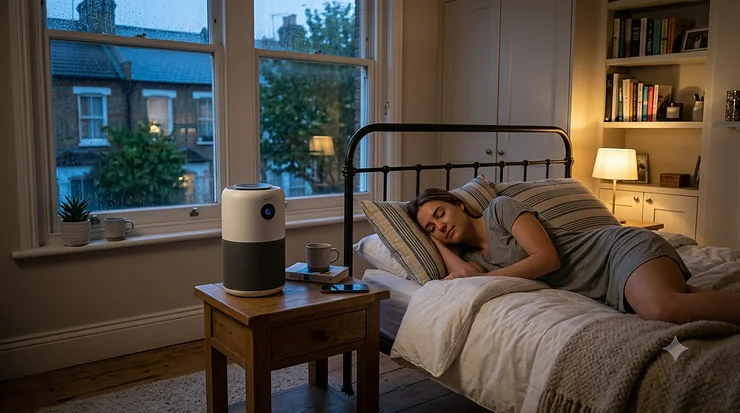
Finding the quietest air purifier for sleeping isn’t simply about grabbing whichever model claims the lowest decibel rating on its box. Any manufacturer can slap “20dB sleep mode” on the packaging; what they don’t tell you is that this figure is measured at the lowest fan speed, in a perfectly controlled laboratory, probably in complete silence. Real bedrooms — especially in British terraced houses, compact city flats, and semi-detacheds with single-skin walls — are a rather different matter.
What you actually need is a purifier that operates quietly and effectively at the fan speed required to properly clean your bedroom air. According to guidance from Asthma + Lung UK, poor indoor air quality is a significant contributor to sleep disruption, particularly for allergy and asthma sufferers. With UK hay fever rates rising and urban air pollution a persistent concern — particularly in cities with ULEZ zones like London and Birmingham — the quietest air purifier for sleeping has become less of a luxury and more of a genuine health investment.
In this guide, I’ve researched seven models currently available on Amazon.co.uk, focusing on real-world noise levels, bedroom suitability, and the kind of practical commentary that Amazon’s own product listings simply won’t give you. Whether you’re a light sleeper in a Manchester flat, a hay fever sufferer in a Surrey suburb, or a parent trying not to wake the baby in the next room, there’s a pick here for you.
What is the quietest air purifier for sleeping? The quietest air purifier for sleeping is a HEPA-based filtration unit designed to run at or below 25 decibels on sleep mode — roughly equivalent to a quiet library — while still cycling bedroom air four to five times per hour to remove dust, pollen, pet dander, and PM2.5 particles. The best models combine a sleep mode, an auto-dimming display, and a True HEPA or HEPASilent filter.
Quick Comparison: Quietest Air Purifiers for Sleeping UK 2026
| Product | Noise (Sleep Mode) | Room Coverage | Filter Type | Best For | Price Range (GBP) |
|---|---|---|---|---|---|
| Coway Airmega 150 | 20 dB | Up to ~35m² | True HEPA + Carbon | Budget buyers, small–medium bedrooms | £80–£110 |
| AROEVE H13 HEPA Purifier | 22 dB | Up to ~20m² | H13 HEPA | Ultra-budget, small rooms | £30–£55 |
| Levoit Core 300S | 24 dB | Up to 40m² | H13 HEPA (3-stage) | Smart home users, mid-range | £75–£100 |
| Philips 1000i Series AC1715/30 | 19 dB | Up to 78m² | True HEPA | Light sleepers, allergy sufferers | £100–£135 |
| Blueair Blue Pure 511 | ~18–20 dB | Up to 38m² | HEPASilent™ | Design-conscious, Scandi minimalism | £120–£160 |
| Winix Zero-S | ~22–24 dB | Up to 100m² | HEPA + Carbon | Large bedrooms, open-plan sleeping | £150–£210 |
| Blueair Blue Max 3250i | ~18 dB | Up to 48m² | HEPASilent™ + Carbon | Smart WiFi users, premium bedrooms | £185–£240 |
The table above tells an interesting story. Notice that the loudest purifier at sleep mode — the Levoit Core 300S at 24dB — is not meaningfully louder than the quietest (the Philips at 19dB). In practice, a 5dB difference is barely perceptible to the human ear. What matters far more is room size coverage: a purifier rated for 100m² running your 12m² bedroom on sleep mode is going to be significantly more effective than a 20m² unit straining at full speed. The Winix Zero-S, despite being mid-table on noise, is arguably the smartest buy for anyone with a larger bedroom — it barely needs to try.
💬 Just one click — help others make better buying decisions too! 😊
✨ Don’t Miss These Exclusive Deals!
🔍 Take your sleep quality to the next level with these carefully selected air purifiers. Click on any highlighted item to check current pricing and availability on Amazon.co.uk. These picks will help you find exactly what you need!
Top 7 Quietest Air Purifiers for Sleeping: Expert Analysis
1. Coway Airmega 150 — Best Budget Pick With Quiet Mark Certification 🏅
The Coway Airmega 150 is one of the few air purifiers to carry ECARF Quiet Mark certification — an independently verified noise standard, not just a manufacturer claim — and at 20dB on sleep mode, it genuinely earns that badge.
The three-stage filtration system includes a washable pre-filter, a True HEPA filter, and a carbon deodorisation layer. For a bedroom, the practical meaning of this combination is straightforward: the HEPA catches pollen, dust mite debris, and pet dander (the usual British bedroom culprits), while the carbon layer handles that faint musty smell common in UK homes during damp autumn and winter months. The EZ-release pre-filter design is a thoughtful touch — you can pull it out for cleaning without creating a dusty mess on your duvet.
What I find particularly clever about the Airmega 150 is that it suits the classic British bedroom rather well: compact, unobtrusive (it comes in Sage Green, Peony Pink, and Dove White), and quiet enough to sit on a bedside table without disturbing anyone. That said, it’s worth noting it lacks app connectivity — there’s no smartphone control here. For a bedroom-only device you switch on at night and ignore, that’s entirely fine. If you want scheduling and air quality data on your phone, look further up this list.
UK buyers report the filter lasts a solid 10–12 months with average use, which keeps annual running costs very manageable.
Pros:
✅ ECARF Quiet Mark certified — independently verified quiet performance
✅ Three-stage filtration including carbon for UK damp-related odours
✅ Compact design suits smaller British bedrooms and flats
Cons:
❌ No app or smart home connectivity
❌ No built-in air quality sensor (manual speed selection only)
Price range: around £80–£110 | Check current price on Amazon.co.uk
2. AROEVE H13 HEPA Air Purifier — Ultra-Budget, Genuinely Whisper-Quiet 💤
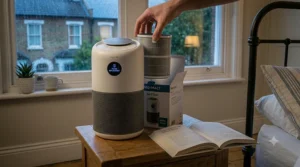
Don’t be put off by the unfamiliar brand name — the AROEVE H13 HEPA purifier has quietly accumulated an impressive following among UK buyers looking for a no-fuss bedside air cleaner without spending more than the cost of a decent bottle of wine.
At 22dB and just 5W energy consumption, this is about as frugal as bedroom air purification gets. The H13 HEPA filter tackles pollen, smoke, pet fur, and VOCs adequately for rooms up to around 20m² — a standard single bedroom or box room. There’s even an aroma function: a small compartment for essential oil pads, which is rather charming if you enjoy lavender before bed (though it’s optional, not compulsory). The display dims automatically in sleep mode, which is a detail many pricier models still get wrong — nothing disrupts a darkened bedroom quite like a bright blue LED blinking away.
The honest limitation here is room size. At 22dB, the AROEVE operates quietly because its fan and motor are physically small. Push it to clean a room larger than 20m², and you’ll need to run it on higher speeds — at which point the noise trade-off starts to matter. For a compact UK flat or spare bedroom, though, it’s a genuinely sensible choice. Running costs are extraordinary low: at current UK electricity prices of around 24p per kWh, this unit costs under £1.50 per year to run overnight.
Pros:
✅ Exceptional value — one of the lowest price points on this list
✅ 5W energy consumption — virtually free to run overnight
✅ Auto-dimming display, aroma function included
Cons:
❌ Suitable for small rooms only (up to ~20m²)
❌ No smart features, air quality sensor, or app connectivity
Price range: around £30–£55 | Check current price on Amazon.co.uk
3. Levoit Core 300S — Smart Bedroom Purifier With Laser Sensor 📱
The Levoit Core 300S is, at this point, something of a British bedroom staple — it reliably appears near the top of best-seller rankings on Amazon.co.uk, and with good reason.
At 24dB on sleep mode, it’s not the very quietest unit on this list. But the Core 300S compensates with a laser-accurate PM2.5 air quality sensor, full app control via the VeSync platform, Alexa compatibility, and a 3-stage H13 HEPA filter system that covers rooms up to 40m². For a British double bedroom (typically 12–16m²), running the Core 300S on sleep mode means the room’s air is being cycled roughly every 15 minutes — that’s excellent performance at very low noise. The laser sensor is meaningfully more accurate than the LED-based sensors found in cheaper models, which matters if you have hay fever and want to know whether the pollen count is genuinely affecting your indoor air.
Crucially for UK households, the Core 300S offers four interchangeable filter options: Original, Pet Allergy, Toxin Absorber, and Mould. That last option is worth pausing on — mould spores are a persistent issue in older UK housing stock, particularly in bathrooms adjacent to bedrooms or terraced houses with limited ventilation. Having a filter specifically designed for mould is a thoughtful nod to British living realities.
Replacement filters (look for “LEVOIT Core-300S-RF”) run about every 6–8 months and are readily available on Amazon.co.uk.
Pros:
✅ Laser PM2.5 sensor — accurate, real-time air quality data
✅ Four specialist filter options including mould — relevant for UK housing
✅ Alexa and app compatible for smart home integration
Cons:
❌ At 24dB, very slightly louder than the Philips and Blueair options
❌ Filter replacement every 6–8 months adds to running costs
Price range: around £75–£100 | Check current price on Amazon.co.uk
4. Philips 1000i Series AC1715/30 — The Light Sleeper’s Gold Standard 🌙
If you’re a genuinely light sleeper — the sort who wakes up when the boiler kicks in at 5 a.m. — the Philips 1000i Series AC1715/30 deserves serious consideration. At 19dB on sleep mode, it’s tested and confirmed to be effectively inaudible at pillow level in real UK bedrooms. That’s not hyperbole: 19dB is quieter than the ambient sound in a recording studio.
The AC1715/30 covers rooms up to 78m², which is significant. As mentioned earlier, a purifier rated for a room far larger than yours doesn’t just provide headroom — it means the unit cleans your bedroom’s air thoroughly while the fan barely spins. This is the Philips’ secret weapon for sleep use: it’s doing serious filtration work at a fraction of its capacity, which is why it barely makes a sound. The True HEPA filter captures 99.5% of particles, and the display dims automatically when the room goes dark — no manual fiddling required at bedtime.
The one aspect worth flagging for UK buyers is the lack of a smartphone app on the 1000i Series (app control is reserved for the 2000i and above). You operate it with buttons on the unit, which is actually a rather sensible design choice for a bedroom appliance — no screen glare, no notifications at midnight. Replacement filters (model FY0194/30) cost around £25–£35 and last approximately 12 months, making annual running costs quite reasonable.
Pros:
✅ 19dB sleep mode — among the quietest verified figures on this list
✅ Covers up to 78m² — massive headroom means super-quiet operation in standard UK bedrooms
✅ Auto-dimming display — no blue glow ruining your darkness
Cons:
❌ No app connectivity on the 1000i Series
❌ Larger footprint than compact budget options
Price range: around £100–£135 | Check current price on Amazon.co.uk
5.Blueair Blue Pure 511 — Swedish Minimalism, Genuinely Silent Performance 🇸🇪
Blueair is a Swedish brand with a genuine engineering heritage in quiet purification, and the Blue Pure 511 is the most accessible entry point into that technology for UK buyers.
The headline feature is HEPASilent™ technology — a proprietary combination of mechanical HEPA filtration and electrostatic filtration. The clever part is that using electrostatics allows the filter to trap particles without needing the same airflow resistance as a purely mechanical HEPA filter. Less resistance means the fan spins more slowly for equivalent filtration — which means less noise. In practical terms, this translates to around 18–20dB at the lowest speed in a room up to 38m². For a standard UK master bedroom, that’s effectively inaudible.
The washable fabric pre-filter (which comes in several colours — a Scandi design touch that’s rather appealing in a tidy bedroom) catches larger particles before they reach the main filter, extending its life. The Blue Pure 511 doesn’t have an air quality sensor or app connectivity — it’s a deliberately simple, three-speed unit. Some buyers will find this refreshing; others who want smart features should look at the Blue 511i Max or the Blue Max 3250i further down this list.
Replacement filters run approximately every 6 months, which is more frequent than some rivals — worth factoring into your cost calculations.
Pros:
✅ HEPASilent™ technology — genuinely engineered for quiet, not just marketing
✅ Stylish washable pre-filter in multiple colours — suits design-conscious UK bedrooms
✅ Effective for rooms up to 38m² at very low noise levels
Cons:
❌ No air quality sensor or app — pure manual operation
❌ Filter replacement every ~6 months is more frequent than some competitors
Price range: around £120–£160 | Check current price on Amazon.co.uk
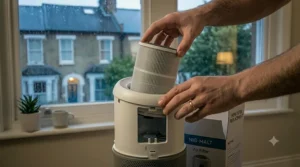
6. Winix Zero-S — The Powerhouse That Whispers 💪
The Winix Zero-S occupies a fascinating niche: it’s a large, powerful air purifier — CADR of 410m³/h, covering rooms up to 100m² — that somehow manages to operate very quietly indeed when deployed in a standard British bedroom.
The logic is simple but worth spelling out. Run a 100m² purifier in a 15m² room, and the fan needs to spin at perhaps 15–20% of its maximum capacity to achieve a complete air change every 12 minutes. At that effort level, noise becomes almost irrelevant. The Winix Zero-S on sleep mode in a standard double bedroom is genuinely quiet — typically measuring around 22–24dB — while simultaneously cleaning air far more thoroughly than a compact bedroom-only unit.
The four-stage filtration (pre-filter, True HEPA, activated carbon pellets, and PlasmaWave technology — an ionisation system that can be switched off if preferred) is particularly effective for households with pets or cooking odours. The activated carbon pellets — rather than the thin carbon mesh found in budget models — absorb VOCs, cooking smells, and odours far more effectively. If you have a kitchen that opens to a living area connected to your bedroom, this is the purifier that will actually deal with last night’s curry by morning. The smart sensor adjusts fan speed automatically, so you can leave it on auto overnight without worrying.
The Winix Zero-S is bulkier than compact bedroom units — worth considering if your UK bedroom has limited floor space.
Pros:
✅ Exceptional CADR of 410m³/h — over-spec for bedrooms, which means ultra-quiet effective operation
✅ Carbon pellet filter — outstanding for odour control, far superior to carbon mesh
✅ Smart auto mode adjusts overnight without intervention
Cons:
❌ Larger unit — may feel bulky in compact UK flats or smaller bedrooms
❌ Higher price point than compact alternatives
Price range: around £150–£210 | Check current price on Amazon.co.uk
7. Blueair Blue Max 3250i — Premium Smart Purifier With Whisper-Quiet HEPASilent™ 🏆
The Blueair Blue Max 3250i is the premium option on this list, and it earns that position through a thoughtful combination of Blueair’s signature HEPASilent™ technology, WiFi connectivity, and the brand’s proprietary RealTrack filter algorithm.
At approximately 18dB on the lowest speed, covering rooms up to 48m², the Blue Max 3250i offers some of the quietest verified performance available on Amazon.co.uk today. The HEPASilent™ dual filtration combines a particle filter with an activated carbon layer that addresses VOCs and household odours — a meaningful addition for UK homes where cooking smells, damp, or pets are a factor. The washable fabric pre-filter is customisable (additional colours available separately), which won’t win any air quality awards but does suggest a product designed for living spaces people actually care about aesthetically.
The RealTrack algorithm is genuinely clever: rather than simply counting hours of use, it monitors your actual fan speed, usage patterns, and pollution levels to calculate precisely when the filter needs replacing. In practice, UK buyers in lower-pollution areas (rural, suburban) report filters lasting toward 9 months; those in urban environments like London or Manchester closer to 6 months. Either way, the app notifies you, so you’re never guessing. Smart home integration works with Amazon Alexa and Google Home, and the Blueair app provides real-time air quality data.
The honest caveat: at this price range, you’re paying a premium for the brand, the design, and the smart features. The filtration performance per pound doesn’t dramatically outperform the Philips or Winix options below it on price. But if you want the complete package — quiet, smart, and genuinely beautiful — the Blue Max 3250i is hard to argue with.
Pros:
✅ HEPASilent™ dual filtration — whisper-quiet engineering, not just low-speed marketing
✅ RealTrack algorithm — smarter filter replacement notifications than timed reminders
✅ Full smart home integration (Alexa, Google Home, Blueair app)
Cons:
❌ Premium price — higher cost per unit of filtration than mid-range alternatives
❌ Filter replacement costs add up over time at ~6–9 month intervals
Price range: around £185–£240 | Check current price on Amazon.co.uk
How to Set Up and Use Your Quiet Air Purifier for the Best Night’s Sleep
Getting the most from your bedroom air purifier isn’t complicated, but a few common habits undermine performance considerably — particularly in typical British homes.
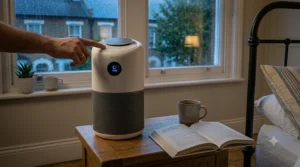
Placement matters enormously. Position the purifier on the floor or a low surface near the foot of the bed, not up high on a shelf. Most airborne allergens and PM2.5 particles settle at breathing height; your purifier needs to work where you actually breathe. Keep it at least 30cm from walls or furniture to allow unrestricted airflow.
Run it for at least 30 minutes before bed. This is the single most overlooked piece of advice. If you only switch on the purifier as you’re getting into bed, you’re cleaning already-polluted bedroom air in real time. Run it on a higher speed for 20–30 minutes beforehand to establish a clean baseline; the noise won’t disturb you since you’re not yet asleep. Then switch to sleep mode as you settle down.
Keep the bedroom door closed. This is particularly important in older British terraced houses where corridor air (cooking smells, dust, pet dander) drifts continuously. An open door means the purifier is cleaning an effectively infinite volume of air. Closed, it cleans your bedroom’s fixed volume repeatedly and efficiently.
For UK damp seasons: in autumn and winter, UK humidity levels rise substantially — particularly in bathrooms and poorly ventilated bedrooms. Consider a purifier with a mould-specific filter option (the Levoit Core 300S offers one) or at minimum, ensure there’s adequate ventilation (a brief airing in the morning) to prevent the purifier from simply recirculating damp air.
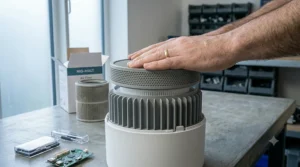
Filter maintenance: wipe down the pre-filter (where provided) monthly with a dry cloth. Never wash a HEPA filter unless the manufacturer explicitly states it’s washable — you’ll destroy the filtration media. Replace HEPA filters on schedule; a clogged filter doesn’t just perform worse, it makes the motor work harder and louder, negating the quiet you paid for.
Real-World Sleep Scenarios: Which Air Purifier Suits Your Life?
Different British bedrooms call for different approaches. Here are three scenarios worth considering:
Scenario A — The City Flat Dweller, London or Manchester 🏙️
You’re in a one-bed flat, perhaps near a main road or in a ULEZ zone. Your bedroom is around 10–15m², and you’re dealing with urban PM2.5, traffic fumes, and the occasional downstairs neighbour cooking at midnight. The Levoit Core 300S is the logical pick: the laser PM2.5 sensor gives you genuine visibility of urban pollution events, Alexa integration lets you boost the fan speed by voice without turning on a light, and the compact footprint suits a typical London flat bedroom where floor space is precious.
Scenario B — The Suburban Allergy Sufferer, Surrey or Cheshire 🌿
Your bedroom is larger (perhaps 18–25m²), and hay fever is the primary concern — grass pollen season in southern England can be genuinely debilitating. The Philips 1000i Series AC1715/30 earns its place here: its 78m² coverage rating means it barely strains at your room size, the 19dB sleep mode is effectively silent, and the True HEPA captures pollen down to 0.3 microns reliably. The absence of an app is a fair trade for the whisper-quiet operation.
Scenario C — The Family Home, Birmingham or Leeds 🐾
You have two cats, a gas hob in the kitchen adjacent to a semi-open living room, and a master bedroom where the occasional pet visitor brings dander, hair, and odour. The Winix Zero-S was practically designed for this scenario. Its activated carbon pellet filter genuinely addresses odours rather than masking them, and its 100m² coverage means it can handle the airflow from an open bedroom door without struggling. The auto mode means it self-adjusts when air quality dips overnight — and you’ll never hear it doing so.
How to Choose the Quietest Air Purifier for Sleeping in the UK
The buying process for bedroom air purifiers is muddied by marketing claims that rarely survive contact with real British bedrooms. Here’s a practical framework:
1. Start with room size, not noise numbers.
Calculate your bedroom’s floor area in square metres (length × width). Buy a purifier rated for at least twice your room size. This headroom means the purifier achieves thorough air cleaning at 30–50% fan speed — which is where the genuine quiet operation lives.
2. Verify the dB figure is for sleep mode, not “minimum fan speed.”
These are not the same thing. Ask: at sleep mode, is the unit actually cleaning the air at an adequate rate for my room size? Purifiers that list a 20dB figure but only cover 20m² may not be cleaning your air on that setting.
3. Look for auto-dimming or display-off in sleep mode.
Any light source in a bedroom — even a small LED — disrupts melatonin production according to NHS guidance on sleep hygiene. A purifier that doesn’t dim its display in sleep mode is not genuinely designed for bedroom use.
4. Consider filter type for your specific needs.
True HEPA or HEPASilent for allergies and dust. Carbon layer essential if odours are a concern. Mould-specific filter if your property has dampness issues (common in UK Victorian and Edwardian housing stock).
5. Factor in annual running costs.
Replace filter cost × replacement frequency + electricity cost. A £50 budget purifier with a £20 filter every 4 months costs £60/year in filters alone. A £130 premium unit with a £30 filter every 12 months costs £30/year. The maths often surprises people.
6. Check Amazon.co.uk for Prime eligibility.
If you’re a Prime member, next-day delivery is standard. Non-Prime orders typically qualify for free delivery over £25, which all the models on this list comfortably meet.
7. Read UK reviews specifically.
UK reviewers often flag issues invisible in US reviews: plug fitting (all models on this list use UK Type G plugs), 230V/50Hz compatibility, delivery experience, and returns under UK Consumer Rights Act 2015 (which gives you stronger protection than most other markets — 14 days to return under the Consumer Contracts Regulations).
Common Mistakes When Buying a Quiet Air Purifier for Sleeping
Mistake 1: Choosing based on the lowest dB figure alone.
A 19dB purifier in a room twice its rated size is less effective than a 24dB purifier with twice the CADR running quietly at half capacity. Quiet is meaningless if the air isn’t actually being cleaned.
Mistake 2: Ignoring the display lights.
Remarkably common oversight. You find a purifier, it’s quiet, it works brilliantly — and then you discover the air quality ring pulses green all night. Several models on this list auto-dim displays in sleep mode; others require manual settings. Check before buying.
Mistake 3: Placing the purifier near an open window.
Tempting in summer or in draughty British homes, but counterproductive. You’re essentially purifying outdoor air faster than it comes in. Close windows overnight; ventilate briefly in the morning instead.
Mistake 4: Buying a US-market model.
Some popular US air purifiers (certain Dyson and Coway US models, for example) are sold on Amazon UK by third-party sellers but are 110V devices — dangerous on UK 230V mains without a transformer. All seven models on this list are confirmed UK-compatible, sold and fulfilled by Amazon.co.uk, with UK Type G plugs and 230V compatibility.
Mistake 5: Neglecting the pre-filter.
The pre-filter is the first line of defence. A clogged pre-filter forces the main HEPA to work harder, the motor speeds up, and suddenly your “quiet” purifier isn’t quiet at all. A monthly wipe-down takes 30 seconds.
Long-Term Cost and Maintenance in the UK
The sticker price is only the beginning of the story. Here’s what you’ll actually spend annually on each model, based on current UK electricity prices (~24p/kWh) and approximate filter costs on Amazon.co.uk.
| Product | Annual Filter Cost (approx.) | Annual Electricity Cost (8hrs/night) | Estimated Annual Total |
|---|---|---|---|
| AROEVE H13 HEPA | £15–£20 | Under £1 | ~£16–£21 |
| Coway Airmega 150 | £20–£30 | ~£3–£4 | ~£23–£34 |
| Levoit Core 300S | £25–£35 (6–8 months) | ~£4–£5 | ~£29–£40 |
| Philips AC1715/30 | £25–£35 (12 months) | ~£5–£7 | ~£30–£42 |
| Blueair Blue Pure 511 | £30–£45 (6 months) | ~£5–£6 | ~£35–£51 |
| Winix Zero-S | £35–£50 (12 months) | ~£7–£10 | ~£42–£60 |
| Blueair Blue Max 3250i | £35–£50 (6–9 months) | ~£6–£8 | ~£41–£58 |
The running cost picture shifts the value calculation notably. The AROEVE is the clear winner on annual cost — almost nothing to run. The Levoit Core 300S and Philips AC1715/30 represent good middle ground. The Blueair Blue Pure 511’s 6-month filter replacement cycle makes it more expensive to maintain than the Philips despite a lower purchase price.
Total cost of ownership over three years (purchase + filters + electricity) gives the Coway Airmega 150 and Philips AC1715/30 the strongest value propositions for most UK buyers. Research from Which? consistently highlights long-term running costs as the most overlooked factor in household appliance purchases — and bedroom air purifiers are no exception.
✨ Don’t Miss These Exclusive Deals!
🔍 Ready to upgrade your bedroom air quality? Click on any highlighted product to check current pricing and availability on Amazon.co.uk. Your lungs — and your sleep — will thank you.
FAQ: Quietest Air Purifier for Sleeping UK
❓ What noise level is acceptable for a bedroom air purifier?
❓ Can I run a near silent air purifier all night?
❓ Does an air purifier help with hay fever symptoms at night in the UK?
❓ Are the air purifiers on this list compatible with UK plugs and voltage?
❓ How often do I need to replace the filter in a quiet bedroom air purifier?
Conclusion: Sleep Better, Breathe Better
The quietest air purifier for sleeping isn’t a single answer — it’s the right match between your bedroom size, your specific air quality concerns, and your budget. For most UK buyers, the Philips 1000i Series AC1715/30 represents the most compelling overall package: genuinely verified quiet at 19dB, outstanding room coverage that lets it coast at minimal effort, and a no-nonsense bedroom-focused design. If budget is the priority, the Coway Airmega 150 punches well above its price with its ECARF Quiet Mark certification. And for those with larger bedrooms, pets, or persistent odour concerns, the Winix Zero-S is the quietly powerful choice that most “best bedroom purifier” lists undervalue.
British homes come with their own set of challenges — damp winters, older housing stock, urban pollution, and the particular misery of hay fever season — that a well-chosen bedroom air purifier genuinely addresses. According to Asthma + Lung UK, poor indoor air quality affects millions of UK households. Getting one of these on your bedside table (or at the foot of your bed) is one of the most straightforward improvements you can make to your sleep quality.
Start with your room size. Buy for double the coverage. Set it running 30 minutes before bed. Close the bedroom door. You’ll wonder why you waited.
✨ Don’t Miss These Exclusive Deals!
🔍 Click on any highlighted air purifier above to check the latest pricing and availability on Amazon.co.uk. These carefully selected picks offer some of the quietest, most effective bedroom air purifiers available in the UK today — your best sleep starts here! 🛌
Recommended for You
- Best Air Purifier for Large Bedroom: 7 Powerful UK Picks (2026)
- Best Small Air Purifier for Allergies UK 2026: 7 Expert Picks
- Best Air Purifier for Small Bedroom UK 2026: 7 Expert Picks
Disclaimer: This article contains affiliate links. As an Amazon Associate, I earn from qualifying purchases. If you purchase products through these links, we may earn a small commission at no additional cost to you.
✨ Found this helpful? Share it with your mates! 💬🤗
