In This Article
Picture an air purifier that doesn’t just trap pollution but dismantles it, molecule by molecule, using nothing more exotic than light and a coated surface. That’s the pitch behind every photocatalytic air purifier, and it’s a seductive one. The reality is more interesting, and a good deal more nuanced.

A photocatalytic air purifier uses ultraviolet light to activate a titanium dioxide catalyst, triggering an oxidation process that breaks organic pollutants, bacteria and odour molecules into smaller compounds such as water and carbon dioxide. Most models pair that stage with a physical filter, because oxidation alone doesn’t handle dust.
Here’s the catch most listings skip. The chemistry is well established in laboratories, and peer-reviewed research on photocatalytic oxidation describes it as a way to break pollutants down rather than merely collect them. Yet the same literature is careful to frame the clean end products as what should happen in theory. In a real living room, air sweeps past a small catalyst surface in moments. The result depends on airflow, catalyst quality and, crucially, byproduct safety.
This guide compares seven real models, from a cup-holder gadget to a premium machine. It draws on published specifications, editorial test results and research papers. I haven’t handled any of these units myself, so you won’t find invented anecdotes here. You’ll get honest analysis, plain-English explanations of the oxidation process and titanium dioxide catalyst, and a candid look at PCO air purifier reviews. Prices are ranges only, so check current listings before buying.
Quick Comparison: 7 Photocatalytic Air Purifier Options at a Glance
| Product | Technology | Coverage (maker/reviewer figures) | Price range | Best For |
|---|---|---|---|---|
| JVC KS-AP120 | Photocatalyst, filter, ioniser | Cup-holder scale; no room rating published | Under £25 | Low-cost car experiment |
| JVC KS-AP320 | Photocatalyst, filter, ioniser, touchless sensor | No room rating published | £55–£65 | Drivers wanting hands-free control |
| Kaltech MY AIR KL-P02EX-K | Wearable photocatalytic pendant | Personal zone only | £95–£120 | Commuters curious about wearables |
| MeacoClean CA-HEPA 47×5 | Photocatalyst, UV-C, HEPA, charcoal, ioniser | Up to 78 m³ (mild allergy); 236 m³/h | £130–£170 | Most UK bedrooms and living rooms |
| Molekule Air Mini+ | PECO, HEPA, carbon | About 23 m² | £250–£350 | Small rooms, app-lovers |
| Molekule Air Pro | PECO, HEPA, carbon | About 93 m² | £700–£850 | Open-plan homes, deep pockets |
| Kaltech KL-W01E | Wall-mounted photocatalytic unit | Not published | £400–£450 (inc VAT) | Fixed, silent installs |
Looking at the table, the MeacoClean CA-HEPA 47×5 is the only model that pairs published airflow and CADR figures with a full photocatalytic-plus-HEPA stack at a mainstream price, which is why it anchors this list. Buyers with larger rooms will notice that the Molekule Air Pro covers roughly four times the floor area of the Molekule Air Mini+, though running costs climb with it. Meanwhile, the JVC and Kaltech units publish little airflow data, so treat them as low-confidence purchases.
One caution on reading the table. Coverage figures aren’t directly comparable, because Meaco quotes room volume in cubic metres while Molekule quotes floor area. A sensible purifier should turn a room’s air over several times an hour, and we’ll show you the arithmetic shortly.
💬 Just one click — help others make better buying decisions too!😊
Top 7 Photocatalytic Air Purifier Picks: Expert Analysis
The picks below are ranked by how well their claims can be checked, not by how loudly the box shouts. Where independent testing exists, I lean on it. Where it doesn’t, I say so.
1. JVC KS-AP120 — pocket-money cup-holder trial
The standout here is scale. The JVC KS-AP120 is designed to sit in a vehicle cup holder, making it the cheapest way into photocatalysis by a distance. JVC’s product page pairs a photocatalyst and UV light with a high-efficiency filter, a negative ion generator and a 360° intake at the base, all in an aluminium body. The touch control is refreshingly simple: one tap for low, another for high, three to switch off.
Here’s what the spec sheet won’t tell you. No airflow figure or room rating appeared in the sources I found. That matters, because a photocatalytic stage only treats air that actually reaches it. Treat this as a personal-space gadget for a car or desk, not something that will clean a bedroom. JVC’s claims about pollen, PM2.5, formaldehyde and mould are manufacturer statements. Pollen and PM2.5 are particles, which a filter, not oxidation, would have to catch.
On reviews, I couldn’t verify a meaningful body of independent user feedback or lab tests, so I won’t characterise buyer sentiment. JVC’s site now lists the model as archived, so check current availability.
Pros:
- ✅ Genuinely compact, cup-holder friendly design
- ✅ Simple one-touch speed control
- ✅ Very low entry price
Cons:
- ❌ No published airflow or independent test data
- ❌ Listed as archived on JVC’s own site
Expect to pay under £25: fair for a curiosity, poor value if you want measurable results.
2. JVC KS-AP320 — touchless control for drivers
Where its sibling relies on a touch sensor, the JVC KS-AP320 adds touchless control, which JVC pitches as a way to avoid looking away from the road. The core recipe is familiar: a photocatalyst with UV light, a high-efficiency filter, a negative ion generator, an aluminium body and a 360° intake at the bottom.
Based on the spec comparison, the real upgrade is ergonomic rather than chemical. Waving a hand beats prodding a button while driving, but it makes little difference on a desk. Nothing in the sources I found suggests a larger reactor or stronger airflow than the cheaper model. That leaves you paying extra for convenience, not performance. As with the JVC KS-AP120, the claims about breaking down pollutants are the maker’s own.
I couldn’t verify independent reviews or lab data for this model either. That’s a limitation of the market, not a verdict on the product. Anyone tempted should treat it as a comfort feature for a car and keep expectations modest.
Pros:
- ✅ Touchless sensor suits in-car use
- ✅ Aluminium body feels more premium
- ✅ Same filter-plus-photocatalyst recipe as its sibling
Cons:
- ❌ No published airflow or room-size rating
- ❌ Extra cost buys convenience, not proven performance
Around £55–£65 at the time of research: acceptable only if hands-free control matters to you.
3. Kaltech MY AIR KL-P02EX-K — wearable clean-air pendant
The standout is portability. The Kaltech MY AIR KL-P02EX-K hangs round your neck and aims to create a cleaner pocket of air near your face. The trade listing describes photocatalytic decomposition of viruses, bacteria, pollen and odour molecules. It cites CE and RoHS compliance plus EMC standards such as EN 55014 and EN 61000-3. Those are electrical-compliance credentials, not efficacy evidence.
Here’s what to weigh. A pendant can only move a tiny volume of air, while the room around you replenishes it constantly. That makes any “protection zone” claim hard to verify, and independent evidence for photocatalytic devices against airborne viruses is limited, as the vs HEPA section below explains. I couldn’t find independent reviews or lab data, so I won’t summarise buyer sentiment.
Where it might make sense is as a novelty for commuters or travellers who accept that benefits are unproven. If you have allergies or asthma, a proper room purifier with a HEPA filter is the more evidence-backed spend.
Pros:
- ✅ Lightweight and genuinely wearable
- ✅ CE and RoHS compliance cited in the listing
- ✅ Available in black or white
Cons:
- ❌ No published performance data
- ❌ Personal-zone claims are hard to verify
Trade listings sat around £95 before VAT and roughly £115 including it, so plan on £95–£120. Value depends entirely on your appetite for experimentation.
4. MeacoClean CA-HEPA 47×5 — best all-round value for UK homes
The standout is completeness. The MeacoClean CA-HEPA 47×5 stacks a pre-filter, a HEPA filter, enhanced charcoal (about 130g), a 254nm UV-C lamp working with a titanium dioxide catalyst coating, and an ioniser in one 4.2kg unit. Airflow peaks at 236 m³/h, with CADR scores of 135 for smoke, 142 for dust and 151 for pollen. In practice, that clears a bedroom several times an hour. Meaco rates it for rooms up to 78 m³ for mild allergies, tightening to around 34 m³ for severe symptoms.
Based on the spec comparison, this is the model where the photocatalytic stage is a bonus rather than the whole bet. The HEPA and charcoal do the heavy lifting, while UV-C and the catalyst add a microbial layer. Woman & Home’s 2025 testing ranked it second fastest at clearing sprayed fragrance, and the reviewer found smoke odour undetectable within about five minutes. Only the Molekule Air Pro beat it, and the one gripe was that it works better with the app. A retailer page lists five reviews, all positive, but that’s too few to lean on. Meaco’s own page showed it out of stock at the time of research, so check availability.
Pros:
- ✅ Published airflow and CADR figures
- ✅ Whisper-quiet at around 24 dB on low
- ✅ Costs roughly 1p an hour to run
Cons:
- ❌ UV lamp and catalyst eventually need replacing
- ❌ Stock has been patchy
Typically £130–£170: strong value against similarly equipped rivals.
5. Molekule Air Mini+ — the smartest compact PECO option
Design and data are the hook. The Molekule Air Mini+ stands about 30cm tall, weighs roughly 3.3kg, and adds a particle sensor, Auto Protect mode and app control to Molekule’s PECO (photoelectrochemical oxidation) filter, HEPA layer and carbon. It’s rated for rooms up to about 23 m², with a listed CADR of 80 CFM and noise of roughly 30–52 dBA. That’s a compact photocatalytic air purifier in the truest sense: a bedroom, nursery or home-office machine, not an open-plan solution.
What most buyers overlook is that PECO is a variant of the idea, not standard titanium dioxide plus UV-C. Molekule says its process outperforms conventional photocatalysis, but independent verification is thinner than the marketing. Reviews are split. Homes & Gardens praised the technology, app and looks but flagged the price and loud medium-to-high speeds. Meanwhile, HouseFresh notes a 2019 US advertising-standards recommendation that Molekule drop 26 claims after a Dyson complaint, and says Consumer Reports and Wirecutter were unimpressed.
Pros:
- ✅ Particle sensor with automatic fan control
- ✅ Portable, app-enabled, tidy design
- ✅ Quiet around 30 dBA on its lowest setting
Cons:
- ❌ Filter replacements are a pricey ongoing cost
- ❌ Loud at medium-to-high speeds
Around £250–£350 depending on the deal. Worthwhile if design and data appeal, otherwise the Meaco is better value.
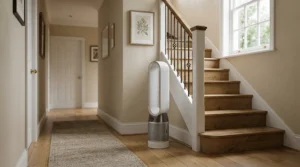
6. Molekule Air Pro — top performer in one UK editor’s tests
Muscle is the story. The Molekule Air Pro is rated for up to roughly 93 m², stands 58.6cm tall and weighs about 10.4kg. Noise runs from around 33 dBA to 64 dBA. On paper, that means open-plan kitchens and family rooms are within reach, though you’ll hear it at top speed.
Here’s what to weigh. Woman & Home found it beat the Meaco on speed and design, while adding that most homes won’t need something this high-tech. TechRadar’s reviewer concluded it filters well but is very pricey, praising the app and real-time readings. LiveScience called the filter replacement costs among the most expensive it had seen. In the UK it’s sold via Amazon. TechRadar quoted £799.99 and £159.99 per filter, with changes recommended every six months, so filters alone could run about £320 a year at list price. Its US FDA Class II clearance is a US regulatory status, not a UK approval.
Pros:
- ✅ Covers large, open-plan spaces
- ✅ Detailed app with real-time air readings
- ✅ Ranked fastest in Woman & Home’s testing
Cons:
- ❌ Filter costs add up quickly
- ❌ Loud at top speed
Expect £700–£850 at the time of research: a premium price that only makes sense for large rooms and serious pollution worries.
7. Kaltech KL-W01E — silent wall-mounted option for fixed installs
Discretion is the hook. The Kaltech KL-W01E (TURNED K series) mounts on the wall with a stand option, and its listing describes silent operation while saving floor space. It’s aimed at homes and commercial spaces, and the listing cites CE and RoHS compliance plus EN 50498 and EN 63000. Those are compliance markers, not performance proof.
The listing claims strong deodorising and sterilising action and says the unit runs without harmful byproducts. I’d treat that as a manufacturer claim until test data appears, given how variable byproduct safety is across photocatalytic devices. Coverage area, airflow and CADR aren’t published in the listing I found, which makes it impossible to size to a room. I also found no independent user reviews. Realistically, it suits low-airflow, fixed-position use, such as waiting rooms, hallways or small offices, where silence matters more than rapid air changes.
Pros:
- ✅ Wall mounting frees up floor space
- ✅ Silent operation per the listing
- ✅ CE and RoHS compliance cited
Cons:
- ❌ No published airflow or room rating
- ❌ Premium price for unverified performance
Around £400–£450 including VAT: hard to justify without published performance data.
The Oxidation Process Explained: What Happens Inside a Photocatalytic Air Purifier
Think of the reactor as a tiny stage with three actors: a UV lamp, a catalyst surface and the air passing over it. When UV light strikes the catalyst, it generates hydroxyl radicals and superoxide ions. The wavelengths discussed in the research literature span roughly 180 to 400 nanometres. These short-lived species attack chemical bonds in organic pollutants, and in principle the oxidation process ends with water vapour and carbon dioxide.
Here’s the practical translation. First, contact time: air that whips past the catalyst in a fraction of a second gets less treatment than air that dawdles, so airflow and reactor size both matter. Second, completeness: if the oxidation process stops halfway, intermediate compounds can escape, which we’ll tackle under byproduct safety. Third, targets: this chemistry acts on gases and biological material, not dust, so a HEPA filter remains non-negotiable.
Meaco’s UV-C lamp operates at 254 nanometres, and the company says it lasts about 20,000 hours, roughly 2.3 years of continuous running. Molekule’s PECO variant adds an electrical element, and its makers argue it’s more effective than conventional photocatalysis. That’s plausible, but weigh it against the independent-evidence caveats above. Any oxidation process is only as good as its slowest link: lamp output, catalyst condition or airflow.

Titanium Dioxide Catalyst: Why It Is the Default, and Why It Wears Out
Why titanium dioxide? Researchers describe it as the most widely used photocatalyst because it works at room temperature, is considered safe, is inexpensive and needs no added chemicals. That’s a rare combination in chemistry, and it explains why almost every consumer photocatalytic air purifier leans on a titanium dioxide catalyst, usually coated onto a honeycomb, plate or filter.
Here’s what that means for you. The catalyst surface isn’t eternal. Meaco says the catalyst plate in the MeacoClean CA-HEPA 47×5 lasts roughly two years, which is why a replacement lamp-and-catalyst pack exists. Molekule takes a different route, building its proprietary catalyst into filters you replace about every six months. Some brands use variants: Daikin has used a titanium apatite photocatalyst, described as similar to titanium dioxide but more effective.
Surfaces can foul with residue over time, which is why makers specify replacement intervals. Skipping those replacements quietly turns a photocatalytic air purifier into an expensive fan with a light. When comparing models, ask three questions. What’s the catalyst’s rated life? Is it replaceable? What does replacement cost? A titanium dioxide catalyst that can’t be swapped means the whole device has a built-in expiry date.
Byproduct Safety: Aldehydes, Ozone and Ultrafine Particles Explained
If the oxidation process were always complete, this section would be a paragraph long. It isn’t, so it’s not. Byproduct safety is where photocatalytic technology faces its most serious scrutiny.
Here’s the evidence. A test-method study hosted by the US National Institutes of Health ran ten portable air cleaners, using seven technologies, through a draft byproduct protocol. The findings showed the photocatalytic oxidation and germicidal UV technologies producing the highest aldehyde emission rates, about 202 and 243 micrograms per hour respectively. Both UV wavelengths tested (222nm and 254nm) also generated ultrafine particles. Separately, the US EPA’s guide to home air cleaners lists photocatalytic units among UV-based cleaners and warns that ozone generators sold as air cleaners deliberately produce a lung irritant.
Three cautions apply. First, it’s a small sample, so you can’t pin these results on any model in this guide, and none of the seven publishes third-party byproduct data that I could find. Second, aldehydes such as formaldehyde are exactly what incomplete oxidation of organic vapours can generate. Third, good design may help: carbon stages, sensible airflow and ozone-free operation reduce risk.
For practical byproduct safety, choose models that state they don’t emit ozone, keep rooms ventilated, replace catalysts on schedule, and stop using any unit that leaves a sharp or chemical smell.
PCO Air Purifier Reviews: What Editors and Owners Actually Report
Searching for PCO air purifier reviews turns up a curious pattern: plenty of praise for whole machines, almost no evidence about the catalyst stage itself. Editors typically test how fast a purifier clears smoke, fragrance or particles. Those results mostly reflect fan power, HEPA quality and carbon, not oxidation.
With that filter applied, here’s the sentiment I could verify. For Meaco, Woman & Home’s 2025 review was warm about speed, size and price, with the app the only real caveat. For Molekule, reviews are mixed. Homes & Gardens liked the technology, design and app but disliked the price and loud higher speeds. TechRadar found the Molekule Air Pro capable but very expensive, and LiveScience objected to filter costs. HouseFresh recounts the 2019 advertising-standards recommendation and unimpressed verdicts from two major US testers. For the JVC and Kaltech products, independent coverage was negligible.
The takeaway is simple. Treat PCO air purifier reviews as evidence about the whole machine, not the photocatalytic stage. Verified sentiment is strongest for the MeacoClean CA-HEPA 47×5, mixed for the Molekule Air Mini+ and Molekule Air Pro, and effectively absent for the rest. When PCO air purifier reviews go quiet, published specifications and byproduct safety data matter even more.
Compact Photocatalytic Air Purifier: Does Small Actually Work?
Yes, if you respect the arithmetic. A compact photocatalytic air purifier can only clean the room its fan can turn over. The quick formula: air changes per hour equal airflow (m³/h) divided by room volume (m³). The MeacoClean CA-HEPA 47×5 moves up to 236 m³/h, so in a 3.5m × 4m bedroom with 2.4m ceilings (about 34 m³) it manages roughly seven changes an hour, exactly the tier Meaco suggests for severe allergies. Put it in a 78 m³ living room and that falls to about three, the mild-allergy tier.
By contrast, the Molekule Air Mini+ is rated for about 23 m² with a listed CADR of 80 CFM, so it suits a bedroom or home office rather than a lounge. The JVC KS-AP120 and Kaltech MY AIR KL-P02EX-K publish no airflow, so you can’t do the sums at all. That’s the honest limit of any compact photocatalytic air purifier: without airflow data, “compact” can quietly mean “decorative”.
If you’re shopping small, prioritise four things: published airflow, low-speed noise, clear intakes and replaceable parts. Place the unit away from curtains and walls, and match it to one room. Small is fine. Unmeasured is not.
How to Choose a Photocatalytic Air Purifier: 6 Steps
- Measure your room volume. Multiply length × width × height in metres, then divide the purifier’s airflow by that figure. Aim for about three changes an hour for mild symptoms and five to seven for severe ones.
- Check real airflow or CADR. Vague “covers 50 m²” claims can’t be compared, whereas cubic metres per hour can.
- Insist on a HEPA filter. Oxidation doesn’t capture dust, pollen or pet dander, so the filter is your particle defence.
- Ask about byproduct safety. Look for statements on ozone and any third-party test data, and be wary of blanket “no harmful byproducts” claims without proof.
- Add up consumables. Filters, UV lamps and catalyst plates all cost money, and the Molekule Air Pro shows how running costs can rival the purchase price.
- Check noise and compliance. Look for decibel figures at low speed for bedrooms, UKCA or CE marking, and warranty terms (Meaco offers two years, extendable to five).
Photocatalytic Air Purifier vs HEPA-Only: Which Deserves Your Money?
A HEPA-plus-carbon purifier is the safe, well-understood baseline. A photocatalytic air purifier adds a chemical stage on top. Whether that stage earns its keep depends on evidence, and the evidence is cautious.
| Factor | Photocatalytic + HEPA | HEPA + carbon only | Edge |
|---|---|---|---|
| Dust, pollen, dander | HEPA stage does the work | HEPA stage does the work | Tie |
| Gases and odours | Carbon plus oxidation stage | Carbon only | Slight edge to photocatalytic |
| Microbial claims | Extra stage, limited evidence | None claimed | Unproven |
| Byproduct risk | Possible aldehydes; ozone if poorly designed | Minimal | HEPA-only |
| Running costs | UV lamp and catalyst upkeep | Filters only | HEPA-only |
| Best For | Buyers wanting an extra stage, like the MeacoClean CA-HEPA 47×5 | Budget-minded allergy sufferers | — |
Looking at the table, the photocatalytic stage is a nice-to-have, not a game-changer. UK scientific advice reinforces that. When the UK government asked the SAGE Environmental Modelling Group to review air cleaning against Covid-19, as summarised by the Clean Air Programme, HEPA-style filtration and germicidal UV were considered potentially beneficial. Photocatalytic oxidation had limited supporting evidence and could produce secondary pollutants such as ozone and nitrogen oxides. If your priority is allergens, buy on filtration quality first.
Long-Term Cost & Maintenance: The Bill After the Box
The sticker price is only chapter one. Consumables decide whether a photocatalytic air purifier stays a bargain.
| Product | Upfront range | Recurring costs | Value verdict | Best For |
|---|---|---|---|---|
| MeacoClean CA-HEPA 47×5 | £130–£170 | Filter set about every 6 months; UV lamp around 20,000 hours; roughly 1p/hour power | Strong | Bedrooms, most homes |
| Molekule Air Mini+ | £250–£350 | Replacement PECO-HEPA filters; check current UK price | Moderate | Small rooms, app fans |
| Molekule Air Pro | £700–£850 | About £160 per filter every six months | Premium | Open-plan homes |
| JVC KS-AP120 | Under £25 | Not published | Low-risk curiosity | Car experiments |
Doing the sums, running the MeacoClean CA-HEPA 47×5 around the clock at about 1p an hour comes to roughly £85–£95 a year in electricity. The Molekule Air Pro, by contrast, could add around £320 a year in filters at list price, some 40% of its purchase cost annually. Over three years, a mid-priced machine with cheap consumables often beats a premium one on total cost of ownership, so factor in filters, lamps and catalyst plates before you click.
Setup, First 30 Days and a Simple Maintenance Schedule
Placement comes first. Keep the intakes clear of curtains and walls, since most designs draw air from several sides, and don’t tuck the unit behind a sofa. Remove the protective bag from the HEPA filter before first use, a step reviewers and manufacturers both mention.
Days 1–3: Run the unit on a low or automatic setting continuously rather than boosting it now and then. Note any odour. A sharp or chemical smell means switch off, ventilate and contact the supplier, which is basic byproduct safety.
Week 2: Wipe dust from the casing with a microfibre cloth, as Woman & Home recommends for the white-topped Meaco.
Month 1: Check the pre-filter or intake for lint and pet hair.
Month 6: Replace the filter set. Meaco and Molekule both recommend roughly six-monthly changes, though heavy use may shorten that.
Around month 24: Replace the catalyst plate and UV lamp per the manual. Meaco quotes roughly two years for its catalyst.
Common mistakes in the first 30 days include leaving the unit on sleep mode permanently, ignoring the filter indicator and expecting instant pollen relief. Set phone reminders for replacement dates. A forgotten filter turns any purifier into a noisy ornament.
Real-World Scenarios: Matching a Photocatalytic Air Purifier to Your Life
The hay-fever renter (about £150, 3.5m × 4m bedroom). The MeacoClean CA-HEPA 47×5 is the logical fit. At roughly 34 m³, the room gets about seven air changes an hour, and the low-speed noise figure of around 24 dB suits sleeping. Run it constantly through pollen season and remember the filter every six months.
The home-worker who loves data (about £300, small home office). The Molekule Air Mini+ suits someone who wants an app, a particle sensor and tidy design. Accept the trade-offs: higher filter costs and noise at medium-to-high speeds. It’s a compact photocatalytic air purifier where the software is half the appeal.
The open-plan family with a dog (£700+, 60 m² living space). The Molekule Air Pro is the only model here rated for that footprint. Budget roughly £320 a year for filters and accept the noise at top speed. Whether the premium is justified depends on how much you value speed and monitoring.
The curious commuter (under £25). The JVC KS-AP120 works as a low-stakes experiment for a car, provided you expect no lab-grade results. Keep ventilation as your main defence against stale cabin air.
Problem → Solution Guide: Smells, Sneezes and Suspicion
Problem: lingering cooking smells. Look at charcoal weight, not just the photocatalytic stage. Meaco publishes carbon quantities, about 130g for the MeacoClean CA-HEPA 47×5, and heavier beds generally hold more odour gas.
Problem: new paint or furniture fumes. Ventilate first. Government advisers note that VOC concentrations are generally much higher indoors than outdoors, are often highest in new buildings or after construction work, and can be reduced by efficient ventilation. Purifiers supplement that advice rather than replace it.
Problem: a sharp smell after switching on. It could be ozone or other oxidation byproducts, or simply new-plastic odour. Switch off, air the room and check the manual. If the smell persists, contact the supplier.
Problem: “Is it even working?” Use an independent PM2.5 monitor, or the app on the Molekule Air Mini+ or Molekule Air Pro, and watch readings after cooking or cleaning.
Problem: noise at night. Use sleep or low modes. The MeacoClean CA-HEPA 47×5 is quoted as low as 24 dB, whereas the Molekule Air Pro reaches about 33 dBA at minimum.
FAQ
❓ Can a photocatalytic air purifier replace opening the windows?
❓ Does a photocatalytic air purifier remove cigarette smoke and cooking smells?
❓ How much does a photocatalytic air purifier cost to run each day in the UK?
❓ Is a photocatalytic air purifier suitable for asthma or hay fever?
❓ Where can I buy a photocatalytic air purifier in the UK?
Conclusion: Should You Buy a Photocatalytic Air Purifier in 2026?
Here’s the honest verdict. A photocatalytic air purifier can be a worthwhile addition, but it works best as an extra stage behind a genuinely good HEPA and carbon filter, not as a magic wand. The chemistry is real, yet the independent evidence for consumer devices is patchy, and byproduct safety deserves your attention before you press the power button.
For most UK homes, the MeacoClean CA-HEPA 47×5 is the sensible starting point, thanks to published airflow, verified editorial praise and modest running costs. If you want a compact photocatalytic air purifier with an app and sensors, the Molekule Air Mini+ is the stylish option, provided you accept the filter bills. For big open-plan spaces and deep pockets, the Molekule Air Pro delivers speed and monitoring at a serious price. The JVC KS-AP120, JVC KS-AP320, Kaltech MY AIR KL-P02EX-K and Kaltech KL-W01E remain low-evidence buys, best approached as experiments.
Whatever you choose, match airflow to room volume, ventilate regularly and replace parts on schedule. Do that, and even a modest machine will earn its place.
✨ Ready to Find Your Fit?
🔍 Take your indoor air to the next level with these carefully selected picks. Click on any highlighted product name to check current pricing and availability, then match airflow to your room and breathe a little easier at home!
Recommended for You
- HEPA Ioniser Air Purifier Under £200: 7 Best UK Picks (2026)
- HEPA Ioniser Air Purifier for Allergies: 7 Best UK Picks (2026)
- HEPA Ioniser Air Purifier: 7 Best UK Picks Tested for 2026
Disclaimer: This article contains affiliate links. As an Amazon Associate, I earn from qualifying purchases. If you purchase products through these links, we may earn a small commission at no additional cost to you.
✨ Found this helpful? Share it with your friends! 💬🤗
