In This Article
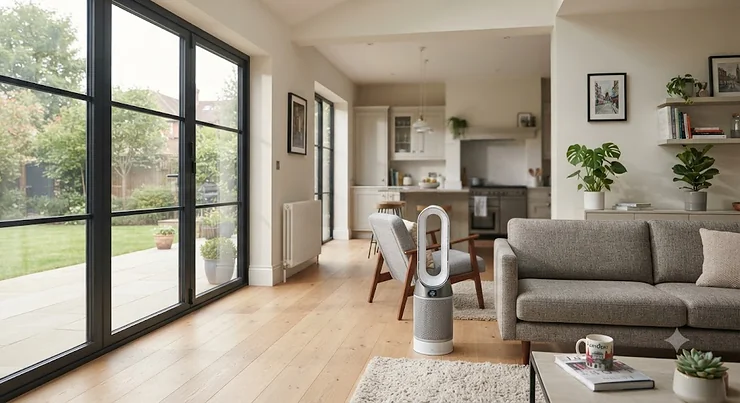
Open plan living is brilliant for parties and terrible for air quality, and nobody warns you about the second part until you’re stood in your kitchen watching cooking smoke drift, unbothered, all the way into the sofa end of the room forty feet away. An air purifier for open plan living is any unit powerful enough to keep air moving across a knocked-through kitchen-diner-lounge, rather than one designed for a single, sealed-off bedroom. As a category, air purifiers work by drawing room air through a series of filters to strip out particulate matter and, in some cases, gases, before recirculating it — that’s the whole definition, really, and it’s not a special category of appliance, it’s a normal purifier being asked to do a much bigger job.
The trouble is that most air purifiers on the market were engineered with a 12-15 square metre bedroom in mind, and manufacturers are not always forthcoming about that fact on the box. Drop one into a 55 square metre open-plan space and it will run flat out, all day, and still lose the fight against a Sunday roast. What follows is a properly researched look at the products that can genuinely handle a large, connected space — with real specs, honestly reported reviewer sentiment, and the sort of comparative reasoning that a rewritten Amazon listing simply won’t give you.
We’re going to cover seven real machines spanning budget to genuinely eye-watering premium territory, walk through how Clean Air Delivery Rate actually translates into square metres in practice (spoiler: not the way the marketing suggests), and look honestly at whether one big powerful air purifier open plan solution beats scattering two or three smaller ones around the room. This article contains affiliate links — full disclosure sits at the bottom, as it should.
Quick Comparison Table
| Product | CADR | Realistic Coverage | Noise (low-high) | Price Range | Best For |
|---|---|---|---|---|---|
| Levoit Core 600S | ~697 m³/h | 30-45 m² | 26-54 dB | £220-£280 range | All-round open-plan workhorse |
| Blueair Blue Pure 211i Max | ~410 CFM (696 m³/h) | 35-50 m² | 23-53 dB | £300-£380 range | Quiet, whole-floor coverage |
| Philips Series 3000i AC3033 | 520 m³/h | 30-35 m² | Low-45 dB | £400-£460 range | Smart control, highest single-unit CADR |
| Xiaomi Smart Air Purifier 4 Pro | 500 m³/h | 25-35 m² | 33.7-~65 dB | £140-£190 range | Best value for a mid-size open-plan zone |
| Coway Airmega AP-1512HH Mighty | 421 m³/h | 25-30 m² | Low-52 dB | £200-£260 range | Long-trusted budget/mid pick |
| Dyson Purifier Big+Quiet Formaldehyde | Untested to CADR standard, high-output | 40-50 m² | Low dB, whisper-quiet | £850-£900 range | Premium flagship with gas detection |
| IKEA FÖRNUFTIG | 25-120 m³/h | 6-8 m² each | Low-moderate | Under £65 each | Budget multi-unit zoning strategy |
Looking at the table, the pattern that jumps out is how far the manufacturer-quoted coverage figures drift from what actually holds up in an open-plan room once you factor in air changes per hour rather than a single pass. The Levoit Core 600S and Blueair Blue Pure 211i Max both claim room sizes well over 100 square metres on the box, yet their realistic open-plan coverage sits closer to 30-50 square metres when you want proper allergy-grade filtration rather than a token clean. Budget doesn’t map neatly to performance either — the IKEA FÖRNUFTIG is cheap precisely because it’s honest about being small, which is arguably more useful than a bigger unit quietly underperforming its claims.
💬 Bookmark this table now — you’ll want to scroll back to it once you’ve read the coverage-reality section below.
Top 7 Air Purifiers for Open Plan Living: Expert Analysis
Coverage claims on the box are one thing; how a purifier behaves parked in the corner of a genuinely large, furniture-cluttered, doorless space is another. Below are seven real products — spanning ordinary budget picks to a purifier that costs more than some people’s first car — assessed on what they’ll actually do for you, not what the marketing copy promises.
1. Levoit Core 600S — best all-rounder for open-plan homes
The Core 600S is the biggest unit in Levoit’s popular Core range, and it’s become something of a default recommendation for larger UK living spaces for good reason. Levoit’s own figure claims coverage up to roughly 147 square metres at a single air change per hour, which sounds enormous, but that number evaporates once you apply the stricter five-air-changes-per-hour standard that allergy sufferers actually need — at which point you’re looking at something closer to 30-45 square metres, which is still a genuinely useful footprint for a mid-sized open-plan kitchen-diner.
Its three-stage filtration pairs an H13 HEPA layer with an activated carbon element for cooking odours, which matters enormously in an open-plan layout where the hob and the sofa share the same air. Based on the spec comparison with rivals at this price point, the 600S’s standout feature is its VortexAir 3.0 fan design, which reviewers consistently note delivers noticeably stronger air throw across a room than the flat-fronted competitors in this bracket — useful when your “room” is actually three rooms with the walls removed.
Reviewers consistently report that sleep mode is genuinely whisper-quiet, dropping to around 26dB, while top speed climbs to a fridge-hum-level 54dB that you’ll notice during a video call. A commonly repeated complaint in aggregated review sentiment concerns replacement filter cost, which sits noticeably higher than budget alternatives — something to factor into total ownership cost rather than sticker price alone.
Pros:
- ✅ Genuinely strong air throw across large, open spaces
- ✅ Real-time PM2.5 display and useful auto mode
- ✅ Whisper-quiet sleep mode for overnight running
Cons:
- ❌ Replacement filters cost more than most budget rivals
- ❌ Bulky footprint that eats floor space in smaller zones
Priced in the £220-£280 range depending on retailer promotions, the Core 600S earns its place as a genuine mid-range value pick — not the cheapest option here, but arguably the one that balances price against real open-plan performance most convincingly.
2. Blueair Blue Pure 211i Max — best for whisper-quiet whole-floor coverage
Blueair’s HEPASilent technology has a cult following among people who’ve tried louder purifiers and given up on running them overnight, and the 211i Max is the version built specifically for larger spaces. What most buyers overlook about this model is that its low-speed CADR is deceptively strong — reviewers benchmarking it against the smaller Core 300 found the Blueair matching that rival’s top speed while running on a noticeably gentler setting, which is precisely the sort of efficiency that matters when a purifier needs to run constantly in a shared living space.
The 211i Max pairs a washable pre-filter with particle and carbon filtration stages, and Blueair rates it for spaces up to roughly 3,000 square feet at a single pass — again, a figure that should be treated as a ceiling rather than a working recommendation. For proper allergy-grade cleaning, expect a realistic working coverage closer to 35-50 square metres, which puts it firmly in open-plan territory rather than single-room use.
Aggregated customer feedback consistently praises its Scandinavian design — it genuinely doesn’t look like an appliance, which matters more than manufacturers admit when the unit is going to live permanently in your living space rather than tucked in a utility room. The recurring criticism in review sentiment is filter cost and the fact that its ionising element cannot be switched off, which will bother buyers specifically trying to avoid ionisation technology.
Pros:
- ✅ Exceptionally quiet even at working speeds
- ✅ Stylish design that blends into open-plan interiors
- ✅ Smart RealTrack filter-life tracking via the app
Cons:
- ❌ Built-in ioniser cannot be disabled
- ❌ Replacement filters are a recurring cost complaint
Sitting in the £300-£380 range, this is a premium purchase, but one that reviewers consistently frame as worth it specifically for buyers whose priority is quiet, constant background operation rather than outright power.
3. Philips Series 3000i AC3033 — best for smart control and highest CADR on this list
Philips leans hard into the “invisible appliance” pitch with the 3000i, wrapping a genuinely powerful purifier in fabric-covered styling that reviewers repeatedly compare to a speaker rather than a filtration unit. Its 520 m³/h CADR is the highest raw figure among the seven products featured here, and Philips’s NanoProtect HEPA technology claims roughly double the air-cleaning efficiency of a traditional HEPA H13 filter for the same energy draw — a genuinely useful advantage in a large space where you’re running the unit near-constantly.
Here’s what to weigh: Philips quotes coverage up to 135 square metres, purifying a 20 square metre test room in around six minutes, but that figure is based on a single air exchange in an enclosed test chamber rather than a real, furniture-filled open-plan layout with doorways feeding air in from elsewhere. A more honest working estimate for genuine allergy relief sits around 30-35 square metres — still strong, but worth knowing before you buy expecting whole-floor coverage from one unit.
The Air+ companion app gets consistently positive aggregated feedback for its real-time pollutant breakdown, distinguishing between allergens, gases and PM2.5 rather than lumping everything into one vague number. Where reviewer sentiment turns critical is price relative to physical footprint — at roughly 6.8kg and over 60cm tall, several owners note it demands a genuine floor commitment rather than a shelf spot.
Pros:
- ✅ Highest raw CADR of any unit in this round-up
- ✅ Detailed real-time app breakdown of specific pollutants
- ✅ Long-lasting NanoProtect filters reduce replacement frequency
Cons:
- ❌ Large physical footprint needs dedicated floor space
- ❌ Premium price for what’s still a single-zone solution
Expect to pay in the £400-£460 range, positioning the AC3033 as a genuine premium contender for buyers who want the highest raw output alongside serious smart-home integration.
4. Xiaomi Smart Air Purifier 4 Pro — best value for a mid-size open-plan zone
Xiaomi has quietly built one of the strongest value propositions in air purification, and the Smart Air Purifier 4 Pro undercuts most Western rivals by a wide margin while still posting genuinely competitive numbers — a 500 m³/h particle CADR and a manufacturer-stated coverage of 35-60 square metres. Based on the spec comparison, that CADR figure sits within touching distance of the far pricier Philips unit above, which is a striking result for something typically retailing at under half the price.
The unit’s dual PM2.5/PM10 laser sensor gives genuinely responsive auto-mode behaviour — reviewers note it reacts within moments to cooking smoke or a freshly opened window, ramping fan speed up and back down without manual input. Night mode runs at a claimed 33.7dB, which is respectably quiet, though several aggregated reviews mention that top-speed operation is noticeably louder and more noticeable than premium rivals at equivalent output.
What most buyers overlook about budget-tier smart purifiers generally is app reliability, and this is where Xiaomi’s ecosystem earns genuine credit — the Mi Home/Xiaomi Home app is mature, well-supported, and doesn’t suffer the abandonment problems that plague smaller brands. The trade-off, honestly reported in review sentiment, is build materials that feel noticeably more plasticky than the metal-accented premium options on this list.
Pros:
- ✅ Exceptional CADR-to-price ratio among smart purifiers
- ✅ Fast, genuinely responsive auto mode
- ✅ Mature, reliable companion app
Cons:
- ❌ Build quality feels budget next to premium rivals
- ❌ Noticeably louder at top speed than pricier alternatives
Typically found in the £140-£190 range, the 4 Pro is arguably the smartest first purchase for anyone furnishing a mid-size open-plan flat on a realistic budget.
5. Coway Airmega AP-1512HH Mighty — the long-trusted budget-to-mid pick
The Coway Airmega AP-1512HH has been a fixture of “best air purifier” round-ups for years, and its longevity says something the newer smart gadgets can’t claim yet — a long track record of aggregated reviews to draw on. With a 421 m³/h CADR, it sits comfortably in the mid-pack for raw power, but its reputation is built less on outright numbers and more on consistency: reviewers repeatedly describe it as a purifier that simply keeps working, year after year, without the smart-home quirks that occasionally plague app-dependent rivals.
The spec sheet won’t tell you this, but user reports suggest the Mighty’s genuine strength in an open-plan setting is its eco mode, which uses a light sensor to automatically drop fan speed overnight or when the room’s unoccupied, quietly reducing running costs over months of near-constant use — a meaningful consideration when a unit needs to run continuously across a large, connected living space.
Aggregated customer sentiment consistently highlights its compact footprint relative to its output, and its air quality indicator light, which shifts colour to give an at-a-glance read on the room without needing to check a phone app. The recurring criticism concerns coverage claims versus reality — several reviewers note that in genuinely open-plan rooms above 30 square metres, the Mighty benefits from a second unit or careful central placement rather than being asked to cover the whole space alone.
Pros:
- ✅ Long-standing reputation for reliability over years of use
- ✅ Genuinely useful eco mode reduces running costs
- ✅ Compact size for its output level
Cons:
- ❌ Struggles alone in open-plan rooms above 30 square metres
- ❌ No smartphone app on the standard model
Priced in the £200-£260 range, it’s a sensible mid-tier choice, particularly for buyers prioritising long-term reliability data over cutting-edge smart features.
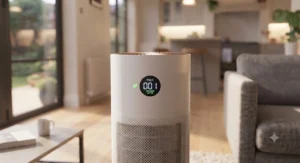
6. Dyson Purifier Big+Quiet Formaldehyde — the premium flagship with gas detection
If budget genuinely isn’t a constraint, the Big+Quiet Formaldehyde is Dyson’s answer to the “one purifier, whole open-plan floor” brief, and reviewers who’ve tested it against the industry-standard 12 square metre single-sensor benchmark note that Dyson instead measures performance across a 100 square metre space using 36 sensors — a testing approach that, while harder to directly compare against CADR-rated rivals, at least acknowledges that real homes aren’t small, sealed test chambers.
What most buyers overlook about this machine is that its headline feature isn’t raw filtration power but permanent formaldehyde destruction via a Selective Catalytic Oxidisation filter, alongside HEPA H13-grade particle capture and genuine NO2 monitoring — pollutants a standard HEPA-and-carbon combo simply doesn’t address. For a family concerned about VOCs off-gassing from new furniture or flooring in an open-plan renovation, that’s a genuinely different value proposition to the other six products here.
Reviewers consistently praise its air projection, which Dyson claims throws purified air over ten metres — directly relevant in an open-plan layout where you need clean air reaching the far end of the room, not just recirculating near the unit itself. The unavoidable criticism, echoed across virtually every review found, is price: at close to £900, it costs more than several of this list’s other products combined.
Pros:
- ✅ Only unit here with permanent formaldehyde destruction
- ✅ Genuine long-distance air projection across large rooms
- ✅ Whole-machine HEPA H13 sealing prevents pollutant leakage
Cons:
- ❌ Price puts it out of reach for most household budgets
- ❌ No published CADR makes direct comparison difficult
At around £850-£900, this sits firmly in luxury-appliance territory, and it’s genuinely hard to justify unless gas and VOC monitoring specifically matters to your household.
7. IKEA FÖRNUFTIG — the budget building block for zone-based coverage
The FÖRNUFTIG doesn’t pretend to be a large-room solution, and that honesty is precisely its appeal. IKEA rates it for an 8 square metre space with a modest 25-120 m³/h CADR range, which is genuinely tiny next to everything else on this list — but at under £65, it opens up a completely different strategy for open-plan living: buying two or three and placing them strategically around distinct zones (kitchen, dining, sofa area) rather than relying on a single powerful unit to reach every corner.
Aggregated reviews are strikingly consistent for a budget product, sitting around 4.3 out of 5 across hundreds of ratings, with owners repeatedly praising the wall-mounting option that frees up floor space — genuinely useful in an open-plan room where every clear surface matters. The dial-only control with no app or smart features is, depending on your priorities, either refreshingly simple or frustratingly basic; reviewer sentiment splits fairly evenly on this point.
A recurring theme in aggregated feedback is that the lowest fan speed is close to inaudible but correspondingly weak, while the top speed becomes genuinely noticeable in a quiet room — a trade-off common to compact, affordable units. For odour-heavy zones like a kitchen, IKEA sells an optional gas filter add-on that several reviewers specifically credit with clearing cooking or paint smells within an hour of switching it on.
Pros:
- ✅ Genuinely low cost per unit enables multi-zone strategies
- ✅ Wall-mountable design saves valuable floor space
- ✅ Strong, consistent aggregated review scores for the price
Cons:
- ❌ Tiny 8 square metre coverage per individual unit
- ❌ No app, sensor auto mode, or smart features
At under £65 per unit, three FÖRNUFTIGs positioned around distinct zones can cost roughly the same as one mid-range single unit — a genuinely different approach worth weighing seriously, which we’ll unpack properly below.
Practical Usage Guide: Setting Up Your Purifier for Maximum Coverage
Getting an air purifier for open plan living to actually perform starts well before you press the power button. Placement is the single most overlooked factor: pushing a unit into a corner behind a sofa, which is where most people instinctively put appliances, can cut its effective air throw by a noticeable margin because the intake and outflow both get partially blocked. Aim for a central position with at least 30-50cm of clearance on all sides, ideally somewhere that sits between your main pollution source (the hob, most commonly) and the space you spend the most time in.
In the first 30 days, resist the urge to leave a unit permanently on its lowest, quietest setting — most auto-mode purifiers need a period running on higher speeds to properly clear accumulated particulate before settling into efficient maintenance mode. A common mistake is judging a new purifier as underpowered within the first few days, when actually it’s still working through the room’s existing particle load. Vacuum washable pre-filters monthly; a clogged pre-filter forces the main HEPA element to work harder and shortens its working life considerably.
For genuinely open-plan spaces, consider running the unit on a slightly elevated baseline speed rather than pure auto mode, since sensors mounted on the unit itself may not detect pollution building up at the far end of a large, connected room until it’s already noticeably diffused. Pairing this with the manufacturer’s companion app (where available) to review historical air quality data helps you spot patterns — cooking times, guest visits, open-window periods — worth adjusting your routine around.
Real-World Scenarios: Matching Purifiers to Your Open-Plan Layout
Picture three fairly different households, each with a knocked-through living space and a different set of priorities.
First, a couple in a 45 square metre converted warehouse flat with polished concrete floors and a lot of west-facing glass — meaning dust and pollen accumulate visibly on every surface by midweek. For them, a single powerful unit centrally placed, such as the Levoit Core 600S or Blueair Blue Pure 211i Max, makes more sense than scattering smaller units, since the open sightlines mean air genuinely circulates freely across the whole floor without partition walls interrupting airflow.
Second, a family with two young children and a cat in a 60 square metre kitchen-diner-lounge extension, where cooking odours, pet dander and general household chaos all compete for attention. Here, a zone-based approach genuinely wins: a mid-power unit like the Coway Airmega AP-1512HH Mighty near the kitchen for cooking odours, paired with an IKEA FÖRNUFTIG or two near the sofa and play area, tends to outperform a single unit trying to be everywhere at once — because the pollution sources themselves are localised and moving.
Third, a budget-conscious renter in a 35 square metre studio-style open-plan flat who’s prioritising value above everything. The Xiaomi Smart Air Purifier 4 Pro fits this brief precisely: enough genuine CADR to cover the space, smart auto mode to keep running costs sensible, and a price that doesn’t dominate a tight furnishing budget.
Problem → Solution: Fixing the Most Common Open-Plan Air Quality Complaints
Problem: Cooking smoke drifts straight into the seating area. Position your purifier between the kitchen and living zone rather than tucked against a far wall, and consider a unit with a strong activated carbon stage — both the Levoit Core 600S and Coway Airmega AP-1512HH Mighty handle odour capture noticeably better than particle-only alternatives.
Problem: One unit reaches the kitchen but the far sofa corner still feels stuffy. This is the classic open-plan complaint, and it’s usually a sign that a single-unit strategy has hit its practical limit. Rather than upgrading to an even larger (and pricier) machine, adding a second smaller unit — an IKEA FÖRNUFTIG or similar — near the underserved zone is typically more cost-effective than chasing ever-higher CADR from one appliance.
Problem: The purifier is too loud to run during video calls or while working from the dining table. Prioritise a unit with a genuinely quiet low-speed rating, such as the Blueair Blue Pure 211i Max at 23dB, and position it slightly further from your desk area rather than directly beside it.
Problem: Running costs feel higher than expected. Check whether the unit has an eco or auto mode that scales down when the room’s unoccupied — the Coway Airmega AP-1512HH Mighty‘s light-sensor eco mode is specifically designed for this, and switching from constant top-speed running to a properly calibrated auto mode can meaningfully reduce both electricity use and filter wear.
Problem: Persistent chemical or “new furniture” smell that HEPA filtration doesn’t seem to touch. Standard HEPA filters capture particles, not gases — for genuine VOC and formaldehyde concerns, only a unit with dedicated gas-oxidation filtration, such as the Dyson Purifier Big+Quiet Formaldehyde, will meaningfully address the source.
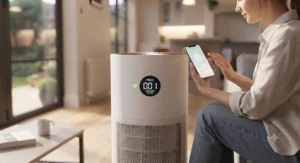
How to Choose an Air Purifier for Open Plan Living
- Start with your room’s actual floor area in square metres, measured properly rather than estimated, since every CADR-to-coverage calculation downstream depends on this number being accurate.
- Apply the five-air-changes-per-hour rule for allergy relief, not the more generous two-changes figure manufacturers often lead with — this typically means sizing for a room roughly half the manufacturer’s headline coverage claim.
- Prioritise CADR over vague marketing terms like “purifies large rooms,” since CADR is the one figure that’s independently comparable across brands.
- Check the activated carbon stage specifically if cooking odours or VOCs are a concern — a thin sprayed-on carbon layer performs very differently to a substantial pelletised carbon bed.
- Weigh noise at your expected running speed, not just the marketed sleep-mode figure, since an open-plan purifier often needs to run on a mid-speed setting rather than its quietest one to keep pace with a large space.
- Factor in total filter replacement cost over a year, not just the purchase price, since cheaper units sometimes carry disproportionately expensive ongoing filter costs.
- Decide between one large unit and multiple smaller ones early, because it changes which products are even worth shortlisting — see the dedicated section below.
Air Purifier Coverage Area: Reality vs the Spec Sheet
This is arguably the single most misunderstood part of buying an air purifier 60 sqm or larger, and it’s worth being blunt about it: manufacturer coverage figures are almost never calculated the way you’d assume. Most brands quote coverage based on a single air exchange per hour in an empty, sealed test chamber — a scenario that bears limited resemblance to a furniture-filled, doorway-connected open-plan room where air is constantly being disturbed by movement, cooking, and draughts.
For genuine allergy or asthma relief, air quality professionals typically recommend targeting five air changes per hour rather than one, which effectively divides the manufacturer’s headline square metre figure by roughly five. A purifier boldly marketed as covering 100 square metres is, by this stricter and more medically meaningful standard, really suited to a 20 square metre room if you want it working at full effectiveness rather than just technically circulating air. This single miscalculation is probably responsible for more disappointed first-time buyers than any other factor on this list.
Practically, this means that when you’re specifically searching for an air purifier for 50 square metres of genuine open-plan floor space, you should be looking at products whose manufacturer-quoted coverage sits in the 200-250 square metre range at a single pass — which, among our seven products, points squarely toward the Levoit Core 600S, Blueair Blue Pure 211i Max, or a well-positioned Philips Series 3000i AC3033, rather than anything claiming a more modest headline figure. According to UK Health Security Agency guidance on domestic indoor air, improving ventilation and air circulation is one of the most effective and low-cost ways to support any filtration strategy, which is a useful reminder that a purifier works best alongside decent airflow, not as a total substitute for it.
One Large Air Purifier vs Multiple Smaller Units for Open-Plan Spaces
There’s a genuine, unresolved debate among reviewers and owners about whether a single powerful air purifier open plan solution beats distributing two or three smaller units around a large room, and the honest answer is: it depends heavily on your space’s shape and pollution sources.
A single large unit makes the most sense in genuinely open, unobstructed spaces — think warehouse conversions or loft-style flats with few internal walls — where air can circulate freely from one central point. It’s also simpler: one filter to replace, one app to check, one power socket to manage. The trade-off is that air quality at the far edges of a large room will always lag behind air quality near the unit itself, sometimes noticeably so during active pollution events like cooking.
Multiple smaller units, by contrast, genuinely shine when your open-plan space has distinct pollution zones — a kitchen generating smoke and grease particles, a pet bed generating dander, a desk area where you specifically want the cleanest air while working. Positioning a modest unit at each source tends to outperform a single central unit trying to serve all three simultaneously, simply because it’s addressing pollution closer to where it’s actually generated. Cost-wise, two IKEA FÖRNUFTIG units plus a Xiaomi Smart Air Purifier 4 Pro for the main seating area can land in a similar total price bracket to one Blueair Blue Pure 211i Max, while arguably delivering more even coverage across a genuinely large, multi-zone room.
The honest verdict: if your open-plan space is one continuous, unobstructed volume, buy the biggest single unit your budget allows. If it’s really three functional zones wearing one open-plan label, multiple smaller units will likely serve you better — and cost roughly the same either way.
Common Mistakes When Buying an Air Purifier for a Large Space
The most frequent mistake, by a wide margin, is trusting the headline coverage figure at face value rather than applying the air-changes-per-hour adjustment covered above — buyers routinely purchase a unit rated for their exact room size, only to find it running constantly at top speed and still struggling.
A second common error is prioritising smart features over raw filtration performance. An elegant app and voice control genuinely add convenience, but they don’t compensate for an undersized CADR in a large room — buyers sometimes choose the flashiest smart purifier over a plainer, more powerful rival and end up with worse actual air quality.
Third, many buyers overlook filter replacement economics entirely at the point of purchase, discovering months later that a cheaper unit’s filters cost nearly as much annually as a pricier rival’s — erasing the upfront saving within the first year of ownership. Finally, placement mistakes are rife: buying the right unit and then tucking it into a corner or behind furniture undermines even the most powerful purifier’s real-world performance.
Long-Term Cost & Maintenance: What Open-Plan Purification Really Costs
Purchase price is only the opening bid. Running an air purifier continuously in a large open-plan space — which is generally necessary given the bigger volume of air involved — typically adds somewhere in the range of £30-£80 a year in electricity, depending on wattage and how much time it spends on higher fan speeds rather than eco or auto mode. Filter replacements are the more significant ongoing cost: budget roughly £40-£90 annually for mid-range units like the Levoit Core 600S or Coway Airmega AP-1512HH Mighty, rising toward £100-£150 for premium filters on units like the Blueair Blue Pure 211i Max or Philips Series 3000i AC3033.
Over a three-year ownership period, a genuinely budget unit with cheap but frequently-replaced filters can end up costing a similar total to a pricier unit with longer-lasting filtration — which is worth factoring into any upfront price comparison rather than judging purely on the sticker figure. Vacuuming washable pre-filters monthly, rather than waiting for a replacement reminder, meaningfully extends the working life of the more expensive HEPA and carbon stages inside.
Safety, Regulations & Certification: What UK Buyers Need to Know
Any electrical appliance sold in the UK must carry UKCA marking (or CE marking during the current transitional period), confirming it meets UK product safety regulations — always check for this on the box or in the product listing before buying from a lesser-known retailer. Genuine HEPA filtration should be certified to capture 99.97% of particles at 0.3 microns; be wary of “HEPA-type” or “HEPA-style” wording, which are unregulated marketing terms rather than a guaranteed filtration standard.
If ozone exposure is a concern, avoid units that rely on uncontrolled ionisation without the option to disable it, since ozone is itself a respiratory irritant that can worsen the very symptoms a purifier is meant to relieve. It’s also worth checking Defra’s Daily Air Quality Index for your postcode before deciding how much outdoor pollution is likely infiltrating your open-plan space through doors and windows, since that context helps you judge how hard your indoor filtration genuinely needs to work. According to Asthma + Lung UK’s guidance on improving indoor air quality, air purifiers should be treated as one part of a wider strategy alongside good ventilation, reduced VOC-emitting products, and controlling damp — not as a standalone fix for a household with genuine respiratory health concerns, and anyone managing a diagnosed condition should discuss changes with their GP or asthma nurse rather than relying on filtration alone.
✨ Ready to stop guessing and start breathing easier?
🔍 Compare the specific coverage figures above against your own room’s square metreage before you buy. Click through on any of the highlighted products to check current pricing and availability, and give your open-plan space the air quality it actually needs.
Air Purifiers for Different Open-Plan Households
Renters in shared open-plan flats often do best with a portable, easily repositioned unit like the Xiaomi Smart Air Purifier 4 Pro or a pair of IKEA FÖRNUFTIG units, since neither requires permanent installation and both can move house alongside you without much fuss. Families with young children should weigh child-lock functionality and rounded, bump-safe casings — the Levoit Core 600S specifically includes both, alongside a stable dual-handle base that makes repositioning safer around toddlers.
Pet owners contending with dander and litter-box odours in an open-plan layout benefit most from units with a substantial activated carbon stage rather than particle filtration alone; the Coway Airmega AP-1512HH Mighty and Levoit Core 600S both perform well here according to aggregated review sentiment. For households specifically managing allergy or asthma symptoms, prioritise genuine HEPA H13 certification and a strong auto mode that reacts quickly to pollen or dust spikes, making the Philips Series 3000i AC3033 and Blueair Blue Pure 211i Max particularly well-suited given their laser-sensor responsiveness.
Features That Actually Matter (And Those That Don’t)
Genuine CADR figures, true HEPA H13 certification, and substantial activated carbon depth are the three specifications worth scrutinising closely — everything else is largely convenience layered on top. Real-time PM2.5 displays are genuinely useful for understanding your room’s actual pollution patterns over time, not just a gimmick, since they let you correlate spikes with specific activities like cooking or opening windows during high pollen periods.
Voice assistant compatibility, by contrast, is pure convenience with no bearing on filtration performance — pleasant to have, irrelevant to air quality outcomes. Similarly, elaborate app ecosystems matter less than whether the auto mode they control actually responds quickly and proportionately to real pollution events; a beautifully designed app controlling a sluggish sensor is worse than a basic dial controlling a fast one.
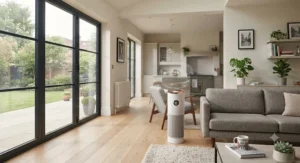
Frequently Asked Questions
❓ What size air purifier do I need for open plan living?
❓ Is one large air purifier better than two small ones for a big room?
❓ How much does it cost to run an air purifier 60 sqm continuously?
❓ Do air purifiers actually help with asthma in a large living space?
❓ Can I use a bedroom-sized air purifier in an open-plan kitchen-diner?
Conclusion
Choosing an air purifier for open plan living genuinely comes down to being honest with yourself about two things: your room’s real square metreage, and whether your space is one continuous zone or several distinct ones wearing a single open-plan label. Get those two answers right, and the rest of the decision becomes considerably more straightforward.
For most genuinely open, unobstructed spaces, the Levoit Core 600S offers the strongest all-round balance of price and real-world coverage, while the Blueair Blue Pure 211i Max suits anyone prioritising near-silent overnight running above raw power. Budget-conscious buyers shouldn’t dismiss the Xiaomi Smart Air Purifier 4 Pro or a zone-based IKEA FÖRNUFTIG strategy, both of which can outperform a single mismatched premium unit for considerably less outlay. And for households with genuine VOC or formaldehyde concerns, the Dyson Purifier Big+Quiet Formaldehyde remains the only product here addressing that specific problem directly, premium price notwithstanding.
Whichever route you take, apply the five-air-changes-per-hour reality check before trusting any box’s headline coverage claim, and your open-plan air quality will thank you for it.
✨ Don’t Miss These Exclusive Deals!
🔍 Take your open-plan air quality to the next level with the models covered above. Click through on any highlighted product to check current pricing and availability, and start breathing genuinely fresher air in every corner of your knocked-through space.
Recommended for You
- Air Purifier for Kitchen Diner: 7 Best Picks Tested for 2026
- Best Air Purifier for Home Office in 2026: 7 Quiet Picks Tested
- Desk Air Purifier: 7 Best Compact Picks for UK Offices (2026)
Disclaimer: This article contains affiliate links. As an Amazon Associate, I earn from qualifying purchases. If you purchase products through these links, we may earn a small commission at no additional cost to you.
✨ Found this helpful? Share it with your friends! 💬🤗
