In This Article
There’s a particular kind of stuffiness that settles over a desk by mid-afternoon. Your third coffee’s gone cold, the radiator’s ticking away in the corner, and somewhere between the dog fur drifting in from the hallway and the printer toner hanging in the air, you realise you haven’t actually taken a proper breath in about an hour. That’s usually the moment people start googling desk air purifier and land here.
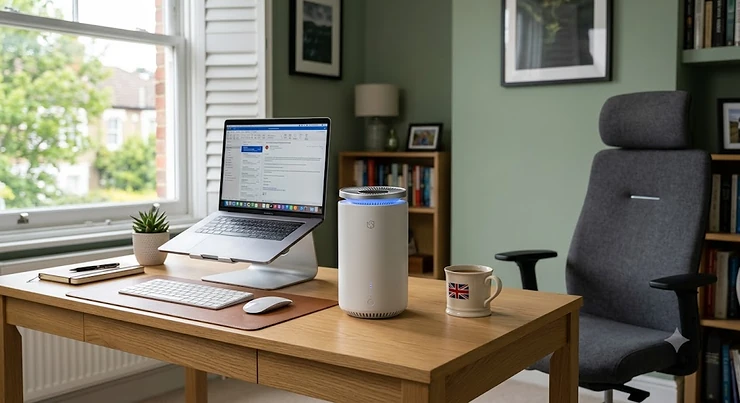
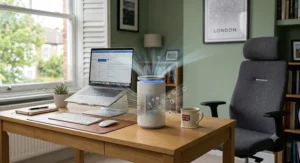
A desk air purifier is a compact, close-range air-cleaning unit designed to sit within arm’s reach of you — on a desk, shelf or bedside table — pulling in the air immediately around your face rather than trying to clean an entire room. Think of it as the difference between a reading lamp and the overhead light: one is aimed at you specifically, the other is doing a job for the whole space. For hay fever sufferers, home workers with pets, or anyone stuck in a poorly ventilated box room, that distinction matters enormously.
This guide is built around genuine research rather than recycled marketing copy. We’ve pulled together seven real, currently available models spanning budget USB-powered units through to premium HEPA machines, and we’ve grounded every recommendation in actual specifications and aggregated customer sentiment rather than invented “hands-on” claims. As guidance on indoor airborne allergens explains, everyday indoor activity — poor ventilation, outdoor particles drifting through open windows, cleaning, pet ownership — is a genuine contributor to indoor air pollution, and that’s precisely the kind of low-level, close-proximity pollution a desktop air purifier is built to intercept. Whether you’re chasing a compact air purifier home office setup, a small quiet air purifier for desk use overnight, or simply the best air purifier under £80 home office budget allows, you’ll find a genuine match below.
Quick Comparison Table
Before we go deep on each model, here’s the fast version for anyone who just wants the shortlist.
| Model | Best For | Noise (lowest setting) | Filtration | Price Range |
|---|---|---|---|---|
| MEGAWISE EPI810 | Cheapest true HEPA, USB-friendly | ~35 dB | 3-stage HEPA + carbon | Around £20-£30 |
| MORENTO MR2566 | Budget aromatherapy combo | 22 dB | 3-in-1 HEPA + carbon | Around £25-£40 |
| Levoit Core Mini | Lowest running cost, tiniest desks | 27 dB | 3-stage HEPA + carbon | Around £35-£50 |
| Tower T673000BLG | HEPA 13 with mood lighting | 26 dB | HEPA 13 + carbon | Around £45-£65 |
| Blueair Blue Pure Mini Max | Build quality and cheap filters | 26 dB | HEPASilent (electrostatic + mechanical) | Around £75-£85 |
| Medify MA-14 | Medical-grade H13 in a small footprint | Low-30s dB | True HEPA H13 + carbon | Around £90-£120 |
| Philips 600i (AC0650/20) | Coverage beyond just the desk | 19 dB | NanoProtect HEPA | Around £110-£150 |
Looking at that spread, the pattern is fairly clear: the cheaper units win on upfront cost and give you real, verified HEPA-grade filtration for not much money, but they generally ask you to compromise somewhere — either on noise at higher fan speeds, on how far the “clean air zone” actually reaches, or on smart features. The Blueair Blue Pure Mini Max and Medify MA-14 sit in the middle, trading a higher price for meaningfully better particle capture, while the Philips 600i stops being a strictly “desk” purifier and starts covering the whole room, which is worth knowing before you commit.
💬 Found a match already? Scroll down to the full breakdown before you commit — the small print on filter costs is where these decisions usually get made.
Top 7 Desk Air Purifiers: Expert Analysis
1. MEGAWISE EPI810 — cheapest true HEPA pick with USB-friendly power
The MEGAWISE EPI810 is the entry point of this list, and it earns that spot by refusing to cut the one corner that actually matters: it uses a genuine 3-stage filtration system with a true HEPA layer rather than the vaguer “HEPA-style” wording some budget units lean on. It runs on a standard low-voltage adapter, and because its power draw sits in USB-charger territory, it’s the kind of unit people happily plug into a desktop hub or laptop dock rather than hunting for a spare wall socket. At 6.5W in sleep mode, it’s barely a rounding error on your electricity bill even running continuously.
Independent testing found the MEGAWISE EPI810 performs respectably in small rooms up to roughly 200 sq ft, though it has to work harder — and get noticeably louder, up to around 57 dB on turbo — to match the particle-clearing speed of pricier rivals. On its lowest setting it’s genuinely unobtrusive, sitting around 35 dB, which is fine for background desk use but won’t disappear the way premium units do.
Reviewers consistently note that the EPI810 is best treated as a “better than nothing, cheaply” option rather than a serious allergy-management tool — ideal for a student room, a small home office, or as a second unit for a specific corner of a larger space. If you’ve got mild dust sensitivity and want proof that filtration works before spending more, this is a sensible first purchase. If you’re dealing with genuine asthma or severe pet allergies, you’ll likely outgrow it within a season.
Pros:
- ✅ Genuine 3-stage true HEPA filtration at a low entry price
- ✅ Low-voltage power draw suits USB-style desk setups
- ✅ Simple one-button control with optional night light
Cons:
- ❌ Gets notably loud on turbo speed compared with rivals
- ❌ Coverage area is genuinely small, not room-sized
At around £20-£30, the MEGAWISE EPI810 is honest value: you’re not getting smart sensors or app control, but you are getting real HEPA media doing real work, which is more than some pricier “ioniser” gadgets can claim.
2. MORENTO MR2566 — best budget aromatherapy combo
The MORENTO MR2566 carves out its own niche by combining a 3-in-1 HEPA and activated carbon filter with a genuinely useful aromatherapy pad and a soft blue ambient light — features that sound gimmicky until you’re working late and appreciate not having a stark white LED glaring at you. Its 360-degree air intake pulls from all sides, which matters more than it sounds on a cluttered desk where airflow can otherwise get blocked from one direction.
With two fan speeds and a built-in timer (2, 5 or 8 hours), the MORENTO MR2566 is designed for people who want to set it running and forget about it rather than fiddle with settings. On sleep mode it drops to a claimed 22 dB, among the quietest figures in this entire list, and the display dims automatically after a few seconds so it won’t cast light across your workspace at night.
Aggregated customer feedback is broadly positive on effectiveness against pet dander and general room odours, with several reviewers specifically praising how unobtrusive it is in a bedroom or small office. The recurring criticism is value for money relative to size — a few buyers feel the unit is a touch pricier than its physical footprint suggests, though most still rate it highly overall.
Pros:
- ✅ Genuinely quiet sleep mode around 22 dB
- ✅ Built-in aromatherapy pad adds real personality
- ✅ Automatic timer removes the need to babysit it
Cons:
- ❌ Only two fan speeds limits fine control
- ❌ Some buyers feel it’s pricey for its compact size
Sitting in the £25-£40 range, the MORENTO MR2566 is a strong pick if ambience matters to you as much as raw filtration power — a purifier that also does a bit of interior design.
3. Levoit Core Mini — the quietest running cost on the market
If there’s a default answer to “what’s a good small quiet air purifier for desk use,” it’s probably the Levoit Core Mini. Levoit has shifted over 6.5 million units globally, and the Core Mini is the brand’s answer to genuinely tiny spaces — rated for rooms up to around 6.7 m² at full efficiency, which in practical terms means it’s built to clean the metre or so of air directly around your keyboard, not your whole study.
Independent lab testing recorded the Core Mini at just 27 dB at its lowest speed, rising to around 44-45 dB at full blast — numbers that hold up well against the rest of this list. Running on a 7W motor, Levoit states it costs less than a dollar a year to operate continuously, which is the kind of detail that matters once you factor in leaving it on 24/7 through allergy season. Its CADR (Clean Air Delivery Rate) is modest, roughly 78 m³/h, which is exactly what you’d expect from something this size — this is a personal-zone purifier, not a room purifier wearing a smaller badge.
One reviewer who used it on a desk for three weeks reported the tobacco smell in an adjoining room noticeably dropped, and praised the sleep mode as quiet enough not to disturb rest, though they noted the built-in fragrance sponge felt more like a novelty than a serious feature. That’s a fairly representative summary of real user sentiment: strong for its size, honest about its limits.
Pros:
- ✅ Among the quietest units tested at 27 dB lowest setting
- ✅ Genuinely tiny running cost thanks to a 7W motor
- ✅ Compact enough to disappear into a cluttered desk
Cons:
- ❌ CADR is low, so it can’t stretch beyond a very small zone
- ❌ Fragrance sponge feature is more novelty than function
Typically priced in the £35-£50 range, the Levoit Core Mini rewards buyers who want the smallest possible footprint and the lowest possible electricity bill, and who are honest with themselves about only needing to clean the air right in front of them.
4. Tower T673000BLG — HEPA 13 filtration with genuine mood lighting
The Tower T673000BLG punches above its size by fitting a true HEPA 13 filter — a step up from the HEPA 11 found in several rivals on this list — into a genuinely stylish, desk-friendly shell. Its three-stage system (pre-filter, HEPA 13, activated carbon) is rated to capture 99.98% of fine particulates, and it delivers a CADR of 120 m³/h, respectable for a unit this compact and enough to properly service a small home office rather than just the six inches around your monitor.
What makes the T673000BLG stand out on paper is the PM2.5 dust sensor, which gives you a live readout of pollution levels rather than leaving you guessing whether the thing is actually doing anything. The four-speed fan and 12-hour auto-off timer add flexibility that budget rivals skip, and the four-colour mood lighting is a genuinely thoughtful touch for anyone who wants their desk purifier to double as ambient lighting after dark.
Reviewers repeatedly single out the effectiveness against pollen allergies, with one buyer describing noticeable relief from eye, breathing and skin symptoms after introducing it to a bedroom. The recurring gripe is cosmetic rather than functional — a couple of owners mention the white power cord looks slightly out of place against the darker unit colours, which is a minor design quibble rather than a performance issue.
Pros:
- ✅ True HEPA 13 filtration, a genuine step up from HEPA 11
- ✅ Live PM2.5 sensor shows real pollution readings
- ✅ Backed by a 3-year guarantee with registration
Cons:
- ❌ 1,500-hour filter lifespan means more frequent replacement
- ❌ White cord looks slightly mismatched on darker colourways
At around £45-£65, the Tower T673000BLG is arguably the best all-rounder for anyone wanting genuine HEPA 13 performance without stepping into premium pricing.
5. Blueair Blue Pure Mini Max — Scandinavian design with the cheapest filters to run
The Blueair Blue Pure Mini Max takes a different filtration approach entirely. Its HEPASilent technology combines electrostatic charging with mechanical filtration, a method Blueair claims cleans air faster and more quietly than a conventional HEPA filter of equivalent size — and independent testing backs that up, recording 99.97% particle removal down to 0.1 microns. For a personal air purifier workspace setup where you’re sitting close to the unit for eight hours a day, that quieter operation is genuinely noticeable.
At its lowest setting, testers measured the Mini Max at around 26 dB — described as “barely audible from four feet away” — climbing to 35 dB on speed two and 47 dB on its highest setting. The washable, customisable fabric pre-filter is a standout practical feature: rather than throwing away the whole assembly, you can pop the outer fabric in the wash, which meaningfully cuts long-term waste and cost. Replacement particle and carbon filters are inexpensive too, at roughly £18, and Blueair states they last up to six months even running 24 hours a day.
Aggregated reviews are strongly positive, with one home-office user describing a noticeable improvement in air freshness within days and praising how the compact cylindrical design blends into a room rather than looking like “an appliance.” The main criticism across review platforms is the lack of automated fan control or a built-in particle sensor — you’re cycling through three manual speeds rather than letting the unit react to conditions on its own.
Pros:
- ✅ HEPASilent tech is quieter than conventional HEPA at equal output
- ✅ Washable, swappable fabric pre-filter cuts long-term costs
- ✅ AHAM Verifide independently tested performance
Cons:
- ❌ No automatic fan speed adjustment or particle sensor
- ❌ Touch controls offer no fine-grained speed control
Generally listed in the £75-£85 range, the Blueair Blue Pure Mini Max is the pick for anyone who wants premium build quality and design without paying premium running costs.
6. Medify MA-14 — medical-grade H13 filtration in a small footprint
The Medify MA-14 exists because its founders were originally trying to help family members with asthma, and that clinical origin shows in the spec sheet. Where most of this list uses HEPA 11 or basic HEPA 13 claims, the MA-14 is independently lab-tested by Intertek to remove 99.9% of particles down to 0.1 microns using genuine H13-grade media — the same filtration standard used in hospital settings. Its CADR sits around 120 (roughly 70 CFM), which HouseFresh’s testing noted is closer to a $700 Dyson than to the mini purifiers it’s actually competing against on price.
That filtration strength comes with trade-offs. Independent reviewers found the MA-14 isn’t the quietest option here, and it lacks the smart features — no air quality monitor, no app connectivity, no auto mode — that some rivals build in. What you get instead is straightforward, honest power: three fan speeds, a night light, sleep mode, and a filter-change indicator, all wrapped around a filter that’s genuinely doing more work per cubic metre than most units in its size class.
One UK reviewer working with cleaning solvents and workshop dust reported the MA-14 cleared lingering odours where a larger, pricier competitor had failed to, calling the result “stunning” for something this compact. That kind of feedback lines up with the lab data: this is a purifier built to prioritise filtration grade over bells and whistles, and it delivers exactly that trade-off honestly.
Pros:
- ✅ Genuine H13 HEPA, independently tested to 99.9% removal
- ✅ CADR punches well above its physical size
- ✅ Backed by CARB, ETL and Energy Star certification
Cons:
- ❌ No smart features, air quality sensor or app control
- ❌ Runs louder than the quietest rivals on this list
Typically priced in the £90-£120 range, the Medify MA-14 suits anyone who cares more about filtration grade than gadgetry — a genuinely capable purifier wearing a desk-sized body.
7. Philips 600i (AC0650/20) — coverage that stretches well beyond just the desk
The Philips 600i is the one entry here that quietly outgrows the “desk purifier” label, and that’s worth knowing before you buy. Standing just 34 cm tall — genuinely desk- or shelf-friendly — it’s rated to cover rooms up to 44 m², roughly a decent-sized home office or open-plan bedroom-study combo, with a CADR of 170 m³/h. Its two-layer NanoProtect HEPA filtration uses an electrostatic charge to attract particles as small as 0.003 microns, which Philips states cleans up to twice as much air per watt as a conventional HEPA H13 filter of similar size.
Energy efficiency is where the 600i genuinely separates itself: it draws a maximum of just 12W, dropping to 2W in sleep mode, where noise falls to a claimed 19 dB — quieter than a whisper and the lowest figure of any unit on this list. The AeraSense sensor scans air quality roughly 1,000 times a second and reports back through both the on-device display and the Philips Air+ app, giving you actual data rather than a guess about whether it’s working.
Aggregated Amazon UK review data shows a strong majority finding it effective and appreciating the near-silent sleep mode, though a meaningful minority — around a fifth of reviewers commenting on connectivity — report intermittent Wi-Fi drops requiring a full app reset. A separate cluster of buyers has noted the unit ships with a European two-pin plug adapter rather than a UK three-pin, which is a genuinely avoidable frustration worth checking for at purchase.
Pros:
- ✅ Whisper-quiet 19 dB sleep mode, the lowest on this list
- ✅ Covers a full room, not just the immediate desk area
- ✅ Live air quality data through display and Air+ app
Cons:
- ❌ Some units ship with a EU plug rather than UK three-pin
- ❌ App connectivity issues reported by a notable minority
Generally listed in the £110-£150 range, the Philips 600i is the choice for anyone who wants a compact air purifier home office solution that can also handle the rest of the room once you step away from the desk.
Practical Usage Guide: Getting the Most From Your Desk Air Purifier
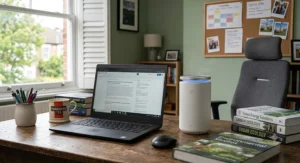
Buying the right unit is only half the job — placement and maintenance make a bigger difference than most people expect. Position matters more than power: even the Medify MA-14‘s medical-grade filter underperforms if it’s tucked behind a monitor stand or jammed against a wall, because restricted airflow starves the fan of the volume it needs to pull through. Give any desk purifier at least 15-20 cm of clear space on the intake side, and where possible, position it slightly elevated — a shelf or a stack of books works fine — so it’s drawing air from roughly head height rather than floor-level dust that’s already settling.
In the first 30 days, the most common mistake isn’t choosing the wrong model, it’s running it at the wrong speed. New owners frequently leave a unit like the MORENTO MR2566 on its lowest, quietest setting permanently, then wonder why symptoms haven’t improved — when actually running it on a higher speed for the first hour after arriving at your desk, then dropping to a quiet setting for the rest of the day, clears the existing particle load far faster. Filters also need a proper break-in check: unwrap any plastic film fully (a surprisingly common oversight with HEPA units bought online), and note the date so you’re not guessing when the replacement indicator eventually lights up.
For long-term upkeep, activated carbon layers — present in every model on this list — degrade faster than the HEPA media itself, particularly if you’re near a kitchen, a smoker, or simply live somewhere with higher ambient pollution. A rough rule of thumb across this category: check carbon performance around the 3-month mark even if the manufacturer quotes 6 months, and replace pre-filters (where washable, like the Blueair Blue Pure Mini Max‘s fabric layer) every fortnight to stop dust building up and choking airflow before it ever reaches the main filter.
Real-World Scenarios: Which Purifier Fits Your Situation
The hay fever sufferer working from a box room. If your home office doubles as a spare bedroom with limited ventilation and you’re dealing with seasonal symptoms every spring, prioritise genuine HEPA grade over smart features. The Tower T673000BLG‘s HEPA 13 filter and live PM2.5 readout give you both filtration strength and visible proof it’s working, which matters when you’re trying to correlate symptom relief with air quality.
The budget-conscious student sharing a flat. Space is tight, sockets are contested, and you don’t want to explain a £150 purchase to a housemate. The MEGAWISE EPI810‘s low power draw and sub-£30 price point make it an easy first purifier, particularly paired with a USB hub you likely already own.
The remote worker with a cat and a proper home office. If you’ve got a dedicated room rather than a desk squeezed into a corner, and pet dander is the recurring issue, the Philips 600i‘s wider room coverage means you’re not just cleaning the air at your keyboard while the rest of the room stays static. Its app-based air quality tracking also lets you actually correlate bad air days with symptom flare-ups over time.
How to Choose a Desk Air Purifier
- Match coverage to your actual space, not your aspirations. A unit rated for 6-8 m² like the Levoit Core Mini is genuinely fine for a desk zone, but hopeless for an open-plan room — check the manufacturer’s stated coverage against your real floor area, not just the desk surface.
- Prioritise true HEPA over vague “HEPA-style” wording. Which?’s independent air purifier testing has flagged models that struggle to clear small particles from the air despite HEPA-adjacent marketing language — always check for a stated H11, H13 or H14 grade rather than generic wording.
- Treat noise at your typical working speed as more important than the marketed lowest-setting figure. A unit that’s silent at its lowest speed but roars at medium, where you’ll actually run it most days, isn’t the quiet purifier the box implies.
- Factor in filter replacement cost over 12 months, not just the sticker price. A cheaper unit with pricier, harder-to-find filters can cost more over a year than a pricier unit with a £18 filter, like the Blueair Blue Pure Mini Max.
- Check the plug type and cable length before ordering. Several imported models, including some Philips units, ship with EU adapters rather than UK three-pin plugs — a five-minute check that avoids a returns hassle.
- Decide whether you actually need smart features. App control and air quality sensors, as on the Philips 600i, add real value if you want data over time, but add nothing if you just want quiet background filtration.
- Consider your allergy severity honestly. Mild seasonal sniffles suit a budget pick; genuine asthma or severe pet allergies justify stepping up to H13-grade filtration like the Medify MA-14 or Tower T673000BLG.
Common Mistakes When Buying a Desk Air Purifier
The single most common error is buying on room-size marketing claims without checking the small print on how that figure was calculated — many manufacturers quote coverage based on a single air exchange per hour, which is a far weaker standard than the 4-5 exchanges per hour recommended for allergy relief. A unit “rated” for 40 m² on that basis might only genuinely refresh a much smaller desk-sized zone at a meaningful pace.
A second frequent mistake is ignoring cumulative noise fatigue. A purifier that measures 35 dB in a spec sheet sounds negligible on paper, but running eight hours a day, five days a week, that low hum becomes surprisingly wearing — several reviewers of budget units like the MEGAWISE EPI810 specifically mention this only becoming noticeable after weeks of continuous desk use, not on day one.
Finally, buyers regularly forget to budget for consumables. A £25 purifier with a £15 replacement filter every three months works out considerably more expensive over two years than a £75 unit with a £18 filter lasting six months — exactly the trade-off between the MORENTO MR2566 and the Blueair Blue Pure Mini Max.
Desk Air Purifier vs Full-Room Air Purifier
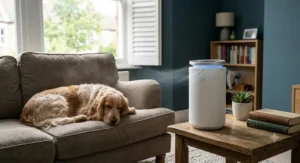
The core distinction is proximity versus coverage. A desk air purifier — every model in this guide — is designed to clean the small volume of air immediately around you, typically within a metre or two, and it does that job faster and more efficiently than a room unit would for that same immediate zone, simply because it’s not fighting to move air across a much larger space. A full-room purifier, by contrast, is engineered to cycle the entire room’s air multiple times an hour, which requires a bigger fan, a larger filter surface area, and inevitably more noise and higher running costs.
For someone working from a single desk in a shared or open-plan space, a desk unit like the Levoit Core Mini or MORENTO MR2566 genuinely outperforms a room purifier for personal exposure, because your face is always within its effective radius. But if you’ve got a dedicated home office and want the whole room’s baseline air quality improved — useful if you’re in there for eight-plus hours and moving around rather than staying glued to one chair — something with genuine room coverage like the Philips 600i closes that gap far more effectively than a purely desk-scale unit ever could.
There’s no universally “better” option here; it’s a question of whether you’re solving for the air at your face or the air in your room, and honestly assessing which one your working pattern actually needs.
What to Expect: Real-World Performance
On paper, CADR figures and micron ratings are abstract. In practice, most users of genuine HEPA desk purifiers report a noticeable difference within the first few days — less dust settling visibly on dark surfaces, a reduction in that faint “stuffy room” smell, and for allergy sufferers, a gradual easing of morning congestion rather than an overnight cure. The Tower T673000BLG‘s live PM2.5 readout is genuinely useful here, because it turns a vague sense of “the air feels better” into an actual number you can watch trend downward over the first hour of operation.
What genuine HEPA filtration won’t do is fix a fundamentally poorly ventilated room, mask cooking smells from an adjoining kitchen entirely, or replace opening a window occasionally. It’s a meaningful reduction in particle load, not a total environmental reset — and reviewers who understand that distinction going in are consistently more satisfied than those expecting a dramatic, single-day transformation.
Desk Air Purifiers for Home Office Workers
Anyone spending genuine working hours at a desk — the kind covered by workplace display screen equipment considerations — benefits from thinking about air quality alongside the more familiar advice on posture and screen height. The HSE’s guidance on display screen equipment at home applies to anyone using screens daily for continuous periods of an hour or more, and recommends assessments cover both office and home working setups — and while air purification isn’t part of that regulation, the same principle of treating your desk as a genuine workstation, not just a spot for a laptop, applies equally to the air around it.
For a compact air purifier home office setup specifically, the practical sweet spot for most people is a unit like the Tower T673000BLG or Blueair Blue Pure Mini Max: powerful enough to make a measurable difference over a full working day, quiet enough not to intrude on video calls, and small enough not to eat into already-limited desk real estate. If your home office genuinely is a spare room rather than a corner of another space, stepping up to the Philips 600i‘s wider coverage means the air quality benefit extends beyond your immediate seating position.
Long-Term Cost & Maintenance
Running costs on this category are refreshingly low across the board — even the least efficient unit here draws under 15W at typical settings, meaning annual electricity costs generally sit somewhere between £6 and £20 for continuous use, which lines up with independent industry testing showing air purifier running costs can range from as little as £6 to as much as £45 a year depending on the model. The real cost driver is filters, not electricity.
Budget units with proprietary filter cartridges, like the MEGAWISE EPI810 and MORENTO MR2566, typically need replacements every 3-4 months at £10-£20 a time — roughly £30-£80 annually. Mid-range and premium units often last longer between changes and, in Blueair’s case specifically, cost less per replacement despite the higher purchase price, meaning the Blueair Blue Pure Mini Max can actually work out cheaper to run year-on-year than several cheaper-to-buy rivals. When comparing total cost of ownership, always multiply the filter price by how many replacements you’ll realistically need in 12 months rather than judging on the sticker price alone.
Safety, Certification and Regulations Guide
In the UK, electrical appliances including air purifiers must carry either a CE or UKCA conformity mark, confirming they meet relevant safety standards for electrical goods sold domestically — worth checking on the product listing or packaging before purchase, particularly with lesser-known imported brands. Beyond basic electrical safety, look for independent performance verification: AHAM Verifide, the certification programme referenced by both the Blueair Blue Pure Mini Max and several Levoit models, involves genuine third-party CADR testing rather than relying purely on manufacturer claims.
Allergy UK’s indoor air quality guidance notes that good indoor air quality is particularly important for vulnerable groups such as babies, children and the elderly, as well as people living with respiratory and allergic conditions, which is worth bearing in mind if you’re buying for a shared household rather than a single desk. None of the seven units reviewed here use ionisers or UV-C technology that can generate ozone as a by-product — all rely on genuine mechanical or HEPASilent filtration, which is the safer and better-evidenced approach for continuous, close-range use.
Frequently Asked Questions
❓ Do desk air purifiers actually work?
❓ How often should I replace the filter on a small air purifier for desk use?
❓ Can I run a personal air purifier workspace unit all day without it costing much?
❓ Is a USB powered air purifier as effective as a mains-powered one?
❓ What's the best air purifier under £80 for a home office?
Conclusion
There’s no single “best” desk air purifier, only the right match for your room, your budget and how seriously you’re taking your symptoms. If you want proof that filtration works before spending much, the MEGAWISE EPI810 or MORENTO MR2566 are honest, low-risk starting points. If your priority is the quietest possible operation at the lowest possible running cost, the Levoit Core Mini remains hard to beat for genuinely tiny spaces. Buyers who want proper HEPA 13 performance without premium pricing should look closely at the Tower T673000BLG, while anyone prioritising build quality and long-term filter economy will get real value from the Blueair Blue Pure Mini Max.
For medical-grade filtration in a compact shell, the Medify MA-14 is the standout, and if your home office genuinely extends beyond your immediate desk, the Philips 600i is the only unit here built to cover the whole room rather than just your personal air pocket. Whichever you choose, remember that placement, fan speed habits and filter maintenance matter almost as much as the unit itself — a great purifier jammed against a wall on its lowest setting will always underperform a modest one used properly.
✨ Ready to breathe easier at your desk? Check current prices and availability on the models above before you decide — stock and offers shift regularly.
Recommended for You
- Air Purifier for VOCs Home Office: 7 Proven Picks for 2026
- Air Purifier for Nursery: 7 Safe, Quiet Picks for 2026 (UK)
- 7 Safest Air Purifiers for Newborn Nurseries in 2026 (UK Guide)
Disclaimer: This article contains affiliate links. As an Amazon Associate, I earn from qualifying purchases. If you purchase products through these links, we may earn a small commission at no additional cost to you.
✨ Found this helpful? Share it with your friends! 💬🤗
