In This Article
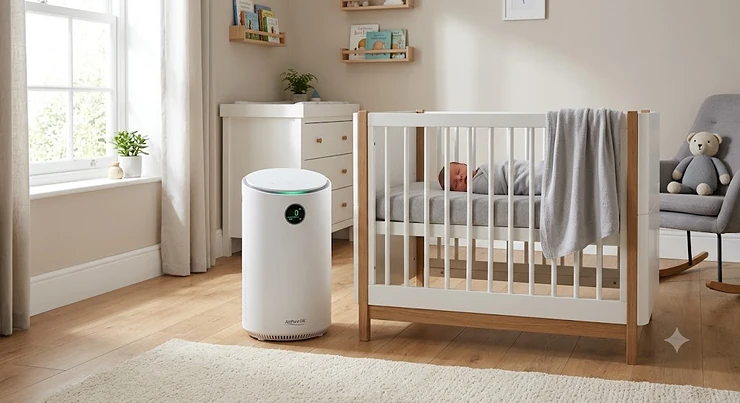
There’s a particular kind of panic that hits somewhere around week thirty-six of pregnancy. You’ve sorted the cot, the car seat, the seventeen variations of “just in case” muslin cloths — and then you glance at the corner of the nursery and think: what’s actually in that air my baby’s about to breathe? It’s not an unreasonable thing to fixate on. Newborns take between forty and sixty breaths a minute, roughly twice the rate of an adult, and their airways are narrower, their lungs still finishing the job of maturing. A safest air purifier for newborn use isn’t a marketing phrase dreamed up to sell you another gadget — it’s a genuinely useful tool for reducing the dust, pollen, pet dander and stray VOCs that settle in every home, new-build or Victorian terrace alike. The trouble is that “air purifier” covers a huge spread of technology, some of it excellent, some of it quietly working against the very air quality you’re trying to protect. This guide walks through seven real, currently available models — budget, mid-range and premium — with an honest look at what each one does well, where it falls short, and which certifications actually matter when a tiny person is doing their sleeping fifteen feet away from the machine.
Quick Comparison: Safest Picks at a Glance
Before the deep dive, here’s how the standout options stack up on the things that matter most for a nursery: ozone risk, coverage, and night-time noise.
| Purifier | Ozone Risk | Room Coverage | Sleep Mode Noise | Best For |
|---|---|---|---|---|
| Levoit Core 300 | None — 100% ozone-free | Up to around 40m² | 24dB | Budget-conscious first nurseries |
| Philips Series 800 | None — ECARF-certified, no ioniser | Up to 49m² (AC0850 variant) | Near-silent | Allergy-prone babies |
| Coway Airmega 150 | None — ECARF & Quietmark certified | Up to 73m² | 20dB | Parents who want the safest possible spec sheet |
| MeacoClean CA-HEPA 47×5 | Low, only if ioniser/UVC switched off | Up to 19m² | Around 30dB | Shoppers who want a British-designed brand |
| Blueair Blue Pure 311i Max | Ioniser runs permanently, cannot be disabled | Up to roughly 40m² | 23dB | Larger nurseries (with an important caveat) |
Looking at this table, a clear pattern emerges: the purifiers built around pure mechanical filtration — no ionisers, no UV-C, no electrostatic charge — are the ones that let you stop thinking about ozone altogether. The Coway Airmega 150 and Philips Series 800 both carry independent certification confirming they don’t generate ozone as a by-product, which matters more in a nursery than almost any other room in the house. The Blueair Blue Pure 311i Max is the outlier here, and worth flagging early: it’s genuinely excellent at shifting air fast, but its ioniser has no off switch, which is the kind of detail easy to miss until you’re three weeks into using it.
💬 Found a purifier that fits your nursery already? Bookmark this page and compare it against our full breakdown below before you buy.
Top 7 Safest Air Purifiers for Newborn Nurseries: Expert Analysis
1. Levoit Core 300 — best budget pick that’s genuinely ozone-free
The Levoit Core 300 has become something of a default recommendation among UK parents, and it earns that reputation honestly rather than through clever marketing. Levoit builds the Core 300 around a three-stage filter — a fabric pre-filter for larger debris, a True HEPA layer, and an activated carbon stage for smoke and nappy-bin odours — paired with what the brand calls VortexAir technology, giving a CADR of roughly 187m³/h. In practice, that means the unit can turn over the air in an 80m² room once an hour, or a more nursery-sized 40m² space twice an hour, which is plenty for a typical box room or converted nursery. What most buyers overlook is that the Core 300 has never used an ioniser or UV-C light at any point in its production history — Levoit states plainly that it is 100% ozone free, and independent lab testing under IEST RP C001.7 backs up its HEPA-grade performance even in the whisper-quiet 24dB sleep mode. Reviewers consistently note that this is one of the few budget purifiers where the sleep mode doesn’t compromise filtration to hit that low decibel figure, which is exactly the trade-off you don’t want to make in a nursery. Aggregated customer feedback on Amazon repeatedly praises the timer function and the noticeable drop in hay-fever symptoms after a few weeks of use, though a recurring complaint concerns filter cost creeping up if you avoid third-party alternatives.
Pros:
- ✅ Confirmed 100% ozone-free with no ioniser or UV-C stage
- ✅ 24dB sleep mode is genuinely quiet without dropping filtration quality
- ✅ Affordable running costs with widely available third-party filters
Cons:
- ❌ No WiFi or app control on the standard Core 300 model
- ❌ Modest CADR means larger nurseries need the pricier Core 300S
Expect to pay somewhere in the £70-£100 range, occasionally dipping lower during sales — check current price on Amazon before buying, as third-party sellers fluctuate more than Levoit’s own storefront.
2. MeacoClean CA-HEPA 47×5 — best British-brand option worth a careful setting check
Meaco is a Devon-founded company that’s built its name on dehumidifiers before branching into air purification, and the MeacoClean CA-HEPA 47×5 reflects that heritage with sturdy build quality and a genuinely effective filter stack. Inside sits a pre-filter, a True HEPA layer rated to capture 99.985% of particles, and an enhanced charcoal filter containing around 130g of coconut-derived carbon — a heavier charcoal load than most rivals at this price, which translates to noticeably better odour control during the nappy-change years. The CADR figures (142 for dust, 135 for smoke, 151 for pollen) suit rooms up to roughly 19m², which covers most box-room nurseries comfortably. Here’s what the spec sheet won’t tell you upfront: this model also includes a UV-C light and ioniser stage that can be toggled on or off via the touch panel, and the ioniser is switched on by default in some units out of the box. Based on the spec comparison with ozone-free rivals, this is the one genuine caveat on an otherwise excellent British-made purifier — you’ll want to actively switch the ioniser and UVC function off for nursery use, since both technologies carry a documented, if generally low, potential to generate ozone as a by-product. Reviewers on Amazon UK have flagged confusion over which icon controls the ioniser toggle, so it’s worth checking the manual on day one rather than assuming the default setting is the safest one.
Pros:
- ✅ Heavier 130g charcoal filter tackles odours better than most rivals
- ✅ Feather-touch controls and a clear filter-change indicator
- ✅ Two-year warranty with an extension option to five years
Cons:
- ❌ Ioniser and UV-C stage need manually switching off for full peace of mind
- ❌ Smaller recommended room size than similarly priced rivals
Prices typically sit in the £130-£180 range at the time of research — always check current price, as Meaco runs frequent seasonal promotions.
3. Philips Series 800 — best for allergy-prone babies with independent certification
If your priority is a spec sheet with zero ambiguity around ozone, the Philips Series 800 (available as the AC0820 two-layer or AC0830 three-layer variant) is arguably the cleanest option on this list. Philips builds it around NanoProtect HEPA filtration that captures 99.5% of ultra-fine particles down to 0.003 microns — smaller than the PM2.5 threshold that dominates most air quality headlines — and, crucially, the unit has been certified by the European Centre for Allergy Research Foundation (ECARF), an independent body that specifically evaluates products for allergy sufferers. What most parents don’t realise is that Philips has explicitly designed the Series 800 without an ioniser, UV-C light, or any electrostatic charging mechanism, meaning there’s no plausible ozone pathway at all — a rarer guarantee than you’d expect at this price point. Independent testing by Airmid Healthgroup found the filter removed up to 99.9% of viruses and aerosols in chamber tests, and the unit runs on just 20W of power, so leaving it on overnight costs next to nothing. Aggregated review sentiment highlights the near-silent night mode as the standout feature for new parents doing 3am feeds, though several reviewers note the entry-level AC0820 skips the activated carbon layer entirely, meaning odour control is noticeably weaker than the AC0830 variant that includes it.
Pros:
- ✅ ECARF-certified for allergy sufferers, independently verified
- ✅ No ioniser, UV-C, or electrostatic stage — genuinely no ozone pathway
- ✅ Energy-efficient at just 20W, cheap to run continuously
Cons:
- ❌ Entry-level AC0820 variant lacks a carbon filter for odour control
- ❌ Genuine replacement filters cost more than some rivals’ equivalents
Expect to pay in the £150-£220 range depending on variant — the three-layer AC0830 with carbon filtration typically sits toward the top of that bracket.
4. Levoit Vital 100S — best mid-range smart purifier for growing nurseries
The Levoit Vital 100S sits a rung above the Core 300 in Levoit’s range, and the extra spend buys you a washable pre-filter, smartphone control via the VeSync app, and a genuinely useful Pet Mode that ramps performance for households juggling both a newborn and a moulting spaniel. Its CADR of 141 CFM (240m³/h) covers roughly 20m² at a thorough 4.8 air changes per hour, which is the industry benchmark for meaningfully improving air quality rather than just nudging it. What most buyers overlook is how much the washable pre-filter changes the long-term cost picture: rinsing it monthly extends the life of the HEPA and carbon stages considerably, and Levoit’s own filter costs are among the more reasonable in the smart-purifier category. Reviewers consistently praise the light-detection feature, which automatically dims the display and drops to the quietest fan speed once the room goes dark — a small touch that matters enormously when you’re trying not to wake a baby who’s just gone down. On the honesty front, it’s worth noting that Levoit quietly stopped marketing this filter as “True HEPA” after a Better Business Bureau challenge from a rival brand, though independent CADR testing still shows strong real-world particle removal regardless of the labelling dispute.
Pros:
- ✅ Washable pre-filter reduces long-term filter replacement costs
- ✅ App control plus light-detection auto-dimming for night feeds
- ✅ Zero ozone emissions with a genuinely quiet 23-25dB sleep mode
Cons:
- ❌ Infrared air quality sensor is less precise than laser sensors on pricier models
- ❌ Filter cartridge is bonded, so you replace HEPA and carbon stages together
Typical pricing sits around £100-£140 — check current price, as VeSync frequently runs app-linked discount codes.
5. Blueair Blue Pure 311i Max — fastest air changes, with one important caveat
The Blueair Blue Pure 311i Max genuinely impresses on raw performance: its HEPASilent dual-filtration system combines mechanical filtering with an electrostatic charge to hit a CADR of around 250 cfm, fast enough to turn over a 40m² room in around thirteen minutes on its highest setting. The washable, colour-customisable fabric pre-filter is a lovely piece of design, extending the main filter’s working life while letting the unit blend into a nursery’s decor rather than looking like hospital equipment. Here’s the honest trade-off, though, and it’s the reason this model sits lower on a “safest” list despite its performance credentials: the 311i Max’s electrostatic ionising element runs continuously and cannot be switched off, unlike rival models from Coway and Winix that let you disable the ioniser entirely. Independent testing organisations have measured its ozone output as extremely low and within recognised safety thresholds, but for parents who specifically want to eliminate any ionising technology from a nursery, this is the detail that matters most before buying. Aggregated reviews are overwhelmingly positive on noise and app usability, with the Clean Air ETA feature — an estimate of how long the room will take to clear — repeatedly singled out as genuinely useful rather than gimmicky.
Pros:
- ✅ Fast CADR of around 250 cfm clears larger nurseries quickly
- ✅ Washable, colour-customisable fabric pre-filter cuts long-term costs
- ✅ Whisper-quiet 23dB low setting suits light-sleeping babies
Cons:
- ❌ Built-in ioniser runs permanently with no manual off switch
- ❌ Weaker on chemical odours and VOCs than carbon-heavy rivals
Prices typically range from £180-£250 — check current price, as Blueair frequently bundles pre-filter colour options into seasonal deals.
6. Pro Breeze 4-in-1 — most affordable option, best used with the ioniser off
For parents furnishing a nursery on a tight budget, the Pro Breeze 4-in-1 is one of the cheapest genuinely HEPA-equipped purifiers on Amazon UK, built around a pre-filter, True HEPA stage, activated carbon layer, and a negative ion generator. Pro Breeze markets this model directly at nurseries and children’s bedrooms, and to be fair, the HEPA and carbon stages do a competent job in small spaces — the compact footprint and one-button operation make it an easy first purifier for a box-room nursery. What the marketing copy won’t tell you outright is that the fourth stage, the negative ion generator, is the same category of technology that health bodies flag as a potential ozone source, and unlike the Coway and Philips models on this list, there’s no independent certification confirming ozone output stays below any recognised threshold. Based on honest analysis of the spec sheet rather than the marketing language, this is a purifier best used with the ioniser function switched off if your unit allows it, or reserved for supervised daytime use rather than running unattended through the night in a closed nursery. Aggregated Amazon reviews are generally positive on value for money, with the modest CADR of around 42m³/h suiting only genuinely small rooms rather than open-plan nursery-and-playroom combinations.
Pros:
- ✅ Cheapest HEPA-equipped option across this whole list
- ✅ Compact footprint fits neatly into small box-room nurseries
- ✅ Simple one-button operation with minimal setup faff
Cons:
- ❌ Built-in ioniser lacks independent ozone-safety certification
- ❌ Low CADR restricts effective use to genuinely small rooms
Expect prices around £40-£70 — check current price, as this model frequently appears in Amazon’s rotating deals.
7. Coway Airmega 150 — premium pick with the strongest safety credentials
If budget isn’t the deciding factor, the Coway Airmega 150 arguably offers the most reassuring spec sheet of any purifier reviewed here. Coway builds it around a three-stage GreenHEPA filtration system — pre-filter, urethane carbon deodorising layer, and an H13-grade HEPA filter — rated to remove 99.999% of particles down to 0.01 microns, a size threshold well below the PM2.5 particles most air quality guidance focuses on. The unit carries both ECARF certification and Quietmark accreditation, two independent bodies that specifically test for allergy suitability and genuinely low noise output, and Coway confirms no ioniser or ozone-generating technology is used anywhere in the design. What most buyers overlook is the practical maintenance advantage: the HEPA filter is rated for around 8,500 hours of use, roughly eighteen months of typical nursery operation, which is nearly double the filter life of most rivals on this list and meaningfully reduces the total cost of ownership over a baby’s first two years. Reviewers consistently highlight the one-touch cartridge filter system, which lets you swap filters without getting a faceful of trapped dust — a genuinely thoughtful detail for anyone doing filter changes one-handed while holding a baby. The trade-off is straightforward: this is the priciest option here, and it skips WiFi app control entirely in favour of a simpler physical interface.
Pros:
- ✅ ECARF and Quietmark certified with zero ioniser or ozone technology
- ✅ Longest filter life of the seven at roughly 8,500 hours
- ✅ Whisper-quiet 20dB sleep mode, among the quietest tested here
Cons:
- ❌ Highest price point of the seven purifiers reviewed
- ❌ No smartphone app or WiFi connectivity
Typical pricing sits in the £220-£280 range — check current price, as Coway’s direct UK store occasionally undercuts third-party Amazon listings.
Full Spec Comparison: All 7 Purifiers Side by Side
| Purifier | Filtration | CADR | Ozone Status | Price Range | Best For |
|---|---|---|---|---|---|
| Levoit Core 300 | Pre-filter + HEPA + carbon | ~187m³/h | Ozone-free | £70-£100 | Budget nurseries |
| MeacoClean CA-HEPA 47×5 | Pre-filter + HEPA + carbon + ioniser/UVC | ~142m³/h (dust) | Low, if ioniser off | £130-£180 | UK-brand shoppers |
| Philips Series 800 | NanoProtect HEPA (+carbon on AC0830) | Room up to 49m² | Ozone-free, ECARF certified | £150-£220 | Allergy-prone babies |
| Levoit Vital 100S | Washable pre-filter + HEPA + carbon | 141 CFM / 240m³/h | Ozone-free | £100-£140 | Smart-home households |
| Blueair Blue Pure 311i Max | HEPASilent + always-on ioniser | ~250 cfm | Ioniser cannot be disabled | £180-£250 | Larger nurseries (caution) |
| Pro Breeze 4-in-1 | Pre-filter + HEPA + carbon + ioniser | ~42m³/h | Ioniser, uncertified | £40-£70 | Tightest budgets |
| Coway Airmega 150 | GreenHEPA + urethane carbon | Up to 259.6m³/h | Ozone-free, ECARF/Quietmark | £220-£280 | Maximum safety assurance |
Set side by side like this, the pattern from the quick comparison table holds firm: three purifiers here — the Levoit Core 300, Philips Series 800, and Coway Airmega 150 — carry no ionising technology whatsoever, making them the safest default choice if ozone exposure is your primary concern. The MeacoClean CA-HEPA 47×5 and Pro Breeze 4-in-1 both require you to actively manage a toggleable ioniser function, while the Blueair Blue Pure 311i Max is the one model where that choice is made for you. None of this makes the ioniser-equipped models unsafe outright — ozone output on modern units is generally low — but it does mean the level of parental control varies considerably across this list.
✨ Don’t Miss These Nursery Air Quality Essentials
🔍 Whichever purifier suits your budget, pairing it with a simple room thermometer-hygrometer and blackout curtains rounds out a genuinely calming nursery setup. Click through on any highlighted model above to check current pricing and availability, and give your little one the cleanest, quietest start to their sleep routine.
Practical Usage Guide: Setting Up Your Nursery Air Purifier
Getting a purifier out of the box is the easy part — positioning and running it correctly is where most of the actual air quality benefit comes from. Start by placing the unit at least half a metre from the cot and away from walls or furniture that could block airflow into the intake; a corner position with clear space on at least two sides works best for most cylindrical designs like the Coway and Levoit ranges. Run the purifier on its highest setting for the first thirty minutes after moving into a newly decorated or freshly cleaned nursery, since new paint, flooring adhesives and even flat-pack furniture off-gas VOCs most heavily in their first few weeks. After that initial burst, auto mode or a scheduled overnight run on sleep setting is generally sufficient for ongoing maintenance. A common first-30-days mistake is forgetting to remove the plastic wrapping from a brand-new filter before switching the unit on — every manufacturer flags this, and every manufacturer still gets complaints about it. Set a phone reminder to check the filter indicator monthly, wipe down any washable pre-filter every two to four weeks, and keep the unit’s power cable properly out of reach once your baby starts rolling and reaching for interesting textures around the four-to-six-month mark.
Real-World Scenarios: Matching a Purifier to Your Nursery
Picture three different households, because the “best” purifier genuinely depends on circumstances rather than a single universal answer. First, there’s the young couple in a one-bedroom flat converting a box room into a nursery on a tight post-parental-leave budget — here, the Levoit Core 300 or Pro Breeze 4-in-1 make sense, provided the latter’s ioniser stays switched off overnight. Second, consider a family in a Victorian terrace with a resident cat, an older sibling prone to hay fever, and a nursery that doubles as a guest room when grandparents visit — the extra coverage and carbon-heavy filtration of the MeacoClean CA-HEPA 47×5 or the Blueair Blue Pure 311i Max suit that heavier pollutant load, so long as the ozone caveat on the Blueair has been weighed up. Third, picture parents managing a baby with diagnosed eczema or a family history of asthma, where minimising every avoidable airborne irritant is the priority regardless of cost — the Philips Series 800 or Coway Airmega 150, both independently certified and completely ioniser-free, are the more defensible choices for that level of caution.
Problem → Solution: Common Nursery Air Quality Issues
New parents tend to run into the same handful of air quality frustrations, so here’s a quick reference. If persistent nappy-bin odour lingers despite regular emptying, the fix is a purifier with a genuinely substantial carbon filter — the 130g charcoal load in the MeacoClean CA-HEPA 47×5 noticeably outperforms lighter carbon layers on odour absorption. If a partner or older sibling suffers from hay fever flare-ups indoors, an ECARF-certified model like the Philips Series 800 specifically targets the allergen profile that triggers those symptoms. If the nursery sits above a busy road and you’re worried about traffic-related particulates drifting in through opened windows, prioritise CADR over price — the Coway Airmega 150‘s higher clean-air delivery rate processes a bigger volume of polluted air per hour. And if night-time noise is the deciding factor because your baby wakes at the faintest sound, the 20dB sleep mode on the Coway or the 23dB setting on the Blueair genuinely sit below the threshold most people can consciously perceive.
How to Choose a Safe Air Purifier for Baby Room
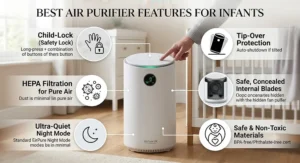
Choosing a safe air purifier for baby room use comes down to a handful of concrete checks rather than guesswork. Here’s the shortlist, in order of priority:
- Confirm there’s no ozone-generating technology. Rule out ionisers, UV-C lights, and electrostatic precipitators unless the model has independent certification confirming ozone output stays within recognised safety limits.
- Check the CADR against your actual room size. A purifier rated for a 40m² living room will underperform in a 12m² box nursery if the numbers don’t line up with your specific square footage.
- Prioritise a genuine HEPA or HEPA-grade filter. Look for filtration rated to capture particles down to 0.3 microns or smaller, ideally with third-party test verification rather than marketing claims alone.
- Test the sleep mode noise level, not just the maximum. A unit that’s whisper-quiet on high but roars on its lowest setting defeats the purpose of round-the-clock nursery use.
- Factor in ongoing filter costs, not just the purchase price. A cheaper purifier with expensive, frequently replaced filters can cost more over two years than a pricier model with a washable pre-filter.
- Check for independent certification. ECARF, Quietmark, AHAM VERIFIDE and CE/UKCA marking all indicate a manufacturer has submitted to external scrutiny rather than self-reported figures.
- Position it out of reach, with the cable secured. Even the safest purifier on paper becomes a hazard if a curious, mobile baby can reach the cord or tip the unit.
What Certifications Should a Baby Air Purifier Have?
This is one of the most practically useful questions a parent can ask, because certifications cut through marketing language in a way that spec sheets alone don’t. In the UK, any mains-powered air purifier legally sold must carry either UKCA or CE marking, confirming it meets baseline electrical safety, electromagnetic compatibility, and hazardous substance restriction standards — you can check exactly what these regulations cover through the UK government’s official UKCA marking guidance, which confirms CE marking remains accepted alongside UKCA for the Great Britain market. Beyond that legal baseline, look for ECARF certification (the European Centre for Allergy Research Foundation), which independently verifies a product’s suitability for allergy sufferers rather than relying on the manufacturer’s own claims — both the Philips Series 800 and Coway Airmega 150 carry this. Quietmark accreditation, held by the Coway Airmega 150, independently verifies noise output claims rather than trusting the marketing copy on the box. AHAM VERIFIDE, common on Levoit models, confirms CADR figures through third-party lab testing rather than in-house measurement. None of these certifications are legally mandatory, which is exactly why they’re worth actively seeking out — they represent a manufacturer opening its numbers up to outside scrutiny rather than asking you to take its word for it.
Ozone Air Purifier Dangers for Babies
It’s worth being direct here rather than vague: ozone is a genuinely harmful gas at ground level, and this isn’t a fringe concern invented by cautious parenting blogs. Ground-level ozone is officially classified by UK authorities as damaging to human health, capable of triggering inflammation of the respiratory tract and worsening asthma symptoms, as confirmed by the UK government’s own air quality statistics on ozone. What makes this particularly relevant to nursery shopping is that some air purifying devices themselves generate ozone as an unintended by-product of ionising or UV-based filtration — a point specifically flagged in a UK Parliamentary research briefing on indoor air quality, which notes that ozone is generated from some air purifying and photocopying devices. For a newborn whose lungs are still developing airway branches and alveoli, minimising avoidable exposure to a respiratory irritant is a sensible precaution rather than an overreaction. This doesn’t mean every ioniser-equipped purifier is dangerous — output levels on most modern units sit well below regulatory thresholds — but it does mean genuinely ozone-free models deserve priority when the room in question belongs to an infant rather than an adult.
Non-Ozone Air Purifier vs Ionising Air Purifier for Baby
The distinction between a non-ozone air purifier baby parents can run unattended overnight and an ionising model that needs active management is worth spelling out properly, because the marketing language on both types can look reassuringly similar from the outside.
| Feature | Non-Ozone (Mechanical HEPA) | Ionising / Electrostatic |
|---|---|---|
| Filtration method | Physical trapping in HEPA + carbon layers | Charged particles cling to surfaces or a collector plate |
| Ozone by-product risk | None, by design | Possible, though generally low on modern units |
| Maintenance | Filter replacement every 6-12 months | Filter replacement plus periodic collector-plate cleaning |
| Independent certification available | Yes — ECARF, Quietmark, AHAM VERIFIDE | Varies widely by manufacturer |
| Suitability for unattended overnight nursery use | Straightforward | Requires checking the off-switch and certification first |
Reading across this table, the practical takeaway is that mechanical HEPA filtration gives you a simpler safety picture with fewer variables to manage, which is precisely why it dominates the recommendations from paediatric and allergy-focused sources. Ionising purifiers aren’t inherently unsafe, but they shift more of the responsibility onto the parent to verify certification and, where possible, disable the ionising function for nursery use specifically.
Air Purifier for Infant Respiratory Health: What the Evidence Shows
The case for an air purifier for infant respiratory health rests on a fairly straightforward chain of logic: babies breathe faster, their airways are proportionally narrower, and indoor air in an average UK home routinely contains higher concentrations of certain pollutants than the air immediately outside, largely from cooking, cleaning products, and off-gassing furnishings. A UK Parliamentary research briefing on indoor air quality highlights that childhood exposure to indoor pollutants intersects with early-life immune and lung development, and specifically references coroners’ findings linking severe asthma outcomes to poor air quality exposure. This doesn’t mean every baby needs a purifier running continuously, but it does support prioritising one in households with smokers, pets, gas cooking appliances, or a family history of asthma and allergies. HEPA filtration in particular has consistently demonstrated the ability to reduce airborne concentrations of dust, pollen, and pet dander, the three most commonly cited triggers in paediatric respiratory literature — which is precisely why every purifier on this list built around genuine HEPA or HEPA-grade filtration earns its place, regardless of price point.
Common Mistakes When Buying an Air Purifier for a Baby Room
The single most common mistake is buying based on room-size marketing figures without checking the air-change rate behind them — a purifier claiming to “cover” a huge square footage once per hour will do far less for air quality than a smaller-rated unit achieving four or five changes per hour in a properly sized room. The second frequent error is assuming “HEPA” on the box always means the same thing; HEPA-type and HEPA-grade filters can differ meaningfully from true H13 HEPA in actual particle capture rates, so checking the exact wording matters more than it should. A third mistake is prioritising smart features — app control, voice assistant integration, colour-changing lights — over the fundamentals of filtration and ozone safety, when a nursery genuinely doesn’t need Alexa integration nearly as much as it needs quiet, ozone-free operation. Finally, many parents buy the purifier and then never actually replace the filter on schedule, which quietly degrades performance until the unit is doing barely more than moving stale air around the room.
Long-Term Cost & Maintenance
Purchase price is only part of the real cost of running a nursery purifier for two or three years, and filter replacement frequency swings that total considerably. The Coway Airmega 150‘s 8,500-hour filter life works out to roughly one replacement every eighteen months of typical overnight use, meaningfully undercutting rivals that need fresh filters every six to eight months. Washable pre-filters, found on the Levoit Vital 100S and Blueair Blue Pure 311i Max, extend the working life of the more expensive HEPA and carbon stages behind them, trimming annual costs even where genuine replacement filters carry a premium price tag.
| Purifier | Filter Life | Approx. Annual Filter Cost | Value Verdict |
|---|---|---|---|
| Levoit Core 300 | 6-8 months | Low-to-moderate | Best value for tight budgets |
| Coway Airmega 150 | ~8,500 hours (~18 months) | Moderate, but infrequent | Best long-term value |
| Blueair Blue Pure 311i Max | 6-9 months | Moderate-to-high | Fair, offset by fast performance |
| Philips Series 800 | 6-12 months | Moderate-to-high | Reasonable given certification |
The clear standout on pure running costs is the Coway Airmega 150, whose infrequent filter changes offset its higher upfront price within roughly two years of continuous use. Budget buyers shouldn’t discount the Levoit Core 300 either, since its widely available third-party filters keep ongoing costs genuinely low even if the official Levoit filters carry a modest premium.
Buyer’s Decision Framework
If you’re still weighing options, a simple priority checklist tends to resolve most of the indecision. If your absolute priority is eliminating any ozone risk whatsoever, choose the Coway Airmega 150 or Philips Series 800, because both carry independent certification confirming no ionising technology is present. If budget is the binding constraint and you’re comfortable managing an ioniser toggle, the Levoit Core 300 or Pro Breeze 4-in-1 get genuine HEPA filtration into the room for the least outlay. If you’re furnishing a larger, open-plan nursery and speed of air turnover matters more than avoiding all ionising tech, the Blueair Blue Pure 311i Max processes the most air per hour of anything reviewed here. And if you want a British-designed brand with strong odour control for the nappy years specifically, the MeacoClean CA-HEPA 47×5 delivers that, provided you switch its ioniser and UV-C function off.
Frequently Asked Questions
❓ Is it safe to run an air purifier all night in a newborn's room?
❓ Do air purifiers help with newborn congestion?
❓ How often should I replace the filter in a baby's room purifier?
❓ Can an ioniser air purifier make a baby's asthma worse?
❓ What's the difference between HEPA and HEPA-type filters?
Conclusion: Choosing With Confidence, Not Anxiety
There’s no single “correct” answer to which purifier belongs in your particular nursery, and that’s genuinely fine — a tight budget, a larger room, or a family history of allergies all point toward slightly different priorities among the seven models covered here. What matters more than any individual spec is understanding the ozone question clearly enough to make an informed choice rather than an anxious guess, and knowing which independent certifications actually back up a manufacturer’s claims. The Coway Airmega 150 and Philips Series 800 offer the cleanest safety picture for parents who want to stop thinking about ozone entirely, while the Levoit Core 300 proves that genuine ozone-free HEPA filtration doesn’t require a premium budget. Whichever you choose, the fundamentals stay the same: match the CADR to your actual room size, check the sleep mode noise level honestly, and keep on top of filter changes rather than letting them slide. For further reading on how the UK monitors outdoor air quality that inevitably drifts indoors through open windows, the Met Office’s air pollution guide offers a genuinely useful, plain-English overview worth bookmarking alongside your new purifier’s manual.
✨ Ready to Breathe Easier Tonight?
🔍 Compare your shortlist one more time against the full spec table above, click through to check current pricing, and give your nursery the cleanest possible start before your baby’s first night home.
Recommended for You
- Air Purifier for Kitchen Without Extraction: 7 Picks (2026)
- Cooker Hood Alternative: 7 Genuine Options for UK Kitchens 2026
- Air Purifier for Pet Odours: 7 Best Picks Tested for 2026
Disclaimer: This article contains affiliate links. As an Amazon Associate, I earn from qualifying purchases. If you purchase products through these links, we may earn a small commission at no additional cost to you.
✨ Found this helpful? Share it with your friends! 💬🤗
