
In This Article
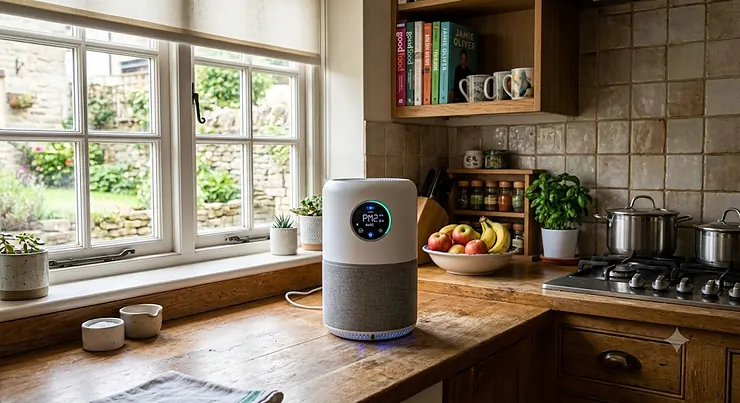
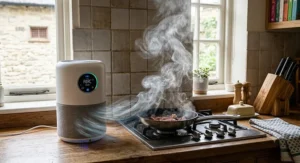
Onions hit the pan, and within about ninety seconds your whole flat knows about it. If your kitchen has no ducted hood — common in older conversions, studio flats, and plenty of rented properties across the UK — that smell isn’t going anywhere fast. An air purifier for kitchen without extraction is essentially a standalone recirculating unit: it pulls air in, strips out grease particles and odour-causing gases through HEPA and activated carbon filters, then pushes the cleaned air straight back into the room, with no ducting or wall vent required. It’s not a like-for-like swap for proper mechanical extraction, and building regulations agree, but it’s a genuinely useful middle ground when a wall-mounted extractor simply isn’t on the table.
We’ve spent time cross-referencing manufacturer specs, aggregated review sentiment from UK retailers, and independent testing data to bring you seven real, currently available machines that actually earn their keep in a kitchen setting — not a bedroom-first purifier awkwardly repurposed. Coverage spans strict budget picks under £100 through to serious open-plan performers north of £350, because a studio kitchenette and a knocked-through kitchen-diner have very different needs.
Before we get into the seven, it’s worth being upfront about the legal backdrop. Under Approved Document F of the Building Regulations, kitchens are classed as “wet rooms” requiring proper extract ventilation — a recirculating purifier does not count towards that requirement, because it can’t remove the moisture that causes condensation and mould. It’s a genuine odour and air-quality upgrade, not a substitute for a working extractor fan where one is legally due. We’ll unpack exactly what that means for tenants and landlords further down.
Quick Comparison Table
| Product | Best For | Filter Type | Price Range |
|---|---|---|---|
| Levoit Core Mini | Tiny kitchenettes & studio flats | HEPA + light carbon | £40-£60 |
| Bosch Air 500 | Compact budget alternative | HEPA + carbon | £70-£100 |
| Levoit Core 300S | Best all-rounder mid-size kitchen | 3-stage HEPA + carbon | £120-£150 |
| Philips Series 900 (AC0950/10) | Alternative-brand mid-range pick | NanoProtect HEPA + activated carbon | £200-£280 |
| Levoit Core 400S | Larger kitchen-diners | 3-stage HEPA + carbon, laser sensor | mid-£200s |
| Levoit Vital 200S-P | Premium, AHAM-verified performance | HEPA + activated carbon | £220-£280 |
| Blueair Blue Pure 211i Max | Open-plan kitchen-living spaces | HEPASilent dual filtration + carbon | £380-£450 range |
Looking at the spread above, the sensible pattern is size-matching rather than chasing the biggest number on the box: the Levoit Core Mini and Bosch Air 500 suit single-person kitchenettes, the Levoit Core 300S and Philips Series 900 cover the average UK galley or L-shaped kitchen, and the Blueair Blue Pure 211i Max earns its premium price only if your kitchen bleeds into a living or dining space with no dividing door. Buying too small for an open-plan layout is the single most common mistake in this category, and it’s one every “Best For” column here is designed to head off.
💬 Found a pick that suits your kitchen? Tap through to check today’s price and current stock levels before they shift.
Top 7 Air Purifiers for Kitchens Without Extraction: Expert Analysis
1. Levoit Core Mini — best ultra-budget pick for tiny kitchenettes
The standout here is size: this is a genuinely pocket-sized unit that still runs a proper three-layer HEPA filter, not a token gesture. Levoit rates it to refresh roughly 34m² once an hour, and at a 7W draw it’s cheap enough to leave running continuously without noticing it on your electricity bill. The three-stage filtration handles fine dust and smoke particles well, though the carbon layer is thin compared with dedicated odour-control units, so it’s better suited to light cooking (toast, reheating, the odd stir-fry) than daily curry-house-strength frying.
Based on the spec comparison, this is the right call for renters in studio flats, HMO kitchenettes, or anyone who just needs to take the edge off everyday smells rather than fully neutralise heavy cooking odour. Reviewers consistently note it’s quiet, unobtrusive on a worktop, and backed by responsive customer service when parts go missing or a cable gets chewed by a pet.
Pros:
- ✅ Small enough for cramped kitchen worktops
- ✅ Very low running cost at just 7W
- ✅ Genuinely quiet even on higher settings
Cons:
- ❌ Thin carbon layer struggles with strong frying odours
- ❌ No auto mode or air quality sensor
Prices sit around £40-£60 depending on colour and bundle, making it one of the cheapest genuine entry points into this category — solid value if your cooking is light and your kitchen is small.
2. Bosch Air 500 — best compact budget alternative
What most buyers overlook about this model is the USB-C charging port, which is a small but practical touch — no bulky adapter brick hogging a socket on a cramped kitchen counter. Rated for rooms up to 23m², with a sub-25dB(A) sleep mode and a CADR of 100 m³/h, it’s aimed squarely at smaller spaces rather than open-plan kitchen-diners.
Here’s what to weigh: the Bosch name carries genuine reliability expectations from its wider appliance range, and the compact footprint means it slots onto a narrow worktop where boxier units won’t fit. It won’t out-muscle a dedicated large-capacity carbon filter on stubborn fish or garlic smells, but for everyday cooking in a small flat it’s a sensible, low-fuss choice from a brand people already trust with their ovens and hobs.
Pros:
- ✅ USB-C powered — no bulky mains adapter
- ✅ Trusted mainstream appliance brand
- ✅ Genuinely quiet sleep mode under 25dB
Cons:
- ❌ Limited to smaller rooms (23m² rated)
- ❌ Carbon capacity modest for heavy frying
Expect a price in the £70-£100 range, positioning it just above the ultra-budget tier as a step up in build quality and brand trust rather than raw filtration power.
3. Levoit Core 300S — best all-round mid-range pick for everyday kitchens
The 300S earns its “best all-rounder” tag through the combination of a laser air quality sensor and genuine auto mode — the unit reacts to a spike in particles the moment you start frying, rather than you needing to remember to switch it on. Levoit lists CADR at 258 m³/h with coverage suited to a mid-size kitchen, and the 3-stage HEPA plus activated carbon filter handles day-to-day cooking smells competently.
On paper this means the 300S sits in the sweet spot most UK kitchens actually need: powerful enough for regular cooking, but not so large or expensive that it’s overkill for a single galley kitchen. Reviewers consistently mention the VeSync app integration as a genuine convenience rather than a gimmick, letting you check filter life and switch modes remotely, and Levoit’s customer service is repeatedly praised for replacing parts without a fuss.
Pros:
- ✅ Auto mode reacts to cooking in real time
- ✅ App control via VeSync for filter tracking
- ✅ Strong reputation for responsive customer support
Cons:
- ❌ No air quality number display, only colour indicator
- ❌ Filter replacement cost adds up if run constantly
Typical pricing sits around £120-£150, and value here comes from not needing to upgrade again — most single-kitchen households won’t outgrow it.
4. Philips Series 900 (AC0950/10) — best alternative-brand mid-range pick
The standout feature is Philips’ NanoProtect HEPA technology paired with a genuine activated carbon layer — unlike the entry-level Philips 600 Series, which skips carbon filtration entirely and is therefore a poor match for cooking odours specifically. With a CADR of 250 m³/h across roughly 65m², this model is built with gas and chemical odour removal in mind, not just particulate matter.
What most buyers overlook about this model is that Philips’ AeraSense sensor technology scans air quality up to 1,000 times a second, giving genuinely responsive auto-adjustment rather than the sluggish lag some rivals show. Reviewers who’ve run Philips units specifically in kitchens report the machine noticeably reduces lingering cooking smell within the room, though a small number flag that the plug supplied can arrive as a Euro adapter rather than UK three-pin, so it’s worth checking the listing before you buy.
Pros:
- ✅ Genuine activated carbon layer for odours
- ✅ Fast-reacting AeraSense air quality sensor
- ✅ Established 80-plus-year appliance brand
Cons:
- ❌ Some units ship with a non-UK plug adapter
- ❌ Pricier than comparable Levoit alternatives
Expect a price in the £200-£280 range — a fair premium if you specifically want a non-Levoit brand with equivalent carbon filtration.
5. Levoit Core 400S — best for larger kitchen-diners
The 400S is essentially the 300S’s bigger sibling, built for kitchens that open into a dining area rather than a sealed-off galley. It carries a noticeably higher CADR and a laser particle sensor, meaning it can keep pace with a bigger air volume without constantly running flat-out on its loudest setting.
Based on the spec comparison, this is the model to reach for if your “kitchen” is really a kitchen-diner knocked through into one room — the extra fan capacity means it clears smoke and odour across a wider space in a comparable time to the 300S working in a smaller one. Aggregated review sentiment consistently flags the quieter running noise at mid-speed as a genuine advantage over rival units of similar coverage, letting you leave it on auto during meal prep without it dominating conversation.
Pros:
- ✅ Higher CADR suits open-plan kitchen-diners
- ✅ Laser sensor gives responsive auto mode
- ✅ Quieter at mid-speed than similarly rated rivals
Cons:
- ❌ Larger footprint needs dedicated floor or counter space
- ❌ Step up in price over the 300S for the extra capacity
Pricing typically lands in the mid-£200s, positioning it as the natural upgrade path for anyone who finds the 300S undersized for their layout.

6. Levoit Vital 200S-P — premium AHAM-verified pick
What sets the Vital 200S-P apart is independent AHAM Verifide certification — third-party testing of air-cleaning performance rather than Levoit’s own marketing figures. CADR figures of 250 CFM for smoke, 254 CFM for dust, and 289 CFM for pollen are all independently confirmed, which matters if you want more than a brand’s word for it.
The spec sheet won’t tell you this, but user reports suggest the washable pre-filter meaningfully extends the life of the main HEPA element, cutting long-term filter spend compared with units that only offer a single combined cartridge. It’s built and marketed around allergy control first, so treat the kitchen-odour performance as a strong secondary benefit rather than the headline feature — pair it with the carbon-forward models above if cooking smell, not allergens, is your primary concern.
Pros:
- ✅ Independently AHAM-verified CADR figures
- ✅ Washable pre-filter extends HEPA filter life
- ✅ Smart scheduling and pet mode via VeSync app
Cons:
- ❌ Designed primarily for allergens, not heavy cooking odour
- ❌ Premium price for a kitchen-specific buyer
Typical UK pricing runs £220-£280, justified for households that also want strong allergen control alongside general kitchen air quality.
7. Blueair Blue Pure 211i Max — best for open-plan kitchen-living spaces
The clear standout is raw scale: Blueair rates the 211i Max to refresh air across a genuinely large footprint in under an hour, and independent testing has repeatedly rated it among the fastest units for clearing frying odours from a test kitchen. HEPASilent dual filtration — combining mechanical and electrostatic capture — lets it run quieter at a given CADR than a comparable pure-HEPA unit, which matters a great deal if it’s sharing a room with a sofa and a television.
Reviewers consistently note the Scandinavian design and washable fabric pre-filter as genuine differentiators from the plastic-box aesthetic of most rivals, and the RealTrack filter algorithm gives a more accurate replacement countdown than a simple fixed-months timer. What most buyers overlook, however, is that Blueair’s own recommended “optimal” room size is considerably smaller than the headline coverage figure on the box — treat the eye-catching square-footage number as a one-air-change-per-hour ceiling, not the size at which it performs best.
Pros:
- ✅ Fastest tested odour clearance in open-plan tests
- ✅ Genuinely quiet for its air-cleaning capacity
- ✅ App-based air quality monitoring and scheduling
Cons:
- ❌ Premium price bracket, well above single-kitchen units
- ❌ Optimal room size smaller than headline coverage figure
Expect a £380-£450 range for this model — a real investment, but the only unit on this list genuinely built for a kitchen that flows into a living or dining area.
What to Expect: Real-World Performance in a Kitchen Without an Extractor
Here’s the honest expectation-setting most product pages skip: a recirculating air purifier reduces lingering smell and airborne particulate, but it works on a delay, not instantly, and it does nothing for the steam and moisture that a proper extractor removes at source. Independent kitchen-specific testing has found that units with a substantial activated carbon layer typically return a mid-sized kitchen to a near-baseline smell within roughly 45-60 minutes on high speed, while thinner carbon filters can take considerably longer for the same job. Running the purifier before you start cooking, not just afterwards, consistently shortens that clearance time.
The chemistry matters here too: cooking releases a mix of volatile organic compounds (VOCs), and HEPA filtration alone does nothing to capture these gaseous molecules — only activated carbon adsorbs them. That’s precisely why every model recommended above pairs HEPA with a genuine carbon layer, rather than relying on particle filtration alone, which would leave the smoke haze gone but the smell of last night’s dinner very much intact.
Practical Usage Guide: Setting Up Your Portable Recirculating Kitchen Solution
Getting the most from a portable recirculating kitchen solution comes down to placement, timing, and maintenance discipline rather than simply plugging it in and forgetting about it. Position the unit close to the cooking zone but not directly in a splash path — a nearby worktop end or a stable spot on the floor a metre or so from the hob both work well, since air purifiers pull from all sides rather than needing a direct line to the pan.
Switch it on a few minutes before you start cooking rather than waiting until the smell has already spread; this gives the fan time to establish airflow before pollutant levels spike. Run it on its highest setting during active cooking, then drop to auto or a lower speed for 20-30 minutes afterwards to mop up the remaining odour. In the first 30 days, the most common mistake is neglecting the pre-filter — a light vacuum every one to two weeks stops grease and dust clogging the mesh and dragging down airflow long before the main HEPA/carbon cartridge is due for replacement. Most manufacturers recommend swapping the main filter every 6-8 months in a kitchen setting specifically, noticeably sooner than the 12-month figure quoted for bedroom use, simply because kitchen air carries a heavier particulate and grease load.
Real-World Scenarios: Air Purifiers for Rented Flat Kitchens
Picture a first-year professional in a converted Victorian terrace, kitchen tucked into what used to be a hallway cupboard, single small window, and a landlord who’s politely but firmly declined to fit a new extractor mid-tenancy. Here the compact Levoit Core Mini or Bosch Air 500 genuinely earns its keep — low running cost, small enough not to eat into already-tight worktop space, and sufficient for the lighter, less frequent cooking typical of a single-occupancy flat.
Now consider a small family sharing a kitchen-diner in a converted flat where the original wall between kitchen and lounge has been knocked through — a common feature in period conversions across UK cities. This is squarely Blueair Blue Pure 211i Max or Levoit Core 400S territory: enough CADR to keep pace with the larger shared air volume, ideally left running on auto mode throughout the evening rather than switched off the moment cooking finishes. Finally, picture a couple in a mid-size two-bed flat who cook daily, fairly intensively, but don’t want a five-figure premium price tag — the Levoit Core 300S or Philips Series 900 hit that mid-range balance of genuine carbon-filter odour control without stretching to Blueair money.
As a portable kitchen extractor alternative, none of these units are a legal substitute for mechanical ventilation where one is required — but for day-to-day comfort in a rented flat where you have no control over fitting a new extractor, they’re a meaningfully better solution than doing nothing.
Problem → Solution: Common Kitchen Air Quality Complaints Solved
Problem: Smell lingers for hours after cooking. Run the purifier before and during cooking rather than only afterwards, and check the carbon filter weight isn’t undersized for how often you cook — thin carbon layers saturate within weeks under daily use.
Problem: The unit seems louder than expected. Placement matters more than people assume; keeping the purifier away from hard, reflective surfaces like tiled splashbacks reduces perceived noise, and running on auto rather than a fixed high speed avoids unnecessary full-power operation.
Problem: Filters need replacing faster than the “recommended months” suggest. This is normal in a kitchen specifically — grease and cooking particulate load a filter faster than bedroom or living-room use, so budget for filter changes roughly every 6-8 months rather than the 12-month figure often quoted on the box.
Problem: Condensation and window fogging persist despite the purifier running. This is the clearest sign a recirculating purifier alone isn’t enough — it cannot remove moisture, only a proper extractor venting outside, or consistent window opening, will resolve genuine condensation and damp issues.
Problem: Renting means no permission to alter ventilation. A portable recirculating kitchen solution needs no wiring, drilling, or landlord sign-off, making it the practical stopgap for cooking odour specifically, while any damp or condensation issue should still be raised with the landlord directly as a repairs matter.
How to Choose an Air Purifier for a Kitchen Without Extraction
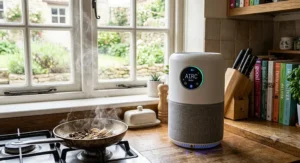
Choosing the right unit comes down to matching a handful of criteria to your specific kitchen, rather than simply picking the highest-rated model overall.
- Measure your kitchen’s floor area first. Match this against the manufacturer’s rated coverage, and if your kitchen opens into a dining or living space, add that square footage too — undersizing is the most common buying mistake in this category.
- Check for a genuine activated carbon layer, not just HEPA. HEPA alone captures smoke particles but does nothing for the gaseous compounds that actually cause lingering smell.
- Look at carbon filter weight, not just the word “carbon” on the box. A thicker carbon layer saturates more slowly under daily cooking use than a thin wrap-style filter.
- Prioritise auto mode with a real sensor over a purely manual unit. A sensor-driven auto mode reacts to cooking spikes without you needing to remember to switch speeds.
- Factor in noise at the speed you’ll actually use daily. A quoted “whisper-quiet” low speed is irrelevant if you’ll be running it on high through most of dinner prep.
- Budget for filter replacement cost, not just the purchase price. Total cost of ownership over two to three years can meaningfully change which model represents the better value.
- Confirm it fits your available worktop or floor space realistically. A powerful unit is no use if it physically won’t fit anywhere sensible in a small kitchen.
Air Purifier vs Filterless Cooker Hood: Which Actually Clears Cooking Odours?
A filterless cooker hood alternative usually means one of two things in practice: a recirculating hood fitted above the hob that passes air through grease and carbon filters before releasing it back into the room, or a standalone air purifier placed elsewhere in the kitchen. Both share a fundamental limitation — neither vents anything outside, so neither removes moisture, and neither counts as compliant extract ventilation under building regulations.
Where they differ is capture efficiency and flexibility. A recirculating cooker hood captures grease and steam at the exact point it’s generated, directly above the hob, which gives it an edge on grease particle removal specifically. A portable air purifier, by contrast, can’t intercept pollutants quite as efficiently at source, but it’s far more flexible — no installation, no permission needed from a landlord, and it can be moved between rooms or taken with you at the end of a tenancy. For odour specifically, a purifier with a substantial carbon filter often outperforms a thin-carbon recirculating hood, since hood carbon cartridges are frequently smaller and replaced less often than they should be. If you’re renting and can’t alter the kitchen at all, the standalone purifier is generally the more practical no-extractor-fan kitchen air purifier route; if you’re renovating and have the choice, a genuinely ducted hood beats both options for moisture control.
Common Mistakes When Buying a Kitchen Air Purifier
The single biggest mistake is buying based on the headline square-footage figure on the box rather than the manufacturer’s own “optimal performance” figure, which is often considerably smaller — as we saw with the Blueair 211i Max above. A close second is ignoring carbon filter capacity entirely and choosing on HEPA percentage alone; a 99.97% particle-removal claim says nothing about odour performance if the carbon layer is an afterthought. Buyers also frequently underestimate ongoing filter costs, comparing only the upfront price and later discovering that a cheaper unit’s filters cost more per year than a pricier rival’s. Finally, plenty of people buy a bedroom-marketed purifier and expect kitchen-grade odour performance — bedroom units are typically optimised for quiet operation and allergen control rather than the heavier grease-and-VOC load of daily cooking.
Kitchen Air Quality in Rented Property: Landlord Ventilation Rules Explained
Landlord ventilation rules in England sit across a few overlapping pieces of regulation, and it’s genuinely worth understanding them if you’re dealing with a kitchen that has no working extractor. There is no blanket legal requirement for every kitchen to have an extractor fan — what the law actually demands, under the Homes (Fitness for Human Habitation) Act 2018, is that a rented property remains free from serious damp and mould throughout the tenancy. According to guidance from the National Residential Landlords Association, whether a specific extractor is required in practice depends heavily on the age of the property and whether the kitchen has been renovated since 2006 — newer or refurbished kitchens require mechanical extraction under Building Regulations, while older, unaltered kitchens may rely on window ventilation if that genuinely keeps the space free from condensation.
For kitchen air quality in a rented property more broadly, the practical split is this: cooking odour and general air freshness are entirely reasonable to manage yourself with a portable purifier, since no landlord obligation covers “the flat smells of last night’s cooking.” Persistent condensation, black mould, or a broken extractor that was previously working, however, sit squarely with the landlord’s repairing obligations and should be reported in writing rather than worked around indefinitely with an air purifier. If cooking fumes are triggering respiratory symptoms, it’s also worth being aware that poor indoor air quality is a recognised aggravating factor for conditions like asthma, and the NHS lists strong smells and fumes among common asthma triggers worth minimising at home.
Long-Term Cost & Maintenance
Total cost of ownership over roughly three years tells a more useful story than the sticker price alone. A budget unit like the Levoit Core Mini, priced around £40-£60, typically needs a filter change every 6-8 months at a modest cost each time, keeping annual running costs genuinely low thanks to its light power draw. A mid-range pick like the Levoit Core 300S or Philips Series 900 carries a higher upfront cost but a broadly comparable filter-replacement rhythm, so the gap in total ownership cost between budget and mid-range narrows over a few years even though the purchase price gap looks large on day one.
Premium units like the Blueair Blue Pure 211i Max shift the equation slightly: replacement filters cost more individually, but Blueair’s RealTrack algorithm and the washable fabric pre-filter mean the main cartridge often lasts close to its full nine-month rating rather than needing early replacement from grease saturation, which the pre-filter intercepts first. Electricity cost across all seven units here is modest — even run continuously on a low-to-auto setting, none of these draw enough power to meaningfully move a typical UK household energy bill, so filter replacement, not electricity, is the dominant long-term cost to plan around.
Features That Actually Matter (And Those That Don’t)
A genuine activated carbon filter and a working auto-mode sensor matter enormously for kitchen use — these two features are what separate a purifier that actually tackles cooking odour from one that just moves clean-smelling air around. App connectivity is a genuine convenience for filter-life tracking and remote scheduling, but it’s not essential; plenty of buyers happily run these units on manual settings without ever opening the companion app.
Ionisers, by contrast, tend to generate more marketing noise than practical benefit for kitchen odour specifically, and some buyers actively prefer models where the ioniser can be switched off. Similarly, headline square-footage coverage figures are frequently inflated relative to a manufacturer’s own “optimal performance” recommendation, so treat the big number on the box with healthy scepticism and look for the smaller, more honest figure buried in the small print or spec sheet instead.
Air Purifiers for Renters, Students and Small-Kitchen Living
For students and renters specifically, portability and zero-installation are the priorities that should outweigh raw filtration power in most cases. A compact, budget-friendly unit like the Levoit Core Mini or Bosch Air 500 ticks every box that matters here: no drilling, no landlord permission required, easy to pack into a house move at the end of a tenancy, and cheap enough that losing it to a flatmate dispute over ownership isn’t a financial disaster. Shared-house kitchens, where cooking habits vary wildly between housemates, also benefit from a unit with genuine auto mode — the Levoit Core 300S reacts to whoever’s cooking without anyone needing to remember to switch it on manually.
For small-kitchen living more broadly, whether that’s a studio flat or a one-bed conversion, the key lesson from the models above is to resist over-buying. A premium open-plan unit like the Blue Pure 211i Max is genuinely wasted capacity in a small, enclosed kitchen — you’ll pay a real premium for coverage you’ll never use, when a mid-range pick with strong carbon filtration will do the actual job just as well for considerably less outlay.
✨ Ready to shortlist your kitchen’s perfect match? Check current prices on the models above before availability shifts.
FAQ
❓ Does an air purifier really remove cooking smells, or just circulate them?
❓ Can I use a portable air purifier instead of an extractor fan in a rented kitchen?
❓ How often should I replace the filter in a kitchen air purifier?
❓ What size air purifier do I need for an open-plan kitchen-diner?
❓ Is a recirculating cooker hood better than a standalone air purifier?
Conclusion
If your kitchen has no ducted extractor and moving isn’t an option, a genuinely carbon-filtered air purifier is one of the most practical upgrades you can make — provided you’re realistic about what it can and can’t do. It will meaningfully cut lingering cooking smell and airborne particulate; it will not remove moisture or replace mechanical ventilation where that’s genuinely required by law. Match the unit’s coverage to your actual kitchen size (and any adjoining open-plan space), prioritise a real activated carbon layer over headline HEPA percentages, and budget realistically for filter replacement every 6-8 months rather than the longer intervals quoted for bedroom use.
Across the seven models here, there’s a sensible pick for nearly every kitchen and budget: the Levoit Core Mini or Bosch Air 500 for tight studio kitchenettes, the Levoit Core 300S or Philips Series 900 for the average UK galley kitchen, and the Blueair Blue Pure 211i Max or Levoit Vital 200S-P where a larger open-plan space or allergen control is the priority. Whichever you choose, remember it’s solving the smell-and-air-quality problem, not the ventilation-and-damp problem — and knowing that distinction is what actually gets you the right appliance the first time.
✨ Ready to stop your flat smelling like last night’s dinner? Check today’s price on your best-matched pick above and get it ordered before stock shifts. 🍳💨
Recommended for You
- Cooker Hood Alternative: 7 Genuine Options for UK Kitchens 2026
- Air Purifier for Pet Odours: 7 Best Picks Tested for 2026
- Air Purifier For Smoke Odour: 7 Real UK Picks Tested (2026)
Disclaimer: This article contains affiliate links. As an Amazon Associate, I earn from qualifying purchases. If you purchase products through these links, we may earn a small commission at no additional cost to you.
✨ Found this helpful? Share it with your friends! 💬🤗
