In This Article
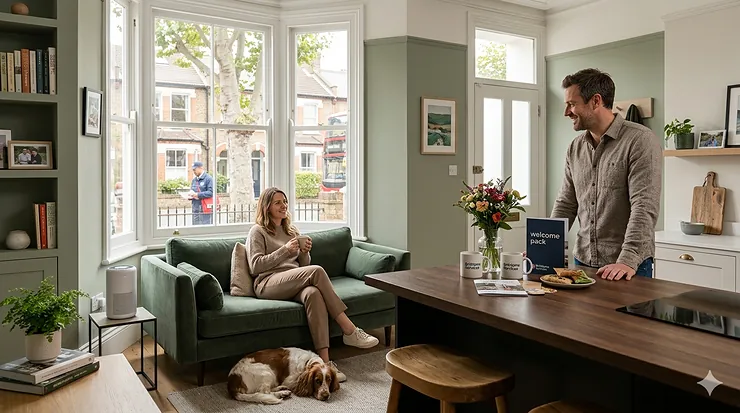
Here’s something most people find deeply unfair: the air inside your home is typically two to five times more polluted than the air outside. While you’re busy blaming the trees for your itchy eyes and congested mornings, the real culprits — dust mites, pet dander, mould spores, and microscopic pollen particles that hitched a ride on your jacket — are quietly staging a siege in your bedroom, your home office, and that cosy corner of the sofa you call yours.
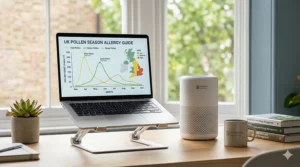
A small air purifier for allergies won’t solve everything, and it certainly isn’t magic. But pair a decent HEPA-filtration unit with sensible placement and regular maintenance, and the difference in day-to-day breathing quality can be genuinely remarkable. We’re talking fewer bleary-eyed mornings, less reaching for the antihistamines at 7am, and the quiet satisfaction of knowing the air you’re breathing at night is actually doing you some good.
The UK context matters here, too. According to Allergy UK, nearly half the British population suffers from at least one allergic condition — and our damp, mild climate creates near-perfect conditions for mould spores and dust mite proliferation. Unlike a dry continental climate where you might catch a break in winter, the British weather offers allergens a remarkably cosy, year-round habitat. Compact terraced houses, carpeted bedrooms, and the kind of draughty older builds that characterise much of UK housing stock don’t help matters either.
The good news: you don’t need a large, expensive unit to make a meaningful difference in a bedroom or home office. A well-chosen small air purifier for allergies — something that sits neatly on a bedside table, doesn’t sound like a tumble dryer, and doesn’t cost a fortune to run — can filter a 15–20m² room several times an hour. That’s the sweet spot for most UK buyers.
This guide covers seven units currently available on Amazon.co.uk, ranging from budget desktop options to smart, app-connected models. All prices are in GBP, all units operate on 230V with UK-compatible plugs, and all have been selected with British living conditions firmly in mind.
Quick Comparison: Best Small Air Purifiers for Allergies UK 2026
| Product | Room Size | CADR | Filter Type | Noise (Low) | Price Range | Best For |
|---|---|---|---|---|---|---|
| LEVOIT Core Mini | Up to ~7m² | 78 m³/h | H13 HEPA + Carbon | ~41 dB | Under £35 | Desk/bedside budget buy |
| Blueair Blue Pure 511 | Up to 38m² | ~190 m³/h | HEPASilent + Carbon | ~17 dB | £80–£100 | Small living room, bedroom |
| Philips AC0650/20 | Up to 44m² | ~190 m³/h | NanoProtect HEPA | ~33 dB | £130–£160 | Smart home, hay fever |
| Coway Airmega 50 | Up to ~10m² | 113 m³/h | H13 HEPA + Carbon | ~18 dB | £80–£110 | Quiet bedroom use |
| AROEVE MK04 (H13) | Up to ~15m² | Est. 80–100 m³/h | H13 HEPA + Carbon | ~22 dB | Under £45 | Budget-conscious buyers |
| Russell Hobbs RHAP1032WDB | Up to ~20m² | 100 m³/h | Carbon + HEPA | ~25 dB | £40–£60 | UK brand, aroma function |
| Bosch Air 500 | Up to 23m² | 100 m³/h | Multi-stage HEPA | < 25 dB | £70–£90 | Engineering reliability |
The table above reveals something worth noting straight away: there’s a meaningful jump in room coverage between the truly desktop-sized units (LEVOIT Core Mini, Coway Airmega 50) and the mid-range compact options. If your bedroom is a typical UK single or double (10–15m²), almost any unit here will serve you adequately. If you’re trying to cover a larger open-plan studio flat, you’ll want the Philips or Blueair. Budget buyers who resist the LEVOIT Core Mini’s limited coverage will find the Russell Hobbs and Bosch Air 500 offer better value per square metre at very reasonable prices.
💬 Just one click — help others make better buying decisions too! 😊
✨ Don’t Miss These Exclusive Deals!
🔍 Take your allergy relief to the next level with these carefully selected products. Click on any highlighted item to check current pricing and availability on Amazon.co.uk. These picks will help you breathe easier from day one!
Top 7 Small Air Purifiers for Allergies: Expert Analysis
1. LEVOIT Core Mini — The Bedside Table Essential
The LEVOIT Core Mini is about the size of a large mug and weighs roughly 1.3 kg. That sounds like faint praise until you realise it means you can genuinely move it from bedroom to home office and back again without a second thought — which, in a compact UK flat, matters enormously.
Its three-stage filtration (pre-filter, H13 HEPA, activated carbon) captures up to 99.97% of particles as small as 0.3 microns — that includes the pollen, dust mite droppings, and pet dander that trigger most common allergy symptoms. The CADR of 78 m³/h is modest, but in a small bedroom or study under 8m², it turns the air over comfortably. The fragrance sponge feature is a genuinely nice touch: add a couple of drops of essential oil and it doubles as a subtle diffuser — a small luxury that feels rather civilised at the end of a long day.
What most UK buyers overlook: this unit is nearly silent on its lowest setting, registering around 24–26 dB. That’s quieter than a library. However, at maximum speed, it does climb to around 45 dB, so if you’re a light sleeper and running it on high, you may notice it. The fix is simple — run it on high for an hour before bed, then drop to the lowest setting when you turn in.
Replacement filters cost around £10–£15 for a two-pack, which represents fair ongoing running costs. Prime-eligible, typically next-day delivery.
✅ Ultra-compact, easy to move around the flat
✅ Very quiet on low settings — ideal for bedside use
✅ Affordable replacement filters available on Amazon.co.uk
❌ Very limited room coverage — unsuitable for rooms above 8m²
❌ No smart features, air quality sensor, or app
Price range: under £35. Exceptional value for a desktop allergy solution.
2. Blueair Blue Pure 511 — The Cult Favourite That Earns Its Reputation
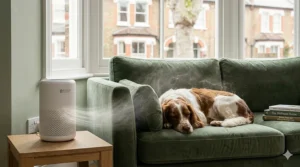
If you’ve spent more than ten minutes researching air purifiers for allergies, you’ve almost certainly come across the Blueair Blue Pure 511. The Swedish brand has become something of a byword for quiet, effective filtration, and the 511 is the smaller sibling of the award-winning Blue Max 3250i — delivering a lot of the same engineering in a footprint that fits comfortably on a bedside table or chest of drawers.
What sets it apart is Blueair’s HEPASilent dual-filtration technology, which combines mechanical and electrostatic filtration to capture 99.97% of particles down to 0.1 microns. Note that last figure: most HEPA filters capture particles down to 0.3 microns, which is already excellent, but 0.1 microns means the 511 is catching even the finest airborne particles that other budget units let slip through. In practical terms for UK allergy sufferers, this means more effective capture of the smallest pollen fragments and mould spores that are notoriously difficult to trap.
With a CADR of around 190 m³/h and coverage up to 38m², this is no toy. It handles a proper bedroom, a generously-sized home office, or a modest living room without breaking a sweat. Whisper-quiet at around 17 dB on its lowest setting — you’d honestly struggle to tell it was on. The colourful fabric pre-filters are washable and machine-safe, which keeps replacement costs down considerably.
UK customers on Amazon.co.uk consistently praise the noticeable reduction in morning congestion within the first few days of use. The spec sheet won’t tell you this, but the 511’s real advantage is that it works well even when you forget about it — set it on auto, walk away, and just breathe.
✅ HEPASilent captures particles to 0.1 microns — exceptional for pollen and mould
✅ Whisper-quiet — one of the quietest units in this guide
✅ Washable fabric pre-filter reduces long-term running costs
❌ No app control or air quality sensor at this price point
❌ Replacement combined filters are pricier than some rivals
Price range: £80–£100. The best all-round small air purifier for allergies in the UK under £100.
3. Philips Air Purifier 600 Series (AC0650/20) — The Smart Choice for Hay Fever Sufferers
Philips has been quietly producing some of the more sophisticated consumer air purifiers on the market, and the AC0650/20 represents the brand’s sweet spot: serious filtration capability, a genuinely useful app, and a design that doesn’t look like it belongs in a hospital waiting room.
The NanoProtect HEPA filter removes 99.97% of airborne pollutants and the unit covers rooms up to 44m² — which makes it a legitimate option for a larger bedroom or a modest open-plan living space. The VitaShield IPS technology is particularly interesting: it reduces the size of particles as they pass through, making subsequent filtration more effective. The real-world implication for hay fever sufferers is a noticeably faster improvement in air quality during peak pollen season (typically May to July in the UK).
What elevates this unit over the competition is the Philips Clean Home+ app, which lets you monitor real-time air quality, schedule cleaning cycles, and receive filter replacement alerts — useful when you’re the sort of person who simply forgets until their nose reminds them. The built-in PM2.5 sensor responds to changes in air quality automatically, increasing fan speed when particulate levels rise. In practice, this means it ramps up quietly during breakfast (when opening windows lets in morning pollen) and settles back down once conditions improve.
UK reviewers frequently comment on its reliable sensor accuracy compared to cheaper rivals that often over- or underreact to airborne particles. It’s a particularly strong choice if you suffer from both hay fever and indoor allergies, as the combination of smart sensing and strong HEPA filtration addresses both simultaneously.
✅ App control with real-time PM2.5 monitoring
✅ VitaShield IPS technology for enhanced filtration
✅ Covers up to 44m² — strong performance for its size
❌ One of the pricier units in the compact category
❌ App can feel unnecessarily complex for simple bedroom use
Price range: £130–£160. Worth every penny if smart sensing and app control matter to you.
4. Coway Airmega 50 — The Quietly Brilliant Bedroom Specialist
The Korean brand Coway has built a formidable reputation in the air purification world, and the Airmega 50 is their most compact offering — small enough to sit on a bedside table without dominating it, yet genuinely capable enough to warrant serious consideration.
Its CADR of 113 m³/h is meaningfully higher than the LEVOIT Core Mini despite a similarly compact footprint, covering rooms up to around 10m² efficiently. The three-stage filtration combines a washable pre-filter with an H13 True HEPA layer and activated carbon, capturing allergens, fine particles, and odours. The built-in air quality indicator uses colour-coded LED lighting — blue for clean, purple for moderate, red for poor — which sounds gimmicky until you realise it’s actually quite useful for understanding how quickly the unit is improving your room’s air quality in real time.
At its lowest setting, the Airmega 50 operates at around 18 dB — that’s genuinely close to silence. The auto mode is also unusually smart: rather than the crude on/off behaviour of cheaper alternatives, it adjusts fan speed in small increments, which means it rarely startles you awake. For light sleepers who are also allergy sufferers, this combination of quiet operation and effective H13 filtration makes it one of the most compelling bedroom-specific choices on Amazon.co.uk.
UK buyers should note that Coway’s replacement filters are readily available on Amazon.co.uk, which matters more than it might seem — some rival brands have notoriously patchy UK filter availability that turns a £70 purchase into a frustrating subscription lottery.
✅ Extremely quiet — one of the lowest noise floors in this test
✅ Air quality indicator helps you understand room conditions at a glance
✅ Replacement filters readily available on Amazon.co.uk
❌ Limited room coverage — best suited to rooms under 10m²
❌ No app or smart home connectivity
Price range: £80–£110. Arguably the best compact air purifier for allergy-driven insomnia.
5. AROEVE Air Purifier (H13 HEPA, MK04) — The Budget Overperformer
The AROEVE MK04 is one of those units that makes you do a double-take at the price tag. At under £45 on Amazon.co.uk, it offers H13 True HEPA filtration, a 22 dB sleep mode, an aroma pad, and energy consumption of just 5W — less than an LED bulb.
For context, 5W running costs matter in Britain’s current energy landscape. Running an air purifier continuously overnight at this wattage costs less than 1p per hour at average UK electricity rates. That’s genuinely negligible, and it means you can run the AROEVE continuously without it registering on your electricity bill.
The H13 HEPA specification is worth highlighting at this price point. H13 is the same filtration grade used in hospital-grade environments, capturing 99.97% of particles down to 0.3 microns. At this price, most competitors offer HEPA-style filters that don’t meet H13 standards — the AROEVE’s genuine H13 certification gives it a meaningful edge for allergy sufferers who need reliable particle capture.
Coverage is estimated at 10–15m², making it an honest match for a standard UK double bedroom. The three-stage filter (nylon pre-filter, H13 HEPA, activated carbon) addresses pollen, dust mites, pet dander, and VOCs adequately. UK reviewers with hay fever report tangible morning improvements within the first week of continuous use.
The trade-offs are real: no smart features, no air quality sensor, basic controls. But if your priority is clean air in a bedroom rather than an app experience, the AROEVE makes a compelling, no-nonsense case.
✅ H13 True HEPA at a genuinely budget price
✅ Ultra-low 5W energy consumption — negligible running costs
✅ 22 dB sleep mode — whisper quiet
❌ No smart features, auto mode, or air quality sensing
❌ Aroma function can be a bit overpowering if over-applied
Price range: under £45. The best value small air purifier for allergies on Amazon.co.uk.
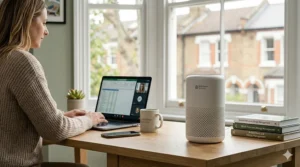
6. Russell Hobbs Clean Air Mini Aroma (RHAP1032WDB) — The Great British Option
There’s something quietly reassuring about buying an air purifier from a brand that’s been in British homes since 1952. Russell Hobbs may not have the cult following of Blueair or the technology marketing of Philips, but the Clean Air Mini Aroma RHAP1032WDB is a genuinely well-thought-through unit that suits UK living conditions rather well.
The CADR of 100 m³/h covers rooms up to around 20m², which positions it comfortably for a master bedroom or generous home office. The carbon and HEPA filtration combination captures 99.95% of airborne bacteria, allergens, odours, and dust. The Scandi wood-effect design — available in black or white — is the sort of thing that looks at home on a sideboard without demanding attention, which is either a virtue or irrelevant depending on how much you think about sideboard aesthetics.
The LED display is clear and practical without being blinding at night (a failing of several cheaper units that turn a bedroom into a miniature disco). The integrated aroma function works via a fragrance compartment rather than a chemical diffuser, which is a cleaner and safer approach — particularly relevant if you have asthma, where some essential oil diffusers can actually trigger symptoms.
UK Prime members benefit from next-day delivery direct from Amazon’s UK warehouses, and the unit’s 230V UK-plug compatibility means no adaptor faff whatsoever. Replacement filters are available on Amazon.co.uk at reasonable prices.
✅ British brand with long UK heritage and reliable customer support
✅ Aroma function is safe for asthma sufferers — no chemical diffusers
✅ Clean LED display that doesn’t light up the bedroom like a Christmas tree
❌ Less advanced filtration technology compared to Blueair or Philips rivals
❌ Slightly louder at higher fan speeds compared to the category’s quietest units
Price range: £40–£60. The smart choice for buyers who want a trusted UK brand with practical features.
7. Bosch Air 500 — German Engineering in a Compact Package
Bosch is not a brand that does gimmicks. The Air 500 is a clean, considered unit built to do one thing extremely well: filter the air in a small room quietly, reliably, and efficiently. It covers rooms up to 23m² with a CADR of 100 m³/h and operates at below 25 dB on its sleep mode — so quiet that the only way you’d know it was running is by checking the indicator light.
The USB-C charging port is a thoughtful design decision that’s more useful than it first appears. In a cluttered British bedroom where bedside plugs are perpetually occupied by phone chargers and lamp timers, the ability to run the Air 500 via USB-C means you can power it from a spare socket on a multi-port USB hub. Less cable drama, more clean air.
The multi-stage filtration captures pollen, dust mites, mould spores, and fine particles effectively. Bosch’s filter quality is notably consistent — unlike some budget manufacturers whose filter composition varies between production batches, Bosch’s engineering standards are rigidly maintained. That matters more than marketing specs for allergy sufferers who depend on consistent capture rates.
The unit’s compact footprint — nightstand or desk-sized — makes it an excellent choice for students in halls of residence or anyone renting a small flat where floor space is precious. It’s Prime-eligible on Amazon.co.uk, and Bosch’s UK support infrastructure means returns and warranty claims are handled through proper UK channels.
✅ Bosch engineering reliability — consistent filtration quality batch to batch
✅ USB-C power — ideal for bedrooms with limited plug sockets
✅ Compact footprint suits small UK flats and student accommodation
❌ No smart features or app connectivity
❌ CADR is modest — adequate for 23m² but no more
Price range: £70–£90. The most dependable engineering choice at the compact end of the market.
How to Get the Most From Your Small Air Purifier: A UK Practical Guide
Buying the right unit is only half the job. Placement and usage habits have an enormous impact on real-world allergy relief — and most people get at least one of these wrong initially.
Placement is everything. The single most common mistake is putting an air purifier in the corner of a room behind furniture. Air purifiers need unrestricted 360° airflow — or at minimum clear space on the intake and output sides. Place your unit in the centre of the room where possible, or at least 30cm from walls, furniture, or curtains.
For bedroom allergy relief, position matters seasonally. During British pollen season (typically March to September for grass and tree pollen), place your purifier near the bedroom door rather than the window. This intercepts particles entering the room rather than drawing them in from outside. In winter, when dust mites and indoor mould become the primary concern, positioning near the bed’s head end targets the area where you spend most breathing time.
Run it continuously during hay fever season. It may seem counterintuitive to leave it on while you’re out of the room, but maintaining clean air in your bedroom throughout the day means you’re not walking back into a particle-laden space every evening. At 5–15W depending on the model, the electricity cost is genuinely trivial.
Keep windows closed while running — especially during high-pollen mornings (typically 5–10am in the UK). The Met Office pollen forecast is a surprisingly useful tool for knowing exactly when to keep the bedroom sealed.
Don’t neglect the pre-filter. Most units in this guide have a washable pre-filter. Rinse it under warm water every three to four weeks, let it dry completely before reinstalling, and your HEPA filter will last significantly longer — saving you money and maintaining peak filtration performance.
Which UK Allergy Sufferer Are You? Matching the Right Unit to Your Life
Not all allergy sufferers are the same, and the right air purifier for your situation depends considerably on your lifestyle, home, and specific triggers.
The city-flat renter in a Victorian terrace, Manchester or Leeds: You’re dealing with a cocktail of outdoor urban pollution, dust from old building materials, and the particularly damp conditions that Victorian housing stock creates — ideal for mould. You need something covering at least 15–20m², with activated carbon for VOCs from traffic fumes that seep in. The Bosch Air 500 or Russell Hobbs RHAP1032WDB hits this sweet spot without taking up half your rent budget.
The hay fever martyr in suburban Surrey or Kent: Pollen counts in southern England’s commuter belt regularly hit “very high” from April through August. You need a unit with a genuinely high-grade HEPA filter (H13 or HEPASilent) and ideally an automatic mode that responds to real-time pollen levels. The Philips AC0650/20 with its PM2.5 sensor and app control is built precisely for this situation — it ramps up automatically when conditions deteriorate, which during a particularly brutal June is genuinely invaluable.
The pet owner with dust mite allergies, rural Scotland: Pet dander combined with dust mites in an older, carpeted house creates a particularly challenging allergy environment. The Blueair Blue Pure 511 — with its 0.1-micron filtration capability — handles both with unusual effectiveness. The washable pre-filter specifically targets the larger dander particles before they ever reach the HEPA layer, extending filter life considerably when you’re running the unit in a home with pets.
The student in halls, Bristol or Birmingham: Limited budget, small room (often under 10m²), and a plug socket that’s already working overtime. The AROEVE MK04 at under £45 with its 5W consumption and USB-adjacent power-efficiency is almost tailor-made for this scenario. No app required, no subscription, just clean air.
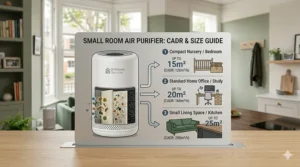
How to Choose a Small Air Purifier for Allergies in the UK: 6 Key Criteria
1. Check the CADR Against Your Actual Room Size
CADR (Clean Air Delivery Rate) measures how quickly a purifier can clean a given space. As a rule of thumb, aim for a CADR that’s at least two-thirds of your room’s floor area in m³/h. For a 15m² bedroom, that’s a minimum CADR of around 100 m³/h. Bigger is better — you can always run a higher-CADR unit on a lower fan speed for quieter operation.
2. True H13 HEPA vs HEPA-Style — It Matters More Than You Think
True H13 HEPA captures 99.97% of particles down to 0.3 microns; HEPASilent (Blueair) extends this to 0.1 microns. “HEPA-style” or “HEPA-type” filters — common on very cheap units — aren’t tested to the same standard and may let fine allergen particles through. For genuine allergy relief, insist on H13 True HEPA or certified HEPASilent technology. Check Amazon.co.uk listings carefully, as the terminology is sometimes used loosely.
3. Noise Level is Non-Negotiable for Bedroom Use
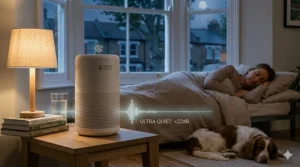
Noise levels below 25 dB on the lowest setting are genuinely inaudible in most situations. Between 25–35 dB, you’ll be aware of the unit but it won’t disturb sleep. Above 35 dB on the lowest setting, light sleepers will notice. Every unit in this guide operates below 28 dB on sleep mode.
4. Running Costs: The Hidden Number Nobody Mentions
A 50W air purifier running 24/7 costs approximately £110 per year at average UK electricity rates (around 25p/kWh). A 7W unit costs around £15 per year. Over three years, the difference exceeds the cost of many of the units themselves. Look for sub-10W consumption if you plan to run it continuously.
5. Filter Availability and Cost on Amazon.co.uk
Some air purifiers are bargain priced specifically because their proprietary replacement filters are expensive and only available through the manufacturer. Before buying, search for replacement filters on Amazon.co.uk — if they don’t exist or cost over £30 per filter, factor that into your total cost of ownership.
6. UK Voltage and Plug Compatibility
All units in this guide are 230V and UK plug-compatible as sold on Amazon.co.uk. However, if you’re ever tempted by a grey-market import or a US Amazon listing, check carefully — US models run on 110V and will either not work or be damaged by UK mains voltage without a transformer.
Common Mistakes When Buying a Small Air Purifier for Allergies
Buying for room size on the box, not actual conditions. Manufacturers’ coverage claims assume an empty, standard-height room with average ceilings. British Victorian properties frequently have high ceilings (2.7–3m+), which adds significant air volume. Adjust accordingly — if your room is 15m² with 2.8m ceilings, treat it as though it were 18m² for sizing purposes.
Assuming all HEPA filters are equal. As noted above, “HEPA-style” is a marketing term, not a certification. The NHS recommends that allergy sufferers use genuinely tested air filtration — guidance consistent with HEPA H13 or better. (NHS advice on hay fever management is worth reading alongside any product purchase.)
Running the unit only when symptomatic. By the time your eyes are watering and your nose is streaming, allergen levels in the room are already high. An air purifier works best as a preventative measure, running continuously through peak allergen periods rather than reactively.
Ignoring the carbon filter. HEPA captures particles; activated carbon absorbs gases, VOCs, and odours. In UK homes near busy roads — particularly those affected by ULEZ zones in London or city centre pollution — the carbon component addresses NO₂ and other combustion byproducts that HEPA alone cannot trap.
Placing it in a corner. Already mentioned in the usage guide, but worth reinforcing: it’s the single most common mistake and one of the most impactful.
How Often Should You Replace a HEPA Filter? The UK Reality
Most manufacturers recommend HEPA filter replacement every six to twelve months. In practice, the UK’s combination of high outdoor pollen, urban pollution, and damp indoor conditions means many users find filters load up faster than the standard guidance suggests.
A good rule of thumb for British conditions: check your filter visually every three months. If it looks grey or is visibly clogged, replace it regardless of the timer. Running a clogged filter doesn’t just reduce efficiency — it can actually release previously captured particles back into the room as airflow forces them through.
Running costs for filters across the products in this guide range from approximately £10–£15 per year (LEVOIT Core Mini replacement packs) to £25–£40 per year (Philips NanoProtect filters). The Blueair 511’s combination filter sits in the middle range, at around £20–£30 annually — but the washable pre-filter means the HEPA layer itself lasts longer than you’d expect.
If your allergy symptoms suddenly worsen despite running your purifier, a clogged or expired filter is the first thing to check. It’s more often the cause than people realise.
✨ Don’t Miss These Exclusive Deals!
🔍 Click on any highlighted product above to check current pricing and availability on Amazon.co.uk — most are Prime-eligible for next-day delivery across mainland UK!
Long-Term Costs and Value: What a Small Air Purifier Actually Costs You Over Three Years
Let’s do the maths that product listings never do for you.
A unit costing £45 with £15/year filter costs and 5W consumption works out at approximately £88 total over three years — including electricity. A unit costing £140 with £30/year filter costs and 15W consumption comes to approximately £230 over three years. Neither figure is unreasonable for genuine allergy relief; the point is to understand what you’re actually committing to before you click “Add to basket.”
| Unit | Purchase Price | Annual Filter Cost | Annual Electricity (24/7, 25p/kWh) | 3-Year Total |
|---|---|---|---|---|
| AROEVE MK04 | ~£40 | ~£12 | ~£11 | ~£85 |
| LEVOIT Core Mini | ~£30 | ~£13 | ~£6 | ~£70 |
| Russell Hobbs RHAP1032 | ~£50 | ~£15 | ~£20 | ~£110 |
| Bosch Air 500 | ~£80 | ~£18 | ~£15 | ~£149 |
| Coway Airmega 50 | ~£95 | ~£20 | ~£31 | ~£208 |
| Blueair Blue Pure 511 | ~£90 | ~£25 | ~£13 | ~£178 |
| Philips AC0650/20 | ~£145 | ~£30 | ~£26 | ~£257 |
These are estimates based on continuous 24/7 operation at average UK electricity rates; your costs may vary depending on usage patterns. VAT at 20% is included in Amazon.co.uk prices. The Blueair 511 and LEVOIT Core Mini emerge as the most cost-efficient choices relative to their filtration capability over the medium term.
Frequently Asked Questions
❓ What is the best small air purifier for allergies in the UK?
❓ Do air purifiers actually help with hay fever in the UK?
❓ Where should I place an air purifier in a small UK bedroom?
❓ How often should I change the HEPA filter in the UK?
❓ Are air purifiers from Amazon.co.uk compatible with UK plugs and voltage?
Conclusion: Breathe Easier, Starting Tonight
The honest truth about small air purifiers for allergies is that the difference between a genuinely good unit and a mediocre one isn’t all that dramatic on the spec sheet — it’s in the daily lived experience of sleeping through the night without congestion, waking up without swollen eyes, and not reaching for the antihistamines before you’ve even had a cup of tea.
All seven units in this guide are currently available on Amazon.co.uk, all work reliably on UK mains power, and all use legitimate HEPA or HEPASilent filtration capable of making a tangible difference to indoor air quality.
For most UK buyers, the decision comes down to three questions: How big is the room? How important is quietness? What’s the realistic total budget including filters? Answer those honestly, and the table at the top of this guide will point you firmly in the right direction.
If you want our single recommendation without the caveats: the Blueair Blue Pure 511 at the £80–£100 price point is the unit we’d put in our own bedroom without a second thought. If the budget is tighter, the AROEVE MK04 at under £45 is a genuinely impressive piece of kit that punches well above its price. Either way — your nose will thank you.
✨ Don’t Miss These Exclusive Deals!
🔍 Click on any highlighted product in this guide to check today’s prices and availability on Amazon.co.uk. Prime members get next-day delivery across most of mainland UK!
Recommended for You
- Best Air Purifier for Small Bedroom UK 2026: 7 Expert Picks
- Best Air Purifier for Bedroom Allergies UK 2026: 7 Expert Picks
- Best Air Purifier for Bedroom UK 2026: 7 Expert Picks
Disclaimer: This article contains affiliate links. As an Amazon Associate, I earn from qualifying purchases. If you purchase products through these links, we may earn a small commission at no additional cost to you.
✨ Found this helpful? Share it with your mates! 💬🤗
