In This Article
Let’s be honest — British homes aren’t exactly famous for their ventilation. We keep windows shut from October through April because, well, it’s either raining sideways or the draught would flatten a grown adult. The result? The air inside your living room quietly accumulates dust, pollen, pet dander, volatile organic compounds (VOCs) from that new sofa, and the ghost of every curry ever cooked on the premises. According to research from the UK Health Security Agency, indoor air pollution can be two to five times worse than outdoors, even in cities.
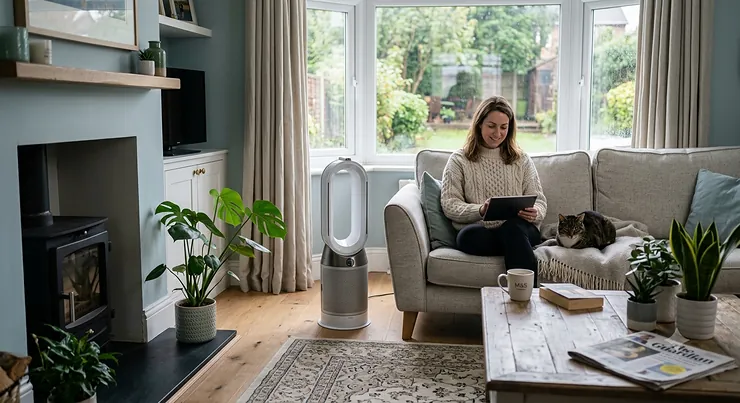
A good air purifier for living room use doesn’t just filter the nasties — it genuinely changes how a space feels. That slightly stuffy, faintly dusty sensation that you’ve filed under “normal”? Gone. If you suffer from hay fever, own a pet, or simply want to stop sneezing every time you plump a cushion, a quality HEPA-equipped unit is one of those rare purchases that actually delivers on its promise.
But here’s the thing: not every air purifier sold on Amazon is worth your time or your money. The market is awash with underpowered little cylinders that look impressive on a listing but couldn’t filter the air in a broom cupboard, let alone a living room. We’ve done the research so you don’t have to — cutting through the spec-sheet fluff to bring you seven units genuinely available on Amazon.co.uk right now, all UK-compatible (230V, UK plug, CE/UKCA certified), and all worth serious consideration.
So whether you’re dealing with a pollen-plagued conservatory in Cheltenham, a smoky open-plan kitchen-diner in Manchester, or a flat in East London where the traffic fumes somehow find their way indoors, there’s a unit here for you.
Quick Comparison: Top 7 Air Purifiers for Living Room at a Glance
| Product | Coverage | Noise (Sleep) | Smart Control | Price Range |
|---|---|---|---|---|
| Levoit Core 300S | Up to 50 m² | 24 dB | Yes (VeSync app/Alexa) | £130–£160 |
| Levoit Core 600S | Up to 160 m² | 26 dB | Yes (VeSync app/Alexa) | £270–£320 |
| Blueair Blue Pure 511 | Up to 38 m² | ~17 dB | Basic (app optional) | £75–£100 |
| Dyson Purifier Cool TP09 | Up to 81 m² | 43 dB (low) | Yes (MyDyson app/Alexa) | £500–£600 |
| Shark NeverChange5 HP300UK | Up to 90 m² | ~35 dB | No | £270–£320 |
| Xiaomi Smart Air Purifier 4 | Up to 48 m² | 33 dB | Yes (Mi Home app) | £130–£180 |
| Coway Airmega 100 | Up to 20 m² | 25 dB | No | £85–£110 |
The table above tells an interesting story. The Levoit Core 600S is the clear winner on sheer room coverage — crucial for open-plan living spaces that are increasingly common in UK new builds. If noise is your primary concern (young children, light sleepers), the Blueair Blue Pure 511’s near-whisper 17 dB performance at low speed is genuinely extraordinary. Budget buyers should note that both the Coway Airmega 100 and Blueair 511 cover smaller living rooms competently at well under £110 — the Coway’s 20 m² rating is fine for a typical second room or a modest lounge in a terraced house.
✨ Don’t Miss These Exclusive Deals!
🔍 Take your home air quality to the next level with these carefully selected air purifiers. Click on any highlighted product to check current pricing and availability on Amazon.co.uk. Clean air starts with a single click.
Top 7 Air Purifiers for Living Room: Expert Analysis
1. Levoit Core 300S — The Best Mid-Range All-Rounder
The Core 300S is arguably the most popular air purifier on Amazon.co.uk for good reason — it hits a near-perfect balance of performance, intelligence, and price. Its H13 True HEPA filter captures 99.97% of airborne particles down to 0.3 microns, which covers everything from pollen and dust mites to PM2.5 fine particles. The 50 m² coverage means it can handle most British living rooms comfortably; a standard semi-detached lounge typically comes in around 20–30 m², giving this unit plenty of headroom.
What most UK buyers overlook about the Core 300S is its laser particulate sensor — this isn’t a token display feature, it actively adjusts fan speed in real time based on detected air quality. Fire up the air fryer, and the unit ramps up before you’ve even noticed the smell. Alexa integration works reliably, the VeSync app is genuinely useful (not just an advertising outlet), and the sleep mode at 24 dB means you’ll hear more noise from the boiler than from this machine. Replacement filters are readily available on Amazon.co.uk and cost roughly £25–£35 per set, which you’ll need every six to eight months with typical UK use.
UK buyers have left overwhelmingly positive reviews, with particular praise for its performance during hay fever season. The sealed H13 filter system — which means no air bypasses the filter — is a detail that cheaper units frequently skip.
✅ Genuinely quiet sleep mode
✅ Laser PM2.5 sensor with real-time response
✅ Compact footprint for UK homes
❌ 50 m² limit may strain in very large open-plan rooms
❌ Filters need replacing every 6–8 months (cost adds up)
In the £130–£160 range, this represents outstanding value. If you own one living room and want smart HEPA filtration without remortgaging, the Core 300S is an easy recommendation.
2. Levoit Core 600S — The One for Open-Plan Homes
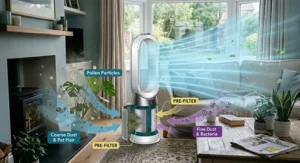
The Core 600S is a different beast entirely — this is the unit for the modern open-plan kitchen-diner-living room that’s become standard in UK new builds and conversions. Its coverage of up to 160 m² is backed by a CADR of around 410 m³/h, which is genuinely impressive rather than a marketing fiction. VortexAir Technology 3.0 draws air from multiple angles and pushes clean air further, which actually matters in a long, narrow room typical of British Victorian terraces.
Running at 24W in auto mode, the annual electricity cost at the current Ofgem cap rate works out to roughly £20–£25 — less than two takeaways. The smart features mirror the Core 300S, with VeSync app control, Alexa compatibility, and a colour-coded air quality ring that gives you an at-a-glance status without needing to squint at an app. The QuietKEAP Technology keeps noise at a respectable 26 dB in sleep mode, though at full power it’s noticeably more assertive than its smaller sibling.
UK reviewers note it handles cooking smells with impressive speed — particularly relevant if your living room bleeds into an open kitchen and someone regularly exercises their right to fry onions at 11pm.
✅ Best-in-class coverage for large or open-plan rooms
✅ Efficient 24W running costs
✅ Full smart home integration
❌ Bulkier footprint — needs floor space away from walls
❌ At full speed, noise becomes noticeable
At £270–£320, it’s not cheap, but for a genuinely large living space it’s the sensible rather than extravagant choice.
3. Blueair Blue Pure 511 — The Budget Overachiever
Sweden’s Blueair makes no pretence at being the most feature-packed brand on this list — and that restraint is precisely what makes the Blue Pure 511 rather good. Its HEPASilent™ technology combines mechanical and electrostatic filtration, meaning the fan doesn’t need to work as hard to achieve the same particle removal. The result is a unit that runs at roughly 17 dB at its lowest setting — quieter than a library, quieter than a sleeping cat, possibly quieter than your own breathing.
Coverage is rated at 38 m², which suits a standard UK living room with room to spare. The fabric pre-filter (which comes in several colours) is washable and catches larger particles before the main filter, extending its life usefully. No app, no Alexa, no PM2.5 display — and for many people, that’s genuinely appealing. Not everyone wants their air purifier sending notifications to their phone; some of us just want it to get on with the job.
The caveat worth knowing: Blueair’s HEPASilent system uses electrostatic ionisation, which produces trace amounts of ozone. The levels are extremely low and within EU/UK safety limits, but if you’re particularly sensitive or simply prefer a system without any ionisation, the Levoit units above are the better call.
✅ Whisper-quiet — best noise performance on this list
✅ Washable pre-filter extends main filter life
✅ Simple, reliable, unfussy to operate
❌ No smart features or air quality display
❌ Electrostatic ionisation (trace ozone)
In the £75–£100 range, this is the living room air purifier for anyone who values silence and simplicity above all else. Particularly well-suited to smaller UK lounge spaces.
4. Dyson Purifier Cool TP09 — The Premium Statement Piece
The Dyson TP09 is the air purifier you buy when you want the room itself to look better, not just feel better. That distinctive tower fan design isn’t just aesthetic vanity — the 360° Glass HEPA + activated carbon filter captures gases and particles simultaneously, including formaldehyde (which off-gasses from furniture, flooring, and paint in newer UK homes for years after installation). The MyDyson app provides room-by-room air quality reporting that is genuinely informative rather than a marketing gimmick.
Coverage is rated at 81 m², and the Dyson’s oscillation function means that clean air reaches corners of the room that a stationary unit would miss. In summer it doubles as an effective fan — a neat trick in a compact British living room where you don’t want both a fan and a purifier taking up floor space. The HEPA 13 + carbon filter is sealed, which matters: cheaper units sometimes have gaps around filters that allow unfiltered air to circulate.
The honest caveat: the Dyson is expensive, and its replacement filter costs — roughly £40–£55 per set annually — add meaningfully to the total cost of ownership. You’re paying a significant premium for the brand, the design, and the dual fan-purifier functionality. Whether that premium is justified depends entirely on how much your living room’s aesthetic means to you and how often you want a fan in summer.
✅ Formaldehyde destruction — unique on this list
✅ Fan + purifier dual function (ideal for UK seasons)
✅ Elegant design; disappears into a living room
❌ Among the most expensive on initial purchase and filter costs
❌ Louder than competitors at low speed (43 dB)
At £500–£600, this is premium territory — best for those who view it as a long-term living room fixture rather than a utility appliance.
5. Shark NeverChange5 Air Purifier MAX HP300UK — The Filter-Change Rebel
The HP300UK makes a genuinely bold claim: never change the main filter. The “NeverChange” branding refers to a washable, re-usable HEPA filter designed to last the lifetime of the product. In a market where annual filter costs can run to £30–£60, this is worth sitting up and paying attention to. Coverage extends to 90 m², putting it in the same territory as the Dyson at a notably lower initial outlay.
The washable filter system works as advertised — you remove it every few months, rinse, dry, and reinsert. What the spec sheet won’t tell you is that this process takes about five minutes and, frankly, requires slightly more commitment than simply ordering a replacement filter off Amazon. The trade-off is real: you save money long-term, but you do need to actually do the washing. In damp British conditions, ensuring the filter is completely dry before reinsertion matters — a half-damp filter is less effective and risks mould.
There’s no smart connectivity — no app, no Alexa — which some will find refreshingly uncomplicated and others will consider a significant omission in 2026. Air quality is indicated via a simple LED ring, which does the job.
✅ Washable HEPA filter — virtually zero ongoing filter costs
✅ Strong 90 m² coverage
✅ Genuinely UK-specific model (HP300UK — UK plug, 230V)
❌ No smart features or app control
❌ Filter must be washed and fully dried — requires maintenance discipline
In the £270–£320 range, if you’re planning to own the unit for five or more years, the maths on filter savings are compelling.
6. Xiaomi Smart Air Purifier 4 — The Value Smart Pick
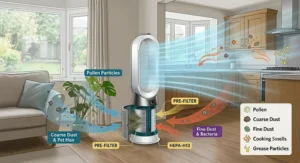
Xiaomi has become a genuine force in UK consumer electronics, and the Smart Air Purifier 4 demonstrates why. The Mi OLED display provides real-time PM2.5 readings with a level of precision that units costing twice as much don’t always match. Coverage is rated at 48 m², the three-stage filtration (pre-filter, True HEPA, activated carbon) is solid, and Mi Home app integration works seamlessly across Android and iOS.
The detail that makes this unit interesting for UK buyers is its laser particle counter, which updates every two seconds — faster than the Levoit Core 300S’s sensor. In practice, this means the auto mode responds to air quality changes with slightly greater urgency, which matters if you’re sharing your living room with a dog whose coat appears to moult year-round. At 33 dB in sleep mode it’s not the quietest unit on this list, but it’s perfectly acceptable for a living room where the television is usually on anyway.
Replacement filters cost around £25–£35 on Amazon.co.uk and are widely available. The Mi Home ecosystem also integrates with Google Home, which gives it broader smart home compatibility than the Levoit units.
✅ Precise OLED PM2.5 display
✅ Google Home + Alexa compatible
✅ Strong value at this price point
❌ 33 dB in sleep mode — not the quietest
❌ Mi Home app can feel cluttered with non-relevant Xiaomi products
In the £130–£180 range, the Xiaomi 4 is the smart choice for tech-savvy UK buyers who want data-driven air quality management without paying Dyson prices.
7. Coway Airmega 100 — The Compact Starter Option
Don’t let the modest footprint fool you. The Coway Airmega 100 packs a True HEPA filter and a washable pre-filter into a unit small enough to sit on a side table, covering up to 20 m² — which is perfectly adequate for smaller British living rooms, studies, or the sort of compact lounge found in a first flat or a converted Victorian terrace. South Korean brand Coway has been making air purifiers longer than most of their competitors, and the build quality shows.
The air quality indicator uses a simple three-colour ring (blue, purple, red) that you learn to read at a glance within about two days. No app, no Wi-Fi, no smart features — just three fan speeds, an auto mode, and an honest approach to the job at hand. The washable pre-filter is a useful cost-saver, though the HEPA layer itself does need replacing periodically (roughly once a year with typical use).
For a first-time buyer uncertain whether an air purifier is genuinely worth the investment, the Coway Airmega 100 is the ideal low-risk entry point. If it transforms your living room and you wish you’d bought something bigger — the Core 600S will be waiting.
✅ Compact design — minimal floor footprint
✅ Washable pre-filter reduces running costs
✅ Simple, no-nonsense operation
❌ 20 m² coverage limits suitability to smaller rooms
❌ No smart features or app connectivity
In the £85–£110 range, this is the most accessible entry point on our list and a genuinely honest product for what it is.
How to Set Up Your Living Room Air Purifier for Maximum Effect
Buying a quality unit is only half the battle. How you position and use it makes a material difference to whether you’re getting full value.
Placement matters more than you’d think. Position your air purifier in the breathing zone — roughly 1–2 metres off the floor and away from walls. Tucking it behind the sofa looks tidier, but you’ll sacrifice significant efficiency. Aim for the centre of the room or between the main source of pollutants (a pet’s favourite spot, the kitchen end of an open-plan room) and where you spend most of your time.
Run it continuously — or at least consistently. This is the single biggest mistake UK buyers make. Running an air purifier for two hours in the evening and then turning it off is a bit like showering before a six-hour train journey and expecting to smell fresh at the other end. Air quality degrades constantly; the unit works best as background infrastructure rather than an occasional intervention. On auto mode at low speed, the electricity cost is genuinely negligible — roughly £20–£30 per year depending on the model.
UK climate tip: Keep windows closed when the unit is running, obviously — but also be aware that during periods of high pollen (May through August in most of England, extending later in the North), opening windows even briefly in the morning can flood a room with allergens that then need an hour to clear. Run the unit on its highest setting for 15–20 minutes after any ventilation before dropping back to auto mode.
Filter maintenance: Mark your filter replacement date in your phone calendar the day the unit arrives. In British conditions — particularly in homes with solid fuel fires, heavy cooking, or pets — filters tend to exhaust at the lower end of manufacturer estimates. A clogged filter doesn’t just reduce effectiveness, it can strain the motor and increase running noise.
New builds and recently decorated rooms: VOC off-gassing from paint, carpets, and flat-pack furniture can persist for months. If you’ve just moved in or redecorated, run the purifier on high for the first week with windows slightly cracked on dry days, then settle into a normal auto routine.
Real Scenarios: Which Purifier Suits Your British Living Room?
UK homes and lifestyles vary enormously — and the “best” unit is the one that fits your actual situation, not the one with the highest CADR number.
Profile 1 — The London Flat Dweller. You live in a one-bedroom conversion in Hackney. Your lounge is roughly 18–22 m², there’s a kitchen at one end, and the sealed windows mean air quality stagnates fast. You want smart control and aren’t bothered about design. Best pick: Coway Airmega 100 (budget) or Levoit Core 300S (smart upgrade). The compact footprints suit tight spaces; the Core 300S’s auto mode handles cooking smells without you having to think about it.
Profile 2 — The Open-Plan New Build, South Manchester. Four-bedroom detached, open kitchen-diner-lounge of around 55–70 m². Two kids, a Labrador, and a weekly curry habit. You need coverage and smart features. Best pick: Levoit Core 600S. The 160 m² coverage isn’t just marketing — it provides meaningful air cycling frequency for a large space. The VeSync app lets you schedule boost modes before cooking, which is exactly the kind of quality-of-life feature that justifies the price.
Profile 3 — The Hay Fever Sufferer, Semi-Detached in Surrey. Standard mid-size living room, early Victorian terraced house with original sash windows. Draughts in winter, pollen ambush in spring. Silence is important — partner works nights. Best pick: Blueair Blue Pure 511. The 17 dB performance at low speed is genuinely unmatched. The washable pre-filter handles the spring pollen surge without requiring expensive replacements every two months.
Profile 4 — The Interior-Conscious Homeowner. You’ve spent considerable money on your living room and a beige cylinder isn’t happening. Best pick: Dyson Purifier Cool TP09. The tower design genuinely earns its place aesthetically, and the dual fan-purifier function means it pulls its weight in summer too — relevant in a British summer that occasionally produces a week of genuine heat.
How to Choose an Air Purifier for Living Room Use: 6 Things That Actually Matter
With so many units on the market, it’s easy to get lost in spec comparisons that don’t map to real-world results. Here’s what to actually focus on.
1. Room coverage — and then some. Choose a unit rated for at least 1.5 times your actual room size. A unit rated exactly for your room will be constantly running at full power to keep up; one with headroom can run quietly at 40–50% capacity and still clean the air effectively. A typical British living room runs 20–35 m² — so you’re looking for a unit rated 30–50 m² at minimum.
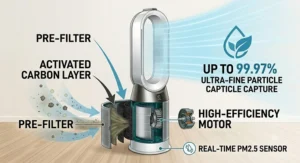
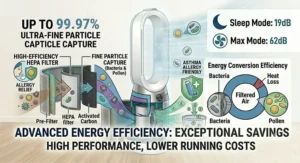
2. True HEPA vs “HEPA-type.” This distinction matters enormously. True (or H13) HEPA captures 99.97% of particles at 0.3 microns. “HEPA-type” is a marketing term for filters that don’t meet that standard. All seven units on this list use genuine HEPA filtration — be sceptical of anything else, particularly at the budget end of Amazon’s catalogue.
3. CADR (Clean Air Delivery Rate). This is the single most honest measure of an air purifier’s performance: how many cubic metres of genuinely clean air it delivers per hour. Higher is better. For a living room, look for CADR of 200 m³/h or above; for a large open-plan space, 350+ m³/h. Manufacturers sometimes publish this figure for dust, smoke, and pollen separately — they should all be comparable.
4. Noise levels. Measured in decibels. Anything above 35 dB at low speed will be noticeable in a quiet room. Sleep mode on quality units runs 22–27 dB — comparable to a whisper. If you have a naturally noisy household (kids, television, the general chaos of British family life), this matters less. If your living room doubles as a home office or study space, it matters a great deal.
5. Filter cost and availability. The initial purchase price is only part of the story. Check the annual filter cost before buying and confirm replacements are available on Amazon.co.uk. Some units use proprietary filters that are expensive, hard to find, or discontinued once a model is phased out. The washable filter models (Shark NeverChange5) sidestep this problem entirely.
6. Smart features — do you actually need them? App control, PM2.5 monitoring, and voice assistant integration are genuinely useful if you’ll use them. The Core 300S’s real-time auto mode is meaningfully more effective than a manual unit at the same price point. But if you’re going to run the unit on auto and forget about it, the Blueair’s simplicity is a virtue rather than a compromise.
Air Purifier for Living Room vs. Opening a Window: Which Is Better?
This is a question British homeowners ask surprisingly often — particularly given our mild outdoor air quality compared to many European cities. The honest answer, like most things in life, is nuanced.
Opening windows provides free ventilation and brings fresh outdoor air, which in most UK locations is genuinely cleaner than the indoor equivalent on an average day, according to guidance from Air Quality England. However, it also imports pollen during spring and summer (a major issue for the 13 million or so hay fever sufferers in the UK), brings in traffic pollution particulates in urban areas, and is simply impractical for five to six months of the year in a British winter.
An air purifier for living room use addresses what ventilation cannot: continuous filtration of particles, allergens, and odours generated inside the home. Dust mites, pet dander, VOCs from furniture and cleaning products, cooking smoke, and mould spores are domestic pollutants that no amount of window-opening resolves. The two approaches complement rather than compete with each other — ventilate when outdoor air quality and weather permit, and let the purifier handle the rest.
A useful reference: the NHS recommends keeping windows closed during high pollen periods for hay fever sufferers. On those days — and there are many of them in British spring and early summer — an air purifier isn’t just useful, it’s genuinely transformative.
Long-Term Cost & Maintenance: What UK Buyers Should Budget For
The purchase price is only the beginning. Running an air purifier for living room use long-term involves two ongoing costs: electricity and filters.
| Unit | Typical Wattage | Annual Electricity (Est.) | Annual Filter Cost | Total Annual Cost |
|---|---|---|---|---|
| Levoit Core 300S | ~22W (auto) | ~£21 | £25–£35 | £46–£56 |
| Levoit Core 600S | ~24W (auto) | ~£23 | £30–£45 | £53–£68 |
| Blueair Blue Pure 511 | ~8W (low) | ~£8 | £40–£50 | £48–£58 |
| Dyson TP09 | ~40W (auto) | ~£38 | £40–£55 | £78–£93 |
| Shark NeverChange5 HP300UK | ~50W (auto) | ~£48 | ~£0 (washable) | ~£48 |
| Xiaomi Smart AP4 | ~22W (auto) | ~£21 | £25–£35 | £46–£56 |
| Coway Airmega 100 | ~18W (auto) | ~£17 | £20–£30 | £37–£47 |
Electricity costs estimated using the April–June 2026 Ofgem cap rate of approximately 26.55p/kWh, assuming 12 hours daily operation.
The table above tells a story that the initial price comparison obscures. The Dyson TP09’s premium extends well beyond the purchase price — its annual running and filter costs are the highest on the list by a meaningful margin. The Shark NeverChange5, conversely, has higher electricity consumption but near-zero filter costs, making it increasingly competitive over three to five years of ownership. The Coway Airmega 100 is the most economical to run on the list — ideal if budget is genuinely the deciding factor.
VAT note: all Amazon.co.uk prices include 20% UK VAT, which is worth bearing in mind if you encounter US-market prices in reviews — they’re typically quoted pre-tax and will look lower as a result.
Common Mistakes When Buying an Air Purifier for Living Room UK
Buying for the size of a room you wish you had. A unit rated for 30 m² will struggle in a 30 m² room — it’ll be working flat out constantly and still not achieving the air change frequency you need. Overspec on coverage.
Ignoring ceiling height. UK room height ratings assume a standard 2.4–2.5 m ceiling. Victorian and Edwardian properties often have ceilings of 3 m or higher. If you live in a period property, add roughly 25% to your effective room volume calculation and size accordingly.
Choosing based on first-year price only. See the maintenance cost table above. A £75 unit with £50/year filters becomes more expensive than a £150 unit with £25/year filters by year three.
Running it only when symptoms flare. An air purifier isn’t a rescue remedy — it’s infrastructure. Running it continuously on auto is the correct approach.
Dismissing “no-name” units without research — or trusting them blindly. Amazon UK is full of cheap units with impressive-sounding specifications that fail to deliver. Conversely, some lesser-known brands genuinely punch above their weight. Focus on verified CADR ratings and actual user reviews — particularly those from UK buyers.
Ignoring filter availability. Before purchasing any unit, search Amazon.co.uk for its replacement filter. If you can’t find it easily, that unit is a risk.
FAQ
❓ How many square metres does an air purifier cover in a living room?
❓ What is HEPA filter technology, and does it matter?
❓ Is an air purifier for lounge use noisy?
❓ How often should I replace the HEPA filter in a living room air purifier in the UK?
❓ Can an air purifier help with living room dust in the UK?
Conclusion: The Cleanest Living Room Air in the UK Starts Here
British homes are, on the whole, reasonably well-insulated and entirely poorly ventilated. It’s a trade-off we’ve made in the interest of warmth that nobody thought too hard about — until indoor air quality became a topic worth discussing. The good news: investing in a quality air purifier for living room use is one of the more straightforward home improvements available, with tangible, measurable results that most users notice within the first week.
The Levoit Core 300S remains our top recommendation for most UK living rooms: smart, quiet, genuinely effective, and priced in a range that doesn’t require justification. Large open-plan homes should look seriously at the Levoit Core 600S. Budget-conscious buyers who value silence above all else will find the Blueair Blue Pure 511 a revelation. And if your living room is also your design statement, the Dyson TP09 earns its premium.
Whatever you choose, run it continuously, maintain the filters, and place it sensibly. The technology does the rest.
✨ Ready to Breathe Better?
🔍 Browse our top-rated air purifier picks on Amazon.co.uk and find the perfect unit for your living room. Click any highlighted product to check current pricing and Prime delivery options. Your nose will thank you.
Recommended for You
- 7 Best Air Purifiers for a Large Living Room UK (2026 Guide)
- Best Stylish Air Purifier for Living Room UK: 7 Picks (2026)
- Best Air Purifier for Living Room with Pets UK 2026 (Top 7 Picks)
Disclaimer: This article contains affiliate links. As an Amazon Associate, I earn from qualifying purchases. If you purchase products through these links, we may earn a small commission at no additional cost to you.
✨ Found this helpful? Share it with your mates! 💬🤗
