In This Article
You wake up sneezing. Your nose is blocked, your eyes feel like they’ve been rolled in sand, and there isn’t a flower within a mile of your pillow. The culprit has probably been living in your mattress rent-free for years. A well-chosen air purifier for dust mite allergy won’t evict it, but it can take a real bite out of what you breathe at 3am.
What Is an Air Purifier for Dust Mite Allergy?
An air purifier for dust mite allergy is a portable machine that pulls room air through a True HEPA or H13 filter. The filter traps the airborne allergen particles that trigger sneezing, itching and wheezing. It reduces what you inhale, but it doesn’t kill mites or clear settled dust, so it works best alongside good bedding hygiene.
Here’s the bit most product pages skip. The mites aren’t really the villains. NHS patient guidance from Oxford University Hospitals explains that the reaction is to proteins in their droppings, which your immune system treats as a threat. That distinction shapes everything below, from which filter you need to where you put the machine.
I’ve compared seven real models using published UK test results and review roundups from Which?, Expert Reviews and Mumsnet, not hands-on testing of our own. Where evidence is thin, I say so. Prices are ranges only and shift constantly, so check current prices before you buy.
Quick Comparison: Air Purifier for Dust Mite Allergy at a Glance
Skim this table first, then dive into the detail.
| Product | Filtration | CADR (m³/h) | Noise range | Price range | Best For |
|---|---|---|---|---|---|
| Hoover H-Purifier 500 | Three-filter system, Allergy UK approved | 330 | 31 dBA (sleep) upwards | Under £100 | Large rooms on a budget |
| Coway Airmega Mighty | Pre-filter, deodorisation, True HEPA | 421 | 24.4–53.8 dB | £150–£200 | Busy family homes |
| Levoit Core 300S | Pre-filter, H13 True HEPA, carbon | 258 | 22–50 dB | £120–£160 | Smart-home fans |
| Blueair Blue Max 3250i | HEPASilent combination filter | 239 | 27.6–49 dB | £150–£190 | Feature-rich mid-size rooms |
| Blueair Blue Pure 511 | HEPASilent combination filter | 191 | Up to 47 dBA | Under £110 | Small bedrooms |
| MeacoDry Arete One 12L | Washable filter, H13 HEPA, dehumidifier | Not quoted | 35–38 dB | £170–£200 | Damp homes |
| Dyson Purifier Hot+Cool HP1 | Sealed H13 HEPA, carbon | Not quoted | 46–63 dB | £500–£600 | One premium year-round appliance |
Looking at the table, the Hoover H-Purifier 500 and Coway Airmega Mighty deliver the most airflow per pound, which matters because airflow is what catches allergen before it settles. The Blueair Blue Pure 511 trades power for size and silence, which suits a small bedroom. The Dyson Purifier Hot+Cool HP1 costs several times more than the rest, so its case rests on doing three jobs rather than on outright filtering muscle.
💬 Just one click — help others make better buying decisions too!😊
Top 7 Air Purifier for Dust Mite Allergy Picks: Expert Analysis
1. Hoover H-Purifier 500 — Allergy UK-approved power at a budget price
The standout here is a charity-backed allergy credential at a price that has tumbled. The spec sheet lists a CADR of 330 m³/h and a maximum room size of 110 m². On paper, that is roughly ten air changes an hour in a 13 m² bedroom, so allergen-laden air is cycled through the filter again and again.
Expert Reviews notes the three-filter system has Allergy UK’s approval, and the auto mode adjusts fan speed to match air quality. Its sleep mode measured about 31 dBA, barely above ambient noise. Based on the spec comparison, this is the one to beat if you want big airflow without a big bill.
Reviewer sentiment is strong but narrow. Expert Reviews gave it a Best Buy and struggled to find real complaints, and it cleared their test aerosol in just over two minutes. I couldn’t verify a large pool of independent owner reviews, so treat this as one expert verdict rather than a consensus.
Pros:
- ✅ Allergy UK-approved three-filter system
- ✅ Strong 330 m³/h airflow for the money
- ✅ Near-silent sleep mode, around 31 dBA
Cons:
- ❌ Fairly hefty at roughly 7kg to move around
- ❌ Replacement filter costs vary, so check first
Price range: under £100 at the time of research, though it was far pricier at launch, so prices may vary. Value verdict: outstanding.
2. Coway Airmega Mighty — the auto mode that reacts to disturbed dust
Dust mite allergen mostly reaches you when something stirs it up, like shaking a duvet. The standout here is an auto mode that Mumsnet’s reviewers say reacts to cooking fumes and disturbed dust. It pairs a washable pre-filter, a deodorisation filter and a True HEPA filter, with a CADR of 421 m³/h, the highest in this guide.
That airflow is the point. More cubic metres per hour means faster recovery after bed-making. The noise range runs from 24.4 dB in sleep mode to 53.8 dB flat out, and Mumsnet’s tester liked the gentle white-noise character of the quiet setting. Filter life is roughly 12 months for the HEPA and six for the deodoriser, which keeps ongoing costs predictable.
The Mumsnet tester used it in a home with two dogs and reported noticeably better air. Reviewers’ recurring complaints are that it’s loud on high settings and not much to look at. It also has no app, which some will count as a feature.
Pros:
- ✅ Class-leading 421 m³/h airflow
- ✅ Auto mode responds quickly to dust and fumes
- ✅ Three-year warranty and straightforward setup
Cons:
- ❌ Loud when running on higher settings
- ❌ Bulky, slightly dated design
Price range: roughly £150–£200. Value verdict: excellent for medium rooms.
3. Levoit Core 300S — smart scheduling and an H13 filter
If you like your gadgets chatty, the standout is app control through VeSync, plus Alexa and Google Assistant support. It uses a pre-filter, an H13 True HEPA filter and activated carbon. The CADR is 258 m³/h, and the noise range is 22–50 dB.
Room-size claims differ between sources, roughly 80 m² to 108 m², so trust the CADR. For a dust mite household, scheduling is the practical win: set it to run hard before bedtime, then drop to quiet auto mode overnight. That Quiet Auto mode never uses the top fan speed, which suits light sleepers.
Mumsnet’s tester appreciated the real-time air quality readout and quick purification. A Mumsnet user with dusty pets vacuums the pre-filter weekly and hadn’t needed a new filter after months of use. The common gripes are a short power cord and replacement filters at around £30.
Pros:
- ✅ H13 True HEPA plus carbon filtration
- ✅ Scheduling, app and voice control
- ✅ Quiet Auto mode for sleep
Cons:
- ❌ Replacement filters cost around £30 each
- ❌ Short power cord limits placement
Price range: roughly £120–£160. Value verdict: very good if you’ll use the smart features.
4. Blueair Blue Max 3250i — fast cleaning with an award-winning pedigree
The standout is speed. Expert Reviews recorded it dragging a test room from 395µg/m³ to a safe level in about two minutes twenty seconds at full tilt. CADR is 239 m³/h, with a 48 m² maximum room size, which is a sensible fit for most UK bedrooms and lounges.
The fabric pre-filter around the drum protects the main filter, extending its life. Power draw ranges from 3W to 19W, so overnight running costs pennies. Noise runs from 27.6 dB to 49 dB. A colour-changing indicator glows from blue to red as air quality shifts.
The product won Expert Reviews’ 2025 Product of the Year for air purifiers. Their reviewer’s grumbles are that the filter is a chore to swap and Alexa commands are awkward. That’s an honest trade: it performs well, but maintenance isn’t slick.
Pros:
- ✅ Rapid particle clearance in testing
- ✅ Low power use, from 3W to 19W
- ✅ Wi-Fi app with scheduling and tracking
Cons:
- ❌ Filter swap is fiddly
- ❌ Voice commands feel awkward
Price range: roughly £150–£190. Value verdict: strong, particularly for tech-friendly households.
5. Blueair Blue Pure 511 — compact, near-silent bedroom guardian
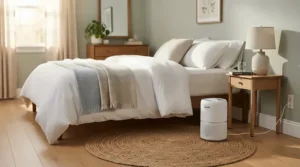
This is the bedside option. It stands 34cm tall, weighs 1.9kg and has three speeds, with CADR at 191 m³/h and a 38 m² maximum room size. Expert Reviews measured 47 dBA at full speed, while the lower settings are almost silent, which is the setting you’ll actually use for sleeping.
It’s not the fastest here. It took just over three and a half minutes to clear the test aerosol. For a single bedroom that’s perfectly adequate, because dust mite allergen exposure happens over eight hours of lying in the same spot. Check the spec if you want a formal H13 rating. The listing claims 99.97% particle removal, but HEPASilent is Blueair’s own combination technology.
Expert Reviews recommended it, citing quiet running and good value. The main reviewer criticism is that it’s not as fast as rivals. I haven’t found a large independent review pool I could verify.
Pros:
- ✅ Nearly silent on low settings
- ✅ Tiny footprint suits bedside tables
- ✅ Low price for a branded unit
Cons:
- ❌ Slower than larger rivals
- ❌ No app, only three speeds
Price range: under £110. Value verdict: great for small bedrooms.
6. MeacoDry Arete One 12L — dehumidifier and H13 HEPA in one box
The standout is two jobs, one appliance. Mites thrive in warm, damp homes, which NHS trust leaflets flag repeatedly, so drying the air attacks the environment as well as filtering the allergen. This combines a dehumidifier, a washable dust filter and an H13 HEPA filter, covering rooms up to about 50 m² at 35–38 dB.
The analytical caution is that a dehumidifier lowers humidity rather than directly removing mites, so view the benefit as supportive. Many allergy guides cite keeping humidity below roughly 50% as a useful target. It also doubles as a laundry-drying aid, which helps if your clothes airer dominates the bedroom.
Mumsnet’s tester praised the quiet running and laundry mode, and two Mumsnet users reported being happy with Meaco’s combined models, one noting milder hay fever. That’s anecdotal and about hay fever, not dust mites. Mumsnet’s spec listing suggests replacing the HEPA filter around every three months, which is a real running cost.
Pros:
- ✅ Dehumidifier and H13 HEPA combined
- ✅ Quiet for its size, 35–38 dB
- ✅ Five-year parts and labour warranty
Cons:
- ❌ Bigger and heavier than a standard purifier
- ❌ HEPA filter replaced roughly every three months
Price range: roughly £170–£200. Value verdict: excellent if damp is also your problem.
7. Dyson Purifier Hot+Cool HP1 — one premium year-round appliance
The standout is versatility. It purifies, heats and cools, with a sealed H13-grade HEPA filter and activated carbon. Sealing matters because it stops unfiltered air slipping past the filter edges. The app reports PM2.5 and PM10 levels and filter life.
The noise range of 46–63 dB is the loudest in this guide, so it’s not a whisper-quiet sleeper. Dyson doesn’t publish a CADR in Mumsnet’s listing, which makes like-for-like airflow comparisons impossible. If you only want a dust mite purifier, this is paying for extras.
Mumsnet’s tester found the room felt fresher after cooking and valued the oscillation for circulating clean air. A Mumsnet user’s partner with hay fever likes his Dyson. Common complaints are size, a short cable and costly replacement filters, which Dyson lists at roughly 12-month intervals.
Pros:
- ✅ Sealed H13-grade HEPA and carbon filtration
- ✅ Heater, fan and purifier in one
- ✅ App shows air quality and filter life
Cons:
- ❌ Expensive upfront and for filters
- ❌ Loudest here at up to 63 dB
Price range: roughly £500–£600. Value verdict: justified only if you’ll use the heater and fan.
Top 7 Compared: Room Size, Smart Features and Filter Life
| Product | Room size (as quoted) | Smart / app | Filter replacement | Best For |
|---|---|---|---|---|
| Hoover H-Purifier 500 | Up to 110 m² | Yes | Indicator light | Large rooms on a budget |
| Coway Airmega Mighty | Up to 109 m² | No | HEPA ~12 months | Family living rooms |
| Levoit Core 300S | 80–108 m² (sources differ) | Yes | ~6–8 months | Scheduling fans |
| Blueair Blue Max 3250i | Up to 48 m² | Yes | Indicator light | Mid-size bedrooms |
| Blueair Blue Pure 511 | Up to 38 m² | No | Indicator light | Small bedrooms |
| MeacoDry Arete One 12L | Up to 50 m² | No | HEPA ~3 months | Damp homes |
| Dyson Purifier Hot+Cool HP1 | Up to 81 m³ (as quoted) | Yes | ~12 months | Year-round premium |
Filter life is where budgets quietly go wrong. The MeacoDry Arete One 12L asks for HEPA changes roughly four times a year, while the Coway Airmega Mighty stretches to about once a year. For bedrooms under 20 m², the Blueair Blue Pure 511 and Hoover H-Purifier 500 give the strongest result per pound, and the Dyson Purifier Hot+Cool HP1 earns its place only if you’d otherwise buy a separate heater and fan.
Bedding Hygiene: The Routine That Makes Any Purifier Work Harder
An air purifier cleans the air. Bedding hygiene attacks the reservoir. Mites live deep in mattresses, pillows and duvets, so skipping this step means your purifier is bailing out a boat while the leak continues.
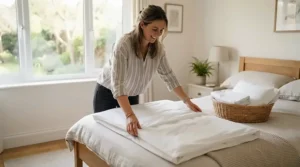
Cambridge University Hospitals’ dust mite guidance recommends barrier covers that are tested to stop allergen escaping, and washing uncovered bedding at 60°C. Note the temperature: other NHS leaflets point out that the allergen dissolves in water, so a cooler wash flushes some away but won’t kill the mites. Here’s a practical weekly rhythm:
- Weekly: Hot-wash sheets and pillowcases at 60°C, and air the mattress by turning back the duvet in the morning.
- Fortnightly: Hot-wash pillows, duvets and blankets where labels allow.
- Monthly: Freeze soft toys for at least 12 hours in a sealed bag, per the same guidance.
- Weekly cleaning: Damp-dust surfaces and vacuum with a HEPA-filter machine, ideally operated by someone who isn’t allergic.
Then add the purifier trick. Run it on a higher speed while you strip the bed, preferably with you out of the room, then drop to a quiet setting overnight. Fabric choices matter too, and padded headboards are named as mite havens in the same guidance. Over the first 30 days, the common mistake is washing at 40°C and assuming the job is done.
Real-World Scenarios: Which Purifier for Which Home?
Specs are abstract. Homes aren’t. Here are three profiles matched to the models above, with the reasoning shown.
The renter in a 12 m² box room (budget under £110, nightly use). You need quiet, small and cheap, with one room to cover. The Blueair Blue Pure 511 fits, with 191 m³/h of airflow comfortably above what a 12 m² room needs. Put it a metre or so from the bed and run it on the lowest setting all night.
The family with two dogs in an open-plan home (budget £100–£200, all-day use). Pet hair, cooking fumes and dust mites make for a busy particle soup. The Coway Airmega Mighty (421 m³/h) or Hoover H-Purifier 500 (330 m³/h) offers headroom. Dog dander is a separate allergen, and the evidence for purifiers is stronger on mites than on pets.
The Victorian terrace with condensation (budget £170–£200, year-round use). Damp and mites go hand in hand, so the MeacoDry Arete One 12L tackles humidity and airborne particles in one go. Run it in the bedroom overnight and use its laundry mode on wet days.
For anyone who wants data, scheduling and room-by-room tracking, the Levoit Core 300S or Blueair Blue Max 3250i fit best. Match the machine to the room you actually sleep in, not the biggest number on the box.
✨ Ready to Breathe Easier?
🔍 Take your bedroom from “sneeze factory” to calmer sleep with these carefully selected purifiers. Click any highlighted product name to check current pricing and availability. Pair your pick with a hot-wash routine and you’ll give yourself the best chance of waking up clear-headed! 🌿
Dust Mite Faecal Particles: What You’re Actually Breathing In
Let’s get properly specific. A house dust mite is about 0.3mm long, feeds on the skin flakes we shed, and turns up in virtually every home regardless of how clean it is. Each one produces droppings constantly, and these droppings carry the potent allergen.
These dust mite faecal particles are the real trigger. They are tiny, but they’re far larger than the 0.3-micron benchmark HEPA filters are tested against, which is good news. Dust mite faecal particles get disturbed by turning over in bed, shaking a duvet or vacuuming, and then drift in the air before eventually settling again.
Two practical consequences follow. First, the allergen outlives the mite, because the droppings persist after the mite dies, so killing mites alone doesn’t fix the problem. Second, timing beats volume: a purifier helps most in the minutes after disturbance and through the night, when you’re breathing in the same cloud of air.
NHS leaflets also emphasise that avoidance measures lower, but never completely remove, mite allergen. Dust mite faecal particles in the bedroom are best tackled from both ends, with fewer mites and cleaner air.
HEPA Microfiltration: What the Label Really Means
HEPA microfiltration sounds like marketing, but it’s a real, standardised idea. A True HEPA filter is rated to capture at least 99.97% of particles at 0.3 microns. H13 grade, under the European EN 1822 standard, is rated at 99.95% or better at the hardest-to-catch particle size. In plain terms, the filter is judged on its worst-case particles, so larger ones such as mite allergen fragments are caught more easily.
Three details separate good HEPA microfiltration from empty claims:
- Seals: A filter is only as good as the housing around it. Dust slipping past the edges bypasses the filter entirely, which is why Dyson emphasises a sealed design.
- Pre-filters: Washable pre-filters catch big debris and protect the HEPA layer, extending its life.
- Terminology: “HEPA-style” and “HEPA-type” aren’t standard classes. Look for True HEPA or H13.
Once a purifier clears the HEPA bar, the filter grade matters less than how much air it moves, which is what CADR tells you. Carbon filters tackle smells and gases, so they’re a bonus for cooking odours but irrelevant to mite allergen.
Do Air Purifiers Really Work for Dust Mites? What the Evidence Says
Honest answer: they help, but they’re not a cure. Mumsnet’s own buying guide describes purifiers as improving air quality rather than being a miracle fix, and says results vary. That matches the research record. A small crossover study of nine mite-allergic patients, published in the journal Allergy, concluded that HEPA air cleaners looked insufficient as a substitute for standard avoidance measures.
Notice the wording: substitute. The study didn’t say purifiers do nothing, and nine patients is a small sample. A hospital leaflet from the Royal United Hospitals Bath also says some people see little improvement even when they follow every measure, and that there’s no way to predict who will benefit.
Same leaflet, though, calls mite-proof covers probably the single most useful step. So the evidence-based sequence looks like this:
- Barrier covers and hot washing first.
- Humidity and ventilation sensible.
- An air purifier as the extra layer.
What to expect in real life? A cleaner-feeling bedroom, possibly fewer morning symptoms, and a lower airborne load after bed-making. What not to expect: a mite-free mattress.
How to Choose an Air Purifier for Dust Mite Allergy
Which? has tested 110 air purifiers and found a huge gap between best and worst, so choosing carefully pays off. Work through these six steps.
- Insist on True HEPA or H13. It’s the filter class that matches how allergen particles behave. Ignore “HEPA-style”.
- Size by CADR, not the box. A common rule of thumb is four to five air changes an hour. For a 12 m² room with a 2.4m ceiling (about 29 m³), multiply by five and aim for at least roughly 145 m³/h.
- Check night-time noise. You’ll live with the sleep setting for eight hours, so look for figures in the low-to-mid 20s or 30s dB.
- Price the filters. Operating costs range from a few pounds a year to over £70, according to Expert Reviews.
- Place it smartly. Put it near where you breathe most, with clear space around the vents, and avoid shoving it behind furniture.
- Skip gimmicks. Be wary of ozone-producing or “ioniser-only” machines marketed for allergies.
Which? notes that most of its Best Buys cost between £200 and £400, but the Hoover H-Purifier 500 shows that strong performance can land far below that.

Air Purifier for Dust Allergy Sufferers: Tailored Advice by Situation
Not every household is the same, so an air purifier for dust allergy sufferers should be matched to the person, not just the room.
If you have asthma: Treat a purifier as a supplement to, never a replacement for, your prescribed treatment. Talk to your GP or pharmacist about managing triggers.
If you share a bed: One partner’s allergy affects both. Choose a quiet model like the Blueair Blue Pure 511 or Coway Airmega Mighty, and use sleep mode.
If you work from home: You’ll spend daytime hours in one room. The Levoit Core 300S schedule feature can ramp up before you start work and drop down during calls.
If you rent: Portable beats built-in. A compact purifier follows you to the next flat, and a hot wash costs nothing in deposit.
If you have pets too: Dog and cat allergens often ride larger particles that settle fast, so a purifier helps less there. Pair it with regular cleaning.
Whoever you are, the best air purifier for dust allergy sufferers is the one that runs every night. A model you switch off because it’s too loud isn’t doing anything.
Air Purifier for Dust Mites Reviews: What Reviewers Consistently Report
Reading air purifier for dust mites reviews across UK sources reveals patterns that spec sheets can’t. I’ve summarised the genuine, aggregated sentiment from Expert Reviews, Mumsnet’s testers and Mumsnet users, not invented owner quotes.
Reviewers praise auto modes. Responsiveness to dust, cooking and sprays comes up repeatedly for the Coway Airmega Mighty, Blueair Blue Max 3250i and Hoover H-Purifier 500.
Reviewers complain about noise at high speed. Loud top settings are flagged on the Coway, Dyson and Blueair ranges. The cure is to buy for the quiet setting, not the maximum one.
Reviewers warn about filter bills. The Levoit’s roughly £30 replacement and the Dyson’s pricey ones are common talking points.
Reviewers stress realistic expectations. Mumsnet is explicit that purifiers don’t clear settled dust or replace cleaning.
One caution about air purifier for dust mites reviews generally: many top-ten lists are affiliate-driven, so favour sources that explain their testing. Where I couldn’t verify real owner reviews for a specific model, I’ve said so above rather than guess.
Air Purifier vs Traditional Alternatives for Dust Mites
A purifier is one tool among several. Here’s how they stack up.
| Option | What it does | Main strength | Main weakness | Best For |
|---|---|---|---|---|
| Air purifier (e.g. Hoover H-Purifier 500) | Filters airborne allergen | Works while you sleep | Doesn’t remove settled allergen | Extra layer of protection |
| Mite-proof barrier covers | Seal mattress, pillows, duvet | Stops allergen escaping | Needs correct fit and testing | First-line defence |
| 60°C hot washing | Kills mites, washes away allergen | Cheap and effective | Not all fabrics tolerate it | Sheets and pillowcases |
| HEPA-filter vacuum | Captures dust from surfaces | Reduces reservoir | Ideally not done by the allergic person | Carpets and upholstery |
| Dehumidifier (e.g. MeacoDry Arete One 12L) | Lowers humidity | Makes homes less mite-friendly | Indirect effect on mites | Damp properties |
The table shows how little overlap there is, which is exactly why combining them works. Barrier covers and hot washing reduce the mites and their droppings at source. A purifier such as the Coway Airmega Mighty catches what gets stirred up anyway. If budget forces a choice, covers and hot washes come first because they cost less and, per NHS trust leaflets, lead the evidence.
Long-Term Cost and Maintenance
A bargain purifier with an expensive filter isn’t a bargain. Here’s what ownership looks like over a year.
| Product | Filter pattern | Running-cost note | Best For |
|---|---|---|---|
| Hoover H-Purifier 500 | Indicator-led | Check filter price before buying | Value hunters |
| Coway Airmega Mighty | HEPA ~12 months, deodoriser ~6 | Predictable, reasonably priced filters | Low-fuss owners |
| Levoit Core 300S | ~6–8 months at ~£30 | Roughly £45–£60 a year | Smart-home users |
| Blueair Blue Max 3250i | Indicator-led | 3W–19W draw is pennies per night | Efficiency fans |
| MeacoDry Arete One 12L | HEPA ~3 months | Highest filter frequency here | Damp homes |
| Dyson Purifier Hot+Cool HP1 | ~12 months or when prompted | Replacement filters are expensive | Premium buyers |
On total cost of ownership, the Coway Airmega Mighty looks like the quiet winner for fuss-free years, while the MeacoDry Arete One 12L is the most demanding on filters but removes the cost of a separate dehumidifier. Expert Reviews puts annual operating costs from a few pounds to over £70, so plan for filters on day one. Maintenance is simple: vacuum or wash the pre-filter on schedule, keep vents clear and never run a clogged filter.
Frequently Asked Questions
❓ How long should I run an air purifier for dust mite allergy each day?
❓ Where should I put an air purifier in the bedroom?
❓ Do air purifiers kill dust mites?
❓ How often should I replace the HEPA filter in a purifier for dust allergy?
❓ Is a cheap air purifier good enough for dust allergy sufferers?
Conclusion
Let’s land the plane. An air purifier for dust mite allergy is a genuinely useful extra layer, but it’s the supporting act. The lead performers are barrier covers, hot washing and sensible humidity control. Add a purifier on top and you get cleaner air through the long hours when your face is inches from the pillow.
If you want one quick decision, here it is. For most bedrooms, the Hoover H-Purifier 500 and Coway Airmega Mighty give the best airflow for the money. The Blueair Blue Pure 511 suits small, quiet rooms. The Levoit Core 300S and Blueair Blue Max 3250i reward the tech-minded. The MeacoDry Arete One 12L earns its place in damp homes, and the Dyson Purifier Hot+Cool HP1 is a luxury for those who want three appliances in one.
Whatever you pick, check filter costs, run it consistently and keep your expectations realistic. If symptoms persist or involve asthma, talk to your GP or pharmacist.
Recommended for You
- Budget Air Purifier For Hayfever: 7 Best Buys Compared (2026)
- Air Purifier For Hayfever Bedroom: 7 Best Quiet Picks UK (2026)
- Air Purifier For Hayfever: 7 Best Picks For UK Homes (2026)
Disclaimer: This article contains affiliate links. As an Amazon Associate, I earn from qualifying purchases. If you purchase products through these links, we may earn a small commission at no additional cost to you.
✨ Found this helpful? Share it with your friends! 💬🤗
