In This Article
Every spring, millions of us in Britain start negotiating with our own noses. Tissues multiply, eyes itch, and the bedroom, supposedly a sanctuary, becomes ground zero. If you’re hunting for a budget air purifier for hayfever, you’ve probably spotted the awkward truth already. The market is a bazaar of confident claims, cryptic acronyms and price tags that run from a takeaway to a second-hand scooter. The trick is finding a budget air purifier for hayfever that suits your room, not just your wallet.
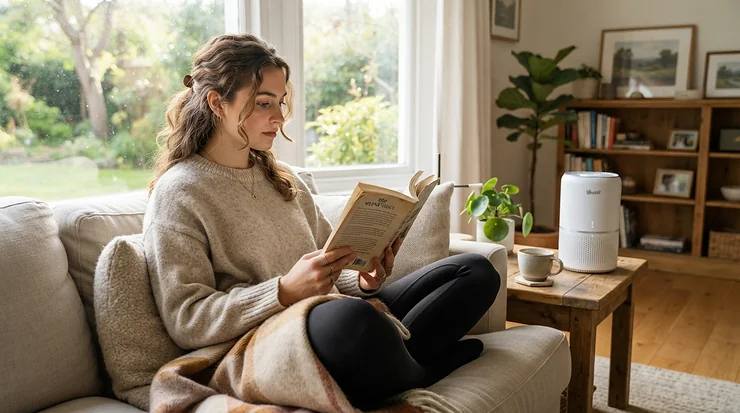
Let’s set honest expectations. The NHS is clear that hay fever can’t be cured or prevented, so medicines and pollen avoidance do the heavy lifting. A purifier is the supporting act. What it can do is pull airborne pollen and dust out of the room where you sleep or work. That is why an air purifier for hayfever sufferers can still earn a place on the bedside table.
Here’s the brief: an air purifier for hayfever under £100 wherever possible, plus a few stretch picks that edge slightly above it (each one flagged). Everything below draws on published specifications, independent reviews and aggregated buyer feedback, not hands-on testing. You’ll see where the evidence is thin as well as where it’s strong. Along the way we’ll cover portable units that follow you from room to room, the low running cost that makes overnight filtering realistic, and why timing this seasonal purchase matters more than most people think.
A quick note: nothing here is medical advice, and prices are ranges only. Check current listings before you buy.
Quick Comparison: 7 Budget Air Purifiers for Hayfever at a Glance
Short on time? This table sorts all seven from pocket-money to stretch-budget. Figures are manufacturer or retailer claims unless stated, and prices are ranges that change often, so check current pricing before buying.
| Product | Price range | Standout spec | Best For |
|---|---|---|---|
| Pro Breeze PB-P03 | Around £40-£50 | 12W tabletop, True HEPA + carbon | Desks and tiny rooms |
| Blueair Blue Pure Mini Max | Under £100 | Around 20 dB on low | Light sleepers, small bedrooms |
| Coway Airmega 50 | Around £80 | Auto mode, Quiet Mark | Single bedrooms |
| Levoit Core 200S | Around £80-£100 | App and schedule control | Smart-home fans, home offices |
| Philips PureProtect Mini 900 Series (AC0920/10) | Around £100-£130 | 250 m³/h CADR, PM2.5 sensor | Larger bedrooms |
| Xiaomi Smart Air Purifier 4 Lite | Around £100-£120 | 360 m³/h CADR | Living spaces on a budget |
| Levoit Core 300S | Around £120-£135 | H13 HEPA, auto mode, 258 m³/h | Open-plan, stubborn hayfever |
Read the table as a ladder. The Coway Airmega 50 and Blueair Blue Pure Mini Max are the sleep-first choices when you only need to clean one bedroom. The Xiaomi Smart Air Purifier 4 Lite and Philips PureProtect Mini 900 buy far more airflow for roughly £20-£40 extra. If an air purifier for hayfever under £100 is your hard limit, the Levoit Core 200S is the feature-richest option. The Levoit Core 300S is worth the stretch if your room is big or your symptoms stubborn.
💬 Just one click — help others make better buying decisions too!😊
Top 7 Budget Air Purifiers for Hayfever: Expert Analysis
The seven models below run from cheapest to priciest. Each gets the same treatment: what the specs mean in practice, who it suits, and what reviewers keep saying. Where I couldn’t verify real-world feedback, I say so.
1. Pro Breeze PB-P03 — cheapest way into filtered air
The Pro Breeze PB-P03 is the “dip a toe in” option at around £40-£50 at the time of research. It packs a pre-filter, True HEPA, activated carbon and an ioniser into a 12W tabletop unit with two fan speeds. Translation: it sips electricity, but it also moves very little air. Coverage claims conflict. One seller lists 15 m² and a comparison site lists 5 m², and when specs disagree by a factor of three, believe the smaller number. Based on the spec comparison, it works best as a personal-space purifier for a desk, a nightstand or a student box room, with the intake roughly an arm’s length from your face. If you’d rather skip the ioniser, check the manual for how to switch it off.
Buyer comments on resale listings describe it as quiet and compact, with a few noticing less dust. One critical comment says it needs clear space around it, so it’s less tiny than it looks.
Pros:
- ✅ Lowest entry price in this round-up
- ✅ Genuine True HEPA stage plus carbon
- ✅ Very low 12W power draw
Cons:
- ❌ Only two speeds, no timer or auto mode
- ❌ Conflicting coverage claims; strictly small-space use
Value verdict: a low-risk first purifier at around £40-£50, provided you keep expectations modest.
2. Blueair Blue Pure Mini Max — whisper-quiet at 20 dB
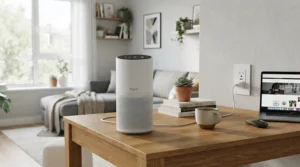
Quiet is the headline. The Blueair Blue Pure Mini Max runs at around 20 dB on low and never climbs above roughly 44 dB, so it won’t fight your sleep. Blueair’s HEPASilent filtration is rated at 100 m³/h for smoke, dust and pollen, and the recommended room size is up to about 20 m². Blueair also claims it can clean 8.5 m² in 12.5 minutes, which is a manufacturer figure worth a pinch of salt. In practice that’s a comfortable fit for a box room or nursery, but a squeeze for a big master bedroom. Which? describes it as a basic, petite model with a night mode and three fan speeds, and lists it as a sensible option under £100. Controls are two buttons, which is either refreshingly simple or mildly irritating, depending on your love of apps.
On Mumsnet, one parent reported fewer sniffles and better sleep for a hayfever-plagued child after buying one. They admitted they couldn’t be sure the purifier, rather than a quirk of the pollen count, deserved the credit.
Pros:
- ✅ Ultra-quiet low setting for night use
- ✅ Light and compact, with travel adapters supplied
- ✅ Simple three-speed, two-button operation
Cons:
- ❌ Modest airflow limits it to small rooms
- ❌ No app and no air-quality-driven auto mode
Value verdict: under £100 and arguably the best “quiet first” buy for small bedrooms.
3. Coway Airmega 50 — the bedroom specialist
The Coway Airmega 50 is a cylinder that looks like a design object rather than a medical device, which matters if it lives on your chest of drawers. Specs worth translating: a CADR of 120.1 m³/h, a recommended room size up to 31 m² (generous, so treat 15-20 m² as realistic), and a sleep-mode noise level of 18.4 dB. It carries Quiet Mark certification, and filters are rated for around eight months. Auto mode adjusts fan speed to what its sensor detects, with a colour-coded air-quality light.
Mumsnet’s reviewer said it noticeably freshened stuffy air and was quiet enough for a light-sleeping partner. They also found it slower to clear smoke and strong smells in open-plan spaces, and turbo mode is louder. That’s the honest picture: bedroom hero, living-room underdog. The auto mode is a real advantage on pollen days, when the fan ramps up without you fiddling with buttons.
Pros:
- ✅ Quiet Mark-certified, very quiet sleep mode
- ✅ Auto mode with visible air-quality indicator
- ✅ Low energy use for a low running cost
Cons:
- ❌ No app or smart-home features
- ❌ Struggles in large open-plan rooms
Value verdict: around £80, it’s one of the strongest all-round buys for a single bedroom.
4. Levoit Core 200S — smart controls on a small budget
Smart features are rare at this price, which is the Levoit Core 200S‘s party trick. You get a three-stage HEPA filter, an app, Alexa support, scheduling and a touch display. Retailer listings quote a sleep mode of about 24 dB and a CADR near 170 m³/h. Published figures vary by source, and the “up to 70 m²” claim some pages make is optimistic, so think bedroom or home office. One buyer comment notes it lacks the auto mode and air-quality sensor of the pricier 400S. A regional newspaper reviewer found it helped with hay fever, but not as a magic fix. Independent lab-style testing from HouseFresh was more mixed, concluding it didn’t quite do enough in its tests.
The sensible reading is that it’s a good small-room machine with excellent controls, not a powerhouse. Buyers on retailer listings praise pollen and dust pickup, and mention noise at full power and replacement filters costing around £30 each.
Pros:
- ✅ App, timer and schedule control
- ✅ Quiet sleep mode for bedrooms
- ✅ Three-stage HEPA filtration
Cons:
- ❌ No auto mode or air-quality sensor
- ❌ Noticeable noise at top speed
Value verdict: typically around £80-£100, making it a smart-feature bargain if you accept its small-room limits.
5. Philips PureProtect Mini 900 Series (AC0920/10) — big-brand filtration, strong airflow
The Philips PureProtect Mini 900 Series (AC0920/10) is rated at 250 m³/h CADR, with Philips stating suitability for rooms up to 65 m². Philips’s own CADR calculation assumes a 48 m³ room, so the 65 m² figure is best read as a ceiling, not a promise. It has a PM2.5 sensor with colour and numerical feedback, plus NanoProtect HEPA filtration that Philips says captures 99.97% of particles down to 0.003 µm in its lab testing. Philips also cites allergen testing with dust mite, birch pollen and cat allergens by an Austrian institute. These are manufacturer claims, and I couldn’t find independent reviews of this exact model, so treat the numbers as promising rather than proven.
Philips sells several 900-series variants, so check the model code on the listing. The Philips store lists a two-year warranty and 60-day returns, which is reassuring. Based on the specs, this suits a larger bedroom or a family room where the sensor can react to cooking and dust as well as pollen.
Pros:
- ✅ 250 m³/h airflow for larger rooms
- ✅ PM2.5 sensor with real-time feedback
- ✅ Two-year warranty on Philips’s own store
Cons:
- ❌ No independent reviews found for this model
- ❌ Sits at the top of the budget bracket
Value verdict: around £100-£130 for strong airflow and a trusted brand, if you’re happy to rely on manufacturer data.
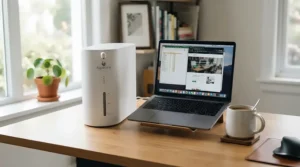
6. Xiaomi Smart Air Purifier 4 Lite — the airflow bargain
If raw airflow per pound is your yardstick, the Xiaomi Smart Air Purifier 4 Lite is hard to beat. It offers 360 m³/h CADR, a quoted coverage of 25-43 m² and a three-in-one filter (pre-filter, HEPA, carbon). It also has 15 fan speeds, an OLED display, auto mode and a timer. Night mode drops to about 33 dB, while the top speed reaches roughly 61 dB, which is loud. Read that as “quiet at night, shouty when you need it”. Xiaomi’s pages mention TÜV Rheinland certification for allergen filtering and a filter life of about six months at 12 hours a day.
Reviewers were positive. One independent tester called it impressive across their tests and noted it was among the quietest at its lowest speed. A Swedish tech site described it as an interesting model for limited budgets. The same site noted that the app is mainly useful if you already own other Xiaomi gadgets.
Pros:
- ✅ Huge 360 m³/h airflow for the money
- ✅ Auto mode, timer and air-quality display
- ✅ Quiet night setting
Cons:
- ❌ Loud at maximum speed
- ❌ Slightly above £100 at typical UK prices
Value verdict: around £100-£120, it’s the best budget pick for living rooms, provided you check the UK warranty on the listing.
7. Levoit Core 300S — the stretch pick with the broadest skills
The Levoit Core 300S is the most capable purifier here, and the only one with a premium-grade filter. It combines a pre-filter, H13 True HEPA and activated carbon, with 258 m³/h CADR and noise from about 22 to 50 dB. Auto mode monitors air quality, and a Quiet Auto setting avoids the highest fan speed, so it won’t wake you at 2 a.m. The VeSync app gives timers of one to twelve hours, scheduling and live air-quality readouts.
Mumsnet’s tester found it easy to set up and effective, though it’s large for a budget model and has a short power cable. Mumsnet users also like the brand. One pet owner reports far less dust and hoovers the filter weekly, but notes it’s noisy on higher settings. Replacement filters cost roughly £30.
Pros:
- ✅ H13 HEPA with auto mode and carbon
- ✅ Strong 258 m³/h airflow
- ✅ Quiet Auto mode for bedrooms
Cons:
- ❌ Short power cable and large footprint
- ❌ Filters cost around £30 each time
Value verdict: around £120-£135, it’s the pick if one purifier must cover a bigger room or you want the strongest filter on this list.
Top 7 Specs Compared
| Product | Coverage (maker’s claim) | CADR | Noise | Best For |
|---|---|---|---|---|
| Pro Breeze PB-P03 | 5-15 m² (sources conflict) | Not stated | Up to ~55 dB | Desks, tiny rooms |
| Blueair Blue Pure Mini Max | Up to 20 m² | 100 m³/h | 20-44 dB | Light sleepers |
| Coway Airmega 50 | Up to 31 m² | 120 m³/h | 18.4-44.1 dB | Bedrooms |
| Levoit Core 200S | Listings say up to 70 m² | ~170 m³/h (listing) | ~24 dB sleep mode | Smart-home fans |
| Philips PureProtect Mini 900 | Up to 65 m² | 250 m³/h | Not stated | Larger rooms |
| Xiaomi Smart Air Purifier 4 Lite | 25-43 m² | 360 m³/h | ~33-61 dB | Open living spaces |
| Levoit Core 300S | Up to 108 m² | 258 m³/h | 22-50 dB | All-rounder |
Mumsnet notes that brands calculate room coverage differently, so CADR is the fairer comparison than the biggest number on the box. By that yardstick, the Xiaomi Smart Air Purifier 4 Lite and Levoit Core 300S lead on airflow. The Coway Airmega 50 and Blueair Blue Pure Mini Max win on night-time noise, and the Pro Breeze PB-P03 is simply the cheapest. Match airflow to room size first, then pick on noise and controls.
Practical Guide: Setting Up Your Budget Air Purifier for Hayfever Season
The best purifier in Britain is useless if it’s wedged behind a wardrobe. Here’s a first-30-days routine that Amazon listings rarely spell out.
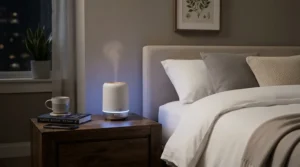
Placement. Leave clear space around the intake and outlet, as Mumsnet advises, and keep the unit within a few metres of where you sleep. Raise small models onto a bedside table so they pull air from breathing height.
The pre-bed reset. On high-pollen days, run the machine at a higher speed for 30-60 minutes with the door and windows shut. Then drop to the quiet setting before lights out. Most of the pollen you carried in during the day is airborne for a while after you walk through the door, so that’s when the machine works hardest.
Cut pollen at source. Allergy UK’s nurse, quoted by Which?, recommends keeping windows shut in the early morning and evening, showering and changing clothes after being outdoors, and wiping pets with a damp cloth. These habits reduce what the purifier has to chase.
Maintenance schedule:
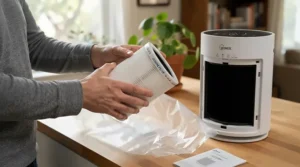
- Weekly: wipe the grille and vacuum the pre-filter if the manual allows. One Mumsnet pet owner hoovers their purifier’s filter every week.
- Monthly: check any filter indicator or inspect the filter colour.
- Every 6-8 months: replace filters. The Levoit Core 200S and Levoit Core 300S both list six to eight months, and the Coway Airmega 50 around eight.
First-month mistakes: parking it in a corner, living permanently on the quietest setting, and ignoring the filter reminder.
Real-World Scenarios: Three Hayfever Households
These are typical profiles built from the specs above, not real people. They show how the logic plays out.
Scenario 1: The student in a 10 m² rented room (budget under £60, nightly use during exam season). A box room is where small airflow works. The Blueair Blue Pure Mini Max sits comfortably within its 20 m² rating, and its low setting won’t disturb flatmates. The Pro Breeze PB-P03 is the cheaper desk-side alternative if funds are really tight.
Scenario 2: The family with a teenager sleeping badly (budget around £100, 12-15 m² bedroom, used March to September). Mumsnet threads show parents asking for exactly this. The Coway Airmega 50 is the sensible centre-ground choice, with auto mode, 120 m³/h and sleep-mode quiet. The Levoit Core 200S wins if the teenager wants app control. This is a classic seasonal purchase: buy early, set up before tree pollen arrives, and run it nightly.
Scenario 3: The home worker in a 30 m² open-plan space (budget up to £135, daytime use, doors often open). Small purifiers will struggle here. The Xiaomi Smart Air Purifier 4 Lite (360 m³/h) or Levoit Core 300S (258 m³/h, H13 filter) make more sense, and the Philips PureProtect Mini 900 is a credible third option. Keep the doors closed while it works, and accept that a unit sized for a bedroom will under-deliver in a lounge.
What Is a Budget Air Purifier for Hayfever?
A budget air purifier for hayfever is a compact, relatively low-cost room appliance that draws air through a filter, ideally a HEPA stage, to trap airborne pollen, dust and pet dander before recirculating cleaner air. Typically priced under about £130, it targets a single room and reduces the pollen load you breathe indoors rather than treating hay fever itself.
That last point matters. The NHS says hay fever has no cure, and Mumsnet’s guide stresses that purifiers don’t remove settled dust, fix damp or replace ventilation and cleaning. Some people with allergies find them helpful, but results vary.
Why does a filter help at all? Whole pollen grains are comparatively large and tend to settle, while smaller fragments and dust can hang in the air much longer. A purifier works on that suspended load, especially in a closed bedroom overnight. Think of it as a very patient bouncer for your breathing zone: it can’t evict everyone, but it keeps the queue moving.
How to Choose a Budget Air Purifier for Hayfever
Follow these six steps and you’ll sidestep most regrets.
- Match the room size. Use the maker’s coverage claim as a ceiling, not a target. For a 12 m² bedroom, any model here is plenty; for 30 m², stick to the bigger-airflow options.
- Check CADR. A widely used rule of thumb is a CADR of four to five times the room’s volume per hour. A 29 m³ bedroom therefore needs roughly 115-145 m³/h, which the Coway Airmega 50 just meets.
- Insist on genuine HEPA. Which? notes that a true HEPA filter must capture at least 99.95% of 0.3 µm particles under EU standards, and warns against vague “HEPA-type” wording.
- Check night-time noise. Look at the dB figure on the lowest speed, not the highest.
- Price the filters. A cheap machine with £30 filters every six to eight months can cost more than a pricier one with longer-lived filters.
- Decide on extras. Auto mode and an air-quality display are useful; apps are optional.
Finally, check footprint and warranty, because a unit you can’t place sensibly won’t get used.
Air Purifier for Hayfever Under £100: What Your Money Really Buys
Here’s the awkward truth. Which? says air purifiers costing under £100 don’t often do well in its tests, partly because smaller fans move less air. That’s not a reason to give up. It’s a reason to match expectations to the room. An air purifier for hayfever under £100 can work well in a single bedroom, but it won’t clean a lounge.
The benchmark at the rock-bottom end is IKEA’s UPPÅTVIND, which Mumsnet picks as its best budget model at under £35. It’s built for rooms of around 7 m², uses an EPA12 filter and has no carbon stage. It isn’t sold through Amazon, so I haven’t ranked it here. One Mumsnet user with tree-pollen hayfever said it improved their sleep and stopped the dry-mouth wake-ups. That sums up the budget category: small rooms, modest expectations, real benefits.
| Price band | What you realistically get | Best For |
|---|---|---|
| Under £50 | Tabletop personal units such as the Pro Breeze PB-P03; small fans, basic controls | Desks and tiny rooms |
| £50-£100 | Real HEPA bedroom units such as the Blueair Blue Pure Mini Max, Coway Airmega 50 and Levoit Core 200S | Single bedrooms |
| £100-£135 | Faster airflow and sensors: Philips PureProtect Mini 900, Xiaomi Smart Air Purifier 4 Lite, Levoit Core 300S | Bigger or shared rooms |
The jump from the middle band to the top is about £20-£50, but airflow roughly doubles or triples. If your room is above about 20 m², stretching past £100 buys far more performance than any feature upgrade in the lower bands.
Air Purifier for Hayfever Sufferers: Matching the Machine to the Misery
Not all hay fever is equal, so an air purifier for hayfever sufferers should fit your pattern, not just your budget.
The blocked-nose sleeper. If you wake with a dry mouth because your nose has given up, prioritise a quiet unit near the pillow. The Coway Airmega 50 and Blueair Blue Pure Mini Max are built for exactly this.
The all-day sufferer. If symptoms hit while you work, a higher-airflow unit such as the Xiaomi Smart Air Purifier 4 Lite or Levoit Core 300S keeps a bigger space cleaner.
The asthmatic or eczema-prone household. NHS Dorset notes hay fever is more common among people with asthma and eczema, and NHS Sussex advises calling NHS 111 if you experience wheezing, breathlessness or chest tightness. A purifier shouldn’t replace medical advice.
The parent shopping for children. Prioritise low noise, cables that stay out of reach and simple controls, such as the Blueair Blue Pure Mini Max‘s two buttons.
Portable Units: Moving One Purifier Between Rooms
The best portable units are light enough to carry, but not so tiny that they’re pointless. The Blueair Blue Pure Mini Max weighs under 2 kg, and the Levoit Core 200S is around 3 kg with a compact footprint. Both are easy to shift between bedroom and study.
Here’s the catch with portable units: a purifier sized for a 12 m² bedroom will under-serve a 30 m² lounge. Mumsnet’s tester noted the Coway Airmega 50 is best suited to single rooms for this reason. A practical routine is to run one unit in the living space during the day and move it to the bedroom an hour before bed. Close the door so it only has to treat one room’s air.
Check cable length before you plan to move things around, because the Levoit Core 300S has a short cord and bulky shape. If you’d rather not shuffle, two cheap portable units (one for the lounge, one for the bedroom) can beat one expensive unit. Place each on a stable surface with clear space around it.
Low Running Cost: What an Air Purifier Really Costs to Run
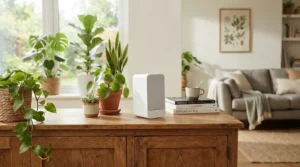
Here’s the good news for anyone fretting over bills. Low running cost is one of the best things about this category. As an illustration, at 30p per kWh (check your own tariff), a 12W unit like the Pro Breeze PB-P03 uses about 0.1 kWh over eight hours, roughly 3p a night. The Levoit Core 200S is listed at around 26W maximum, so eight hours at full blast is about 0.2 kWh, or around 6p. The Xiaomi Smart Air Purifier 4 Lite is rated around 33W, so eight hours at maximum is roughly 8p. Most of the time you’ll run at lower speeds and spend far less. TechRadar’s review of a sister Blueair model estimated under 2p per 24 hours at its everyday setting, using a 35p tariff.
Running a 26W unit at full speed for eight hours nightly over a 120-night season costs only about £7.50. The real cost is filters. At around £30 per replacement every six to eight months, filters can outspend electricity several times over. Choose a model with accessible, reasonably priced filters, and you’ve secured your low running cost.
Seasonal Purchase: When to Buy and When to Switch On
This is a seasonal purchase, and timing it well saves money and stress. Which? gives the UK pollen calendar as tree pollen from late March to mid-May, grass pollen from mid-May to July, and weed pollen from June to September. That’s roughly six months of potential misery.
Three timing tips follow.
First, buy before the rush. Press coverage of a Philips air-purifier price cut appeared in July, mid-season, which suggests shoppers often react to peak pollen rather than plan for it. Never assume a price will fall, though. Check current pricing and compare.
Second, don’t burn filters before the season starts. If you buy in October, run it on low through winter, or keep it for the first high-pollen day, so the filter has life left when you need it most.
Third, track the pollen. The Met Office weather app shows daily pollen levels, helping you decide when to run the purifier on high. A calm autumn purchase and a March start is the least stressful way to approach it.
Features That Actually Matter (And Those That Don’t)
Marketing departments love shiny extras. Here’s what is worth caring about for a budget air purifier for hayfever, and what isn’t.
Matters: a true HEPA filter; CADR matched to room size; a low-noise sleep setting; a washable pre-filter where offered; and filter price and availability.
Nice to have: auto mode with an air-quality sensor, as on the Coway Airmega 50, Philips PureProtect Mini 900 and Levoit Core 300S, plus timers and schedules. They save fiddling but don’t improve filtration.
Doesn’t matter much: ionisers (a bonus, not a reason to buy), glitzy displays, and vague claims about killing viruses, which are irrelevant to pollen. A sleek app won’t help if the fan is too small for your room. The boring numbers (CADR, dB, filter cost) predict satisfaction far better than the extras do.
Common Mistakes When Buying a Budget Air Purifier for Hayfever
Avoid these pitfalls.
- Buying by the largest coverage number. Brands calculate it differently, so use CADR instead.
- Ignoring filter costs. A £30 filter every six to eight months adds up.
- Putting it in the wrong room. A bedroom unit in a lounge won’t cut it.
- Leaving windows open at dawn. Which? advises keeping them shut in the early morning and evening, when pollen is released and settles.
- Expecting a cure. The NHS is clear there isn’t one.
- Trusting “HEPA-type” labels. Check for genuine HEPA.
Fix those six and even the cheapest model will perform closer to its potential.
Budget Air Purifier for Hayfever vs Other Ways to Fight Pollen
A purifier is one tool among several, and the cheapest ones are often free.
| Approach | Strength | Limit | Best For |
|---|---|---|---|
| Air purifier (e.g. Coway Airmega 50) | Cleans suspended pollen and dust in one room | Doesn’t treat symptoms or settled dust | Bedrooms and home offices |
| Pharmacist-advised medicines | Directly treats symptoms (NHS recommends asking a pharmacist) | Doesn’t reduce pollen in your home | Everyone with symptoms |
| HEPA vacuum and damp dusting | Removes settled pollen from floors and surfaces | Doesn’t clean the air | Weekly cleaning |
| Showering and changing after outdoors | Stops pollen reaching the bedroom | Needs daily habit | High-pollen days |
| Keeping windows shut | Free and effective at peak times | Reduces ventilation | Early mornings, evenings |
The pattern is clear. The purifier is a useful addition, not a substitute. Layering these tactics gives a better result than any single one. A Levoit Core 200S in the bedroom, medicine from the pharmacy and a shower after outdoors beats an expensive purifier used alone.
FAQ
❓ Does a budget air purifier for hayfever really need a HEPA filter?
❓ How much does it cost to run a cheap air purifier overnight?
❓ Which air purifier for hayfever under £100 is the quietest?
❓ Is it worth buying a portable air purifier in autumn for next spring?
❓ Can one purifier cover my bedroom and living room?
Conclusion
Finding the right budget air purifier for hayfever comes down to three questions. How big is the room? How quiet must it be at night? And what will the filters cost? For a single bedroom, the Coway Airmega 50 and Blueair Blue Pure Mini Max deliver quiet, effective filtering without fuss, and the Levoit Core 200S adds app control if you want it. For larger spaces, the Xiaomi Smart Air Purifier 4 Lite, Philips PureProtect Mini 900 and Levoit Core 300S are worth the small stretch beyond £100. The Pro Breeze PB-P03 remains the cheapest toe-dip, best kept to a desk.
Be realistic about what to expect. An air purifier for hayfever under £100 can make a bedroom noticeably more comfortable, but it works alongside medicines, pollen avoidance and good habits, not instead of them. If symptoms persist, talk to a pharmacist or GP, and Allergy UK offers further guidance for people living with allergies. For anyone searching for an air purifier for hayfever sufferers, the best choice is the one that fits the room and gets used every night. Plan the seasonal purchase early, enjoy the low running cost, and take your portable units wherever the pollen hits hardest. 🌿
✨ Ready to Breathe Easier This Season?
🔍 Click any highlighted product name to check current pricing and availability, and pick the budget air purifier for hayfever that suits your room. Your nose will thank you come March! 🌸
Recommended for You
- Air Purifier For Hayfever Bedroom: 7 Best Quiet Picks UK (2026)
- Air Purifier For Hayfever: 7 Best Picks For UK Homes (2026)
- Air Purifier For Allergies And Asthma: 7 Best UK Picks (2026)
Disclaimer: This article contains affiliate links. As an Amazon Associate, I earn from qualifying purchases. If you purchase products through these links, we may earn a small commission at no additional cost to you.
✨ Found this helpful? Share it with your friends! 💬
