In This Article
You spend roughly a third of your life in one room. If that room is full of pollen, you pay for it every night. Pollen hitches a ride in on your hair, your jumper, your dressing gown, even your dog. Then it settles into the duvet and waits for you to lie down and breathe deeply for eight hours. That is why an air purifier for hayfever bedroom use has become one of the most-searched home upgrades each spring and summer.
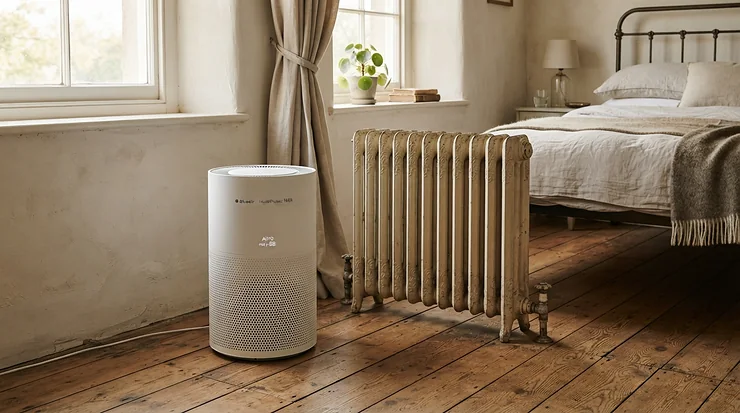
Let’s be honest about what these machines can do. The NHS is clear that hayfever has no cure and that the basics still matter: keep windows and doors shut, and don’t dry washing outdoors. An air purifier is a supporting act, not the headline. But it is a good supporting act. It tackles the pollen that gets past your defences, and the better ones do it quietly enough that you’ll forget they’re running.
This guide covers seven real, UK-available models, from a pocket-sized unit to a premium bladeless tower. For each one I’ve drawn on manufacturer specifications, independent test data and the aggregated sentiment of published reviews. I haven’t tested these myself, and I won’t pretend otherwise. The article covers the specs that matter (and the ones that don’t), what “quiet night mode” really means, how a closed-window pollen barrier works, and how to set everything up so your sleep quality has the best chance of improving.
Quick Comparison: 7 Best Picks at a Glance
| Product | Best For | Claimed Sleep-Mode Noise | CADR (Manufacturer) | Price Range |
|---|---|---|---|---|
| Levoit Core 300S | All-round smart bedroom pick | ~22–24 dB | ~240 m³/h | Around £110–£160 |
| Blueair Blue Pure Mini Max | Compact air purifier for hayfever in small rooms | Whisper-level on low | ~102 m³/h (60 cfm) | Typically under £150 |
| Philips 3000i AC3033/30 | Large, open or heavy-pollen rooms | From 34 dB | 520 m³/h | Roughly £250–£450 |
| Winix 5500-2 | Big bedrooms, allergy-certified peace of mind | ~27.8 dB | ~390 m³/h | Around £150–£220 |
| Dyson Purifier Cool PC1 | Hot sleepers wanting fan and purifier in one | Night mode (~50 dB on quieter settings per one review) | Not directly comparable | Around £450 at launch |
| Levoit Core Mini | Tight budgets, boxrooms, nurseries | ~25 dB | ~78 m³/h | Typically under £60 |
| Philips 600 Series AC0651/10 | Mid-range app control for medium rooms | Sleep mode (check listing) | Check listing | Roughly £100–£180 |
Looking at the table, the Levoit Core 300S is the best balance of price, smart features and sleep-mode manners. The Philips 3000i AC3033/30 and Winix 5500-2 are the muscle for large rooms. If your bedroom is small or you’re on a tight budget, the Blueair Blue Pure Mini Max and Levoit Core Mini make far more sense than an oversized machine you’d run on a whisper setting.
💬 Just one click — help others make better buying decisions too!😊
What Is an Air Purifier for Hayfever Bedroom Use?
An air purifier for hayfever bedroom use is a plug-in appliance that draws bedroom air through a HEPA filter, which traps airborne pollen and other allergens, then releases cleaner air back into the room. The best models also run quietly in a night mode, so they can work through the hours you’re asleep.
That definition hides a few details worth knowing. Which? explains that a purifier sucks in air, traps floating particles and circulates the cleaner air back out. The key word is floating. Pollen already settled on your pillow isn’t touched until something stirs it back into the air, which is why filtration and housekeeping have to work together.
Two numbers separate good machines from decorative ones:
- CADR (Clean Air Delivery Rate) tells you how much filtered air the machine delivers per hour. Higher is faster.
- Room-size rating tells you what floor area the manufacturer thinks it can handle. Treat it as a ceiling, not a target. Buy a unit rated comfortably above your room size so you can run it on a lower, quieter speed.
Top 7 Air Purifier for Hayfever Bedroom Picks: Expert Analysis
Every pick below is a real, UK-available model. Prices are ranges only, so check the current price on Amazon before you buy.
1. Levoit Core 300S — best smart all-rounder for sleepers
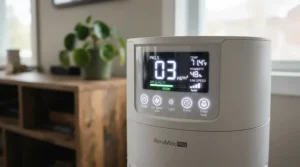
The Levoit Core 300S is the quiet achiever of this list. It stands out for pairing a real-time laser particle sensor with an auto mode that backs off when the air is clean.
On paper it delivers a CADR of around 240 m³/h through three-stage True HEPA filtration, in a body of just 22 x 22 x 36 cm weighing about 2.7 kg. In practice, that is roughly eight full air changes an hour in a typical 12 m² bedroom at top speed. It also means the machine can idle at a whisper on sleep mode and still keep pace with drifting pollen. The manufacturer quotes 22–24 dB in sleep mode, but one independent lab test measured around 41 dBA at close range, so treat the lower figure as a best case.
This is the pick for tech-comfortable buyers who want the VeSync app, scheduling and a screen that switches off at night. Independent reviewers consistently call its sleep mode its strongest feature, and they praise the app as the main reason to pay more than for the non-smart Core 300. The filter should be replaced every six to eight months.
Pros:
- ✅ Laser sensor drives smart auto mode
- ✅ Display switches off completely at night
- ✅ Low running costs; frugal motor
Cons:
- ❌ Real-world noise higher than headline dB
- ❌ Wi-Fi app needed for full control
Price range: around £110–£160. Good value for a smart, sleep-focused machine; check the current price.
2. Blueair Blue Pure Mini Max — best compact air purifier for hayfever
The Blueair Blue Pure Mini Max is the compact air purifier for hayfever that punches above its footprint. Its calling card is HEPASilent filtration, which Blueair says captures 99.97% of particles down to 0.1 microns with a gentle fan.
The numbers are modest by design: a CADR of 60 cfm (about 102 m³/h) and Blueair’s own recommended room size of around 90 ft² (roughly 8 m²). That makes it a smart choice for a box room, nursery or single bedroom, and a poor one for a large master suite. In my arithmetic it manages roughly three to four air changes an hour in a 12 m² room at full speed. Independent testing found it performed very well even in a room nearly twice its recommended size.
It’s deliberately simple: three fan speeds, two buttons, no app and no timer. Reviewers hosted on Blueair’s own site describe it as a light, unobtrusive white-noise presence. One Mumsnet parent reported fewer hayfever problems for a daughter after buying it, though she noted the pollen season might simply have changed. Filters are recommended every six months.
Pros:
- ✅ Genuinely small; sits on a bedside table
- ✅ Washable pre-filter in several colours
- ✅ Strong test results for its size
Cons:
- ❌ No timer or app control
- ❌ Too small for large bedrooms
Price range: typically under £150. Good value if your room is small.
3. Philips 3000i AC3033/30 — best for large, heavily affected rooms
The Philips 3000i AC3033/30 is the heavyweight. Its standout feature is raw airflow: Philips quotes a CADR of 520 m³/h and a recommended room size of up to 135 m².
One reviewer’s testing cited a lower figure of 400 m³/h for particles, so expect some variation depending on the test. Either way, this is far more machine than a 12 m² bedroom needs, and that’s the point. In a small room you can run it on its lowest settings. Philips claims sleep mode runs from 34 dB, with a Quiet Mark certification, dimmed lights and an air-quality display showing allergen, particle and gas levels. At turbo it reaches 66 dB, which reviewers describe as fan-like and impossible to ignore.
Ideal Home scored it 4.5 stars. Other reviewers flag the size (it’s tall and not easy to move between rooms) and the cost of replacement filters, with the FY3430/30 around £75. It suits open-plan bedrooms, loft conversions and households with multiple allergy triggers.
Pros:
- ✅ Huge CADR leaves headroom for quiet running
- ✅ Real-time allergen and particle display
- ✅ Quiet Mark-certified sleep mode
Cons:
- ❌ Bulky and heavy for small rooms
- ❌ Noisy at turbo; pricey filters
Price range: roughly £250–£450 depending on retailer. Best value when bought at the lower end of that range.
4. Winix 5500-2 — best allergy-certified workhorse for big bedrooms
The Winix 5500-2 is the practical choice. Its standout is the washable carbon pre-stage that reduces ongoing filter spend. UK retail listings quote a CADR of 390 m³/h, coverage up to about 99 m², and an Allergy UK certification.
Its four-stage system combines a washable pre-filter, washable carbon, True HEPA and PlasmaWave. Auto mode uses a particle sensor, and sleep mode is listed at around 27.8 dB. That suits anyone in a larger or older bedroom where draughts mean pollen creeps in despite closed windows.
Owners on retail listings praise its auto mode and say the night setting is very quiet. They also say turbo mode is loud, which doesn’t matter because you shouldn’t need it nightly. The recurring complaints are practical ones: no Wi-Fi, no backlit buttons, and the washable carbon is a faff to clean. Some reviewers say sleep mode dims lights without dramatically dropping the fan, so test it on your first night.
Pros:
- ✅ Large coverage; easy to run quietly
- ✅ Washable carbon filter lowers upkeep costs
- ✅ Allergy UK certification listed
Cons:
- ❌ No app or Wi-Fi smarts
- ❌ Loud on turbo; unlit buttons
Price range: around £150–£220. Strong value for the room size.
5. Dyson Purifier Cool PC1 — best for hot sleepers who want a fan too
The Dyson Purifier Cool PC1 is the premium oddity: a fully sealed HEPA H13 purifier that doubles as a bladeless cooling fan. That appeals if you want to keep windows shut in a heatwave, as the NHS advises, without baking.
Dyson says the sealed system captures 99.95% of particles down to 0.1 microns. It adds 350° oscillation, a night mode with a dimmed display and a sleep timer. T3’s reviewer found it cooled the room and was quiet enough to sleep with, quoting about 50 dB on quieter settings and 61.4 dB at maximum. That’s louder than most rivals here at low speed.
Here’s the honest catch. RTINGS’ lab testing rated its particle filtration performance as disappointing and called it a middling bedroom choice. Some buyers also report the cooling is subtle. The spec sheet looks premium, but the pure filtration value-for-money argument is weaker than for the Levoit or Winix. Buy it for the 2-in-1 appeal, not as the cheapest route to clean air.
Pros:
- ✅ Sealed H13 system with remote and app
- ✅ Doubles as an oscillating cooling fan
- ✅ Night mode with timer options
Cons:
- ❌ Mixed lab results on particle removal
- ❌ Premium price; louder on low settings
Price range: around £450 at launch, sometimes less. Value depends on how much you’ll use the fan.
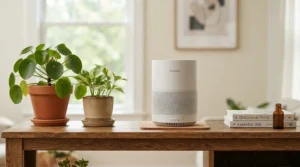
6. Levoit Core Mini — best budget pick for tiny rooms
The Levoit Core Mini is the cheapest way in. Its standout trait is size: it’s small enough to hold in one hand and costs little to run.
Listings quote a CADR of around 74–78 m³/h, a recommended room size of 17–20 m² and a noise range of 25–44 dB at 7W. That room-size claim is optimistic. Independent tester Housefresh found it needed 136 minutes to clear fine particles in a roughly 20 m³ test space, and concluded it isn’t for large rooms. Another test found it cleaned the air well in a small room (91% improvement in an 11 m² space). One retail spec sheet lists its filter as H11 rather than H13, so don’t expect the finest filtration.
Think nursery, spare room or student bedside. It has an aroma function you can ignore, three speeds and no sensor, app or timer. Filters need replacing every four to six months, and over a year that adds up.
Pros:
- ✅ Tiny, light and very cheap to run
- ✅ Energy Star certified; around 7W
- ✅ Decent results in small rooms
Cons:
- ❌ Slow in anything above a box room
- ❌ No auto mode, timer or app
Price range: typically under £60. Great value in a small room, poor value in a big one.
7. Philips 600 Series AC0651/10 — best mid-range app-controlled option
The Philips 600 Series AC0651/10 is the sensible middle road. Its hook is app control with a smart sensor, with a stated coverage of up to 44 m² and HEPA filtration that Philips says removes 99.97% of pollutants.
I couldn’t verify independent test data or sleep-mode decibel readings for this model, so check the Amazon listing for the current CADR and noise figures before buying. Based on the rated coverage, it should suit a medium bedroom with room to spare, running slowly at night. The Philips family also has a track record of Quiet Mark-style sleep modes, but don’t assume that applies to this exact model.
I can’t point to verified aggregated review data for this specific model, so I’d rank it below the Levoit Core 300S for confidence. It’s best seen as an alternative for Philips-loyal buyers who want the brand’s app ecosystem at a gentler price than the Philips 3000i AC3033/30.
Pros:
- ✅ Smart sensor and app control
- ✅ Rated for rooms up to 44 m²
- ✅ Energy-efficient design claimed
Cons:
- ❌ Limited independent test data found
- ❌ Check noise and CADR before buying
Price range: roughly £100–£180. Value verdict: reasonable, pending checks.
Side-by-Side Specs: What the Numbers Mean
| Product | Filtration | Smart Features | Filter Upkeep | Best For |
|---|---|---|---|---|
| Levoit Core 300S | 3-stage True HEPA | Laser sensor, app | Replace every 6–8 months | Smart sleepers |
| Blueair Blue Pure Mini Max | HEPASilent | None | Replace every ~6 months | Small bedrooms |
| Philips 3000i AC3033/30 | NanoProtect HEPA | Display, app | Filter around £75 | Large rooms |
| Winix 5500-2 | 4-stage incl. True HEPA | Auto sensor, no Wi-Fi | Washable carbon | Big bedrooms |
| Dyson Purifier Cool PC1 | Sealed HEPA H13 + carbon | App, remote | Sealed-filter replacement | Hot sleepers |
| Levoit Core Mini | 3-stage (H11 per one spec) | None | Replace every 4–6 months | Box rooms |
| Philips 600 Series AC0651/10 | HEPA | Sensor, app | Check listing | Medium rooms |
Notice how filtration claims cluster around 99.97%, while real differences come from airflow, noise and upkeep. The Winix 5500-2 is the cheapest to maintain over time, while the Philips 3000i AC3033/30 carries the highest filter cost. If you want the least fuss, the Blueair Blue Pure Mini Max and Levoit Core Mini have the simplest controls, but you’ll replace small filters often.
How to Choose an Air Purifier for Hayfever Bedroom Use
Most people buy an under-powered machine and then wonder why nothing changed. As the Meaco team notes in its own guide, selection normally goes wrong on room volume and filter type. Work through these steps in order:
- Measure your room. Multiply floor area by ceiling height. A 12 m² room with a 2.4 m ceiling is about 29 m³. Without this number, every other spec is guesswork.
- Check CADR against that volume. Divide CADR by room volume. At 29 m³, the Levoit Core 300S gives roughly eight changes an hour at full speed. The Levoit Core Mini manages under three.
- Insist on a real HEPA filter. Look for True HEPA or H13 on the spec sheet, not vague “HEPA-type” wording.
- Check the night mode properly. Look for a mode that dims lights and lowers the fan, with sleep-mode dB listed. Bear in mind that manufacturer figures are best-case.
- Look for allergy credentials. The Allergy UK Seal of Approval means independent lab testing against allergen-reduction protocols, which is useful evidence beyond marketing.
- Price the filters. Add the annual filter cost to the purchase price. A cheap machine with pricey filters is a false economy.
- Consider smart sensors. An auto mode lets the machine ramp up when pollen arrives and ease off when the air is clean. It saves effort and energy.
Air Purifier for Hayfever and Sinus Relief: What to Expect
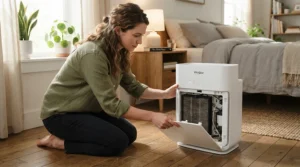
An air purifier for hayfever and sinus relief can reduce the pollen and dust you inhale overnight. That can mean less sneezing and congestion for some people, though results vary and nobody can promise a cure. Ideal Home’s guidance puts it fairly: a purifier won’t cure a pollen allergy, but it can ease symptoms.
Sinus trouble is trickier than it looks. Blocked sinuses can come from pollen, dust mites, mould, pet dander or a cold, and a purifier only helps with airborne triggers. Hayfever symptoms usually flare from late March to September, so if your nose is blocked all winter, other allergens may be involved. That’s worth raising with a pharmacist.
Consider these practical points:
- Run the machine continuously in season rather than for an hour before bed, because pollen keeps arriving through the day.
- Pair it with the treatments your pharmacist suggests, since the purifier is a supplement.
- If you get wheezing, breathlessness or chest tightness, see your GP.
The best fit for sinus-prone sleepers is a machine with a proper HEPA filter and a quiet low setting, such as the Levoit Core 300S or Winix 5500-2.
Compact Air Purifier for Hayfever: When Small Is Smart
A compact air purifier for hayfever makes sense when your bedroom is genuinely small, say under 10–12 m². Smaller units are cheaper, quieter at idle and easy to place near your pillow, which is where it matters.
The physics is simple. A little machine with a CADR of around 78–102 m³/h will only turn over a small room’s air a few times an hour. The Blueair Blue Pure Mini Max and Levoit Core Mini both work in that sweet spot. In a 12 m² room, my arithmetic suggests three to four air changes an hour for the Mini Max and under three for the Core Mini. In a double bedroom with a high ceiling, both would struggle.
A good rule: a compact machine should suit your room at its middle speed, not just its loudest. If you have to run it flat out to cope, you’ve picked too small. The Levoit Core 300S is only marginally bigger and gives far more headroom, so if your room is 12 m² or more, step up.
Closed-Window Pollen Barrier: Building a Bedroom Defence
A closed-window pollen barrier is the idea that your windows, doors and purifier together form layers of protection. Shutting windows stops the bulk of pollen entering. The purifier catches what slips through or walks in on you.
The NHS advice is consistent: keep windows and doors shut as much as possible, avoid fresh flowers indoors and don’t dry washing outside. NHS Greater Manchester adds that pollen clings to hair, skin and clothes, so rinsing off and changing after time outside helps. That’s why the bedroom purifier matters even with windows closed. You are carrying pollen in with you.
Here’s a simple layered routine:
- Check the daily pollen forecast and close windows early on high days.
- Shower and change clothes before bed so pollen stays out of the bedding.
- Place the purifier a metre or so from the bed with clear space around it.
- Run it continuously and let auto mode manage the speed.
Some people also fit mesh pollen screens to windows so they can ventilate. I haven’t verified how well these work, so treat them as an experiment, and rely on closed windows as your baseline. If heat is the reason you open windows, the Dyson Purifier Cool PC1 is one way to stay cooler with everything shut.
Quiet Night Mode: Decoding Decibels for Light Sleepers
Quiet night mode sounds simple, yet it’s the most misleading spec on the page. Brands quote the lowest possible figure, often measured in conditions you won’t recreate in your bedroom.
Take the Levoit Core 300S. The manufacturer says 22–24 dB, while an independent lab measured around 41 dBA in sleep mode at close range. Neither is “wrong”. They’re measured differently. The Philips 3000i AC3033/30 claims 34 dB with Quiet Mark certification, while the Winix 5500-2 is listed around 27.8 dB. A reviewer found the Dyson Purifier Cool PC1 quieter than a typical fan but still around 50 dB on its lower settings.
Look for these features instead:
- A true night mode that dims lights as well as slowing the fan
- Display-off options (the Levoit Core 300S has one)
- A big CADR relative to your room, so the fan can idle slowly
For light sleepers, the best strategy is headroom. A bigger machine on a low setting is often quieter than a small machine pushed hard. The Levoit Core Mini reaches 44.5 dBA at top speed, which is noticeable in a quiet room.
Sleep Quality: What the Evidence Does and Doesn’t Say
Sleep quality is the reason many people buy a bedroom air purifier, but the honest answer is nuanced. I couldn’t find strong clinical evidence that a purifier alone improves sleep. What exists is logic and anecdote.
The logic runs like this: less airborne pollen means less nasal irritation, which should mean less waking with a blocked nose. Mumsnet threads are full of parents saying hayfever has hit their children’s sleep, and some report fewer tissues at night after buying a purifier. That is anecdotal, though. Pollen seasons vary year to year, so it’s hard to separate cause and effect.
A fair way to judge your own results:
- Note how you feel for a week before you start.
- Use the purifier continuously for two to three weeks.
- Compare nights with high and low pollen forecasts.
Noise is the counter-risk. A machine that’s too loud can damage sleep more than pollen does. That’s another reason to prefer headroom and a genuinely quiet night mode. Pair the purifier with showering before bed, washing bedding regularly and any pharmacist-recommended treatments.
Air Purifier vs Other Hayfever Measures
Nobody should buy a purifier instead of following NHS advice. It adds to it. Here’s how the main options compare.
| Approach | What It Does | Limitations | Best For |
|---|---|---|---|
| Closed windows only | Blocks most outdoor pollen | Can’t remove what’s already inside | Everyone, as the baseline |
| Antihistamines and sprays | Treat symptoms | Don’t reduce pollen in the room | Symptom control via your pharmacist |
| HEPA vacuum and damp dusting | Remove settled pollen | Labour-intensive; stirs dust briefly | Weekly upkeep |
| Levoit Core 300S or similar | Captures airborne pollen continuously | Doesn’t clean surfaces | Overnight, in the bedroom |
| Dyson Purifier Cool PC1 | Purifies and cools | Premium price; mixed lab results | Hot sleepers |
The takeaway is layering. Windows and hygiene stop pollen at the door, medicines manage your reaction, and the purifier handles the airborne remainder. If budget forces a choice, closed windows and a pharmacist consultation come first, and a purifier is next in line.
✨ Don’t Miss These Exclusive Deals!
🔍 Take your hayfever season to the next level with these carefully selected purifiers. Click on any highlighted product to check current pricing and availability. These picks will help you create a calmer, cleaner bedroom you’ll actually want to sleep in!
Practical Setup and Maintenance Guide
Where you put the machine matters almost as much as which one you buy. Here’s a no-nonsense routine.
Placement. Stand it 30–50 cm from walls so airflow isn’t blocked, and a metre or two from the bed. Don’t tuck it behind a curtain or inside a wardrobe.
First-night setup. Use auto mode if it has one and switch the display off. Try the sleep setting for a night and listen, since manufacturer decibel figures vary from real-world noise.
Maintenance schedule:
- Wipe the sensor and pre-filter every few weeks. Washable pre-filters on models like the Blueair Blue Pure Mini Max and Winix 5500-2 catch hair and dust.
- Replace filters on the maker’s schedule: roughly every six to eight months for the Levoit Core 300S, six months for the Blueair Blue Pure Mini Max, and four to six months for the Levoit Core Mini.
- Run it after vacuuming or dusting, because those activities throw settled allergens back into the air.
Common first-month mistakes: switching it off during the day, placing it in a corner, and ignoring the filter indicator. If you want a trusted benchmark when comparing models, check the Allergy UK approved products list, which includes air purifiers independently tested for allergen reduction.
Real-World Scenarios: Which Purifier Fits Which Bedroom?
Rather than prescribing one winner, here are three profiles to help you match machine to life.
Scenario 1: The student in a 9 m² rented room. Budget is tight, noise matters because of thin walls, and the window can’t be sealed. The Levoit Core Mini or Blueair Blue Pure Mini Max fits. Run it on the lowest setting that keeps up and replace the filter on schedule.
Scenario 2: The couple in a 14 m² double with a hayfever-prone partner. They want a quiet night mode and app control to check air quality. The Levoit Core 300S is the best match, with the Philips 600 Series AC0651/10 as an alternative if you prefer that brand’s app. Either gives headroom to run slowly.
Scenario 3: The family in a loft conversion with a 25 m² bedroom. Sloping ceilings, draughty windows and several allergy sufferers. Here the Winix 5500-2 or Philips 3000i AC3033/30 makes sense, as both are built for much larger spaces and can idle quietly in a mid-size room. If summer heat is also a problem, the Dyson Purifier Cool PC1 helps keep the room cooler.
The decision rule is straightforward: if your room is under 10 m², go compact. If it’s 10–20 m², choose a mid-size smart model. If it’s larger or has multiple allergy sufferers, buy for airflow.
Long-Term Cost and Maintenance: What You’ll Really Spend
The price on the box is only the start. Filters, electricity and replacement cycles decide whether a purifier is good value over three years.
| Product | Upfront Range | Filter Cost Notes | Running Notes | Best For |
|---|---|---|---|---|
| Levoit Core Mini | Under £60 | Frequent replacement (4–6 months) | Around 7W | Tight budgets |
| Blueair Blue Pure Mini Max | Under £150 | Replace ~6 months | Low energy | Small rooms |
| Levoit Core 300S | £110–£160 | Replace 6–8 months | Frugal motor in testing | Smart value |
| Winix 5500-2 | £150–£220 | Washable carbon cuts costs | Check HEPA interval | Big rooms |
| Philips 3000i AC3033/30 | £250–£450 | FY3430/30 around £75 | Higher-powered | Large spaces |
An independent comparison found the Levoit Core 300S has a very low running cost in sleep mode, while another source puts the Levoit Core Mini at roughly $82 a year for electricity plus filters in US testing. The takeaway is that cheap machines aren’t always cheap to run. If you only need a purifier for a few months a year, the lowest purchase price might be sensible. If you run one year-round, the Winix 5500-2‘s washable carbon and the Levoit Core 300S‘s low consumption pay back sooner.
Common Mistakes When Buying an Air Purifier for Hayfever Bedroom Use
A few errors come up again and again, and all of them are avoidable.
- Buying on marketing room size. Brands quote maximum coverage, usually at top speed. Aim for a machine rated well above your room.
- Ignoring noise at low speed. Check independent measurements, not just the box claim.
- Choosing ionisers or gimmicks over filters. A real HEPA filter is the proven part. Extras are a bonus at best.
- Forgetting the filters. A clogged filter cleans less effectively and strains the motor.
- Expecting a miracle. A purifier eases the pollen load, but you still need windows closed, clean bedding and sensible treatment.
Avoid those five and you’re ahead of most buyers.
FAQ
❓ How long should I run a bedroom air purifier during hayfever season?
❓ Where should I place an air purifier in the bedroom?
❓ How often do I need to change the filter?
❓ Will an air purifier replace my antihistamines?
❓ Is a compact air purifier for hayfever enough for a double bedroom?
Conclusion
If you take one thing from this guide, make it this: buy for your room, not for the box. The best air purifier for hayfever bedroom use is the one with enough airflow to run quietly, a proper HEPA filter and a night mode that doesn’t wake you.
For most UK bedrooms, the Levoit Core 300S is the best balanced choice, combining a smart sensor, a screen that switches off and sensible running costs. If your room is small, the Blueair Blue Pure Mini Max or Levoit Core Mini does the job for less. For bigger spaces, the Winix 5500-2 and Philips 3000i AC3033/30 give you the headroom to idle quietly. The Dyson Purifier Cool PC1 is for hot sleepers who value the fan, and the Philips 600 Series AC0651/10 is a mid-range option once you’ve checked its listing.
Remember the closed-window pollen barrier too. Shut windows, shower before bed and keep bedding clean, then let the purifier handle the rest. Nothing here is a cure, and the NHS is right that a pharmacist can help with symptoms. But a quiet machine humming softly beside the bed is a very reasonable way to give your sleep quality a fighting chance.
Recommended for You
- Air Purifier For Hayfever: 7 Best Picks For UK Homes (2026)
- Air Purifier For Allergies And Asthma: 7 Best UK Picks (2026)
- Air Purifier For Allergy Sufferers Under £150: 7 UK Picks (2026)
Disclaimer: This article contains affiliate links. As an Amazon Associate, I earn from qualifying purchases. If you purchase products through these links, we may earn a small commission at no additional cost to you.
✨ Found this helpful? Share it with your friends! 💬🤗
